Page 322 of 514

NOTE:In AutoStick� mode, the transmission will only
shift up or down when the driver moves the shift lever to
the right (+) or left (-), or as described below.
AutoStick� is deactivated when the shift lever is shifted
from the AutoStick (+/-) position into the DRIVE
position.
General Information
•
You can start out, from a stop, in any gear except sixth.
The system will ignore attempts to upshift at too low
of a vehicle speed.
•If a ratio other than first gear is selected, and the
vehicle is brought to a stop, the transmission control
logic will automatically select the first gear ratio.
•Starting out in second gear is helpful in snowy or icy
conditions. To select second gear after the vehicle is
brought to a stop, tap the shift lever to the right (+)
once.
•Avoid using speed control when AutoStick �is en-
gaged.
•The transmission will automatically shift up when
maximum engine speed is reached while AutoStick� is
engaged.
•Transmission shifting will be more noticeable when
AutoStick� is engaged.
•If a downshift would cause the engine to over-speed,
that shift will not occur until it is safe for the engine.
•If the system detects powertrain overheating, the
transmission will revert to the automatic shift mode
and remain in that mode until the powertrain cools off.
•If the system detects a problem, it will disable the
AutoStick� mode and the transmission will return to
the automatic mode until the problem is corrected.
320 STARTING AND OPERATING
Page 325 of 514

CAUTION! (Continued)
•Driving through standing water may cause dam-
age to your vehicle’s drivetrain components. Al-
ways inspect your vehicle’s fluids (i.e., engine oil,
transmission, axle, etc.) for signs of contamination
(i.e., fluid that is milky or foamy in appearance)
after driving through standing water. Do not con-
tinue to operate the vehicle if any fluid appears
contaminated, as this may result in further dam-
age. Such damage is not covered by the New
Vehicle Limited Warranty.
•Getting water inside your vehicle’s engine can
cause it to lock up and stall out, and cause serious
internal damage to the engine. Such damage is not
covered by the New Vehicle Limited Warranty.
WARNING!
•Driving through standing water limits your vehi-
cle’s traction capabilities. Do not exceed 5 mph
(8 km/h) when driving through standing water.
•Driving through standing water limits your vehi-
cle’s braking capabilities, which increases stop-
ping distances. Therefore, after driving through
standing water, drive slowly and lightly press on
the brake pedal several times to dry the brakes.
•Getting water inside your vehicle’s engine can
cause it to lock up and stall out, and leave you
stranded.
•Failure to follow these warnings may result in
injuries that are serious or fatal to you, your
passengers, and others around you.
5
STARTING AND OPERATING 323
Page 328 of 514
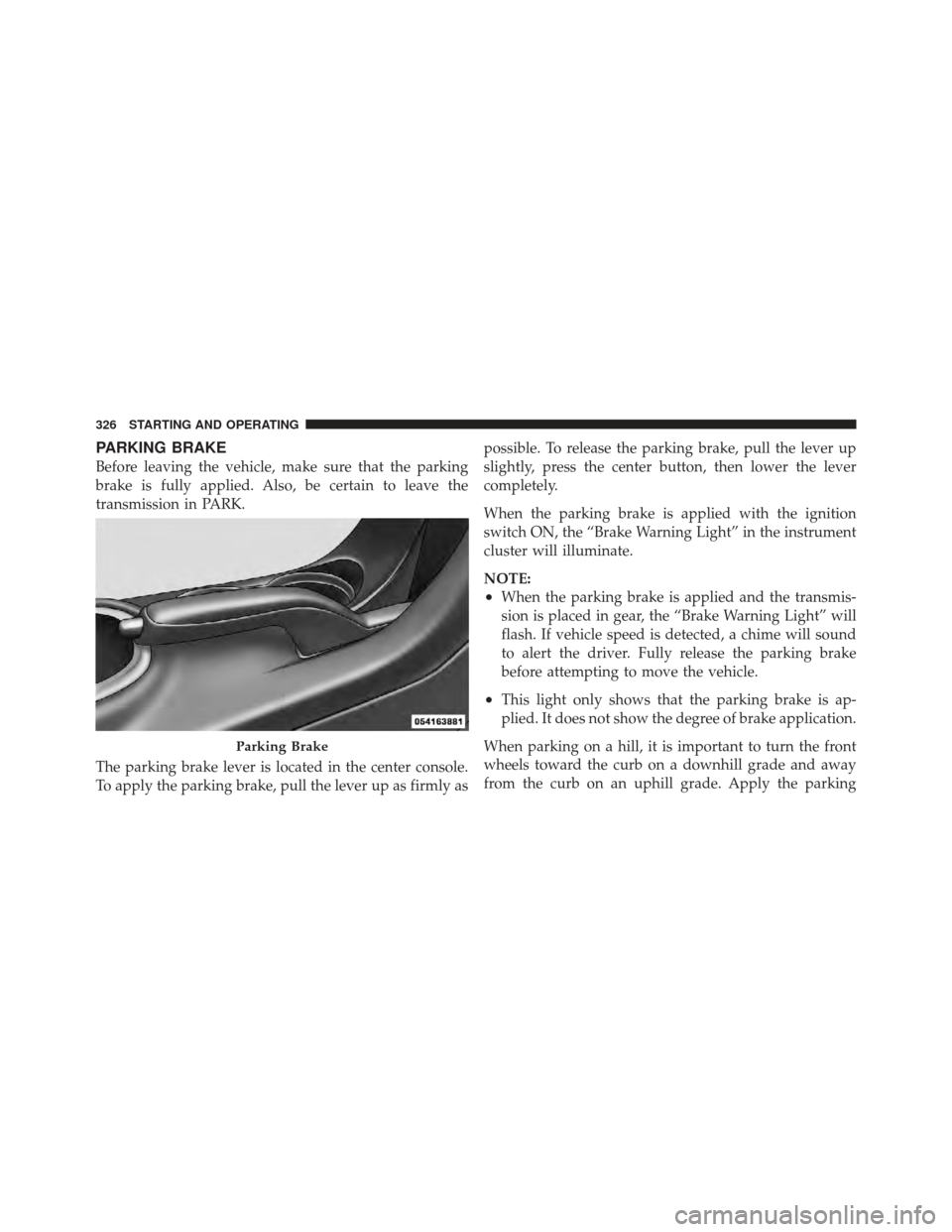
PARKING BRAKE
Before leaving the vehicle, make sure that the parking
brake is fully applied. Also, be certain to leave the
transmission in PARK.
The parking brake lever is located in the center console.
To apply the parking brake, pull the lever up as firmly aspossible. To release the parking brake, pull the lever up
slightly, press the center button, then lower the lever
completely.
When the parking brake is applied with the ignition
switch ON, the “Brake Warning Light” in the instrument
cluster will illuminate.
NOTE:
•When the parking brake is applied and the transmis-
sion is placed in gear, the “Brake Warning Light” will
flash. If vehicle speed is detected, a chime will sound
to alert the driver. Fully release the parking brake
before attempting to move the vehicle.
•This light only shows that the parking brake is ap-
plied. It does not show the degree of brake application.
When parking on a hill, it is important to turn the front
wheels toward the curb on a downhill grade and away
from the curb on an uphill grade. Apply the parking
Parking Brake
326 STARTING AND OPERATING
Page 329 of 514
brake before placing the shift lever in PARK, otherwise
the load on the transmission locking mechanism may
make it difficult to move the shift lever out of PARK. The
parking brake should always be applied whenever the
driver is not in the vehicle.
WARNING!
•Never use the PARK position as a substitute for
the parking brake. Always apply the parking
brake fully when parked to guard against vehicle
movement and possible injury or damage.
•When leaving the vehicle, always remove the key
fob from the ignition and lock your vehicle.(Continued)
WARNING! (Continued)
•Never leave children alone in a vehicle, or with
access to an unlocked vehicle. Allowing children
to be in a vehicle unattended is dangerous for a
number of reasons. A child or others could be
seriously or fatally injured. Children should be
warned not to touch the parking brake, brake
pedal or the shift lever.
•Be sure the parking brake is fully disengaged
before driving; failure to do so can lead to brake
failure and a collision.
•Always fully apply the parking brake when leav-
ing your vehicle or it may roll and cause damage or
injury. Also, be certain to leave the transmission in
PARK. Failure to do so may cause the vehicle to
roll and cause damage or injury.
5
STARTING AND OPERATING 327
Page 383 of 514
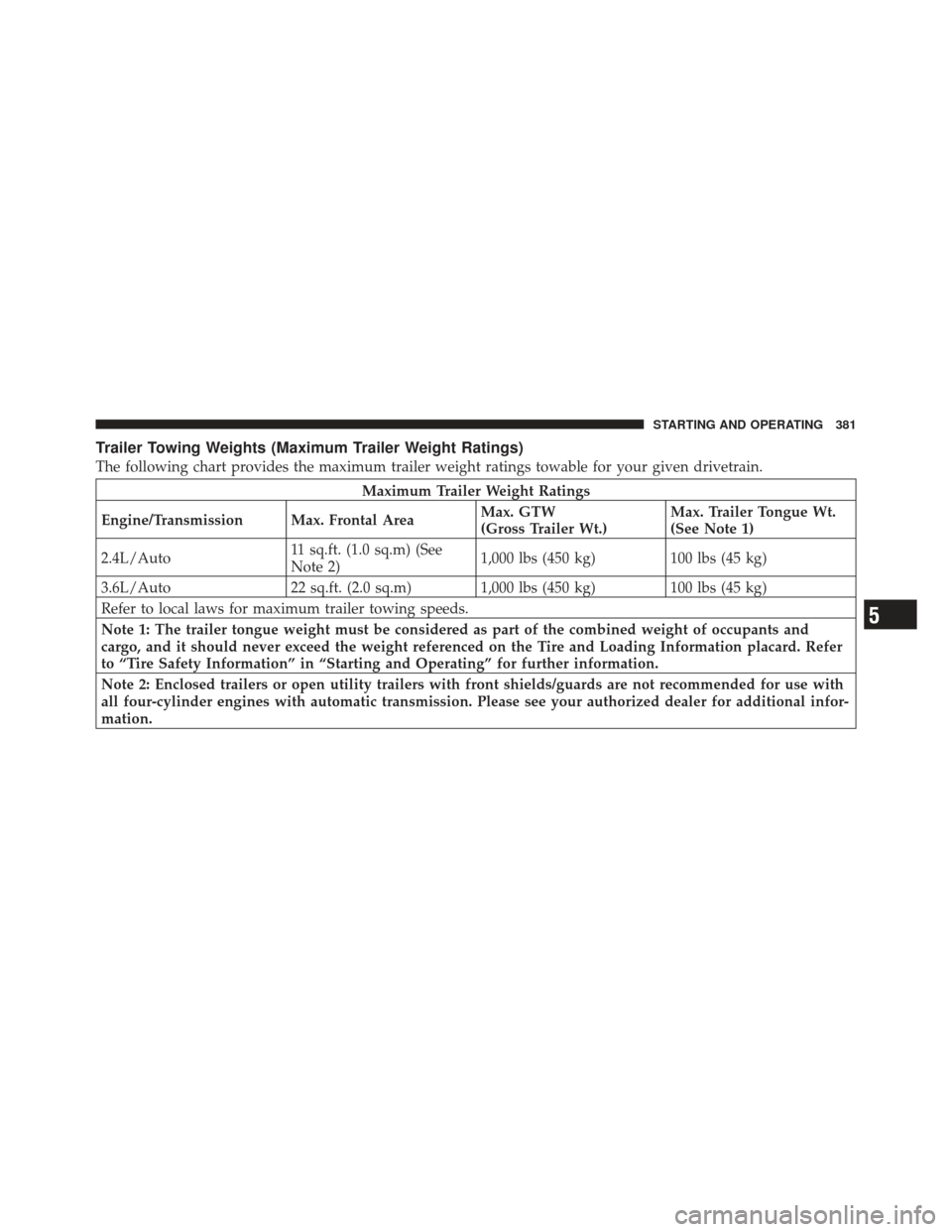
Trailer Towing Weights (Maximum Trailer Weight Ratings)
The following chart provides the maximum trailer weight ratings towable for your given drivetrain.
Maximum Trailer Weight Ratings
Engine/Transmission Max. Frontal Area Max. GTW
(Gross Trailer Wt.)Max. Trailer Tongue Wt.
(See Note 1)
2.4L/Auto 11 sq.ft. (1.0 sq.m) (See
Note 2)1,000 lbs (450 kg)
100 lbs (45 kg)
3.6L/Auto 22 sq.ft. (2.0 sq.m) 1,000 lbs (450 kg) 100 lbs (45 kg)
Refer to local laws for maximum trailer towing speeds.
Note 1: The trailer tongue weight must be considered as part of the combined weight of occupants and
cargo, and it should never exceed the weight referenced on the Tire and Loading Information placard. Refer
to “Tire Safety Information” in “Starting and Operating” for further information.
Note 2: Enclosed trailers or open utility trailers with front shields/guards are not recommended for use with
all four-cylinder engines with automatic transmission. Please see your authorized dealer for additional infor-
mation.
5
STARTING AND OPERATING 381
Page 386 of 514
WARNING!
Improper towing can lead to a collision. Follow these
guidelines to make your trailer towing as safe as
possible:
•Make certain that the load is secured in the trailer
and that it will not shift during travel. When
trailering cargo that is not fully secured, dynamic
load shifts can occur that may be difficult for the
driver to control. You could lose control of your
vehicle and have a collision.
•When hauling cargo, or towing a trailer, do not
overload your vehicle or trailer. Overloading can
cause a loss of control, poor performance, or dam-
age to brakes, axle, engine, transmission, steering,
suspension, chassis structure, or tires.(Continued)
WARNING! (Continued)
•Safety chains must always be used between your
vehicle and trailer. Always connect the chains to
the frame or hook retainers of the vehicle hitch.
Cross the chains under the trailer tongue and
allow enough slack for turning corners.
•Vehicles with trailers should not be parked on a
grade. When parking, apply the parking brake on
the tow vehicle. Put the tow vehicle automatic
transmission in PARK. Always, block or �chock�
the trailer wheels.
•GCWR must not be exceeded.
•Total weight must be distributed between the tow
vehicle and the trailer such that the following four
ratings are not exceeded:
1. GVWR
2. GTW
(Continued)
384 STARTING AND OPERATING
Page 389 of 514

Towing Tips
Before setting out on a trip, practice turning, stopping,
and backing the trailer in an area located away from
heavy traffic.
Make sure all trailer and vehicle lights are working
properly — including hazard flashers.
Automatic Transmission
The DRIVE range can be selected when towing. How-
ever, if frequent shifting occurs, select the�3�range (for a
four-speed automatic) or select a lower gear using the
AutoStick� shift control.
NOTE: Using a lower gear while operating the vehicle
under heavy operating conditions, will improve perfor-
mance and extend transmission life by reducing exces-
sive shifting and heat build-up. This action will also
provide better engine braking. If you
REGULARLY TOW a trailer for more than 45 min-
utes of continuous operation, then change the automatic
transmission fluid and filter according to the interval
specified for “police, taxi, fleet, or frequent trailer tow-
ing.” Refer to the “Maintenance Schedule” for the proper
maintenance intervals.
NOTE: Check the four-speed automatic transmission
fluid level before towing. Six-speed transmissions do not
require a fluid level check before towing. If, however, you
notice fluid leakage or transmission malfunction, see
your authorized dealership service center for assistance.
Electronic Speed Control – If Equipped
•
Do not use in hilly terrain or with heavy loads.
•When using the speed control, if you experience speed
drops greater than 10 mph (16 km/h), disengage until
you can get back to cruising speed.
•Use speed control in flat terrain and with light loads to
maximize fuel efficiency.
5
STARTING AND OPERATING 387
Page 390 of 514
Cooling System
To reduce potential for engine and transmission over-
heating, take the following actions:
•City Driving
When stopped for short periods of time, shift the trans-
mission into NEUTRAL and increase engine idle speed.
•Highway Driving
Reduce speed.
•Air Conditioning
Turn off temporarily.
RECREATIONAL TOWING (BEHIND MOTORHOME, ETC.)
Towing This Vehicle Behind Another Vehicle
Towing Condition Wheels OFF the Ground All Models
Flat Tow NONENOT ALLOWED
Dolly Tow Front
OK
Rear NOT ALLOWED
On Trailer ALLOK
388 STARTING AND OPERATING
