Page 374 of 514
requirements of Material Standard MS-6395. MS-6395
contains additional requirements, developed during ex-
tensive fleet testing, to provide additional protection to
Chrysler Group LLC engines. Use MOPAR�or an
equivalent oil meeting the specification MS-6395.
Starting
The characteristics of E-85 fuel make it unsuitable for use
when ambient temperatures fall below 0°F (-18°C). In the
range of 0°F (-18°C) to 32°F (0°C), you may experience an
increase in the time it takes for your engine to start, and
a deterioration in driveability (sags and/or hesitations)
until the engine is fully warmed up.
NOTE: Use of the engine block heater (if equipped) is
beneficial for E-85 startability when the ambient tempera-
ture is less than 32°F (0°C).
Cruising Range
Because E-85 fuel contains less energy per gallon/liter
than gasoline, you will experience an increase in fuel
consumption. You can expect your miles per gallon
(mpg)/miles per liter and your driving range to decrease
by about 30%, compared to gasoline operation.
Replacement Parts
Many components in your Flexible Fuel Vehicle (FFV) are
designed to be compatible with ethanol. Always be sure
that your vehicle is serviced with correct ethanol com-
patible parts.
CAUTION!
Replacing fuel system components with non-ethanol
compatible components can damage your vehicle.
372 STARTING AND OPERATING
Page 393 of 514
WHAT TO DO IN EMERGENCIES
CONTENTS
�Hazard Warning Flashers ................ 392
� If Your Engine Overheats ................ 392
▫ Engine Oil Overheating (2.4L Engine Only)
— If Equipped ...................... 393
� Jacking And Tire Changing ............... 394
▫ Jack Location ....................... 394
▫ Spare Tire Stowage ................... 394
▫ Preparations For Jacking ............... 395
▫ Jacking Instructions ................... 396 ▫
Road Tire Installation ................. 402
� Jump-Starting ........................ 405
▫ Preparations For Jump-Start ............. 406
▫ Jump-Starting Procedure ............... 408
� Freeing A Stuck Vehicle ................. 409
� Shift Lever Override ................... 411
� Towing A Disabled Vehicle ............... 412
▫ Automatic Transmission ............... 413
▫ Without The Ignition Key .............. 414
6
Page 395 of 514
NOTE:There are steps that you can take to slow down
an impending overheat condition:
•If your air conditioner (A/C) is on, turn it off. The A/C
system adds heat to the engine cooling system and
turning the A/C off can help remove this heat.
•You can also turn the temperature control to maximum
heat, the mode control to floor and the blower control
to high. This allows the heater core to act as a
supplement to the radiator and aids in removing heat
from the engine cooling system.
WARNING!
You or others can be badly burned by hot engine
coolant (antifreeze) or steam from your radiator. If
you see or hear steam coming from under the hood,
do not open the hood until the radiator has had time
to cool. Never try to open a cooling system pressure
cap when the radiator or coolant bottle is hot.
Engine Oil Overheating (2.4L Engine Only) — If
Equipped
During sustained high-speed driving or trailer tow up
long grades on a hot day, the engine oil temperature may
become too hot. If this happens, the “HOTOIL” message
flashes in the odometer and the vehicle speed will be
reduced to 53 mph (85 km/h) until the engine oil
temperature is reduced.6
WHAT TO DO IN EMERGENCIES 393
Page 417 of 514
MAINTAINING YOUR VEHICLE
CONTENTS
�Engine Compartment — 2.4L ............. 417
� Engine Compartment — 3.6L ............. 418
� Onboard Diagnostic System — OBD II ...... 419
▫ Loose Fuel Filler Cap Message ........... 419
� Emissions Inspection And Maintenance
Programs ............................ 420
� Replacement Parts ..................... 421
� Dealer Service ........................ 421
� Maintenance Procedures ................. 422 ▫
Engine Oil ......................... 423
▫ Engine Oil Filter ..................... 426
▫ Engine Air Cleaner Filter ............... 427
▫ Maintenance-Free Battery .............. 427
▫ Air Conditioner Maintenance ............ 429
▫ A/C Air Filter – If Equipped ............ 430
▫ Body Lubrication .................... 431
▫ Windshield Wiper Blades ............... 432
▫ Adding Washer Fluid ................. 433
7
Page 419 of 514
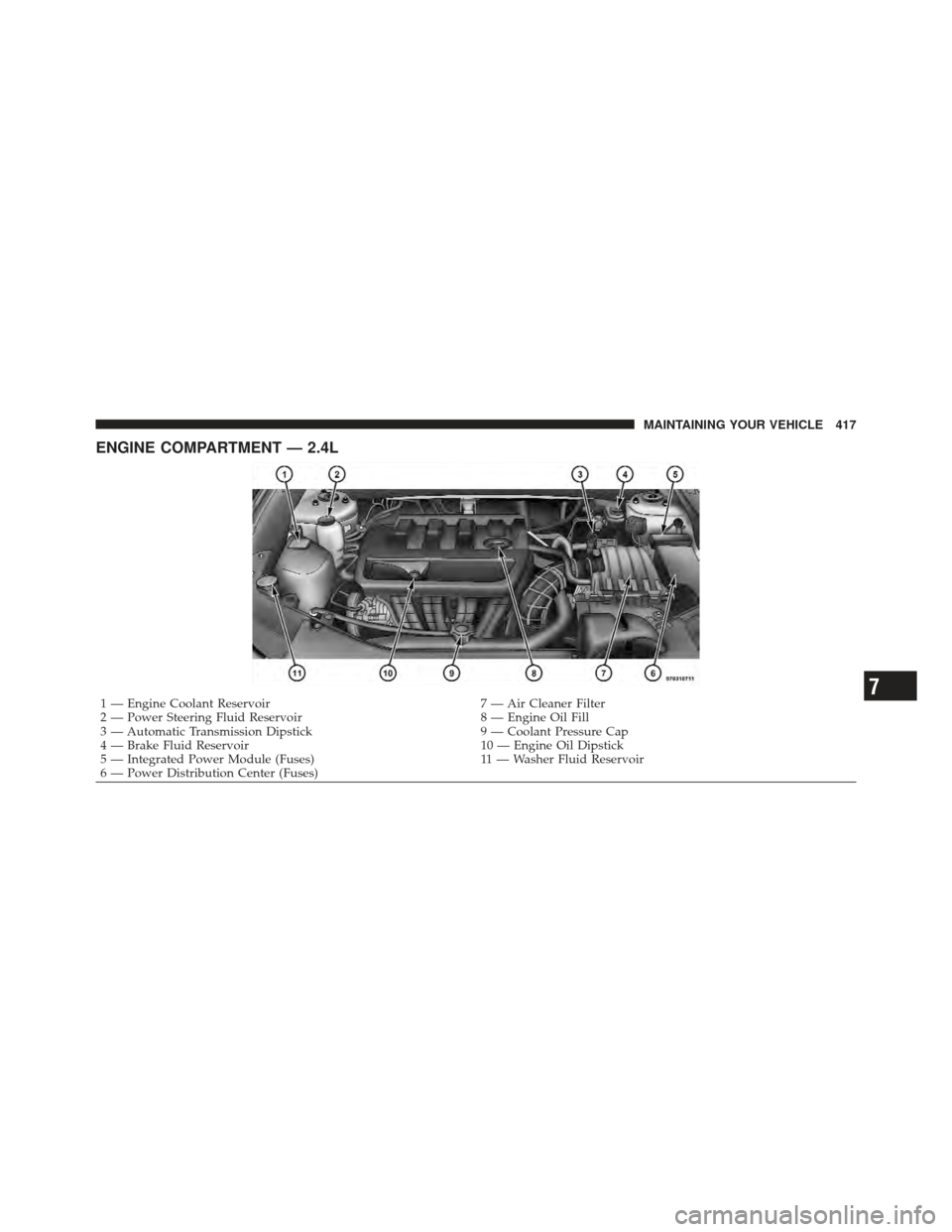
ENGINE COMPARTMENT — 2.4L
1 — Engine Coolant Reservoir7 — Air Cleaner Filter
2 — Power Steering Fluid Reservoir 8 — Engine Oil Fill
3 — Automatic Transmission Dipstick 9 — Coolant Pressure Cap
4 — Brake Fluid Reservoir 10 — Engine Oil Dipstick
5 — Integrated Power Module (Fuses) 11 — Washer Fluid Reservoir
6 — Power Distribution Center (Fuses)7
MAINTAINING YOUR VEHICLE 417
Page 420 of 514
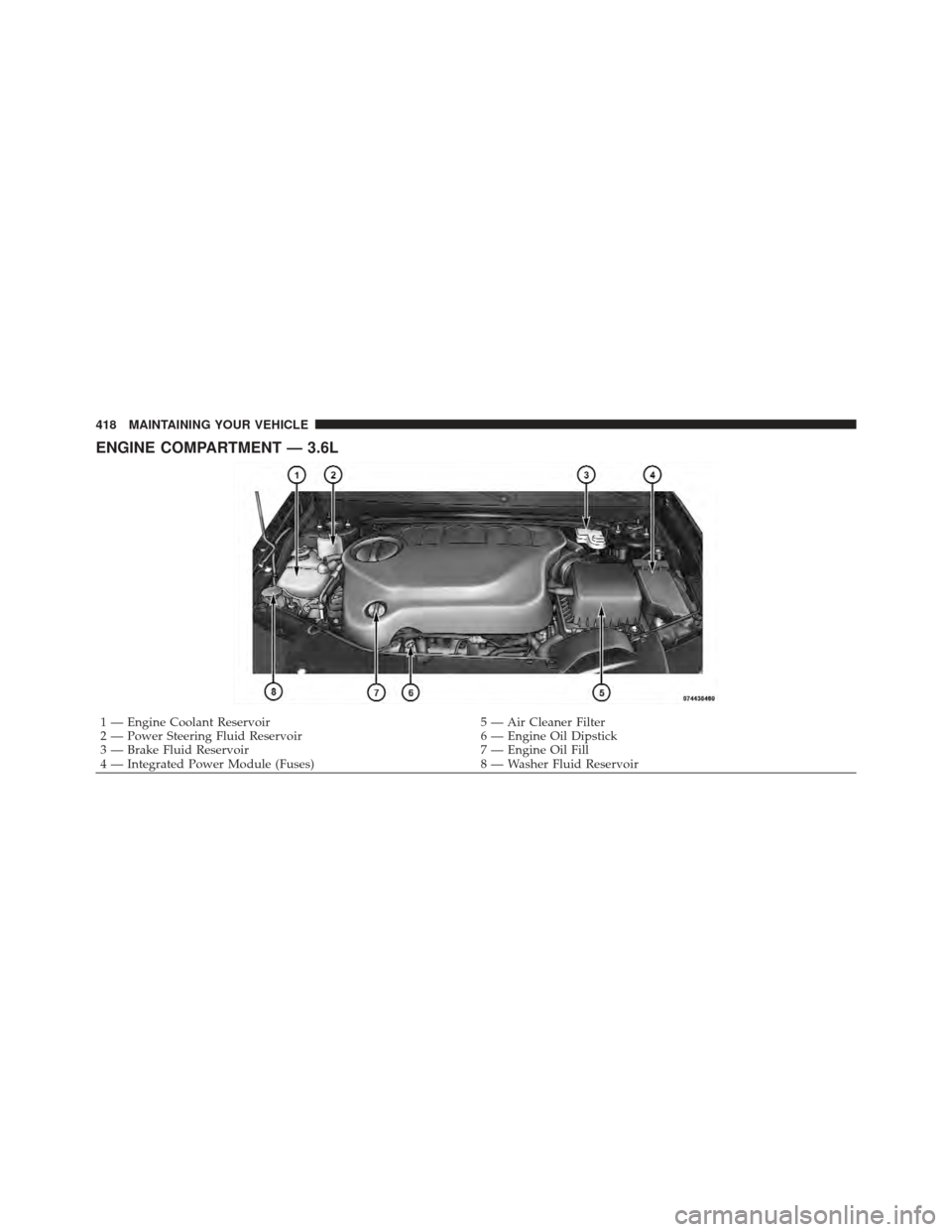
ENGINE COMPARTMENT — 3.6L
1 — Engine Coolant Reservoir5 — Air Cleaner Filter
2 — Power Steering Fluid Reservoir 6 — Engine Oil Dipstick
3 — Brake Fluid Reservoir 7 — Engine Oil Fill
4 — Integrated Power Module (Fuses) 8 — Washer Fluid Reservoir
418 MAINTAINING YOUR VEHICLE
Page 425 of 514

CAUTION! (Continued)
•Your vehicle has been built with improved fluids
that protect the performance and durability of
your vehicle and also allow extended maintenance
intervals. Do not use chemical flushes in these
components as the chemicals can damage your
engine, transmission, power steering or air condi-
tioning. Such damage is not covered by the New
Vehicle Limited Warranty. If a flush is needed
because of component malfunction, use only the
specified fluid for the flushing procedure.
Engine Oil
Checking Oil Level
To assure proper engine lubrication, the engine oil must
be maintained at the correct level. Check the oil level at
regular intervals, such as every fuel stop. The best time to
check the engine oil level is about five minutes after afully warmed engine is shut off. Do not check oil level
before starting the engine after it has sat overnight.
Checking engine oil level when the engine is cold will
give you an incorrect reading.
Checking the oil while the vehicle is on level ground and
only when the engine is hot, will improve the accuracy of
the oil level readings. Maintain the oil level between the
range markings on the dipstick. Either the range mark-
ings consist of a crosshatch zone marked SAFE or a
crosshatch zone marked with MIN at the low end of the
range and MAX at the high end of the range. Adding one
quart of oil when the reading is at the low end of the
range marking will raise the oil level to the high end of
the range marking.
7
MAINTAINING YOUR VEHICLE 423
Page 426 of 514
CAUTION!
Do not overfill the engine. Overfilling the engine
will cause oil aeration, which can lead to loss of oil
pressure and an increase in oil temperature. This
could damage your engine. Also, be sure the oil fill
cap is replaced and tightened after adding oil.
Change Engine Oil
The oil change indicator system will remind you that it is
time to take your vehicle in for scheduled maintenance.
Refer to “Maintenance Schedule” for further information.
NOTE: Under no circumstances should oil change
intervals exceed 8,000 miles (13 000 km) or six months,
whichever occurs first.
Engine Oil Selection
For best performance and maximum protection under all
types of operating conditions, the manufacturer recom-
mends engine oils that are API Certified and meet the
requirements of Chrysler Material Standard MS-6395.
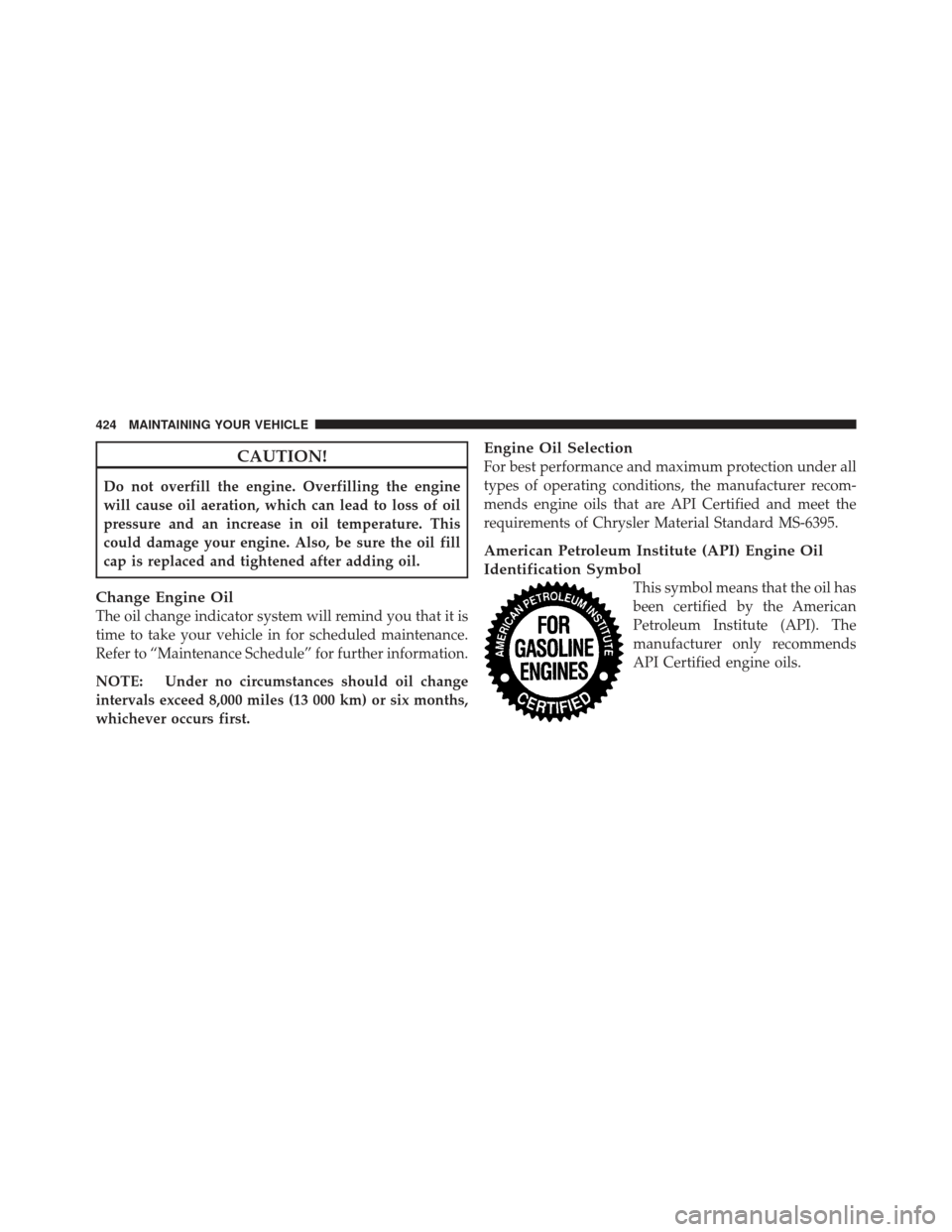
American Petroleum Institute (API) Engine Oil
Identification Symbol
This symbol means that the oil has
been certified by the American
Petroleum Institute (API). The
manufacturer only recommends
API Certified engine oils.
424 MAINTAINING YOUR VEHICLE