Page 386 of 514
WARNING!
Improper towing can lead to a collision. Follow these
guidelines to make your trailer towing as safe as
possible:
•Make certain that the load is secured in the trailer
and that it will not shift during travel. When
trailering cargo that is not fully secured, dynamic
load shifts can occur that may be difficult for the
driver to control. You could lose control of your
vehicle and have a collision.
•When hauling cargo, or towing a trailer, do not
overload your vehicle or trailer. Overloading can
cause a loss of control, poor performance, or dam-
age to brakes, axle, engine, transmission, steering,
suspension, chassis structure, or tires.(Continued)
WARNING! (Continued)
•Safety chains must always be used between your
vehicle and trailer. Always connect the chains to
the frame or hook retainers of the vehicle hitch.
Cross the chains under the trailer tongue and
allow enough slack for turning corners.
•Vehicles with trailers should not be parked on a
grade. When parking, apply the parking brake on
the tow vehicle. Put the tow vehicle automatic
transmission in PARK. Always, block or �chock�
the trailer wheels.
•GCWR must not be exceeded.
•Total weight must be distributed between the tow
vehicle and the trailer such that the following four
ratings are not exceeded:
1. GVWR
2. GTW
(Continued)
384 STARTING AND OPERATING
Page 389 of 514

Towing Tips
Before setting out on a trip, practice turning, stopping,
and backing the trailer in an area located away from
heavy traffic.
Make sure all trailer and vehicle lights are working
properly — including hazard flashers.
Automatic Transmission
The DRIVE range can be selected when towing. How-
ever, if frequent shifting occurs, select the�3�range (for a
four-speed automatic) or select a lower gear using the
AutoStick� shift control.
NOTE: Using a lower gear while operating the vehicle
under heavy operating conditions, will improve perfor-
mance and extend transmission life by reducing exces-
sive shifting and heat build-up. This action will also
provide better engine braking. If you
REGULARLY TOW a trailer for more than 45 min-
utes of continuous operation, then change the automatic
transmission fluid and filter according to the interval
specified for “police, taxi, fleet, or frequent trailer tow-
ing.” Refer to the “Maintenance Schedule” for the proper
maintenance intervals.
NOTE: Check the four-speed automatic transmission
fluid level before towing. Six-speed transmissions do not
require a fluid level check before towing. If, however, you
notice fluid leakage or transmission malfunction, see
your authorized dealership service center for assistance.
Electronic Speed Control – If Equipped
•
Do not use in hilly terrain or with heavy loads.
•When using the speed control, if you experience speed
drops greater than 10 mph (16 km/h), disengage until
you can get back to cruising speed.
•Use speed control in flat terrain and with light loads to
maximize fuel efficiency.
5
STARTING AND OPERATING 387
Page 393 of 514
WHAT TO DO IN EMERGENCIES
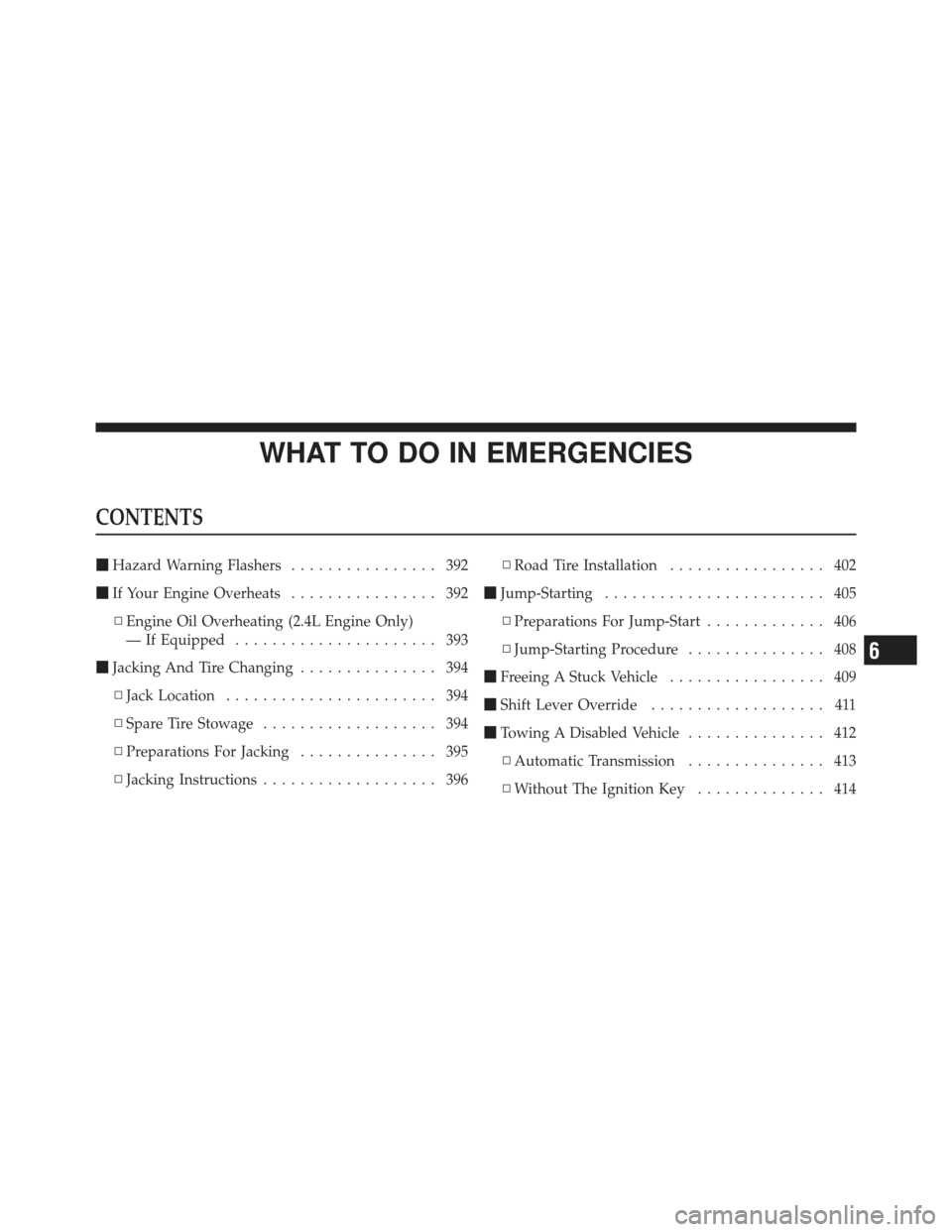
CONTENTS
�Hazard Warning Flashers ................ 392
� If Your Engine Overheats ................ 392
▫ Engine Oil Overheating (2.4L Engine Only)
— If Equipped ...................... 393
� Jacking And Tire Changing ............... 394
▫ Jack Location ....................... 394
▫ Spare Tire Stowage ................... 394
▫ Preparations For Jacking ............... 395
▫ Jacking Instructions ................... 396 ▫
Road Tire Installation ................. 402
� Jump-Starting ........................ 405
▫ Preparations For Jump-Start ............. 406
▫ Jump-Starting Procedure ............... 408
� Freeing A Stuck Vehicle ................. 409
� Shift Lever Override ................... 411
� Towing A Disabled Vehicle ............... 412
▫ Automatic Transmission ............... 413
▫ Without The Ignition Key .............. 414
6
Page 397 of 514
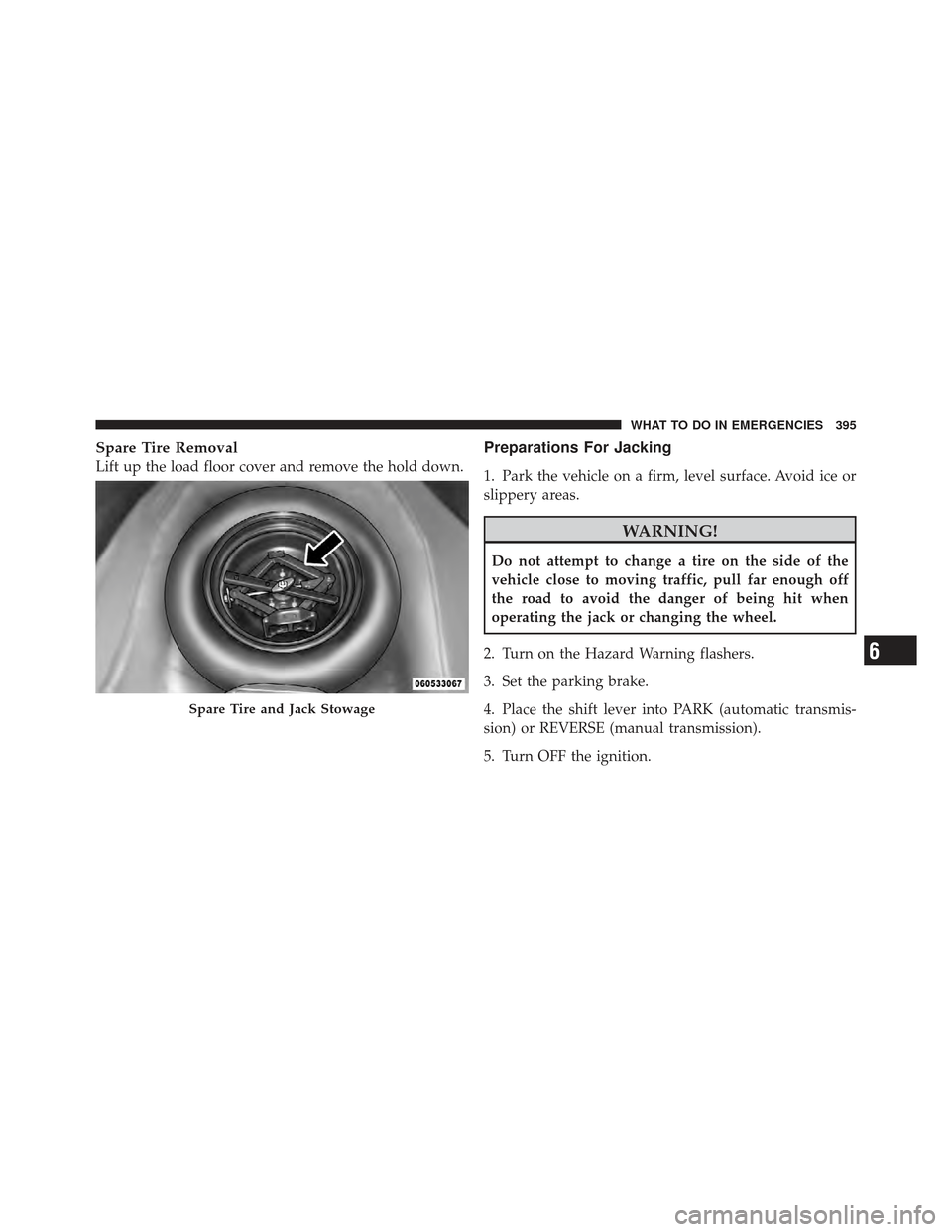
Spare Tire Removal
Lift up the load floor cover and remove the hold down.
Preparations For Jacking
1. Park the vehicle on a firm, level surface. Avoid ice or
slippery areas.
WARNING!
Do not attempt to change a tire on the side of the
vehicle close to moving traffic, pull far enough off
the road to avoid the danger of being hit when
operating the jack or changing the wheel.
2. Turn on the Hazard Warning flashers.
3. Set the parking brake.
4. Place the shift lever into PARK (automatic transmis-
sion) or REVERSE (manual transmission).
5. Turn OFF the ignition.
Spare Tire and Jack Stowage
6
WHAT TO DO IN EMERGENCIES 395
Page 398 of 514
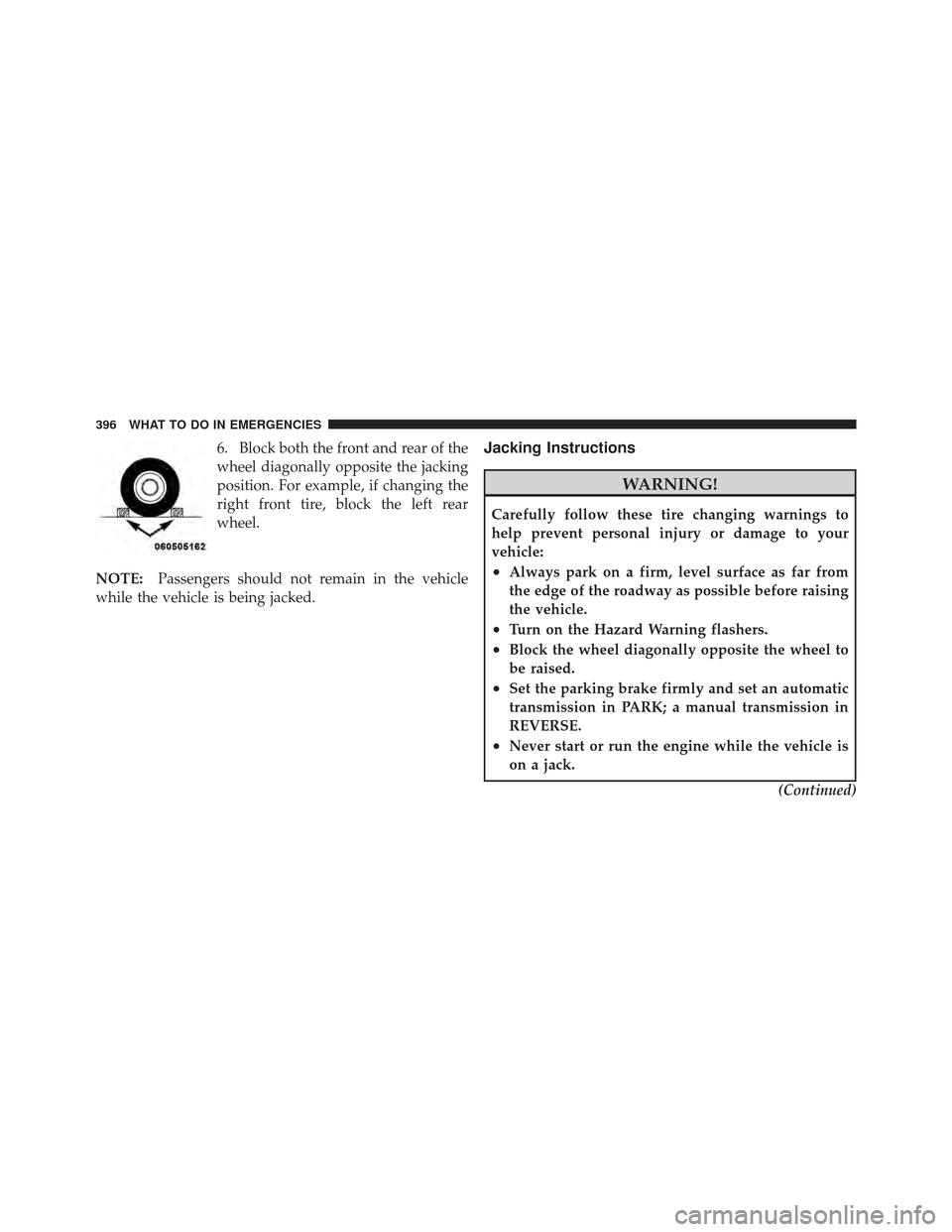
6. Block both the front and rear of the
wheel diagonally opposite the jacking
position. For example, if changing the
right front tire, block the left rear
wheel.
NOTE: Passengers should not remain in the vehicle
while the vehicle is being jacked.Jacking Instructions
WARNING!
Carefully follow these tire changing warnings to
help prevent personal injury or damage to your
vehicle:
•Always park on a firm, level surface as far from
the edge of the roadway as possible before raising
the vehicle.
•Turn on the Hazard Warning flashers.
•Block the wheel diagonally opposite the wheel to
be raised.
•Set the parking brake firmly and set an automatic
transmission in PARK; a manual transmission in
REVERSE.
•Never start or run the engine while the vehicle is
on a jack.
(Continued)
396 WHAT TO DO IN EMERGENCIES
Page 409 of 514
WARNING!
•Take care to avoid the radiator cooling fan when-
ever the hood is raised. It can start anytime the
ignition switch is on. You can be injured by
moving fan blades.
•Remove any metal jewelry such as watch bands or
bracelets that might make an inadvertent electrical
contact. You could be seriously injured.
•Batteries contain sulfuric acid that can burn your
skin or eyes and generate hydrogen gas which is
flammable and explosive. Keep open flames or
sparks away from the battery.
1. Set the parking brake, shift the automatic transmission
into PARK and turn the ignition to LOCK.
2. Turn off the heater, radio, and all unnecessary electri-
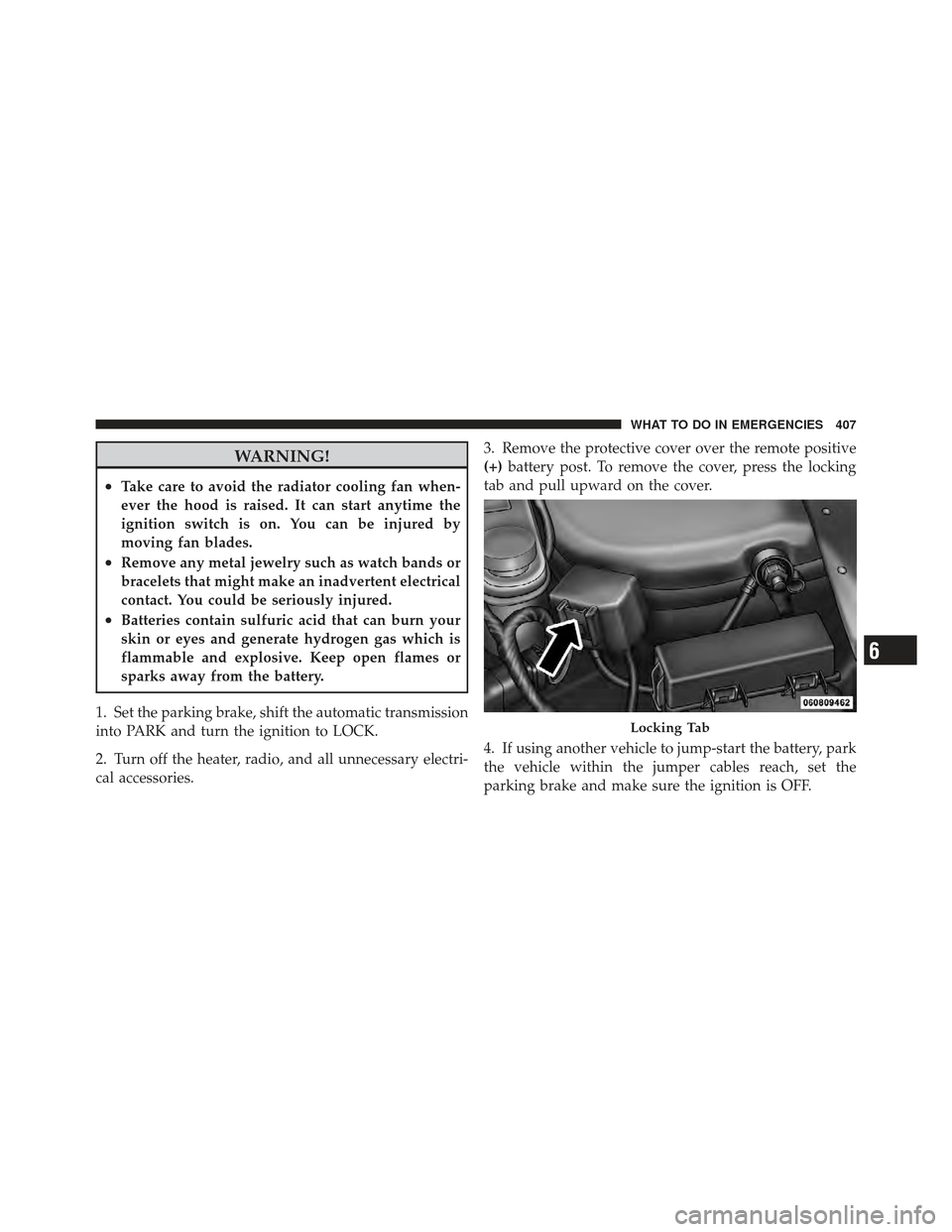
cal accessories. 3. Remove the protective cover over the remote positive
(+)
battery post. To remove the cover, press the locking
tab and pull upward on the cover.
4. If using another vehicle to jump-start the battery, park
the vehicle within the jumper cables reach, set the
parking brake and make sure the ignition is OFF.
Locking Tab
6
WHAT TO DO IN EMERGENCIES 407
Page 414 of 514
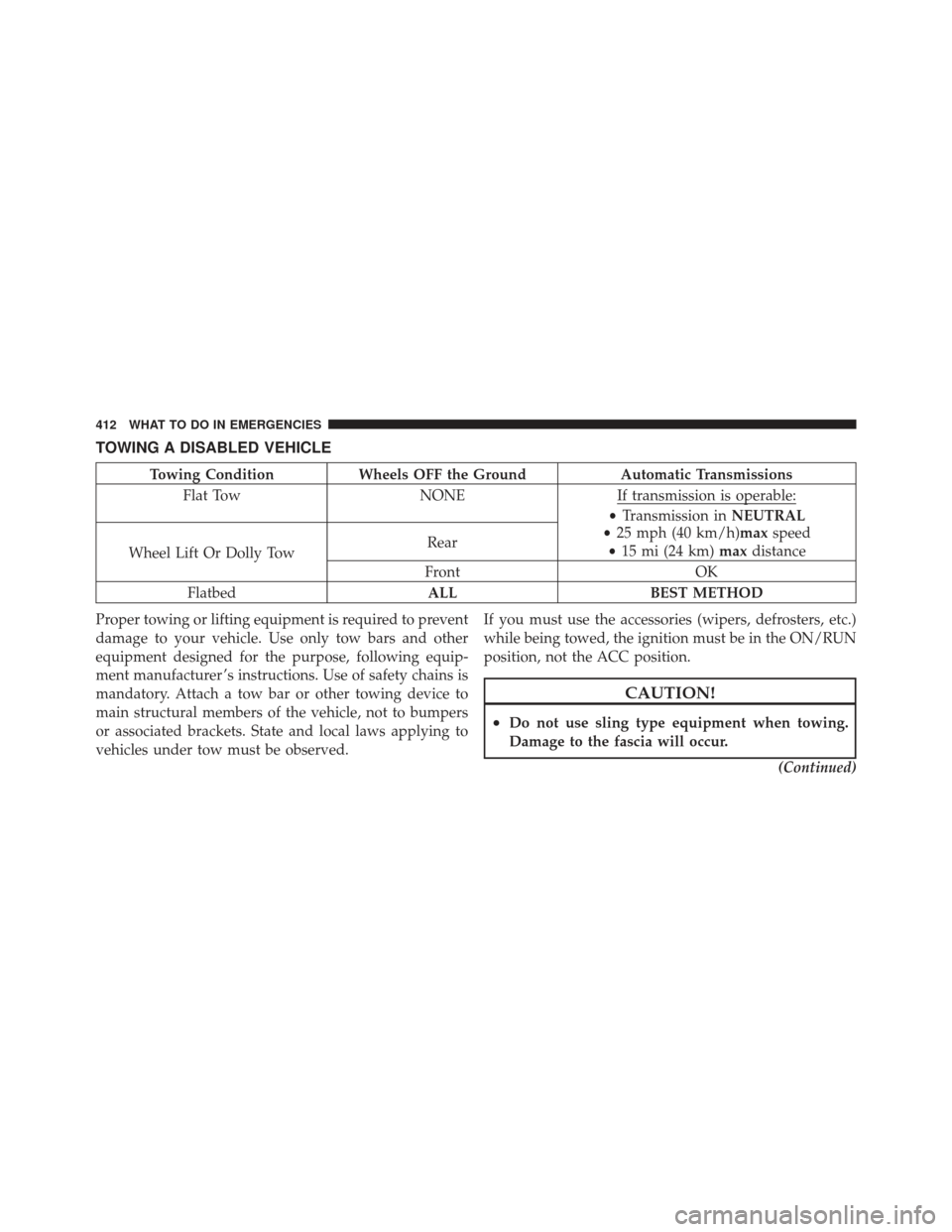
TOWING A DISABLED VEHICLE
Towing ConditionWheels OFF the Ground Automatic Transmissions
Flat Tow NONEIf transmission is operable:
•Transmission in NEUTRAL
• 25 mph (40 km/h)max speed
• 15 mi (24 km) maxdistance
Wheel Lift Or Dolly Tow Rear
Front OK
Flatbed ALLBEST METHOD
Proper towing or lifting equipment is required to prevent
damage to your vehicle. Use only tow bars and other
equipment designed for the purpose, following equip-
ment manufacturer ’s instructions. Use of safety chains is
mandatory. Attach a tow bar or other towing device to
main structural members of the vehicle, not to bumpers
or associated brackets. State and local laws applying to
vehicles under tow must be observed. If you must use the accessories (wipers, defrosters, etc.)
while being towed, the ignition must be in the ON/RUN
position, not the ACC position.
CAUTION!
•Do not use sling type equipment when towing.
Damage to the fascia will occur.
(Continued)
412 WHAT TO DO IN EMERGENCIES
Page 415 of 514
CAUTION! (Continued)
•When securing the vehicle to a flatbed truck, do
not attach to front or rear suspension components.
Damage to your vehicle may result from improper
towing.
•Do not push or tow this vehicle with another
vehicle as damage to the bumper fascia and trans-
mission may result.
•If the vehicle being towed requires steering, the
ignition switch must be in the ON position, not
the LOCK or ACC positions.
Automatic Transmission
The manufacturer recommends towing your vehicle with
all four wheels OFF the ground using a flatbed.If flatbed equipment is not available, and the transmis-
sion is operable, the vehicle may be flat towed (with all
four wheels on the ground) under the following condi-
tions:
•The shift lever must be in NEUTRAL.
•The towing distance must not exceed 15 mi (24 km).
•The towing speed must not exceed 25 mph (40 km/h).
If the transmission is not operable, or the vehicle must
be towed faster than 25 mph (40 km/h) or farther than 15
mi (24 km), it must be towed with the front wheels OFF
the ground (using a flatbed truck, towing dolly, or
wheel lift equipment with the front wheels raised).
6
WHAT TO DO IN EMERGENCIES 413