2012 DACIA SANDERO light
[x] Cancel search: lightPage 58 of 183
headlight flashers ................................. (up to the end of the DU)
horn ...................................................... (up to the end of the DU)
indicators .............................................. (up to the end of the DU)
lights: direction indicators .......................... (up to the end of the DU)
lights: hazard warning ............................... (up to the end of the DU)
indicators: direction indicators .......................... (up to the end of the DU)
hazard warning lights signal ................. (up to the end of the DU)
hazard warning lights signal ................. (up to the end of the DU)
1.52
ENG_UD20449_7
Avertisseurs sonore et lumineux (B90 - L90 Ph2 - F90 Ph2 - R90 Ph2 - Dac\
ia)
ENG_NU_817-9_B90_Dacia_1
Audible and visual signals
AUDIBLE AND VISUAL SIGNALS
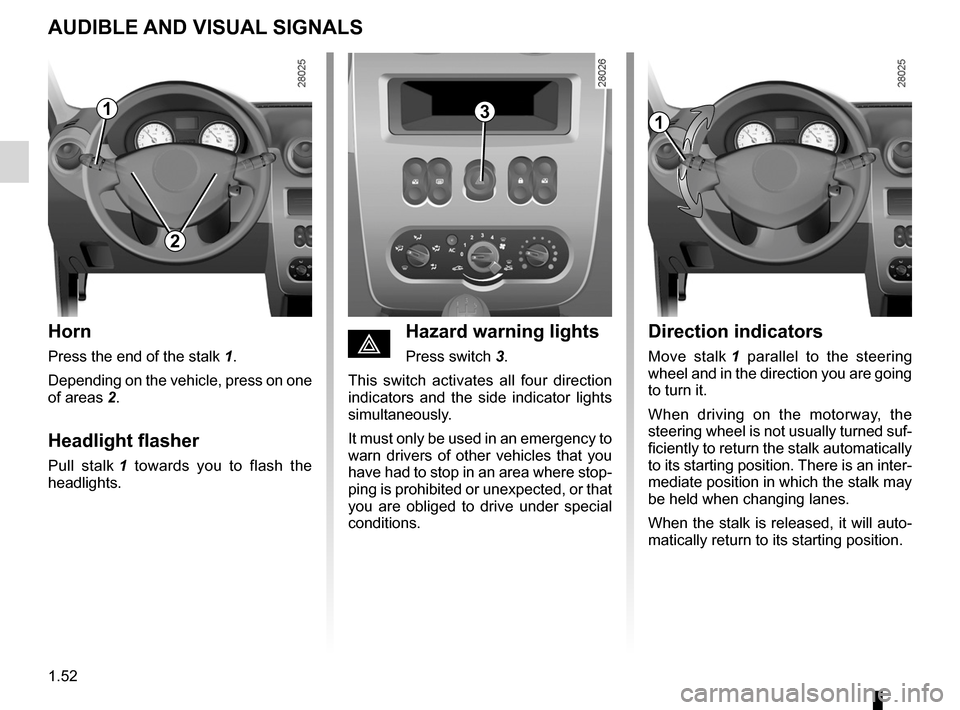
Horn
Press the end of the stalk 1.
Depending on the vehicle, press on one
of areas 2.
Headlight flasher
Pull stalk 1 towards you to flash the
headlights.
Direction indicators
Move stalk 1 parallel to the steering
wheel and in the direction you are going
to turn it.
When driving on the motorway, the
steering wheel is not usually turned suf-
ficiently to return the stalk automatically
to its starting position. There is an inter-
mediate position in which the stalk may
be held when changing lanes.
When the stalk is released, it will auto-
matically return to its starting position.éHazard warning lights
Press switch 3.
This switch activates all four direction
indicators and the side indicator lights
simultaneously.
It must only be used in an emergency to
warn drivers of other vehicles that you
have had to stop in an area where stop-
ping is prohibited or unexpected, or that
you are obliged to drive under special
conditions.
113
2
Page 61 of 183
de-icingrear screen ....................................................... (current page)
JauneNoirNoir texte
1.55
ENG_UD25180_9
Essuie-vitre/Lave-vitre/Dégivrage (B90 - Dacia)
ENG_NU_817-9_B90_Dacia_1
WINDSCREEN WASH/WIPE, DE-ICING (3/3)
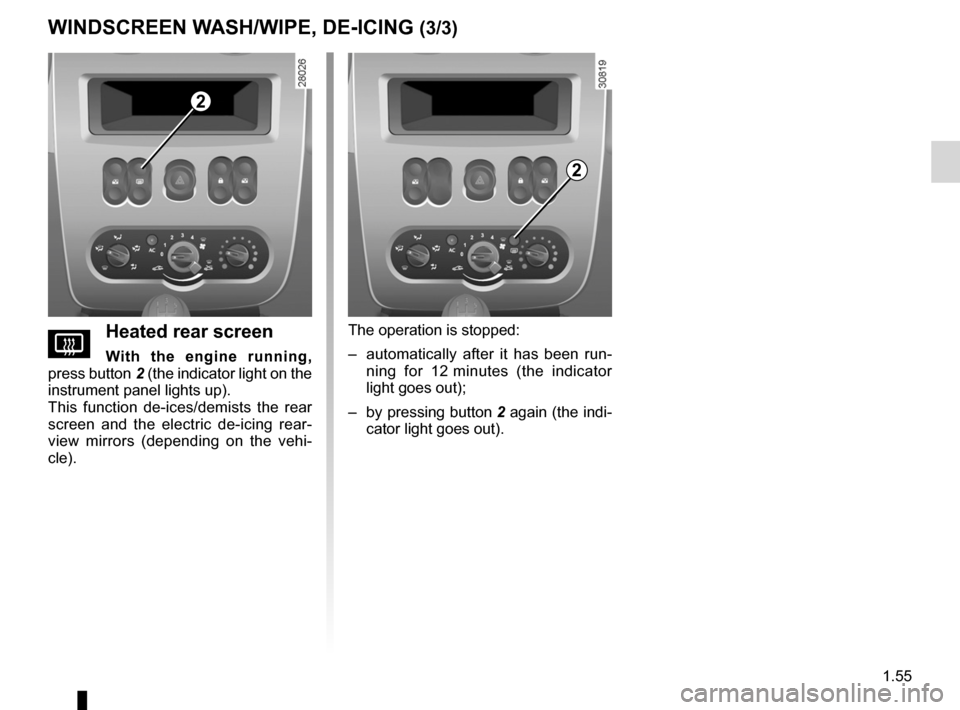
VHeated rear screen
With the engine running,
press button 2 (the indicator light on the
instrument panel lights up).
This function de-ices/demists the rear
screen and the electric de-icing rear -
view mirrors (depending on the vehi -
cle).
The operation is stopped:
– automatically after it has been run -
ning for 12 minutes (the indicator
light goes out);
– by pressing button 2 again (the indi -
cator light goes out).
2
2
Page 63 of 183
JauneNoirNoir texte
1.57
ENG_UD22575_7
Réservoir carburant (B90 - Dacia)
ENG_NU_817-9_B90_Dacia_1
FUEL TANK (2/3)
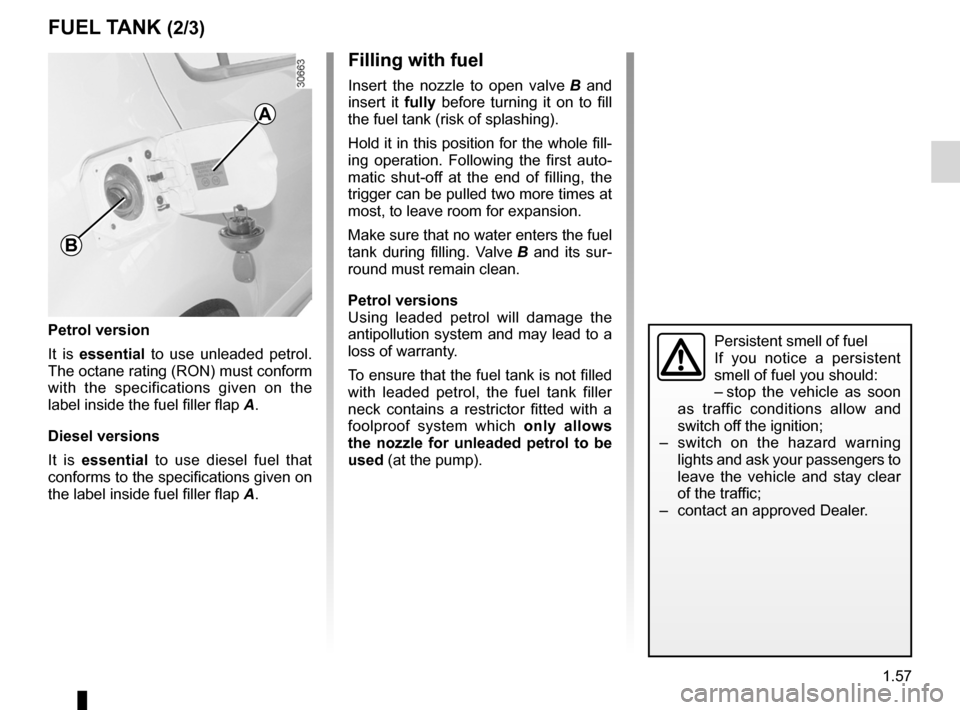
Petrol version
It is essential to use unleaded petrol.
The octane rating (RON) must conform
with the specifications given on the
label inside the fuel filler flap A.
Diesel versions
It is essential to use diesel fuel that
conforms to the specifications given on
the label inside fuel filler flap A.
Filling with fuel
Insert the nozzle to open valve B and
insert it fully before turning it on to fill
the fuel tank (risk of splashing).
Hold it in this position for the whole fill-
ing operation. Following the first auto -
matic shut-off at the end of filling, the
trigger can be pulled two more times at
most, to leave room for expansion.
Make sure that no water enters the fuel
tank during filling. Valve B and its sur -
round must remain clean.
Petrol versions
Using leaded petrol will damage the
antipollution system and may lead to a
loss of warranty.
To ensure that the fuel tank is not filled
with leaded petrol, the fuel tank filler
neck contains a restrictor fitted with a
foolproof system which only allows
the nozzle for unleaded petrol to be
used (at the pump).
Persistent smell of fuel
If you notice a persistent
smell of fuel you should:
– stop the vehicle as soon
as traffic conditions allow and
switch off the ignition;
– switch on the hazard warning
lights and ask your passengers to
leave the vehicle and stay clear
of the traffic;
– contact an approved Dealer.
A
B
Page 66 of 183
running in ............................................................... (current page)
ignition switch ........................................................ (current page)
engine immobiliser (switch) ................................... (current page)
driving .................................................................... (current page)
starting ................................................................... (current page)
2.2
ENG_UD18236_9
Rodage / Contacteur de démarrage (B90 - U90 - L90 Ph2 - Dacia)
ENG_NU_817-9_B90_Dacia_2
Running in, Ignition switch
RUNNING IN, IGNITION SWITCH
Petrol version
For the first 600 miles (1,000 km), do
not exceed 78 mph (130 km/h) in the
highest gear, or 3,000 to 3,500 rpm.
You may only expect top performance
from your vehicle after approximately
1,800 miles (3,000 km).
S e r v i c e i n t e r v a l s : r e f e r t o t h e
Maintenance Service Booklet for the
vehicle.
Diesel version
For the first 900 miles (1,500 km), do
not exceed 2,500 rpm. After complet -
ing this mileage you may drive faster,
although you may only expect top per-
formance after approximately 3,600
miles (6,000 km).
Do not accelerate hard while the engine
is still cold and do not let the engine
over-rev.
S e r v i c e i n t e r v a l s : r e f e r t o t h e
Maintenance Service Booklet for the
vehicle.
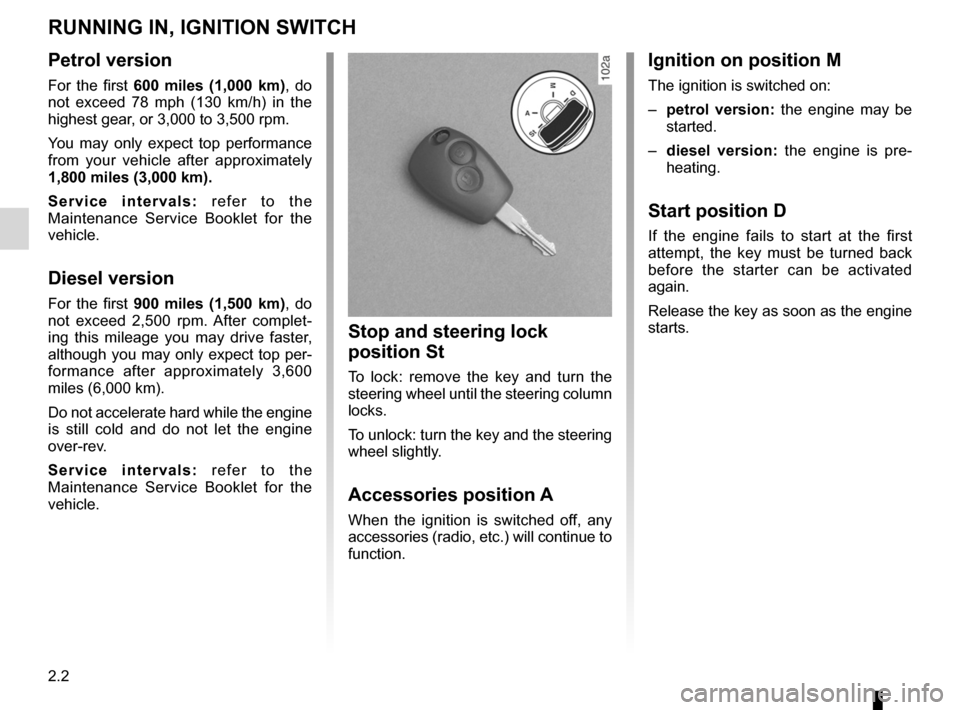
Stop and steering lock
position St
To lock: remove the key and turn the
steering wheel until the steering column
locks.
To unlock: turn the key and the steering
wheel slightly.
Accessories position A
When the ignition is switched off, any
accessories (radio, etc.) will continue to
function.
Ignition on position M
The ignition is switched on:
– petrol version: the engine may be
started.
– diesel version: the engine is pre -
heating.
Start position D
If the engine fails to start at the first
attempt, the key must be turned back
before the starter can be activated
again.
Release the key as soon as the engine
starts.
Page 67 of 183
driving ................................................... (up to the end of the DU)
starting .................................................. (up to the end of the DU)
starting the engine ................................ (up to the end of the DU)
2.3
ENG_UD18206_6
Démarrage, Arrêt du moteur (B90 - L90 Ph2 - F90 Ph2 - R90 Ph2 - Dacia)
ENG_NU_817-9_B90_Dacia_2
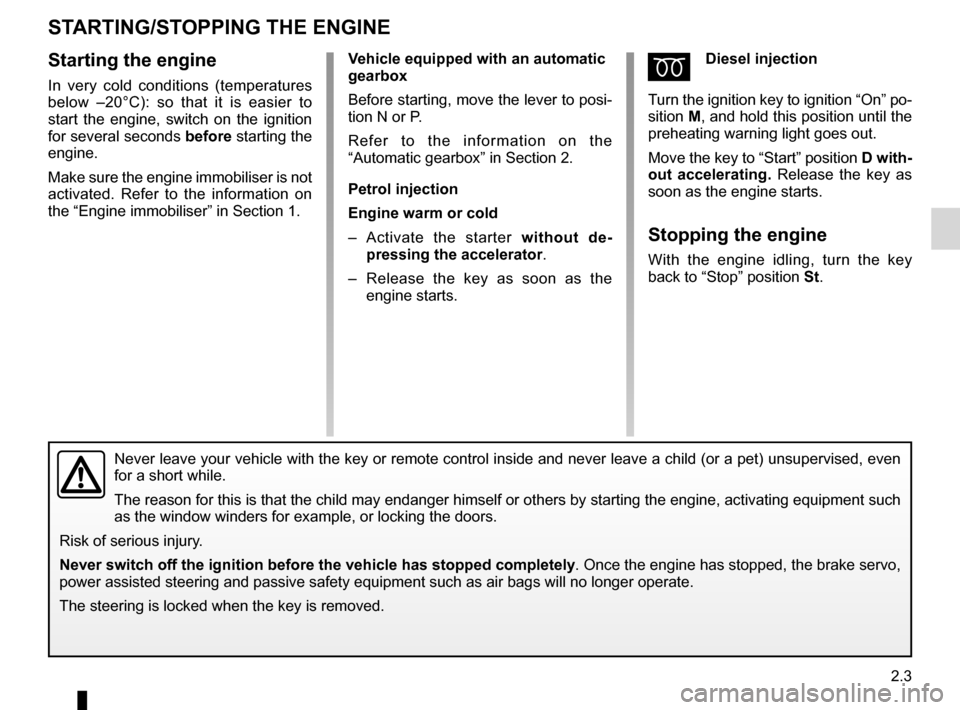
Vehicle equipped with an automatic
gearbox
Before starting, move the lever to posi-
tion N or P.
Refer to the information on the
“Automatic gearbox” in Section 2.
Petrol injection
Engine warm or cold
– Activate the starter without de-
pressing the accelerator.
– Release the key as soon as the
engine starts.ÉDiesel injection
Turn the ignition key to ignition “On” po-
sition M, and hold this position until the
preheating warning light goes out.
Move the key to “Start” position D with-
out accelerating. Release the key as
soon as the engine starts.
Stopping the engine
With the engine idling, turn the key
back to “Stop” position St.
Starting the engine
In very cold conditions (temperatures
below –20°C): so that it is easier to
start the engine, switch on the ignition
for several seconds before starting the
engine.
Make sure the engine immobiliser is not
activated. Refer to the information on
the “Engine immobiliser” in Section 1.
Starting/stopping the engine
STARTING/STOPPING THE ENGINE
Never leave your vehicle with the key or remote control inside and never leave a child (or a pet) unsupervised, even
for a short while.
The reason for this is that the child may endanger himself or others by starting the engine, activating equipment such
as the window winders for example, or locking the doors.
Risk of serious injury.
Never switch off the ignition before the vehicle has stopped completely. Once the engine has stopped, the brake servo,
power assisted steering and passive safety equipment such as air bags wi\
ll no longer operate.
The steering is locked when the key is removed.
Page 68 of 183
driving ................................................... (up to the end of the DU)
catalytic converter ................................. (up to the end of the DU)
catalytic converter ................................. (up to the end of the DU)
special features of petrol vehicles ........ (up to the end of the DU)
2.4
ENG_UD18237_9
Particularités des versions essence (B90 - U90 - L90 Ph2 - F90 Ph2 -\
R90 Ph2 - H79 - Dacia)
ENG_NU_817-9_B90_Dacia_2
Special features of petrol versions
SPECIAL FEATURES OF PETROL VERSIONS
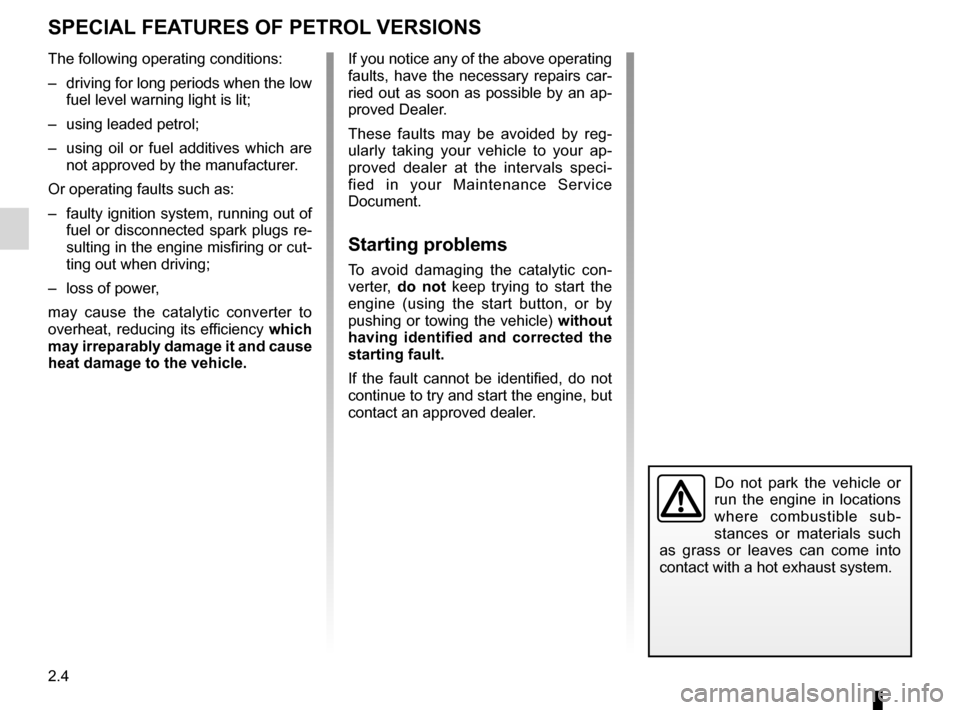
The following operating conditions:
– driving for long periods when the low
fuel level warning light is lit;
– using leaded petrol;
– using oil or fuel additives which are
not approved by the manufacturer.
Or operating faults such as:
– faulty ignition system, running out of
fuel or disconnected spark plugs re-
sulting in the engine misfiring or cut-
ting out when driving;
– loss of power,
may cause the catalytic converter to
overheat, reducing its efficiency which
may irreparably damage it and cause
heat damage to the vehicle. If you notice any of the above operating
faults, have the necessary repairs car-
ried out as soon as possible by an ap-
proved Dealer.
These faults may be avoided by reg
-
ularly taking your vehicle to your ap -
proved dealer at the intervals speci -
fied in your Maintenance Service
Document.
Starting problems
To avoid damaging the catalytic con -
verter, do not keep trying to start the
engine (using the start button, or by
pushing or towing the vehicle) without
having identified and corrected the
starting fault.
If the fault cannot be identified, do not
continue to try and start the engine, but
contact an approved dealer.
Do not park the vehicle or
run the engine in locations
where combustible sub -
stances or materials such
as grass or leaves can come into
contact with a hot exhaust system.
Page 71 of 183

ENG_NU_817-9_B90_Dacia_2
On versions with")
JauneNoirNoir texte
2.7
ENG_UD22287_11
Conseils : antipollution, économies de carburant, conduite (B90 - U9\
0 - L90 Ph2 - F90 Ph2 - R90 Ph2 - H79 - Dacia)
ENG_NU_817-9_B90_Dacia_2
On versions with an automatic gear-
box, it is preferable to keep the gear
lever in position D.
– Do not try to maintain the same
speed up a hill, accelerate no more
than you would on the level. Keep
your foot in the same position on the
accelerator pedal.
– Double declutching and accelerating
before switching off are unnecessary
in modern vehicles.
– Poor weather conditions, flooded
roads. Do not drive through water if it
is higher than the lower edge of the
wheel rim.Exhaust gas monitoring
system
The exhaust gas monitoring system de-
tects operating faults in the vehicle’s
antipollution system. These faults may
cause mechanical damage or the re -
lease of harmful substances.
ÄThis warning light on the in -
strument panel will indicate if
there are any faults in the system:
This comes on when the ignition is
switched on and goes out after three
seconds.
– If it comes on continuously, consult
an approved dealer as soon as pos-
sible.
– If it flashes, reduce the engine speed
until the light stops flashing. Contact
an approved dealer as soon as pos-
sible.
Driving– Drive carefully for the first few miles
until the engine reaches its normal
operating temperature, rather than
let it warm up while the vehicle is sta-
tionary.
ADVICE: antipollution, fuel economy and driving (2/3)
Driving problems
On the driver ’s side, only
use mats specially adapted
for the vehicle and attached
to prefitted devices. Check regularly
to make sure they are secure. Do
not overlay several mats.
Risk of pedals jamming .
– Speed is expensive.
– Sporty driving uses a lot of fuel: drive
with a light right foot.
– Study the road ahead so that you are
able to brake as little as possible, it
can be sufficient just to lift off the ac-
celerator.
– Avoid sudden acceleration.
– Do not overrev the engine in the in-
termediate gears. Always use the
highest gear possible without labour-
ing the engine.
Page 72 of 183

ENG_NU_817-9_B90_Dacia_2
ADVICE: antipollution, fuel economy an")
2.8
ENG_UD22287_11
Conseils : antipollution, économies de carburant, conduite (B90 - U9\
0 - L90 Ph2 - F90 Ph2 - R90 Ph2 - H79 - Dacia)
ENG_NU_817-9_B90_Dacia_2
ADVICE: antipollution, fuel economy and driving (3/3)
– In vehicles fitted with air condi -
tioning, it is normal to observe an
increase in fuel consumption (es -
pecially in urban conditions) when
it is used. For vehicles fitted with
manual air conditioning, switch off
the system when it is not required.
Advice for reducing consumption
and therefore helping to preserve
the environment:
If the vehicle has been parked in the
sun, open the doors for a few mo -
ments to let the hot air escape before
starting the engine.
– Never fill the fuel tank right to the
brim to avoid overflow.
– Do not leave an empty roof rack
fitted to the vehicle.
– It is better to fit a trailer for bulky ob-
jects.
– When towing a caravan, fit a wind
deflector and adjust it carefully.
Advice on use
– Electricity is fuel; switch off all the
electrical components which are not
really needed.
However (safety first), keep your
lights on when the visibility is bad
(“see and be seen”).
– Use the air vents. Driving with the
windows open at 60 mph (100 km/h)
will increase fuel consumption by
4%. –
Avoid using the vehicle for door-to -
door journeys (short journeys, with
long stops in-between) because in
these conditions, the engine never
reaches its ideal temperature.
Tyres
Increased fuel consumption could be
the result of:
– insufficient pressure,
– using non-recommended tyres.