Page 33 of 358

Hybrid system
Before starting
- Place the selector lever in position N
.
- If your vehicle has Keyless Entry and Starting, simply having the key inside the
vehicle is sufficient.
- If not, place the electronic key in the reader.
- Press the brake
pedal.
- Make a single shor t press (about a second) on the START/STOP
button.
- The steering column locks (noticeable
noise and movement of the steeringwheel).
- Keep your foot on the brake pedal until theHybrid4 system starts up (the instrument panel and the Readylamp come on, confirmed by an audible signal).
The hybrid system determines whether it isnecessary to star t the Diesel engine.
Starting with temperatures
above zero
Starting - switching off the engine
With temperatures below zero, you must initiate
pre-heating of the Diesel engine:
-
Without putting your foot on the brakepedal
, make an initial shor t press (about asecond) on the START/STOP button.
- The steering column unlocks (noticeablenoise and movement of the steering wheel).
- Wait until the pre-heater warning lampgoes off.
-
With your foot on the brake pedal
, make
a second short press on the START/STOP
button.
- Keep your foot on the brake pedal until the Hybrid4 system starts up (the Ready
lamp comes on, confirmed by an audible signal)and the Diesel engine star ts.
Starting with temperatures
below zero
Page 38 of 358

ZEV mode *
(all electric)
Zero emissions vehicle operation is assured10 0 % by electric drive.
This mode forces silent running
at moderate speeds.
It
can be activated when therequired conditions are met, particularly if the state of charge of high voltage battery is sufficient (from 4 bars).
Auto mode
It automatically manages the operation of theDiesel engine and the electric motor, according
to inherent vehicle parameters, traffic conditions and driving style so as to optimise
the vehicle's fuel consumption.
In particular, this mode activates "zero emissions" electric runningwhen theconditions allow.
In auto mode, the electric motor:
- can drive the vehicle on its own up
to around 36 mph (60 km/h) in "zeroemissions" electric running, dependingon the state of charge of the battery, if the conditions specific to the vehicle are met
and if acceleration is moderate,
- supplements the Diesel en
gine
when
moving off and changing gear, duringacceleration and when traction from the front wheels is inadequate (it automatically adds4 wheel drive),
- is no longer active above 70 mph (120 km/h).
*
ZEV: Z
ero Emissions Vehicle.
This standardmode to use in preference
is activated automaticallyon starting the hybrid system.
Page 39 of 358

37
Hybrid system
Sport mode
(Diesel and
electric)
4WD mode **
(Diesel and
electric)
This mode allows more dynamic driving byproviding additional performance.Vehicle acceleration and pick-up are
maximised by using the capacity of the electric
motor, supplementing the power of the Diesel
engine.
This mode manages the progressiveness of theaccelerator, the electronic gearbox and the use of the electric motor.
In Sport mode:
- The electric motor can be used up to 70 mph (120 km/h).
This mode provides additional traction
***
at
low speed by driving all 4 wheels of the vehicle continuously: the Diesel engine (front wheel
drive) and the electric motor (rear wheel drive)operate simultaneously and permanently.
Their coupling is managed electronically tooptimise traction on slippery sur faces.
In 4WD mode:
- Power for the electric motor is provided,
i
f needed, by the alternator-star ter motor
of the front engine. The Diesel engine
operates continuously.
- The additional traction from the electricmotor is available up to 75 mph (120 km/h).
In ZEV m
ode:
- The accelerator control is progressive.
- Range and acceleration capacity are
limited. The maximum speed possible is
around 36 mph (60 km/h).
- Under high load or a priority requirement causing the star t of the Diesel engine, thesystem changes automatically to AUTO mode.I
f the conditions do not allow this mode, a message that the "electricmode is not currently available"appears in the screen. The ZEV
warning lamp flashes for a few seconds then goes off and the selector comes on in AUTO.
This mode should be used on snowcovered roads or difficult ground (mud, sand, ...). In this mode, in severe conditionsand if the circumstances allow, it isrecommended that you acceleratestrongly to ensure that you move off andavoid any risk of getting stuck.
For more information on "Automatic restarting of the Diesel engine or ZEV mode not available", refer to the corresponding section.
**
4WD: 4 Wheel Drive.
***
This mode will be even more effective if suitable tyres are fitted (winter tyres in
particular).
Page 42 of 358
View hybrid fl ow information
Hybrid modes
1.
Hybrid mode selected (AUTO, ZEV, SPORT, 4WD).
2.
Messages, e.g.: "Zero Emission" if the Diesel engine is off (0 g/km CO2).
Operation / Energy flows
6.
The Diesel engine supplies the battery (if needed).
7.Arrow from left to right: the battery powers the electric motor (when
the electric motor is operating).
Arrow from right to left: the electric motor/generator recharges the
battery (energy recovery phases).8. The Diesel engine drives the front wheels. 9.The electric motor drives the rear wheels.
Vehicle infrastructure
3.
Diesel engine.4.
Tr a c t i o n b a t t e ry state of charge. 5.
Electric Motor/Generator. Information on the active h
ybrid mode, arrows for energy flows and the state of charge of the battery, is displayed in the instrument panel screen or the screen.
Page 43 of 358
41Hybrid system
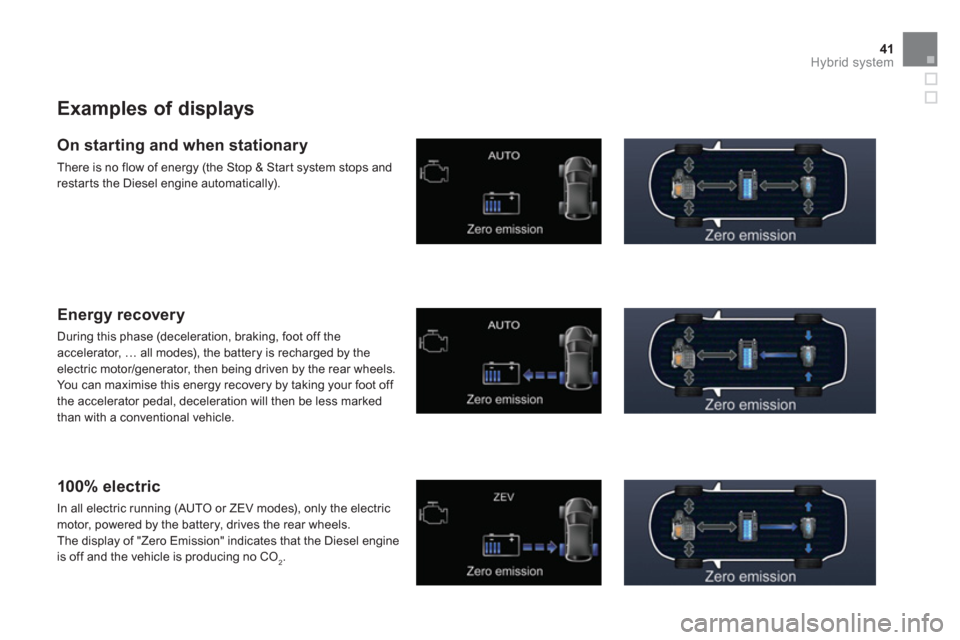
Examples of displays
On starting and when stationary
There is no flow of energy (the Stop & Star t system stops and
restar ts the Diesel engine automatically).
Energy recovery
During this phase (deceleration, braking, foot off the
accelerator, … all modes), the battery is recharged by the electric motor/generator, then being driven by the rear wheels.
You can maximise this energy recovery by taking your foot off
the accelerator pedal, deceleration will then be less marked
th
an with a conventional vehicle.
100% electric
In all electric running (AUTO or ZEV modes), only the electric motor, powered by the battery, drives the rear wheels.
The display of "Zero Emission" indicates that the Diesel engine
is off and the vehicle is producing no CO2.
Page 47 of 358

45
Hybrid system
Limit the causes of excess
consumption
Spread loads throughout the vehicle; place the heaviest items in the bottom of the boot,as close as possible to the rear seats.Limit the loads carried in the vehicle and reduce wind resistance (roof bars, roof rack, bicycle carrier, trailer...). Use a roof box inpreference.Remove roof bars and roof racks after use.
At the end of winter, remove snow tyres and refit your summer tyres.
Observe the recommendations
on maintenance
Check the tyre pressures regularly, when cold, referring to the label in the door aper ture, driver's side.Carry out this check in par ticular:- before a long journey,- at each change of season,- after a long period out of use.
Have your vehicle ser viced regularly (engine oil, oil filter, air filter...) and obser ve the schedule of operations recommended by the manufacturer.
When refuelling, do not continue after the3 rd
cut-off of the nozzle to avoid any over flow.
At the wheel of your new vehicle, it is only after the first 1 800 miles (3 000 kilometres) that you will see the fuel consumption settledown to a consistent average.
Page 53 of 358
51Hybrid system
Vehicle recovery
Before doing any work, with the ignition on, press the brake pedal and put the gear selector toposition N, then switch off the hybrid system.
If necessary because access to the vehicle is difficult, it can be moved a few dozen metres at a speed not exceeding 6 mph (10 km/h).
Use the towing eyes only to pull a vehicle out or
to pull it onto a flat-bed.
The front or rear wheels must not be on theground, use a flat-bed lorry or trailer to recover
t
he vehicle.
Page 58 of 358

Operation indicator lamps
If one of the following indicator lamps comes on in the instrument panel and/or instrument panel screen, this confirms that the corresponding system has come into operation.
Warning / indicator lampStateCauseAction / Observations
Left-hand direction indicatorflashing with buzzer. The lighting stalk is pushed down.
Right-handdirection indicatorflashing with buzzer. The lighting stalk is pushed up.
Sidelampsfixed.The lighting stalk is in the
"Sidelamps" position.
Dipped beamheadlampsfixed.The lighting stalk is in the "Dipped
beam headlamps" position.
Main beam headlampsfixed. The lighting stalk is pulled towardsyou. Pull the stalk to return to dipped beam headlamps.
Frontfoglampsfixed.The front foglamps are switched on. Turn the ring on the stalk rear wards twice to switch off
the front foglamps.
For more information on the lighting controls, refer to the "Visibility" section.
Automatic headlamp dipping
fixed.The lighting stalk has been pulledtowards you and the button (to the right of the steering wheel) has beenpressed.
Its warning lamp is on.
The camera, located in the interior rear view mirror,
authorises or not switching between main and dipped beam, depending on the exterior lighting and the
driving conditions.
Pull the li
ghting stalk to return to dipped beam.
Readyfixed. The vehicle is ready to move off; you can press the accelerator. It comes on once high voltage is established in the
vehicle.