Page 378 of 557
Anti-Lock Brake Light
The “Anti-Lock Brake Light” monitors the anti-
lock brake system. The light will come on when
the ignition switch is turned to the ON position and may
stay on for as long as four seconds.
If the “Anti-Lock Brake Light” remains on or comes on
while driving, it indicates that the anti-lock portion of the
brake system is not functioning and that service is
required. However, the conventional brake system will
continue to operate normally if the “Brake Warning
Light” is not on.
If the “Anti-Lock Brake Light” is on, the brake system
should be serviced as soon as possible to restore the
benefits of anti-lock brakes. If the “Anti-Lock Brake
Light” does not come on when the ignition switch is
turned to the ON position, have the bulb repaired as soon
as possible. If both the “Brake Warning Light” and the “Anti-Lock
Brake Light” remain on, the ABS and EBD systems are
not functioning. Immediate repair to the ABS system is
required.
ELECTRONIC BRAKE CONTROL SYSTEM
Your vehicle is equipped with an advanced electronic
brake control system that include Anti-Lock Brake Sys-
tem (ABS), Traction Control System (TCS), Brake Assist
System (BAS), and the Electronic Stability Control (ESC).
All four of these systems work together to enhance
vehicle stability and control in various driving condi-
tions.
Also, your vehicle is equipped with Hill Start Assist
(HSA), Ready Alert Braking, and Rain Brake Support.
376 STARTING AND OPERATING
Page 454 of 557
▫Brake System ....................... 476
▫ Automatic Transmission ............... 479
▫ Rear Axle .......................... 481
▫ Appearance Care And Protection From
Corrosion .......................... 481
� Fuses .............................. 487
▫ Integrated Power Module .............. 487
▫ Rear Power Distribution Center .......... 491
� Vehicle Storage ....................... 495
� Replacement Bulbs .................... 496 �
Bulb Replacement ..................... 497
▫ Low Beam Headlamp, High Beam
Headlamp, Park/Turn Lamp, Inner Park
Lamp, And Outer Park Lamp ............ 497
▫ Rear Backup Lamp And Turn Signal
Lamps ............................ 500
▫ License Lamp ....................... 501
� Fluid Capacities ...................... 502
� Fluids, Lubricants, And Genuine Parts ....... 503
▫ Engine ............................ 503
▫ Chassis ........................... 504
452 MAINTAINING YOUR VEHICLE
Page 457 of 557

For states that require an Inspection and Mainte-
nance (I/M), this check verifies the “Malfunction
Indicator Light (MIL)” is functioning and is not
on when the engine is running, and that the OBD II
system is ready for testing.
Normally, the OBD II system will be ready. The OBD II
system may notbe ready if your vehicle was recently
serviced, recently had a dead battery or a battery replace-
ment. If the OBD II system should be determined not
ready for the I/M test, your vehicle may fail the test.
Your vehicle has a simple ignition key-actuated test,
which you can use prior to going to the test station. To
check if your vehicle’s OBD II system is ready, you must
do the following:
1. Turn the ignition switch to the ON position, but do not
crank or start the engine.
2. If you crank or start the engine, you will have to start
this test over. 3. As soon as you turn the ignition switch to the ON
position, you will see the MIL symbol come on as part of
a normal bulb check.
4. Approximately 15 seconds later, one of two things will
happen:
a. The MIL will flash for about 10 seconds and then
return to being fully illuminated until you turn OFF
the ignition or start the engine. This means that your
vehicle’s OBD II system is not readyand you should
not proceed to the I/M station.
b. The MIL will not flash at all and will remain fully
illuminated until you turn OFF the ignition or start the
engine. This means that your vehicle’s OBD II system
is ready and you can proceed to the I/M station.
If your OBD II system is not ready,you should see your
authorized dealer or repair facility. If your vehicle was
recently serviced or had a battery failure or replacement,
you may need to do nothing more than drive your
7
MAINTAINING YOUR VEHICLE 455
Page 498 of 557
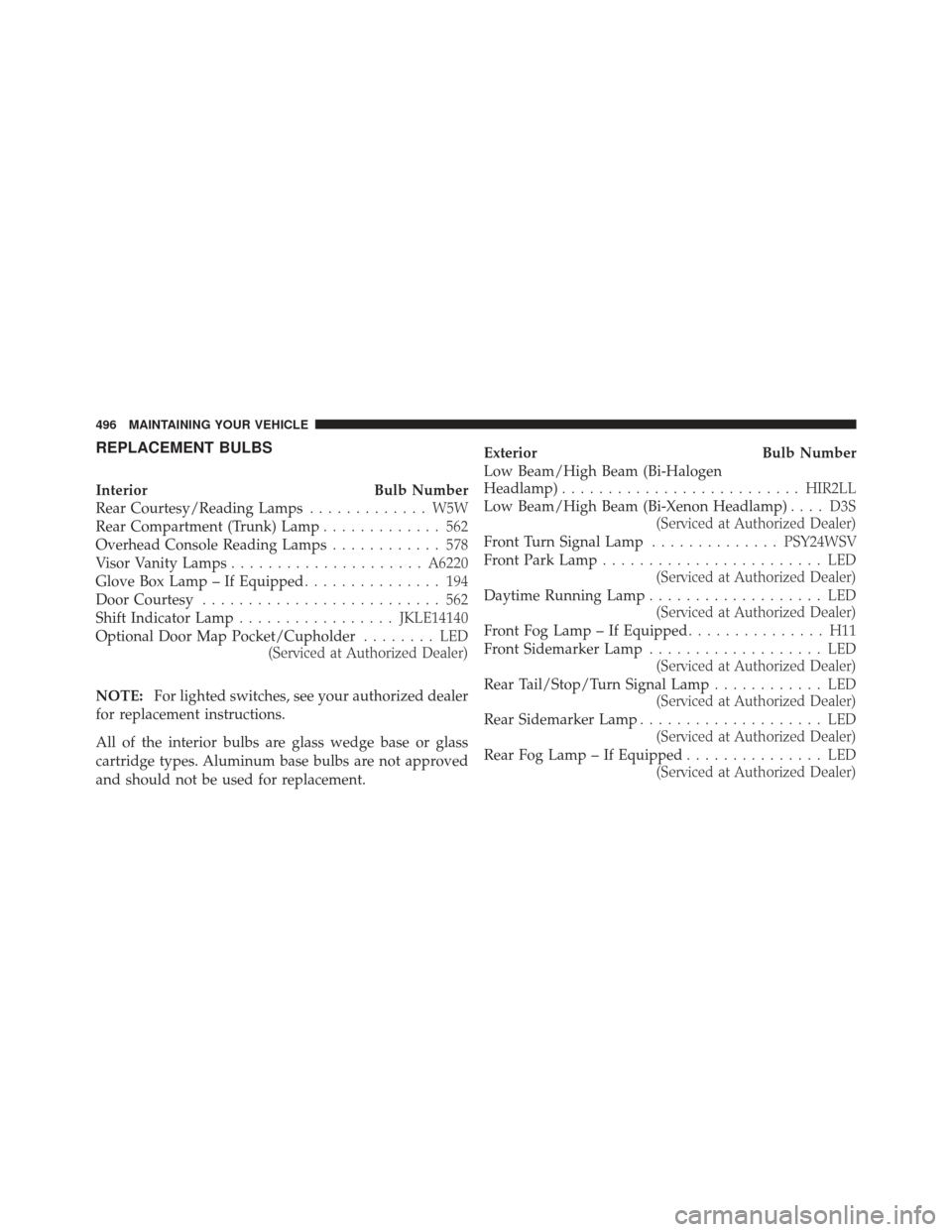
REPLACEMENT BULBS
InteriorBulb Number
Rear Courtesy/Reading Lamps ............. W5W
Rear Compartment (Trunk) Lamp ............. 562
Overhead Console Reading Lamps ............ 578
Visor Vanity Lamps ..................... A6220
Glove Box Lamp – If Equipped ............... 194
Door Courtesy .......................... 562
Shift Indicator Lamp ................. JKLE14140
Optional Door Map Pocket/Cupholder ........ LED
(Serviced at Authorized Dealer)
NOTE: For lighted switches, see your authorized dealer
for replacement instructions.
All of the interior bulbs are glass wedge base or glass
cartridge types. Aluminum base bulbs are not approved
and should not be used for replacement. Exterior
Bulb Number
Low Beam/High Beam (Bi-Halogen
Headlamp) .......................... HIR2LL
Low Beam/High Beam (Bi-Xenon Headlamp) .... D3S
(Serviced at Authorized Dealer)
Front Turn Signal Lamp ..............PSY24WSV
Front Park Lamp ........................ LED
(Serviced at Authorized Dealer)
Daytime Running Lamp ................... LED
(Serviced at Authorized Dealer)
Front Fog Lamp – If Equipped ............... H11
Front Sidemarker Lamp ................... LED
(Serviced at Authorized Dealer)
Rear Tail/Stop/Turn Signal Lamp ............ LED
(Serviced at Authorized Dealer)
Rear Sidemarker Lamp .................... LED
(Serviced at Authorized Dealer)
Rear Fog Lamp – If Equipped ............... LED
(Serviced at Authorized Dealer)
496 MAINTAINING YOUR VEHICLE
Page 499 of 557
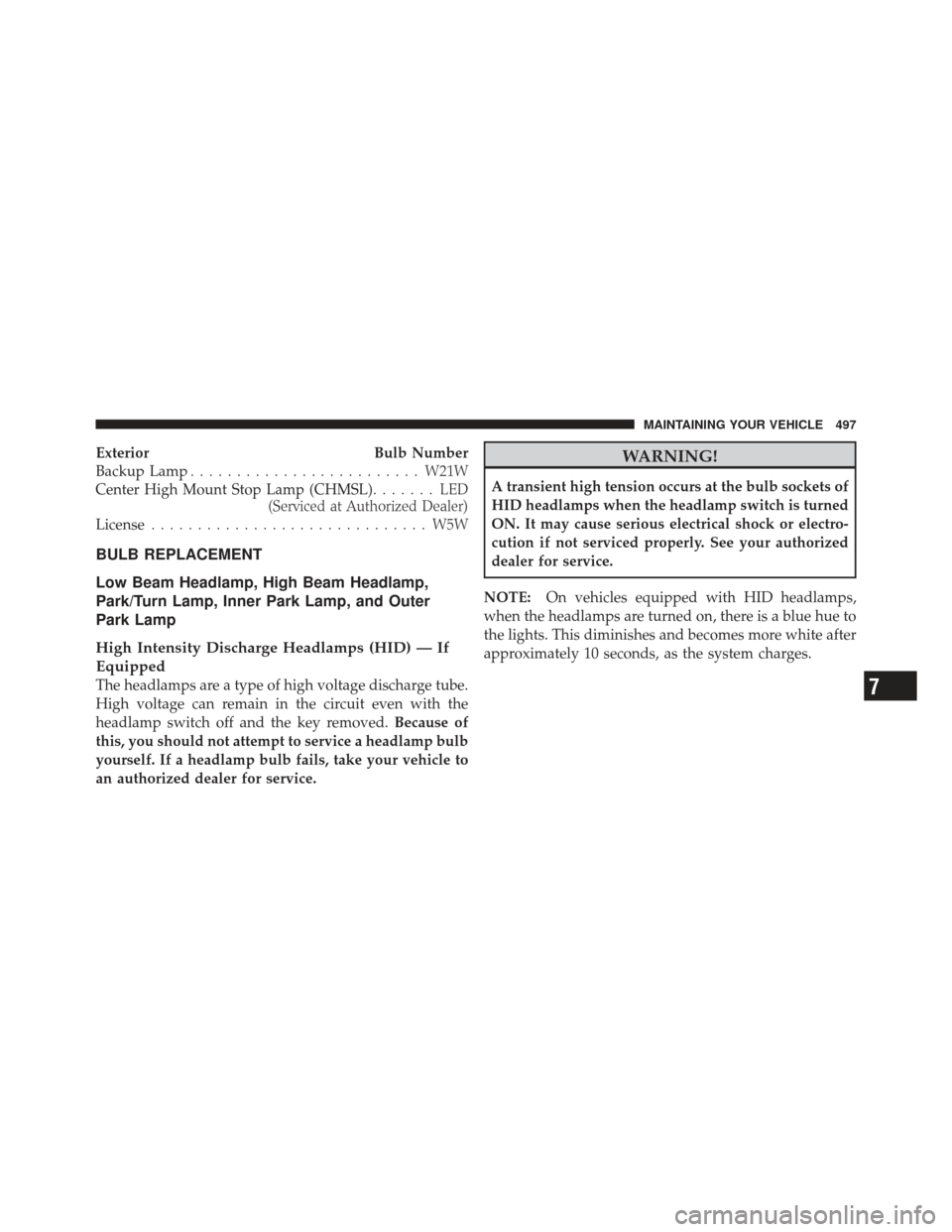
ExteriorBulb Number
Backup Lamp ......................... W21W
Center High Mount Stop Lamp (CHMSL) ....... LED
(Serviced at Authorized Dealer)
License .............................. W5W
BULB REPLACEMENT
Low Beam Headlamp, High Beam Headlamp,
Park/Turn Lamp, Inner Park Lamp, and Outer
Park Lamp
High Intensity Discharge Headlamps (HID) — If
Equipped
The headlamps are a type of high voltage discharge tube.
High voltage can remain in the circuit even with the
headlamp switch off and the key removed. Because of
this, you should not attempt to service a headlamp bulb
yourself. If a headlamp bulb fails, take your vehicle to
an authorized dealer for service.
WARNING!
A transient high tension occurs at the bulb sockets of
HID headlamps when the headlamp switch is turned
ON. It may cause serious electrical shock or electro-
cution if not serviced properly. See your authorized
dealer for service.
NOTE: On vehicles equipped with HID headlamps,
when the headlamps are turned on, there is a blue hue to
the lights. This diminishes and becomes more white after
approximately 10 seconds, as the system charges.
7
MAINTAINING YOUR VEHICLE 497
Page 500 of 557
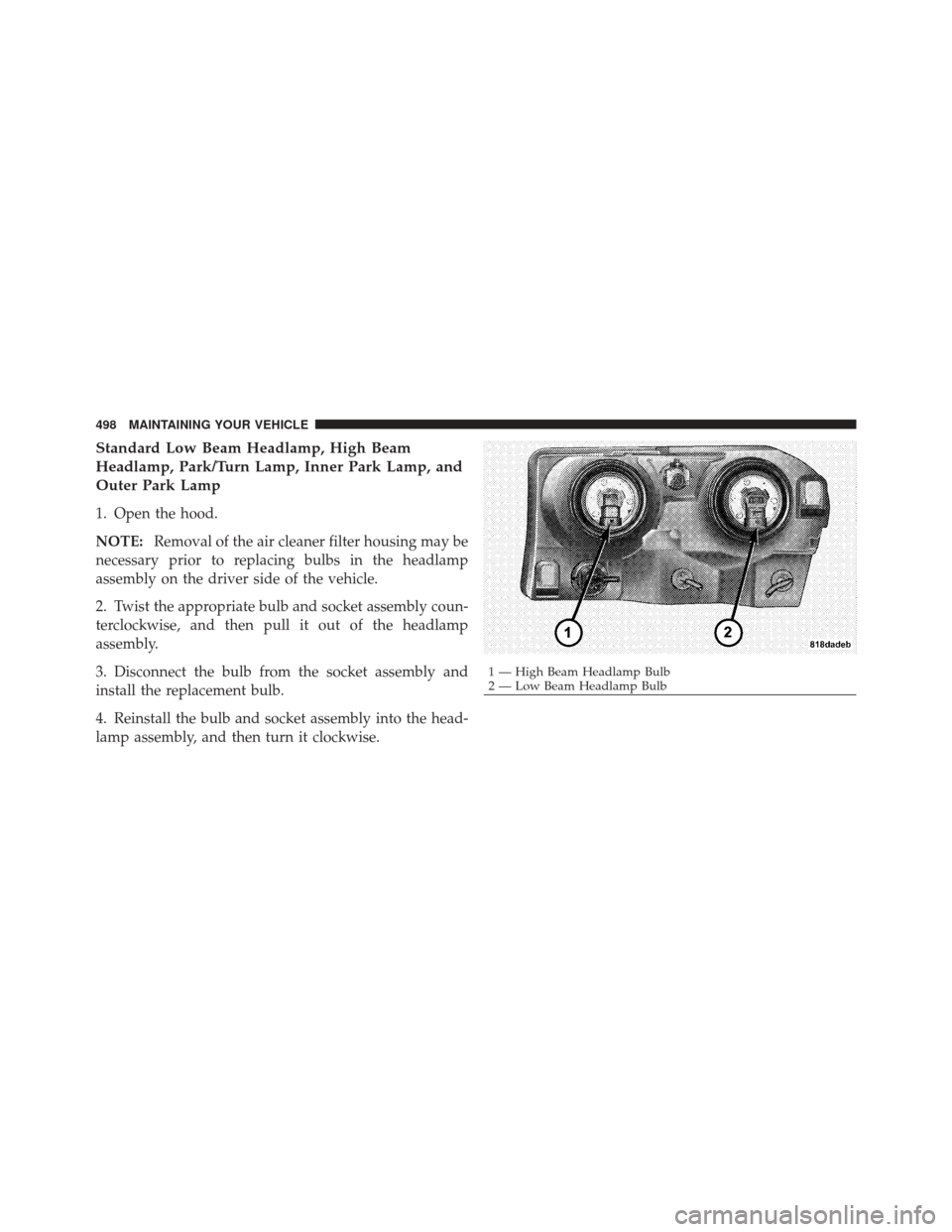
Standard Low Beam Headlamp, High Beam
Headlamp, Park/Turn Lamp, Inner Park Lamp, and
Outer Park Lamp
1. Open the hood.
NOTE:Removal of the air cleaner filter housing may be
necessary prior to replacing bulbs in the headlamp
assembly on the driver side of the vehicle.
2. Twist the appropriate bulb and socket assembly coun-
terclockwise, and then pull it out of the headlamp
assembly.
3. Disconnect the bulb from the socket assembly and
install the replacement bulb.
4. Reinstall the bulb and socket assembly into the head-
lamp assembly, and then turn it clockwise.
1 — High Beam Headlamp Bulb
2 — Low Beam Headlamp Bulb
498 MAINTAINING YOUR VEHICLE
Page 501 of 557
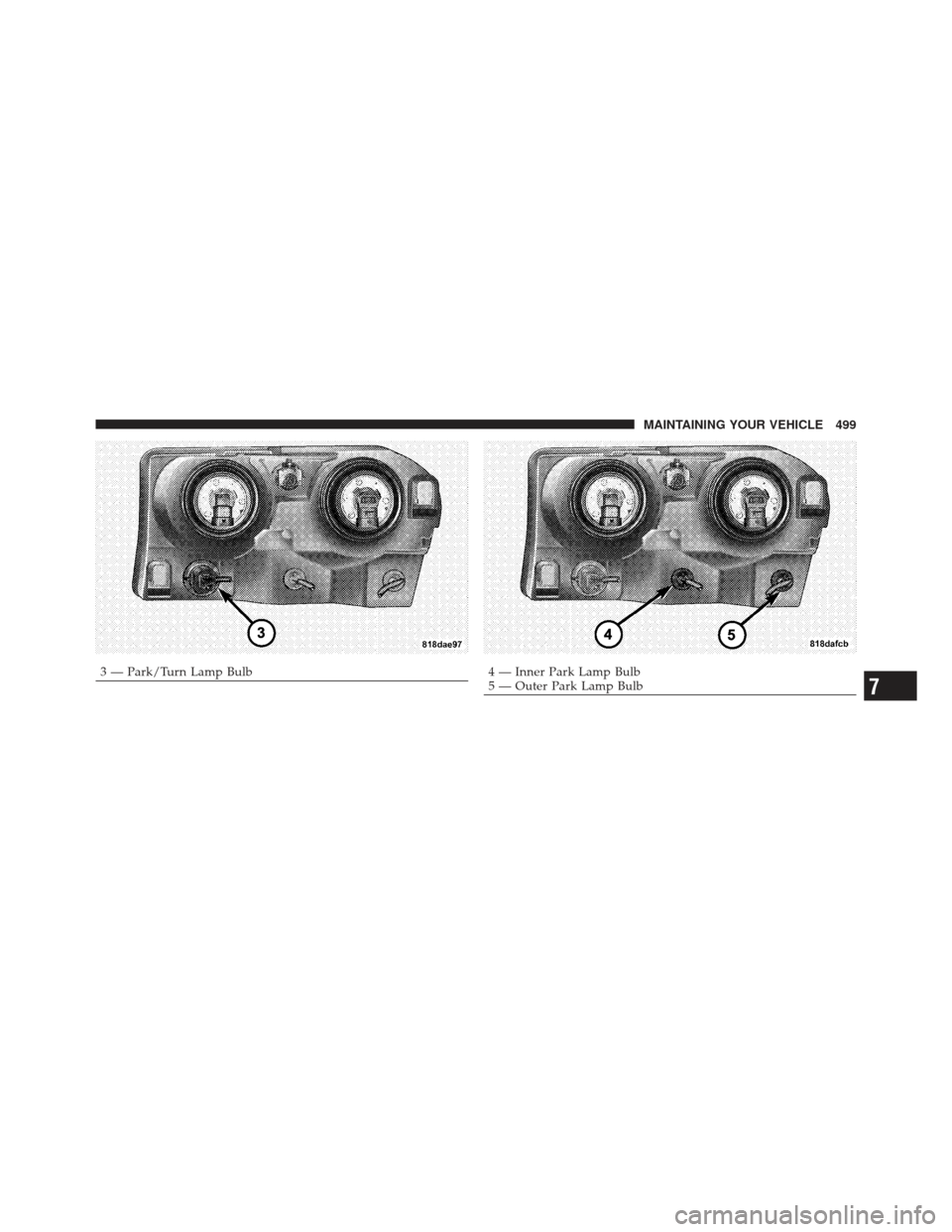
3 — Park/Turn Lamp Bulb4 — Inner Park Lamp Bulb
5 — Outer Park Lamp Bulb
7
MAINTAINING YOUR VEHICLE 499
Page 502 of 557
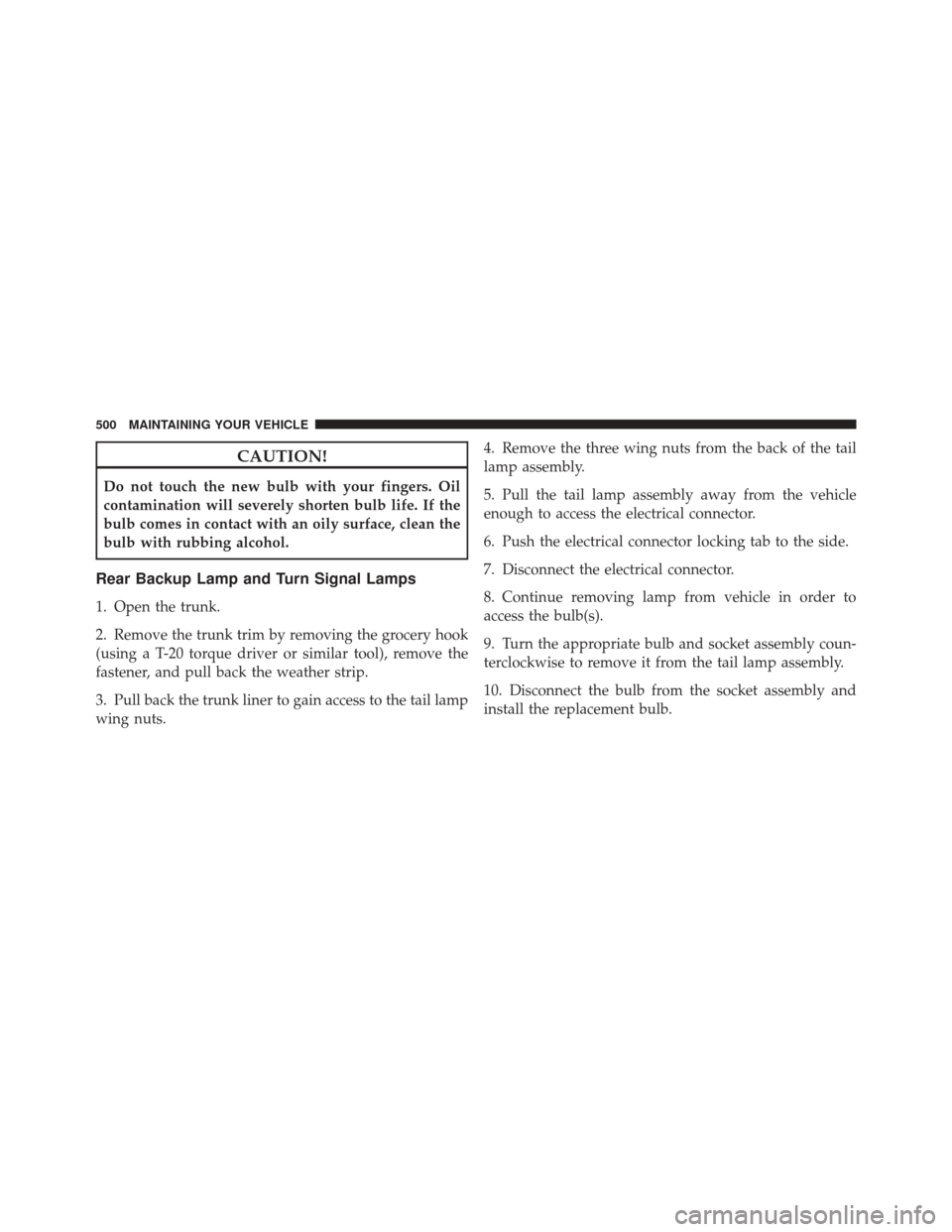
CAUTION!
Do not touch the new bulb with your fingers. Oil
contamination will severely shorten bulb life. If the
bulb comes in contact with an oily surface, clean the
bulb with rubbing alcohol.
Rear Backup Lamp and Turn Signal Lamps
1. Open the trunk.
2. Remove the trunk trim by removing the grocery hook
(using a T-20 torque driver or similar tool), remove the
fastener, and pull back the weather strip.
3. Pull back the trunk liner to gain access to the tail lamp
wing nuts.4. Remove the three wing nuts from the back of the tail
lamp assembly.
5. Pull the tail lamp assembly away from the vehicle
enough to access the electrical connector.
6. Push the electrical connector locking tab to the side.
7. Disconnect the electrical connector.
8. Continue removing lamp from vehicle in order to
access the bulb(s).
9. Turn the appropriate bulb and socket assembly coun-
terclockwise to remove it from the tail lamp assembly.
10. Disconnect the bulb from the socket assembly and
install the replacement bulb.
500 MAINTAINING YOUR VEHICLE