Page 12 of 576

▫Programming Additional Transmitters...... 24
▫Transmitter Battery Replacement.......... 25
▫General Information................... 26
�Remote Starting System — If Equipped....... 26
▫How To Use Remote Start............... 27
�Door Locks........................... 29
▫Manual Door Locks................... 29
▫Power Door Locks.................... 31
▫Child-Protection Door Lock System —
Rear Doors.......................... 32
�Keyless Enter-N-Go™................... 34
�Windows............................ 38
▫Power Windows...................... 38▫Wind Buffeting....................... 41
�Trunk Lock And Release................. 41
�Trunk Safety Warning................... 42
▫Trunk Emergency Release............... 43
�Occupant Restraints..................... 43
▫Lap/Shoulder Belts.................... 47
▫Lap/Shoulder Belt Untwisting Procedure.... 52
▫Seat Belts In Passenger Seating Positions..... 52
▫Automatic Locking Retractor Mode (ALR) —
If Equipped......................... 53
▫Energy Management Feature............. 54
▫Seat Belt Pretensioner.................. 54
▫Enhanced Seat Belt Use Reminder System
(BeltAlert�) ......................... 55
10 THINGS TO KNOW BEFORE STARTING YOUR VEHICLE
Page 13 of 576
▫Seat Belts And Pregnant Women.......... 56
▫Seat Belt Extender..................... 56
▫Supplemental Restraint System (SRS) —
Air Bags............................ 56
▫Air Bag Deployment Sensors And Controls . . . 62
▫Event Data Recorder (EDR).............. 70
▫Child Restraints...................... 71
�Engine Break-In Recommendations.......... 81�Safety Tips........................... 82
▫Transporting Passengers................ 82
▫Exhaust Gas......................... 83
▫Safety Checks You Should Make Inside The
Vehicle............................. 84
▫Periodic Safety Checks You Should Make
Outside The Vehicle................... 86
2
THINGS TO KNOW BEFORE STARTING YOUR VEHICLE 11
Page 34 of 576

Automatic Door Locks — If Equipped
The auto door lock feature default condition is enabled.
When enabled, the door locks will lock automatically
when the vehicle’s speed exceeds 15 mph (24 km/h). The
auto door lock feature can be enabled or disabled by your
authorized dealer. Please see your authorized dealer for
service.
Automatic Unlock Doors On Exit
The doors will unlock automatically on vehicles with
power door locks if:
1. The Automatic Unlock Doors On Exit feature is en-
abled.
2. The transmission was in gear and the vehicle speed
returned to 0 mph (0 km/h).
3. The transmission is in NEUTRAL or PARK.
4. The driver door is opened.5. The doors were not previously unlocked.
6. The vehicle speed is 0 mph (0 km/h).
Automatic Unlock Doors On Exit Programming
To change the current setting, refer to “Uconnect Touch™
Settings” in “Understanding Your Instrument Panel” for
further information.
NOTE:Use the Automatic Unlock Doors On Exit feature
in accordance with local laws.
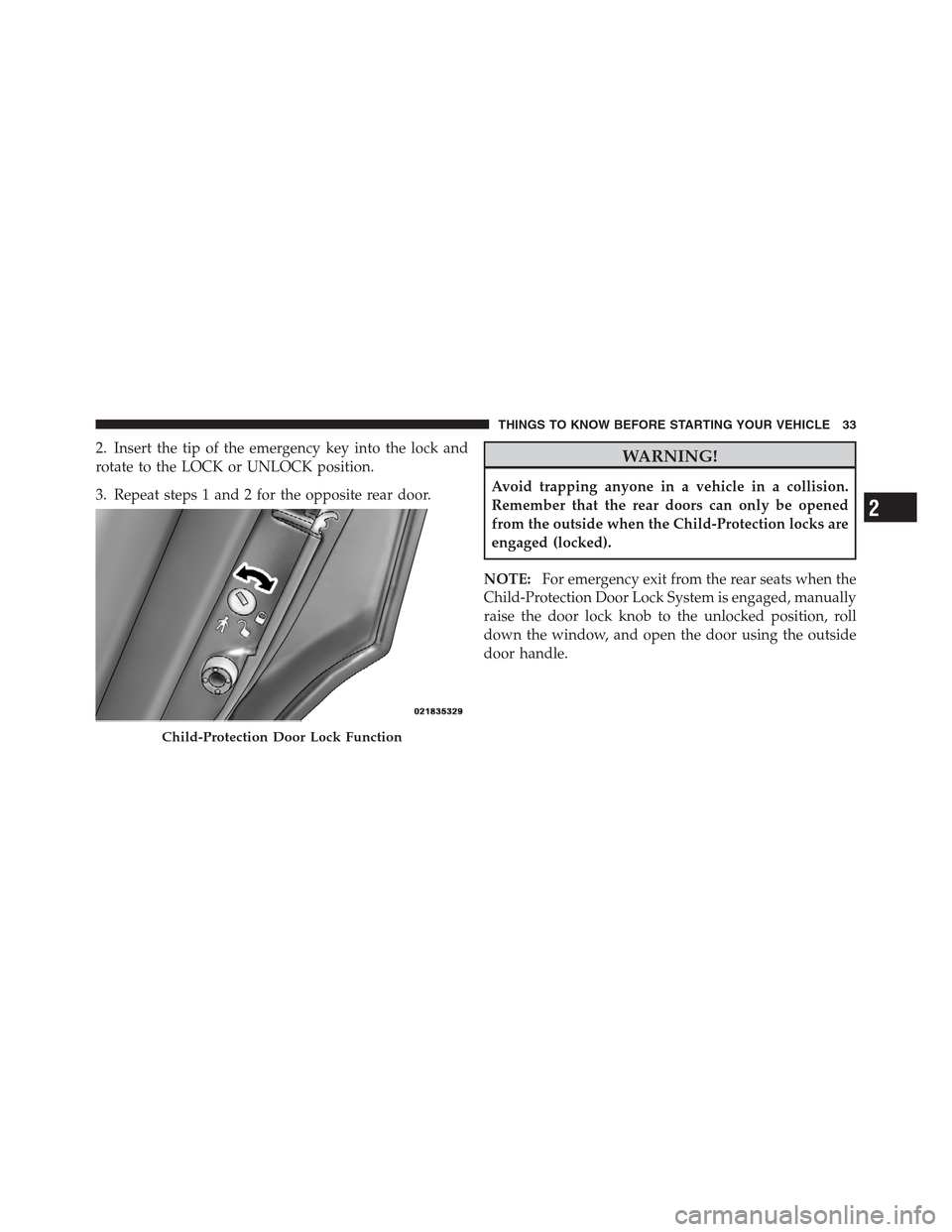
Child-Protection Door Lock System — Rear Doors
To provide a safer environment for small children riding
in the rear seats, the rear doors are equipped with
Child-Protection Door Lock system.
To Engage Or Disengage The Child-Protection
Door Lock System
1. Open the rear door.
32 THINGS TO KNOW BEFORE STARTING YOUR VEHICLE
Page 35 of 576
2. Insert the tip of the emergency key into the lock and
rotate to the LOCK or UNLOCK position.
3. Repeat steps 1 and 2 for the opposite rear door.WARNING!
Avoid trapping anyone in a vehicle in a collision.
Remember that the rear doors can only be opened
from the outside when the Child-Protection locks are
engaged (locked).
NOTE:For emergency exit from the rear seats when the
Child-Protection Door Lock System is engaged, manually
raise the door lock knob to the unlocked position, roll
down the window, and open the door using the outside
door handle.
Child-Protection Door Lock Function
2
THINGS TO KNOW BEFORE STARTING YOUR VEHICLE 33
Page 44 of 576
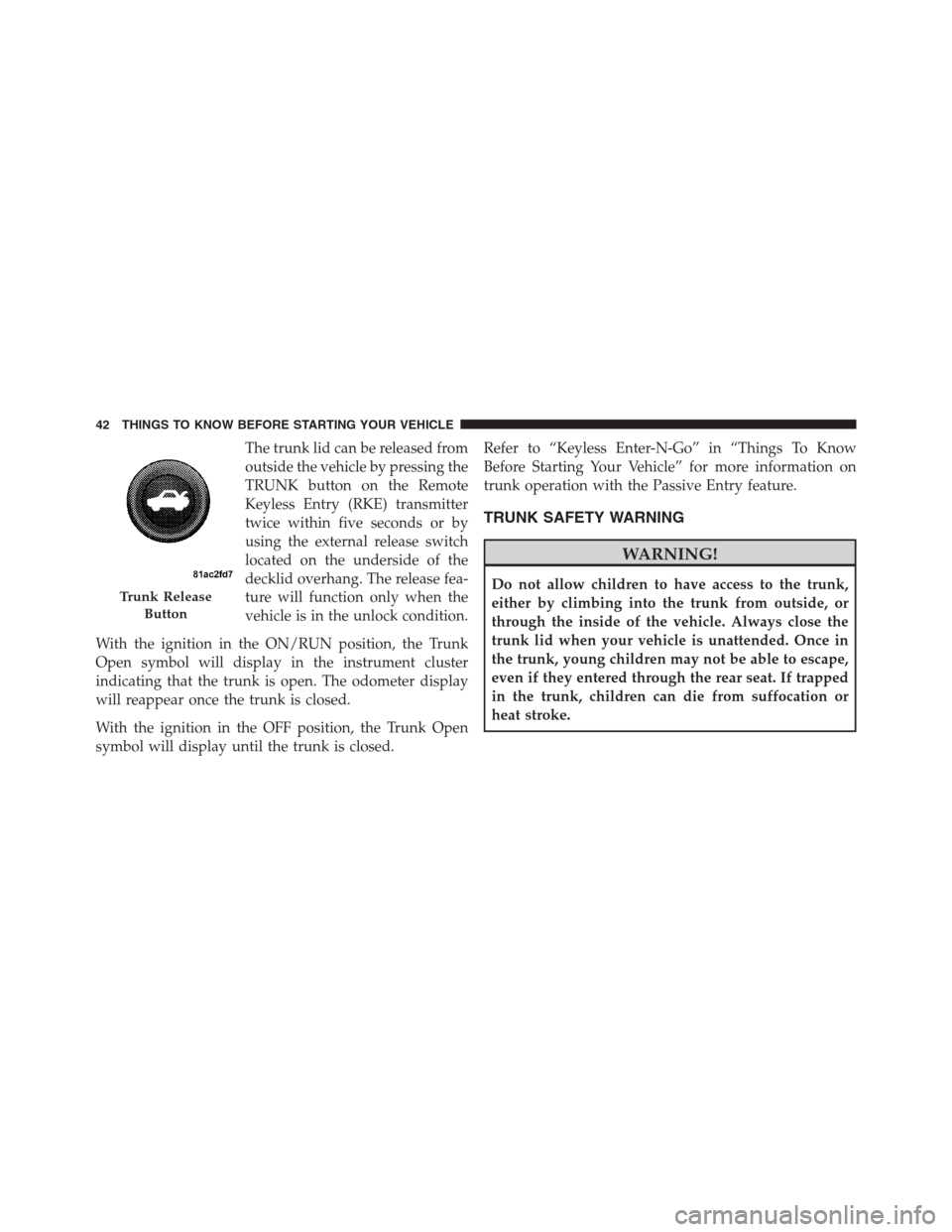
The trunk lid can be released from
outside the vehicle by pressing the
TRUNK button on the Remote
Keyless Entry (RKE) transmitter
twice within five seconds or by
using the external release switch
located on the underside of the
decklid overhang. The release fea-
ture will function only when the
vehicle is in the unlock condition.
With the ignition in the ON/RUN position, the Trunk
Open symbol will display in the instrument cluster
indicating that the trunk is open. The odometer display
will reappear once the trunk is closed.
With the ignition in the OFF position, the Trunk Open
symbol will display until the trunk is closed.Refer to “Keyless Enter-N-Go” in “Things To Know
Before Starting Your Vehicle” for more information on
trunk operation with the Passive Entry feature.
TRUNK SAFETY WARNING
WARNING!
Do not allow children to have access to the trunk,
either by climbing into the trunk from outside, or
through the inside of the vehicle. Always close the
trunk lid when your vehicle is unattended. Once in
the trunk, young children may not be able to escape,
even if they entered through the rear seat. If trapped
in the trunk, children can die from suffocation or
heat stroke.Trunk Release
Button
42 THINGS TO KNOW BEFORE STARTING YOUR VEHICLE
Page 46 of 576
•Front seat belts incorporate pretensioners that may
enhance occupant protection by managing occupant
energy during an impact event
Please pay close attention to the information in this
section. It tells you how to use your restraint system
properly, to keep you and your passengers as safe as
possible.
If you will be carrying children too small for adult-sized
seat belts, the seat belts or the Lower Anchors and Tether
for CHildren (LATCH) feature also can be used to hold
infant and child restraint systems. For more information
on LATCH, refer to Lower Anchors and Tether for
CHildren (LATCH).
NOTE:The Advanced Front Air Bags have a multistage
inflator design. This allows the air bag to have different
rates of inflation based on several factors, including the
severity and type of collision.Here are some simple steps you can take to minimize the
risk of harm from a deploying air bag:
1.Children 12 years old and under should always ride
buckled up in a rear seat.
WARNING!
Infants in rear facing child restraints should never ride
in the front seat of a vehicle with a passenger Ad-
vanced Front Air Bag. An air bag deployment can cause
severe injury or death to infants in that position.
Children that are not big enough to wear the vehicle seat
belt properly (see section on Child Restraints) should be
secured in the rear seat in child restraints or belt-positioning
booster seats. Older children who do not use child restraints
or belt-positioning booster seats should ride properly buck-
led up in the rear seat. Never allow children to slide the
shoulder belt behind them or under their arm.
44 THINGS TO KNOW BEFORE STARTING YOUR VEHICLE
Page 47 of 576
If a child from 1 to 12 years old (not in a rear facing child
seat) must ride in the front passenger seat, move the seat
as far back as possible and use the proper child restraint.
(Refer to “Child Restraints”)
You should read the instructions provided with your
child restraint to make sure that you are using it properly.
2.All occupants should always wear their lap and
shoulder belts properly.
3.The driver and front passenger seats should be
moved back as far as practical to allow the Advanced
Front Air Bags room to inflate.
4.Do not lean against the door or window. Your vehicle
has Supplemental Side Air Bag Inflatable Curtains
(SABIC) or Supplemental Seat-Mounted Side Air Bags
(SAB), and when deployment occurs, the SABIC and
SAB air bags will inflate forcefully into the space
between you and the door.5.If the air bag system in this vehicle needs to be
modified to accommodate a disabled person, contact
the Customer Center. Phone numbers are provided
under�If You Need Assistance�.
WARNING!
•Relying on the air bags alone could lead to more
severe injuries in a collision. The air bags work
with your seat belt to restrain you properly. In
some collisions, the air bags won’t deploy at all.
Always wear your seat belts even though you have
air bags.
(Continued)
2
THINGS TO KNOW BEFORE STARTING YOUR VEHICLE 45
Page 54 of 576
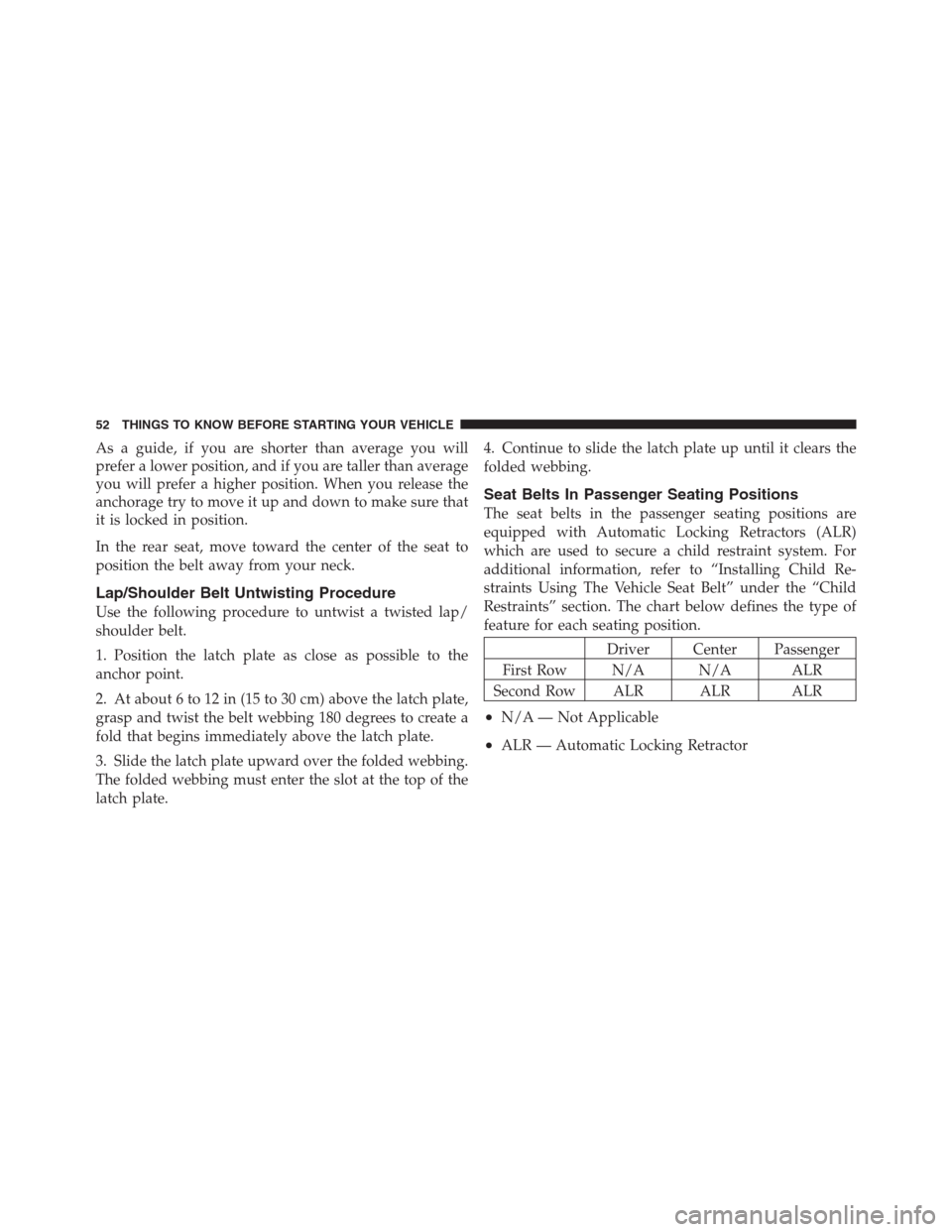
As a guide, if you are shorter than average you will
prefer a lower position, and if you are taller than average
you will prefer a higher position. When you release the
anchorage try to move it up and down to make sure that
it is locked in position.
In the rear seat, move toward the center of the seat to
position the belt away from your neck.
Lap/Shoulder Belt Untwisting Procedure
Use the following procedure to untwist a twisted lap/
shoulder belt.
1. Position the latch plate as close as possible to the
anchor point.
2. At about 6 to 12 in (15 to 30 cm) above the latch plate,
grasp and twist the belt webbing 180 degrees to create a
fold that begins immediately above the latch plate.
3. Slide the latch plate upward over the folded webbing.
The folded webbing must enter the slot at the top of the
latch plate.4. Continue to slide the latch plate up until it clears the
folded webbing.
Seat Belts In Passenger Seating Positions
The seat belts in the passenger seating positions are
equipped with Automatic Locking Retractors (ALR)
which are used to secure a child restraint system. For
additional information, refer to “Installing Child Re-
straints Using The Vehicle Seat Belt” under the “Child
Restraints” section. The chart below defines the type of
feature for each seating position.
Driver Center Passenger
First Row N/A N/A ALR
Second Row ALR ALR ALR
•N/A — Not Applicable
•ALR — Automatic Locking Retractor
52 THINGS TO KNOW BEFORE STARTING YOUR VEHICLE