Page 437 of 576
Trailer Sway Control
The trailer sway control is a telescoping link that can be
installed between the hitch receiver and the trailer tongue
that typically provides adjustable friction associated with
the telescoping motion to dampen any unwanted trailer
swaying motions while traveling.
Weight-Carrying Hitch
A weight-carrying hitch supports the trailer tongue
weight, just as if it were luggage located at a hitch ball or
some other connecting point of the vehicle. These kinds
of hitches are the most popular on the market today and
they are commonly used to tow small- and medium-
sized trailers.
Weight-Distributing Hitch
A weight-distributing system works by applying lever-
age through spring (load) bars. They are typically used
for heavier loads to distribute trailer tongue weight to the
tow vehicle’s front axle and the trailer axle(s). When usedin accordance with the manufacturer’s directions, it pro-
vides for a more level ride, offering more consistent
steering and brake control thereby enhancing towing
safety. The addition of a friction / hydraulic sway control
also dampens sway caused by traffic and crosswinds and
contributes positively to tow vehicle and trailer stability.
Trailer sway control and a weight distributing (load
equalizing) hitch are recommended for heavier Tongue
Weights (TW) and may be required depending on vehicle
and trailer configuration / loading to comply with Gross
Axle Weight Rating (GAWR) requirements.
WARNING!
•An improperly adjusted weight distributing hitch
system may reduce handling, stability, braking
performance, and could result in a collision.
(Continued)
5
STARTING AND OPERATING 435
Page 442 of 576
WARNING! (Continued)
•When hauling cargo or towing a trailer, do not
overload your vehicle or trailer. Overloading can
cause a loss of control, poor performance, or dam-
age to brakes, axle, engine, transmission, steering,
suspension, chassis structure, or tires.
•Safety chains must always be used between your
vehicle and trailer. Always connect the chains to
the frame or hook retainers of the vehicle hitch.
Cross the chains under the trailer tongue and
allow enough slack for turning corners.
•Vehicles with trailers should not be parked on a
grade. When parking, apply the parking brake on
the tow vehicle. Put the tow vehicle automatic
transmission in PARK. Always, block or�chock�
the trailer wheels.
•GCWR must not be exceeded.
(Continued)
WARNING! (Continued)
•Total weight must be distributed between the tow
vehicle and the trailer such that the following four
ratings are not exceeded:
1. Max loading as defined on the “Tire and Load-
ing Information” placard.
2. GTW
3. GAWR
4. Tongue weight rating for the trailer hitch uti-
lized. (This requirement may limit the ability to
always achieve the 10% to 15% range of tongue
weight as a percentage of total trailer weight.)
440 STARTING AND OPERATING
Page 464 of 576
8. Disconnect the positive(+)jumper cable from the
positive(+)post of the booster battery.
9. Disconnect the positive(+)end of the jumper cable
from the remote positive(+)post of the discharged
vehicle.
If frequent jump-starting is required to start your vehicle
you should have the battery and charging system in-
spected at your authorized dealer.
CAUTION!
Accessories that can be plugged into the vehicle
power outlets draw power from the vehicle’s battery,
even when not in use (i.e., cellular phones, etc.).
Eventually, if plugged in long enough, the vehicle’s
battery will discharge sufficiently to degrade battery
life and/or prevent the engine from starting.
FREEING A STUCK VEHICLE
If your vehicle becomes stuck in mud, sand, or snow, it
can often be moved by a rocking motion. Turn your
steering wheel right and left to clear the area around the
front wheels. Then shift back and forth between DRIVE
and REVERSE. Using minimal accelerator pedal pressure
to maintain the rocking motion, without spinning the
wheels, is most effective.
CAUTION!
Racing the engine or spinning the wheels may lead to
transmission overheating and failure. Allow the en-
gine to idle with the shift lever in NEUTRAL for at
least one minute after every five rocking-motion
cycles. This will minimize overheating and reduce
the risk of transmission failure during prolonged
efforts to free a stuck vehicle.
462 WHAT TO DO IN EMERGENCIES
Page 480 of 576

MAINTENANCE PROCEDURES
The pages that follow contain therequiredmaintenance
services determined by the engineers who designed your
vehicle.
Besides those maintenance items specified in the fixed
maintenance schedule, there are other components which
may require servicing or replacement in the future.
CAUTION!
•Failure to properly maintain your vehicle or per-
form repairs and service when necessary could
result in more costly repairs, damage to other
components or negatively impact vehicle perfor-
mance. Immediately have potential malfunctions
examined by an authorized Chrysler Group LLC
dealership or qualified repair center.
(Continued)
CAUTION! (Continued)
•Your vehicle has been built with improved fluids
that protect the performance and durability of
your vehicle and also allow extended maintenance
intervals. Do not use chemical flushes in these
components as the chemicals can damage your
engine, transmission, power steering or air condi-
tioning. Such damage is not covered by the New
Vehicle Limited Warranty. If a flush is needed
because of component malfunction, use only the
specified fluid for the flushing procedure.
478 MAINTAINING YOUR VEHICLE
Page 511 of 576
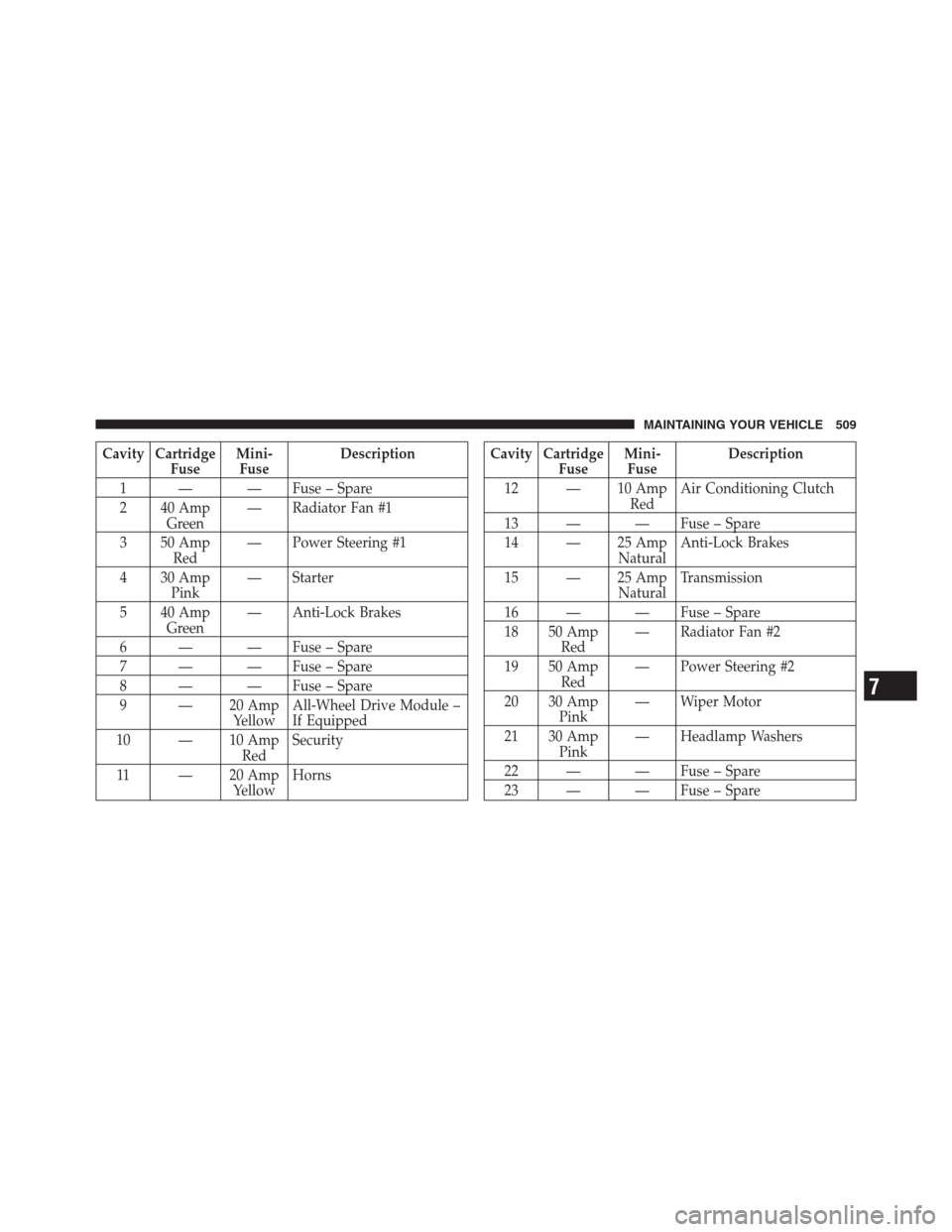
Cavity Cartridge
FuseMini-
FuseDescription
1 — — Fuse – Spare
2 40 Amp
Green— Radiator Fan #1
3 50 Amp
Red— Power Steering #1
4 30 Amp
Pink— Starter
5 40 Amp
Green— Anti-Lock Brakes
6 — — Fuse – Spare
7 — — Fuse – Spare
8 — — Fuse – Spare
9 — 20 Amp
YellowAll-Wheel Drive Module –
If Equipped
10 — 10 Amp
RedSecurity
11 — 20 Amp
YellowHornsCavity Cartridge
FuseMini-
FuseDescription
12 — 10 Amp
RedAir Conditioning Clutch
13 — — Fuse – Spare
14 — 25 Amp
NaturalAnti-Lock Brakes
15 — 25 Amp
NaturalTransmission
16 — — Fuse – Spare
18 50 Amp
Red— Radiator Fan #2
19 50 Amp
Red— Power Steering #2
20 30 Amp
Pink— Wiper Motor
21 30 Amp
Pink— Headlamp Washers
22 — — Fuse – Spare
23 — — Fuse – Spare
7
MAINTAINING YOUR VEHICLE 509
Page 512 of 576
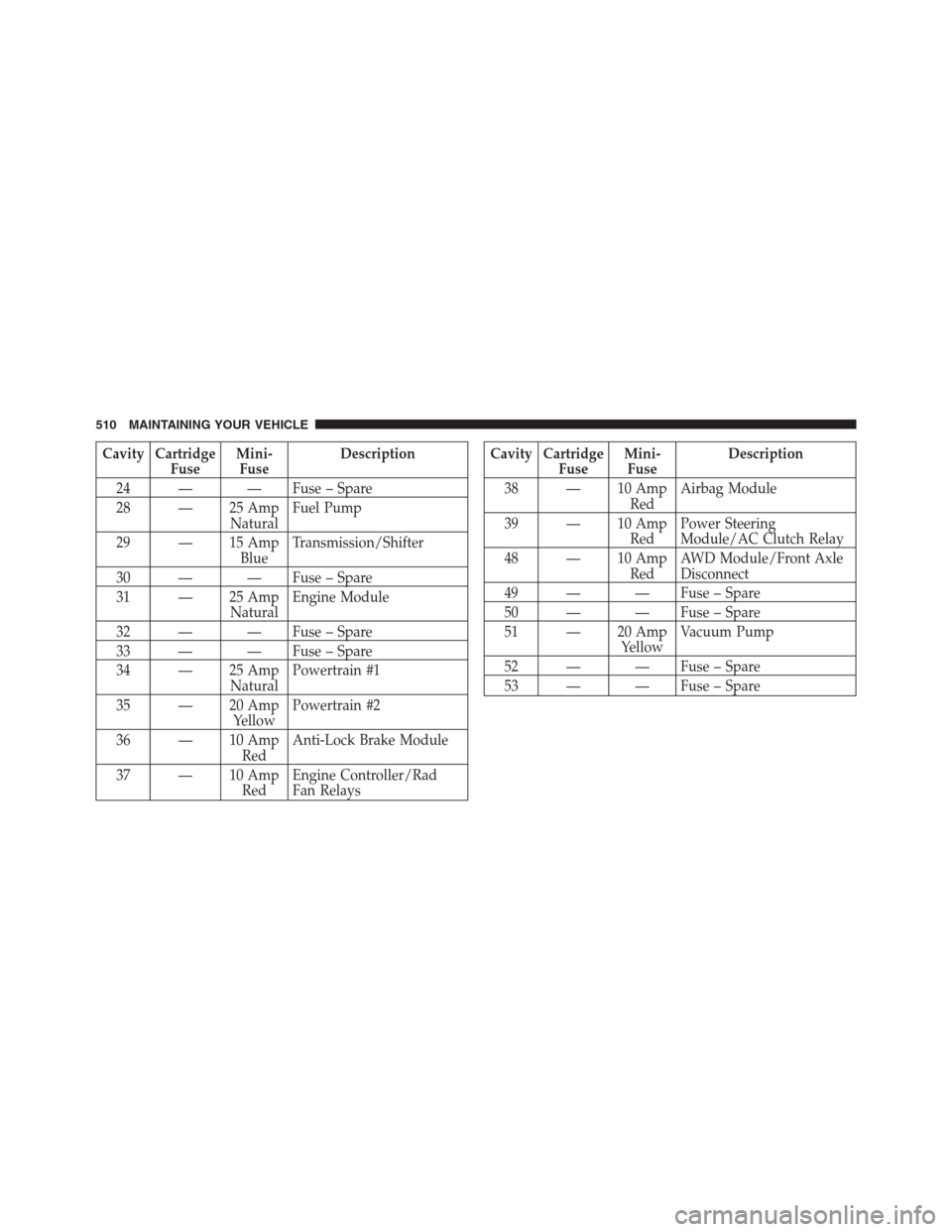
Cavity Cartridge
FuseMini-
FuseDescription
24 — — Fuse – Spare
28 — 25 Amp
NaturalFuel Pump
29 — 15 Amp
BlueTransmission/Shifter
30 — — Fuse – Spare
31 — 25 Amp
NaturalEngine Module
32 — — Fuse – Spare
33 — — Fuse – Spare
34 — 25 Amp
NaturalPowertrain #1
35 — 20 Amp
YellowPowertrain #2
36 — 10 Amp
RedAnti-Lock Brake Module
37 — 10 Amp
RedEngine Controller/Rad
Fan RelaysCavity Cartridge
FuseMini-
FuseDescription
38 — 10 Amp
RedAirbag Module
39 — 10 Amp
RedPower Steering
Module/AC Clutch Relay
48 — 10 Amp
RedAWD Module/Front Axle
Disconnect
49 — — Fuse – Spare
50 — — Fuse – Spare
51 — 20 Amp
YellowVacuum Pump
52 — — Fuse – Spare
53 — — Fuse – Spare
510 MAINTAINING YOUR VEHICLE
Page 516 of 576
Cavity Car-
tridge
FuseMini-
FuseDescription
33 — 15 Amp
BlueIgnition Switch/Wireless
Module
34 — 10 Amp
RedSteering Column
Module/Clock
35 — 10 Amp
RedBattery Sensor
36 — — Fuse — Spare
37 — 15 Amp
BlueRadio
38 — 20 Amp
YellowPower Outlet Inside
Arm Rest
40 — — Fuse — Spare
41 — — Fuse — Spare
42 30 Amp
Pink— Rear DefrostCavity Car-
tridge
FuseMini-
FuseDescription
43 — 25 Amp
NaturalRear Heated Seats/
Steering Wheel
44 — 10 Amp
RedPark Assist/Blind Spot/
Camera
45 — 15 Amp
BlueCluster/Rearview
Mirror/Compass
46 — 10 Amp
RedAdaptive Cruise Control
47 — 10 Amp
RedAdaptive Front Lighting
48 — 20 Amp
YellowActive Suspension
49 — — Fuse — Spare
50 — — Fuse — Spare
514 MAINTAINING YOUR VEHICLE
Page 525 of 576
Chassis
Component Fluid, Lubricant, or Genuine Part
Automatic Transmission – 3.6L En-
gineShell L12108 Transmission Fluid or equivalent.
Automatic Transmission – 5.7L En-
gineMOPAR�ATF+4�Automatic Transmission Fluid or equivalent licensed
ATF+4�product.
Brake Master Cylinder MOPAR�DOT 3 and SAE J1703 should be used or equivalent. If DOT 3
brake fluid is not available, then DOT 4 is acceptable. Use only recom-
mended brake fluids.
Power Steering Reservoir MOPAR�Hydraulic Fluid or equivalent meeting MS-11655, such as Fuchs
EG ZH 3044 or Pentosin CHF 11s.
Front Axle API GL-5 SAE 75W90 Synthetic Gear Lubricant or equivalent.
Rear Axle API GL-5 SAE 75W140 Synthetic Gear Lubricant or equivalent.
Transfer Case MOPAR�Transfer Case Lubricant for BorgWarner 44–40 or equivalent.
7
MAINTAINING YOUR VEHICLE 523