Page 212 of 508
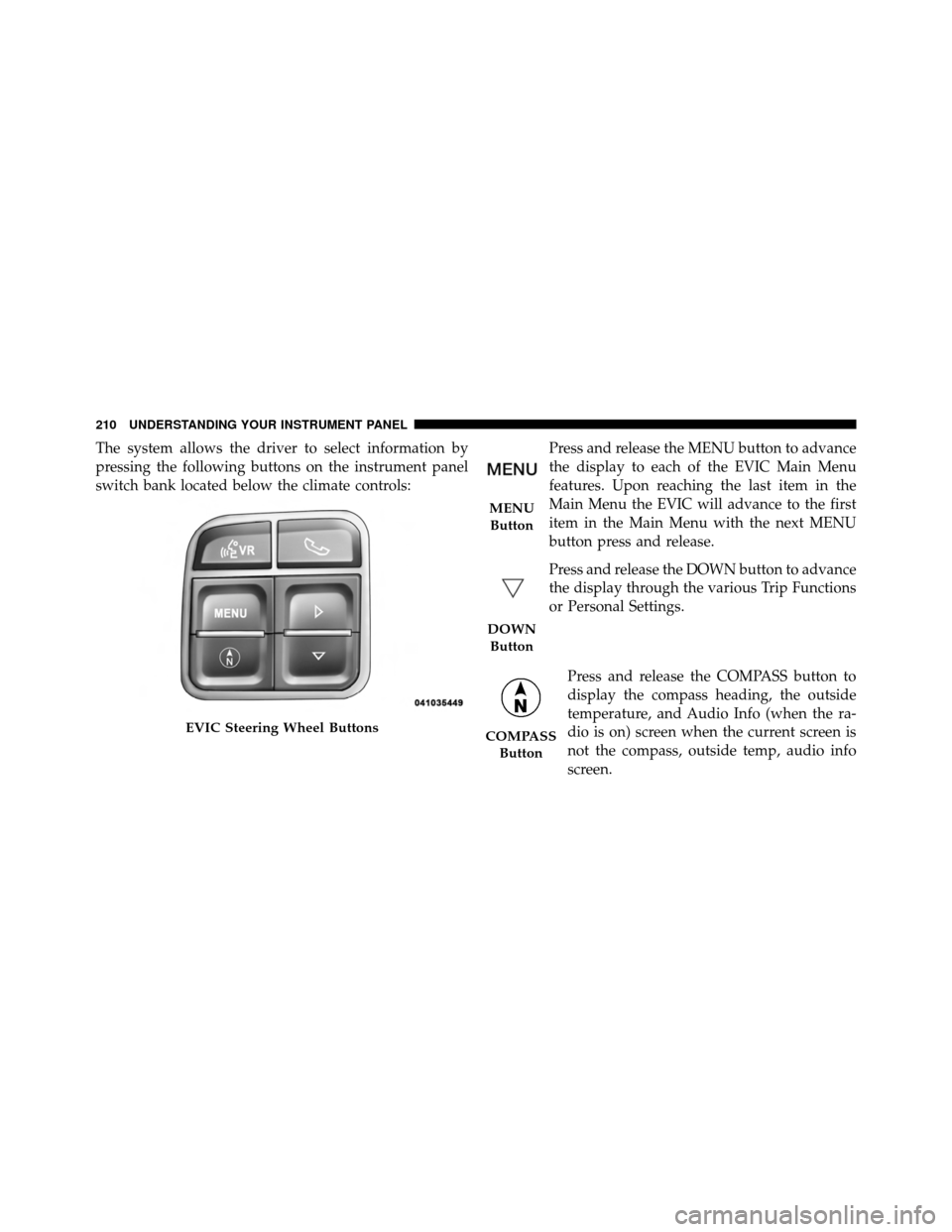
The system allows the driver to select information by
pressing the following buttons on the instrument panel
switch bank located below the climate controls:Press and release the MENU button to advance
the display to each of the EVIC Main Menu
features. Upon reaching the last item in the
Main Menu the EVIC will advance to the first
item in the Main Menu with the next MENU
button press and release.
Press and release the DOWN button to advance
the display through the various Trip Functions
or Personal Settings.
Press and release the COMPASS button to
display the compass heading, the outside
temperature, and Audio Info (when the ra-
dio is on) screen when the current screen is
not the compass, outside temp, audio info
screen.
EVIC Steering Wheel Buttons
MENUButton
DOWN Button
COMPASS Button
210 UNDERSTANDING YOUR INSTRUMENT PANEL
Page 271 of 508
SCANbutton again. During Scan mode, pressing the
<< SEEK andSEEK >> buttons will select the previ-
ous and next tracks.
•RND button (available on sales code RES radio only):
Pressing this button toggles between Shuffle ON and
Shuffle OFF modes for the iPod� or external USB
device, or press the VR button and say �Shuffle ON�or
�Shuffle Off�.IftheRND icon is showing on the radio
display, then the shuffle mode is ON.
List Or Browse Mode
During Play mode, pressing any of the buttons described
below, will bring up List mode. List mode enables
scrolling through the list of menus and tracks on the
audio device.
•TUNE control knob: The TUNEcontrol knob functions
in a similar manner as the scroll wheel on the audio
device or external USB device.
•Turning it clockwise (forward) and counterclock-
wise (backward) scrolls through the lists, displaying
the track detail on the radio display. Once the track
to be played is highlighted on the radio display,
press the TUNEcontrol knob to select and start
playing the track. Turning the TUNEcontrol knob
fast will scroll through the list faster. During fast
scroll, a slight delay in updating the information on
the radio display may be noticeable.
•During all List modes, the iPod� displays all lists in
“wrap-around” mode. So if the track is at the
bottom of the list, just turn the wheel backward
(counterclockwise) to get to the track faster.
•In List mode, the radio PRESETbuttons are used as
shortcuts to the following lists on the iPod� or
external USB device.
•Preset 1 – Playlists
4
UNDERSTANDING YOUR INSTRUMENT PANEL 269
Page 274 of 508
Next Track
Use the SEEK UP button, or press the VR button on the
radio and say “Next Track” to jump to the next track
music on your cellular phone.
Previous Track
Use the SEEK DOWN button, or press the VR button on
the radio and say “Previous Track” to jump to the
previous track music on your cellular phone.
Browse
Browsing is not available on a BTSA device. Only the
current song that is playing will display info.
STEERING WHEEL AUDIO CONTROLS — IF
EQUIPPED
The remote sound system controls are located on the rear
surface of the steering wheel, at the three and nine
o’clock positions.
Remote Sound System Controls(Back View Of Steering Wheel)
272 UNDERSTANDING YOUR INSTRUMENT PANEL
Page 293 of 508
�Tires — General Information ............. 341
▫ Tire Pressure ....................... 341
▫ Tire Inflation Pressures ................ 342
▫ Radial-Ply Tires ..................... 344
▫ Spare Tire Matching Original Equipped Tire
And Wheel – If Equipped .............. 344
▫ Compact Spare Tire – If Equipped ........ 345
▫ Full Size Spare – If Equipped ............ 346
▫ Limited-Use Spare – If Equipped ......... 346
▫ Tire Spinning ....................... 347
▫ Tread Wear Indicators ................. 348
▫ Life Of Tire ........................ 348
▫ Replacement Tires .................... 349 �
Tire Chains .......................... 350
� Snow Tires .......................... 351
� Tire Rotation Recommendations ........... 351
� Tire Pressure Monitor System (TPMS) ....... 352
▫ Base System ........................ 355
▫ Premium System – If Equipped .......... 357
▫ General Information .................. 360
� Fuel Requirements ..................... 360
▫ Reformulated Gasoline ................ 361
▫ Gasoline/Oxygenate Blends ............. 361
▫ E-85 Usage In Non-Flex Fuel Vehicles ...... 362
▫ MMT In Gasoline .................... 362
▫ Materials Added To Fuel ............... 363
5
STARTING AND OPERATING 291
Page 302 of 508

Four-Speed Automatic Transmission — If
Equipped
The shift lever position display (located in the instrument
panel cluster) indicates the transmission gear range. You
must press the brake pedal to move the shift lever out of
the PARK position (refer to “Brake/Transmission Shift
Interlock System” in this section). To drive, move the shift
lever from PARK or NEUTRAL to the DRIVE position.
The electronically-controlled transmission provides a
precise shift schedule. The transmission electronics are
self-calibrating; therefore, the first few shifts on a new
vehicle may be somewhat abrupt. This is a normal
condition, and precision shifts will develop within a few
hundred miles (kilometers).
Shifting from DRIVE to PARK or REVERSE should be
done only after the accelerator pedal is released and the
vehicle is stopped. Be sure to keep your foot on the brake
pedal when moving the shift lever between these gears.
Gear Ranges
DO NOT race the engine when shifting from PARK or
NEUTRAL into another gear range.
PARK
This range supplements the parking brake by locking the
transmission. The engine can be started in this range.
Never attempt to use PARK while vehicle is in motion.
Apply the parking brake when leaving vehicle in this
range.
When parking on a level surface, you may place the shift
lever in the PARK position first, and then apply the
parking brake.
When parking on a hill, apply the parking brake before
placing the shift lever in PARK, otherwise the load on the
transmission locking mechanism may make it difficult to
move the shift lever out of PARK. As an added precau-
tion, turn the front wheels toward the curb on a downhill
grade and away from the curb on an uphill grade.
300 STARTING AND OPERATING
Page 311 of 508

PARK
This range supplements the parking brake by locking the
transmission. The engine can be started in this range.
Never attempt to use PARK while vehicle is in motion.
Apply the parking brake when leaving vehicle in this
range.
When parking on a level surface, you may place the shift
lever in the PARK position first, and then apply the
parking brake.
When parking on a hill, apply the parking brake before
placing the shift lever in PARK, otherwise the load on the
transmission locking mechanism may make it difficult to
move the shift lever out of PARK. As an added precau-
tion, turn the front wheels toward the curb on a downhill
grade and away from the curb on an uphill grade.WARNING!
•Never use the PARK position as a substitute for
the parking brake. Always apply the parking
brake fully when parked to guard against vehicle
movement and possible injury or damage.
•Your vehicle could move and injure you and others
if it is not completely in PARK. Check by trying to
move the shift lever rearward (with the brake
pedal released) after you have placed it in PARK.
Make sure the transmission is in PARK before
leaving the vehicle.(Continued)
5
STARTING AND OPERATING 309
Page 318 of 508

AutoStick�is deactivated when the shift lever is moved
from the AutoStick (+/-) position into the DRIVE
position.
General Information
•
You can start out, from a stop, in any gear except sixth.
The system will ignore attempts to upshift at too low
of a vehicle speed.
•If a ratio other than first gear is selected, and the
vehicle is brought to a stop, the transmission control
logic will automatically select the first gear ratio.
•Starting out in second gear is helpful in snowy or icy
conditions. To select second gear after the vehicle is
brought to a stop, tap the shift lever to the right (+)
once.
•Avoid using speed control when AutoStick� is en-
gaged.
•The transmission will automatically shift up when
maximum engine speed is reached while AutoStick� is
engaged.
•Transmission shifting will be more noticeable when
AutoStick� is engaged.
•If a downshift would cause the engine to overspeed,
that shift will not occur until it is safe for the engine.
•If the system detects powertrain overheating, the
transmission will revert to the automatic shift mode
and remain in that mode until the powertrain cools off.
DRIVING ON SLIPPERY SURFACES
Acceleration
Rapid acceleration on snow covered, wet, or other slip-
pery surfaces may cause the driving wheels to pull
erratically to the right or left. This phenomenon occurs
when there is a difference in the surface traction under
the front (driving) wheels.
316 STARTING AND OPERATING
Page 319 of 508
WARNING!
Rapid acceleration on slippery surfaces is dangerous.
Unequal traction can cause sudden pulling of the
front wheels. You could lose control of the vehicle
and possibly have a collision. Accelerate slowly and
carefully whenever there is likely to be poor traction
(ice, snow, wet, mud, loose sand, etc.).
Traction
When driving on wet or slushy roads, it is possible for a
wedge of water to build up between the tire and road
surface. This is hydroplaning and may cause partial or
complete loss of vehicle control and stopping ability. To
reduce this possibility, the following precautions should
be observed:
1. Slow down during rainstorms or when the roads are
slushy.2. Slow down if the road has standing water or puddles.
3. Replace the tires when tread wear indicators first
become visible.
4. Keep tires properly inflated.
5. Maintain sufficient distance between your vehicle and
the vehicle in front of you to avoid a collision in a sudden
stop.DRIVING THROUGH WATER
Driving through water more than a few inches/
centimeters deep will require extra caution to ensure
safety and prevent damage to your vehicle.
5
STARTING AND OPERATING 317