Page 214 of 508
•Key In Ignition
•Remote start aborted — Door ajar
•Remote start aborted — Hood ajar
•Remote start aborted — Trunk ajar
•Remote start aborted — Fuel low
•Remote start disabled — System fault
•Oil Change Required (with a single chime)
•Low Tire (with a graphic of the car showing which
tire(s) is/are low - with a single chime). Refer to�Ti re
Pressure Monitoring System� in�Starting and Operat-
ing�.
•Check TPM System (with a single chime) Refer to �Ti re
Pressure Monitoring System� in�Starting and
Operating�.
Oil Change Required — If Equipped
Your vehicle is equipped with an engine oil change
indicator system. The Oil Change Required message will
flash in the EVIC display for approximately five seconds
after a single chime has sounded to indicate the next
scheduled oil change interval. The engine oil change
indicator system is duty cycle based, which means the
engine oil change interval may fluctuate dependent upon
your personal driving style.
Unless reset, this message will continue to display each
time you turn the ignition switch to the ON/RUN
position. To turn off the message temporarily, press and
release the MENU button. To reset the oil change indica-
tor system (after performing the scheduled maintenance),
perform the following procedure:
1. Turn the ignition switch to the ON position (Do not
start the engine.)
212 UNDERSTANDING YOUR INSTRUMENT PANEL
Page 367 of 508
WARNING! (Continued)
•Guard against carbon monoxide with proper
maintenance. Have the exhaust system inspected
every time the vehicle is raised. Have any abnor-
mal conditions repaired promptly. Until repaired,
drive with all side windows fully open.
•Keep the trunk closed when driving your vehicle
to prevent carbon monoxide and other poisonous
exhaust gases from entering the vehicle.
FLEXIBLE FUEL (3.6L ENGINE ONLY) — IF
EQUIPPED
E-85 General Information
The information in this section is for Flexible Fuel ve-
hicles only. These vehicles can be identified by a unique
fuel filler door label that statesEthanol (E-85) or Un-
leaded Gasoline Only. This section only covers those
subjects that are unique to these vehicles. Please refer to the other sections of this manual for information on
features that are common between Flexible Fuel and
gasoline-only powered vehicles.E-85 Fuel Cap
5
STARTING AND OPERATING 365
Page 390 of 508

JACKING AND TIRE CHANGING
WARNING!
•Do not attempt to change a tire on the side of the
vehicle close to moving traffic. Pull far enough off
the road to avoid the danger of being hit when
operating the jack or changing the wheel.
•Being under a jacked-up vehicle is dangerous. The
vehicle could slip off the jack and fall on you. You
could be crushed. Never put any part of your body
under a vehicle that is on a jack. If you need to get
under a raised vehicle, take it to a service center
where it can be raised on a lift.
•Never start or run the engine while the vehicle is
on a jack.(Continued)
WARNING! (Continued)
•The jack is designed to be used as a tool for
changing tires only. The jack should not be used to
lift the vehicle for service purposes. The vehicle
should be jacked on a firm level surface only.
Avoid ice or slippery areas.
Jack Location
The jack and jack-handle are stowed under the load floor
in the trunk.
Spare Tire Stowage
The compact spare tire is stowed under the rear load floor
in the trunk.
Spare Tire Removal
Lift up the load floor cover and remove the hold down.
388 WHAT TO DO IN EMERGENCIES
Page 442 of 508
CAUTION!
•Do not use abrasive or strong cleaning materials
such as steel wool or scouring powder, which will
scratch metal and painted surfaces.
•Use of power washers exceeding 1,200 psi
(8 274 kPa) can result in damage or removal of
paint and decals.
Special Care
•
If you drive on salted or dusty roads or if you drive
near the ocean, hose off the undercarriage at least once
a month.
•It is important that the drain holes in the lower edges
of the doors, rocker panels, and trunk be kept clear
and open.
•If you detect any stone chips or scratches in the paint,
touch them up immediately. The cost of such repairs is
considered the responsibility of the owner.
•If your vehicle is damaged due to a collision or similar
cause which destroys the paint and protective coating,
have your vehicle repaired as soon as possible. The
cost of such repairs is considered the responsibility of
the owner.
•If you carry special cargo such as chemicals, fertilizers,
de-icer salt, etc., be sure that such materials are well
packaged and sealed.
•If a lot of driving is done on gravel roads, consider
mud or stone shields behind each wheel.
•Use MOPAR�Touch Up Paint or equivalent on
scratches as soon as possible. Your authorized dealer
has touch up paint to match the color of your vehicle.
440 MAINTAINING YOUR VEHICLE
Page 451 of 508

CAUTION! (Continued)
•When replacing a blown fuse, it is important to
use only a fuse having the correct amperage rating.
The use of a fuse with a rating other than indicated
may result in a dangerous electrical system over-
load. If a properly rated fuse continues to blow, it
indicates a problem in the circuit that must be
corrected.
VEHICLE STORAGE
If you will not be using your vehicle for more than
21 days, you may want to take steps to preserve your
battery.
•Disengage the mini-fuse in the Power Distribution
Center labeled IOD (Ignition Off-Draw).
•Or disconnect the negative cable from the battery.
•Anytime you store your vehicle, or keep it out of
service (i.e., vacation) for two weeks or more, run the
air conditioning system at idle for about five minutes
in the fresh air and high blower setting. This will
ensure adequate system lubrication to minimize the
possibility of compressor damage when the system is
started again.
REPLACEMENT BULBS
All the inside bulbs are brass or glass wedge base.
Aluminum base bulbs are not approved and should not
be used for replacement.
LIGHT BULBS – Interior Bulb No.
Front Courtesy/Reading Lamp..........578/W5W
Center Courtesy/Reading Lamp ..........578/W5W
Visor Vanity Lamp ...................... A6220
Glove Box Lamp ....................... A6220
Shift Indicator Lamp ................. IKLE14140
Rear Compartment (Trunk) Lamp ............. 579
7
MAINTAINING YOUR VEHICLE 449
Page 455 of 508
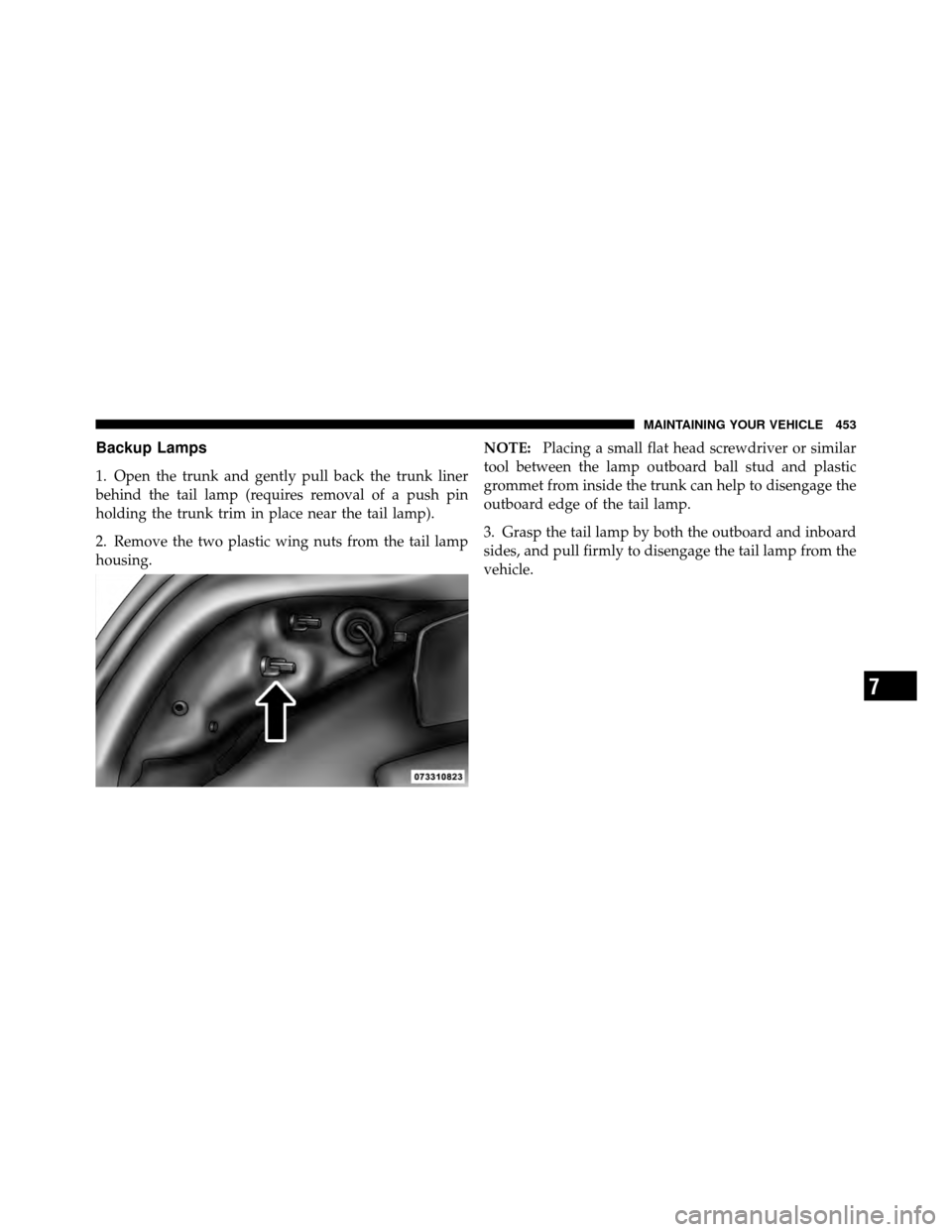
Backup Lamps
1. Open the trunk and gently pull back the trunk liner
behind the tail lamp (requires removal of a push pin
holding the trunk trim in place near the tail lamp).
2. Remove the two plastic wing nuts from the tail lamp
housing.NOTE:
Placing a small flat head screwdriver or similar
tool between the lamp outboard ball stud and plastic
grommet from inside the trunk can help to disengage the
outboard edge of the tail lamp.
3. Grasp the tail lamp by both the outboard and inboard
sides, and pull firmly to disengage the tail lamp from the
vehicle.
7
MAINTAINING YOUR VEHICLE 453
Page 456 of 508
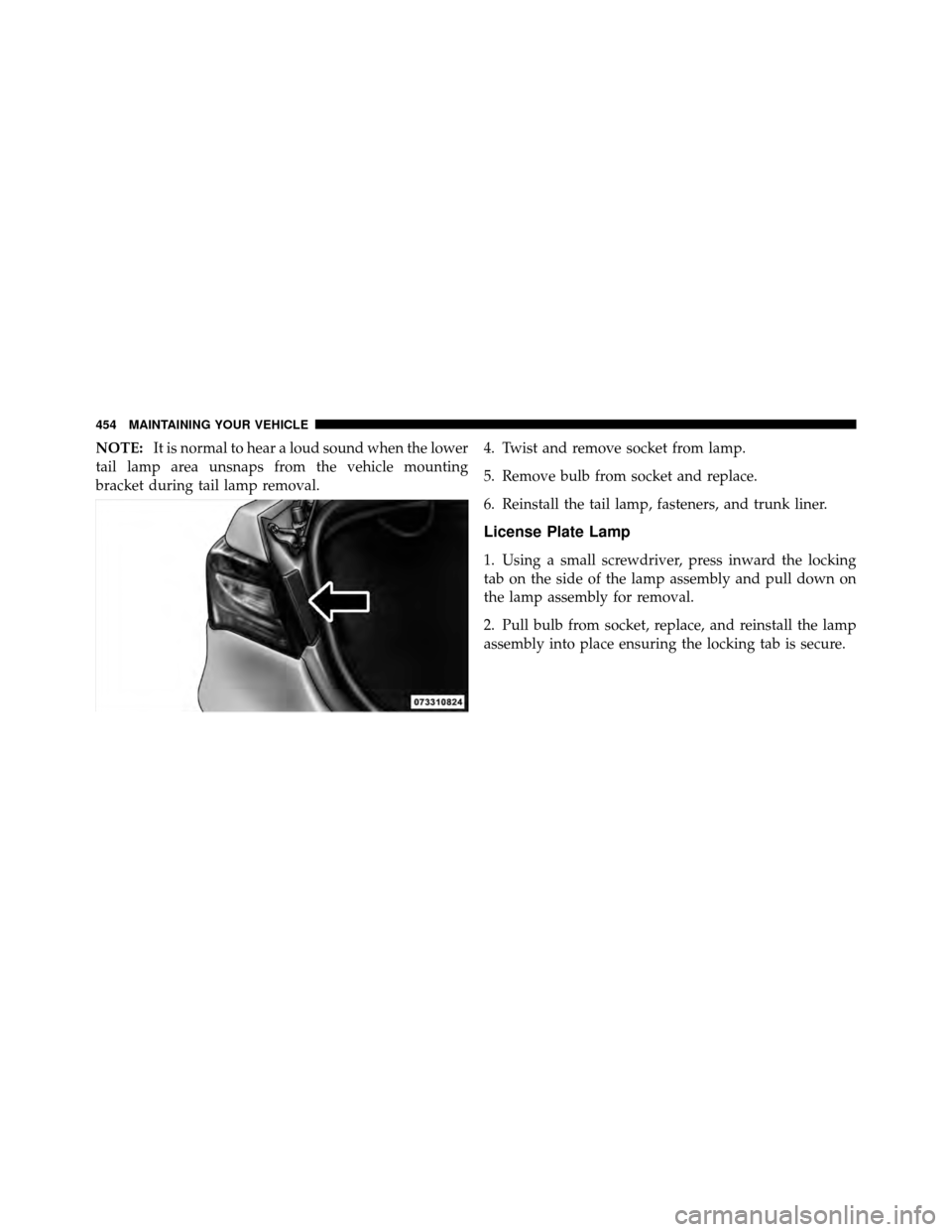
NOTE:It is normal to hear a loud sound when the lower
tail lamp area unsnaps from the vehicle mounting
bracket during tail lamp removal. 4. Twist and remove socket from lamp.
5. Remove bulb from socket and replace.
6. Reinstall the tail lamp, fasteners, and trunk liner.
License Plate Lamp
1. Using a small screwdriver, press inward the locking
tab on the side of the lamp assembly and pull down on
the lamp assembly for removal.
2. Pull bulb from socket, replace, and reinstall the lamp
assembly into place ensuring the locking tab is secure.
454 MAINTAINING YOUR VEHICLE
Page 492 of 508

DrivingOn Slippery Surfaces .................. 316
Through Flowing, Rising, or Shallow
Standing Water ...................... 317
E-85 Fuel ............................. 365
Electric Rear Window Defrost ............... 186
Electric Remote Mirrors .................... 98
Electrical Power Outlets ................... 176
Electronic Speed Control (Cruise Control) ...... 161
Electronic Stability Control (ESC) ............. 328
Electronic Vehicle Information Center (EVIC) .... 209
Emergency Trunk Release .................39,40
Emergency, In Case of Jacking ............................ 388
Jump Starting ....................... 398
Towing ............................ 404
Emission Control System Maintenance ......... 412Engine
............................... 409
Air Cleaner ......................... 419
Block Heater ........................ 297
Break-In Recommendations .............. 84
Checking Oil Level ................... 415
Compartment ....................... 410
Compartment Identification ............. 410
Coolant (Antifreeze) ................ 428,456
Cooling ........................... 428
Exhaust Gas Caution ................86,364
Fails to Start ........................ 295
Flooded, Starting ..................... 295
Fuel Requirements ................. 360,455
Jump Starting ....................... 398
Oil ......................... 415,455,456
Oil Change Interval .............200,212,416
Oil Filler Cap .................... 409,417
Oil Filter ........................... 418
Oil Filter Disposal .................... 418
490 INDEX