Page 328 of 508

ABS is activated during braking under certain road or
stopping conditions. ABS-inducing conditions can in-
clude ice, snow, gravel, bumps, railroad tracks, loose
debris, or panic stops.
You also may experience the following when the brake
system goes into anti-lock:
•The ABS motor running (it may continue to run for a
short time after the stop),
•the clicking sound of solenoid valves,
•brake pedal pulsations,
•and a slight drop or fall away of the brake pedal at the
end of the stop.
These are all normal characteristics of ABS.
WARNING!
The Anti-Lock Brake System contains sophisticated
electronic equipment that may be susceptible to
interference caused by improperly installed or high
output radio transmitting equipment. This interfer-
ence can cause possible loss of anti-lock braking
capability. Installation of such equipment should be
performed by qualified professionals.
All vehicle wheels and tires must be the same size and
type, and tires must be properly inflated to produce
accurate signals for the computer.
ELECTRONIC BRAKE CONTROL SYSTEM
Your vehicle may be equipped with an optional ad-
vanced electronic brake control system that includes
Anti-Lock Brake System (ABS), Traction Control System
(TCS), Brake Assist System (BAS), and Electronic Stability
Control (ESC). All systems work together to enhance
326 STARTING AND OPERATING
Page 383 of 508

•An electronically actuated trailer brake controller is
required when towing a trailer with electronically
actuated brakes. When towing a trailer equipped with
a hydraulic surge actuated brake system, an electronic
brake controller is not required.
•Trailer brakes are recommended for trailers over
1,000 lbs (450 kg) and required for trailers in excess of
2,000 lbs (907 kg).
CAUTION!
If the trailer weighs more than 1,000 lbs (450 kg)
loaded, it should have its own brakes with adequate
braking capacity. Failure to do this could lead to
accelerated brake lining wear, higher brake pedal
effort, and longer stopping distances.
WARNING!
•Do not connect trailer brakes to your vehicle’s
hydraulic brake lines. It can overload your brake
system and cause it to fail. You might not have
brakes when you need them and could have a
collision.
•Towing any trailer will increase your stopping
distance. When towing, you should allow for ad-
ditional space between your vehicle and the ve-
hicle in front of you. Failure to do so could result
in a collision.
Towing Requirements – Trailer Lights And Wiring
Whenever you pull a trailer, regardless of the trailer size,
stop lights and turn signals on the trailer are required for
motoring safety.
5
STARTING AND OPERATING 381
Page 435 of 508

•Make sure that the radiator and coolant recovery
bottle overflow hoses are not kinked or obstructed.
•Keep the front of the radiator clean. If your vehicle is
equipped with air conditioning, keep the front of the
condenser clean.
•Do not change the thermostat for Summer or Winter
operation. If replacement is ever necessary, install
ONLY the correct type thermostat. Other designs may
result in unsatisfactory cooling performance, poor gas
mileage, and increased emissions.
Brake System
In order to assure brake system performance, all brake
system components should be inspected periodically.
Refer to the “Maintenance Schedule” for the proper
maintenance intervals.
WARNING!
Riding the brakes can lead to brake failure and
possibly a collision. Driving with your foot resting or
riding on the brake pedal can result in abnormally
high brake temperatures, excessive lining wear, and
possible brake damage. You would not have your full
braking capacity in an emergency.
Master Cylinder – Brake Fluid Level Check
Check the fluid level in the master cylinder immediately
if the brake system warning light indicates system fail-
ure.
Check the fluid level in the master cylinder when per-
forming underhood services.
7
MAINTAINING YOUR VEHICLE 433
Page 443 of 508
Wheel And Wheel Trim Care
•
All wheels and wheel trim, especially aluminum and
chrome plated wheels, should be cleaned regularly
with a mild soap and water to prevent corrosion.
•To remove heavy soil and/or excessive brake dust, use
MOPAR�Wheel Cleaner or equivalent or select a
non-abrasive, non-acidic cleaner.
CAUTION!
Do not use scouring pads, steel wool, a bristle brush,
or metal polishes. Do not use oven cleaner. These
products may damage the wheel’s protective finish.
Avoid automatic car washes that use acidic solutions
or harsh brushes that may damage the wheel’s pro-
tective finish. Only MOPAR� Wheel Cleaner or
equivalent is recommended.
Cleaning Headlights
Your vehicle has plastic headlights that are lighter and
less susceptible to stone breakage than glass headlights.
Plastic is not as scratch resistant as glass and therefore
different lens cleaning procedures must be followed.
To minimize the possibility of scratching the lenses and
reducing light output, avoid wiping with a dry cloth. To
remove road dirt, wash with a mild soap solution fol-
lowed by rinsing.
Do not use abrasive cleaning components, solvents, steel
wool or other aggressive material to clean the lenses.
Stain Repel Fabric Cleaning Procedure – If
Equipped
Stain Repel seats may be cleaned in the following man-
ner:
•Remove as much of the stain as possible by blotting
with a clean, dry towel.
7
MAINTAINING YOUR VEHICLE 441
Page 447 of 508
CavityCartridge
Fuse Mini
Fuse Description
1 40 Amp
Green —Power Top Module –
If Equipped
2— 20 Amp
Yellow Brake Vacuum Pump
CavityCartridge
Fuse Mini
Fuse Description
3— 10 Amp
Red Center High
Mounted Stop Light
(CHMSL)/Brake
Switch
4— 10 Amp
Red Ignition Switch
5— 20 Amp
Yellow Trailer Tow – If
Equipped
6— 10 Amp
Red Power Mirror
Switch/Climate Con-
trols
7— 30 Amp
Green Ignition Off Draw
(IOD) Sense 1
8— 30 Amp
Green Ignition Off Draw
(IOD) Sense 2
9 40 Amp
Green Battery Feed – Power
Seats – If Equipped
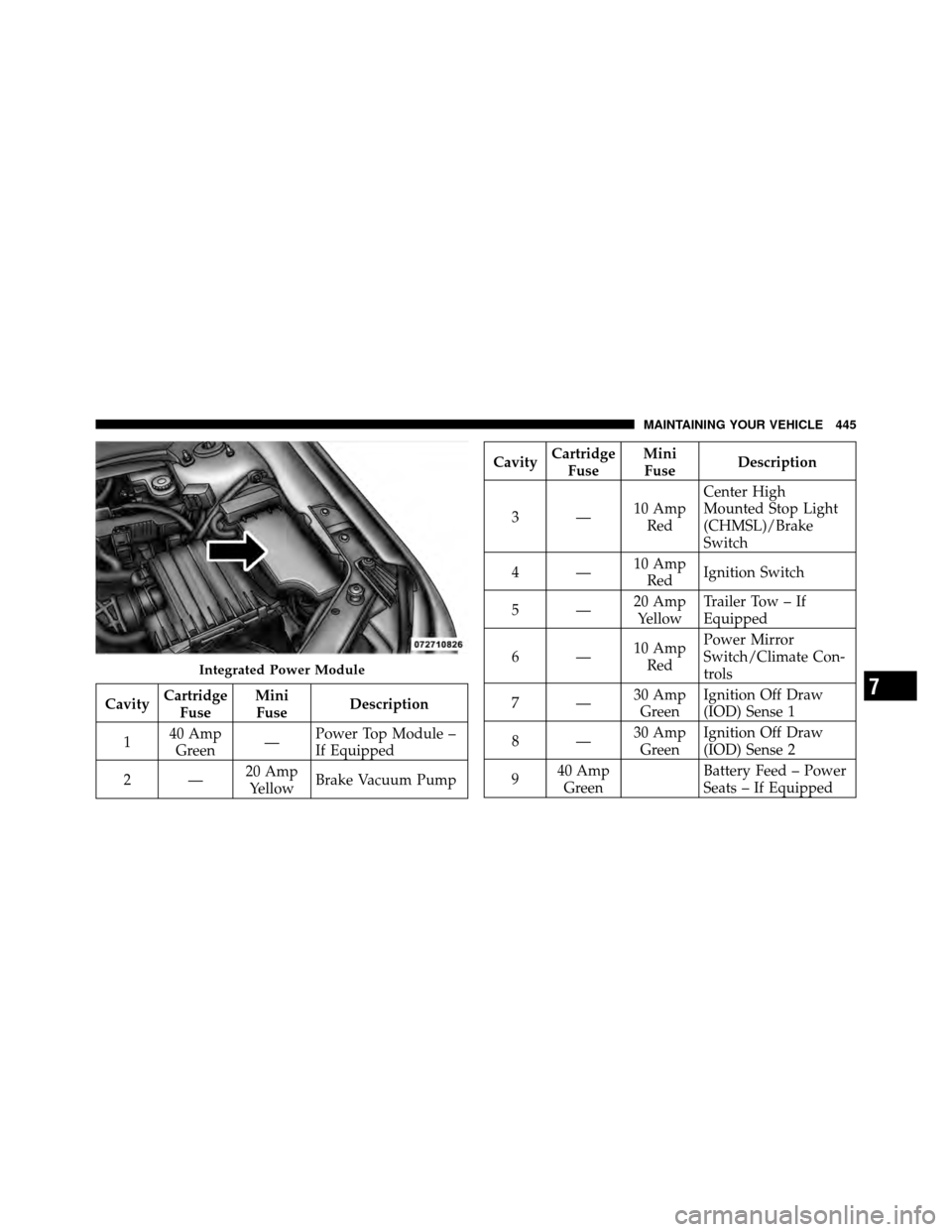
Integrated Power Module
7
MAINTAINING YOUR VEHICLE 445
Page 464 of 508
Once A Month
•Check tire pressure and look for unusual wear or
damage.
•Inspect the battery and clean and tighten the terminals
as required.
•Check the fluid levels of coolant reservoir, brake
master cylinder, and transmission and add as needed.
•Check all lights and other electrical items for correct
operation.At Each Oil Change
•Change the engine oil filter.
•Inspect the brake hoses and lines.
CAUTION!
Failure to perform the required maintenance items
may result in damage to the vehicle.
Required Maintenance Intervals
Refer to the Maintenance Schedules on the following
pages for the required maintenance intervals.
8
M
A I
N T
E
N A
N CE
S
C
H E
D
U L
E
S462 MAINTENANCE SCHEDULES
Page 488 of 508

About Your Brakes....................... 322
ABS (Anti-Lock Brake System) .............. 324
Adding Engine Coolant (Antifreeze) .......... 429
Adding Fuel ........................... 368
Adding Washer Fluid ..................... 425
Additives, Fuel ......................... 363
Air Cleaner, Engine (Engine Air Cleaner Filter) . . . 419
Air Conditioner Maintenance ............... 421
Air Conditioning ........................ 275
Air Conditioning Controls ................. 275
Air Conditioning Filter .................286,422
Air Conditioning Refrigerant .............421,422
Air Conditioning System .............275,279,421
Air Conditioning, Operating Tips ............ 287
Air Pressure, Tires ....................... 342
Airbag .............................. 58,67
Airbag Deployment ....................... 68
Airbag Light ................... 65,66,71,87,195
Airbag Maintenance ....................... 70 Airbag, Side
...................... 61,64,66,67
Airbag, Window (Side Curtain) ...........62,64,67
Alarm System (Security Alarm) ............18,202
Alterations/Modifications, Vehicle ............. 7
Antenna, Satellite Radio ................238,262
Anti-Lock Brake System (ABS) .............. 324
Anti-Lock Warning Light .................. 324
Anti-Theft Security Alarm (Theft Alarm) ........ 18
Antifreeze (Engine Coolant) ..............429,455
Disposal ........................... 431
Appearance Care ........................ 438
Ashtray ............................... 180
Assistance Towing ....................... 114
Auto Down Power Windows ................ 36
Auto Unlock, Doors ....................... 32
Auto Up Power Windows .................. 37
Automatic Dimming Mirror ................. 96
Automatic Door Locks ..................... 32
Automatic Oil Change Indicator ..........200,212
486 INDEX
Page 489 of 508

Automatic Temperature Control (ATC)......... 279
Automatic Transaxle .................... 12,294
Adding Fluid ....................... 457
Selection Of Lubricant ................. 457
Automatic Transmission ................297,435
Adding Fluid .................... 437,438
Fluid and Filter Changes ............... 438
Fluid Level Check ................. 437,438
Fluid Type ......................... 436
Gear Ranges ..................... 300,308
Special Additives ..................... 436
Autostick ............................. 315
B-Pillar Location ........................ 337
Battery ............................... 419
Jump Starting ........................ 30
Keyless Transmitter Replacement (RKE) ..... 26
Location ........................... 419
Belts, Seat .............................. 87 Body Mechanism Lubrication
............... 423
Brake Assist System ...................... 327
Brake System ........................... 433
Anti-Lock (ABS) ..................... 324
Fluid Check ..................... 433,457
Master Cylinder ..................... 433
Parking ........................... 322
Warning Light ....................... 197
Brake, Parking .......................... 322
Brake/Transmission Interlock ............... 299
Brakes ............................... 433
Break-In Recommendations, New Vehicle ........ 84
Bulb Replacement ..................... 449,450
Bulbs, Light .......................... 89,449
Calibration, Compass ..................... 215
Capacities, Antifreeze (Engine Coolant) ......... 20
Capacities, Fluid ........................ 455
10
INDEX 487