Page 321 of 508

CAUTION! (Continued)
•Driving through standing water may cause dam-
age to your vehicle’s drivetrain components. Al-
ways inspect your vehicle’s fluids (i.e., engine oil,
transmission, axle, etc.) for signs of contamination
(i.e., fluid that is milky or foamy in appearance)
after driving through standing water. Do not con-
tinue to operate the vehicle if any fluid appears
contaminated, as this may result in further dam-
age. Such damage is not covered by the New
Vehicle Limited Warranty.
•Getting water inside your vehicle’s engine can
cause it to lock up and stall out, and cause serious
internal damage to the engine. Such damage is not
covered by the New Vehicle Limited Warranty.
WARNING!
•Driving through standing water limits your vehi-
cle’s traction capabilities. Do not exceed 5 mph
(8 km/h) when driving through standing water.
•Driving through standing water limits your vehi-
cle’s braking capabilities, which increases stop-
ping distances. Therefore, after driving through
standing water, drive slowly and lightly press on
the brake pedal several times to dry the brakes.
•Getting water inside your vehicle’s engine can
cause it to lock up and stall out, and leave you
stranded.
•Failure to follow these warnings may result in
injuries that are serious or fatal to you, your
passengers, and others around you.
5
STARTING AND OPERATING 319
Page 384 of 508

Towing Tips
Before setting out on a trip, practice turning, stopping,
and backing the trailer in an area located away from
heavy traffic.
Make sure all trailer and vehicle lights are working
properly — including hazard flashers.
Automatic Transmission
The DRIVE range can be selected when towing. How-
ever, if frequent shifting occurs, select the�3�range (for a
four-speed automatic) or select a lower gear using the
AutoStick� shift control.
NOTE: Using a lower gear while operating the vehicle
under heavy operating conditions, will improve perfor-
mance and extend transmission life by reducing exces-
sive shifting and heat build-up. This action will also
provide better engine braking. If you
REGULARLY TOW a trailer for more than 45 min-
utes of continuous operation, then change the automatic
transmission fluid and filter according to the interval
specified for “police, taxi, fleet, or frequent trailer tow-
ing.” Refer to the “Maintenance Schedule” for the proper
maintenance intervals.
NOTE: Check the four-speed automatic transmission
fluid level before towing. Six-speed transmissions do not
require a fluid level check before towing. If, however, you
notice fluid leakage or transmission malfunction, see
your authorized dealership service center for assistance.
Electronic Speed Control – If Equipped
•
Do not use in hilly terrain or with heavy loads.
•When using the speed control, if you experience speed
drops greater than 10 mph (16 km/h), disengage until
you can get back to cruising speed.
•Use speed control in flat terrain and with light loads to
maximize fuel efficiency.
382 STARTING AND OPERATING
Page 410 of 508
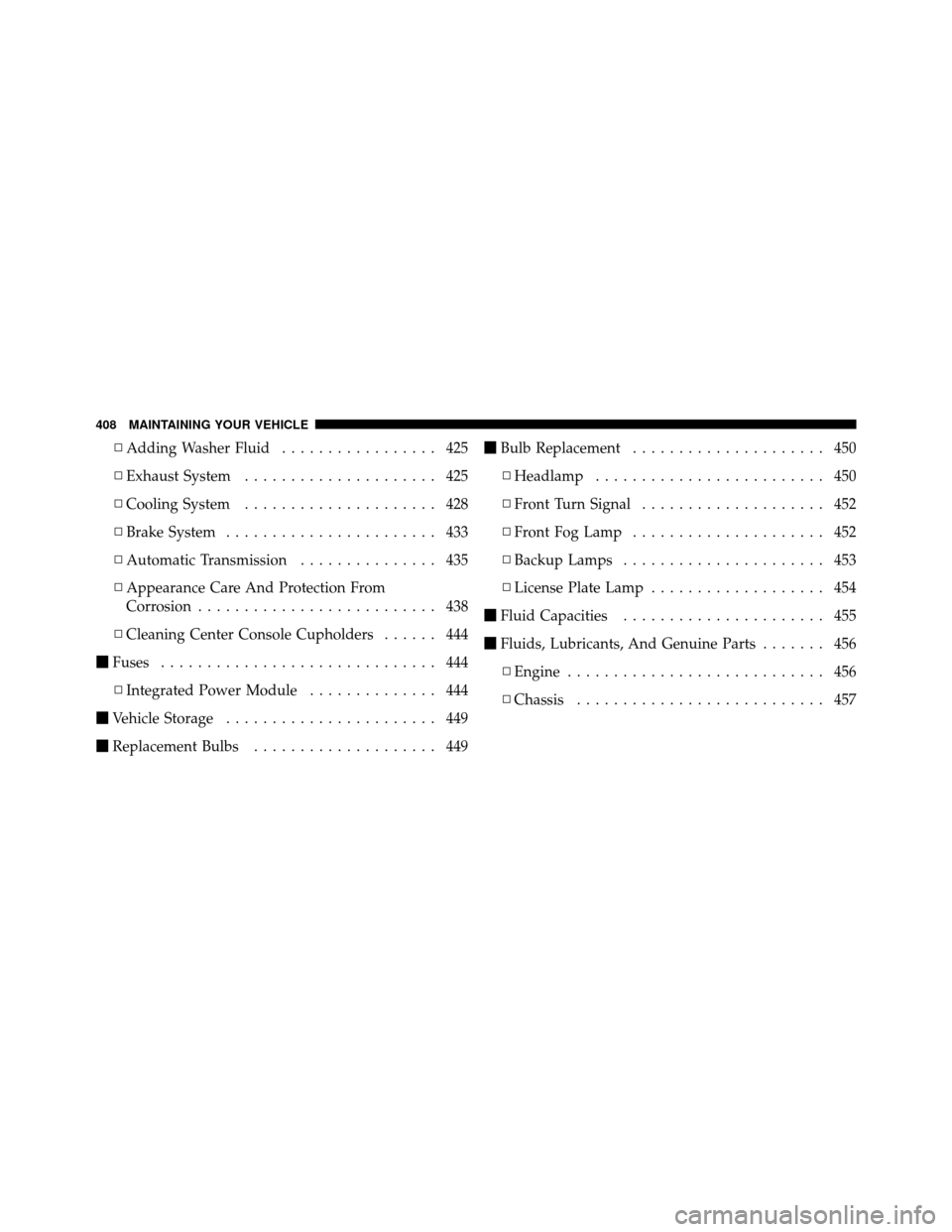
▫Adding Washer Fluid ................. 425
▫ Exhaust System ..................... 425
▫ Cooling System ..................... 428
▫ Brake System ....................... 433
▫ Automatic Transmission ............... 435
▫ Appearance Care And Protection From
Corrosion .......................... 438
▫ Cleaning Center Console Cupholders ...... 444
� Fuses .............................. 444
▫ Integrated Power Module .............. 444
� Vehicle Storage ....................... 449
� Replacement Bulbs .................... 449 �
Bulb Replacement ..................... 450
▫ Headlamp ......................... 450
▫ Front Turn Signal .................... 452
▫ Front Fog Lamp ..................... 452
▫ Backup Lamps ...................... 453
▫ License Plate Lamp ................... 454
� Fluid Capacities ...................... 455
� Fluids, Lubricants, And Genuine Parts ....... 456
▫ Engine ............................ 456
▫ Chassis ........................... 457
408 MAINTAINING YOUR VEHICLE
Page 411 of 508
ENGINE COMPARTMENT — 2.4L
1 — Engine Coolant Reservoir7 — Air Cleaner Filter
2 — Power Steering Fluid Reservoir 8 — Engine Oil Fill
3 — Automatic Transmission Dipstick 9 — Coolant Pressure Cap
4 — Brake Fluid Reservoir 10 — Engine Oil Dipstick
5 — Power Distribution Center (Fuses) 11 — Washer Fluid Reservoir
6 — Integrated Power Module (Fuses)
7
MAINTAINING YOUR VEHICLE 409
Page 417 of 508

CAUTION! (Continued)
•Your vehicle has been built with improved fluids
that protect the performance and durability of
your vehicle and also allow extended maintenance
intervals. Do not use chemical flushes in these
components as the chemicals can damage your
engine, transmission, power steering or air condi-
tioning. Such damage is not covered by the New
Vehicle Limited Warranty. If a flush is needed
because of component malfunction, use only the
specified fluid for the flushing procedure.
Engine Oil
Checking Oil Level
To assure proper engine lubrication, the engine oil must
be maintained at the correct level. Check the oil level at
regular intervals, such as every fuel stop. The best time to
check the engine oil level is about five minutes after afully warmed engine is shut off. Do not check oil level
before starting the engine after it has sat overnight.
Checking engine oil level when the engine is cold will
give you an incorrect reading.
Checking the oil while the vehicle is on level ground and
only when the engine is hot, will improve the accuracy of
the oil level readings. Maintain the oil level between the
range markings on the dipstick. Either the range mark-
ings consist of a crosshatch zone marked SAFE or a
crosshatch zone marked with MIN at the low end of the
range and MAX at the high end of the range. Adding one
quart of oil when the reading is at the low end of the
range marking will raise the oil level to the high end of
the range marking.
7
MAINTAINING YOUR VEHICLE 415
Page 437 of 508

WARNING! (Continued)
•To avoid contamination from foreign matter or
moisture, use only new brake fluid or fluid that
has been in a tightly closed container. Keep the
master cylinder reservoir cap secured at all times.
Brake fluid in a open container absorbs moisture
from the air resulting in a lower boiling point.
This may cause it to boil unexpectedly during hard
or prolonged braking, resulting in sudden brake
failure. This could result in a collision.
•Overfilling the brake fluid reservoir can result in
spilling brake fluid on hot engine parts, causing
the brake fluid to catch fire. Brake fluid can also
damage painted and vinyl surfaces, care should be
taken to avoid its contact with these surfaces.(Continued)
WARNING! (Continued)
•Do not allow petroleum based fluid to contami-
nate the brake fluid. Brake seal components could
be damaged, causing partial or complete brake
failure. This could result in a collision.
Automatic Transmission
The automatic transmission and differential assembly are
contained within a single housing.
The fluid level in the automatic transmission should be
checked whenever the vehicle is serviced. Operation with
an improper fluid level will greatly reduce the life of the
transmission and the fluid.
7
MAINTAINING YOUR VEHICLE 435
Page 438 of 508

Selection Of Lubricant
It is important that the proper lubricant is used in the
transmission to assure optimum transmission performance.
Use only the manufacturer’s recommended transmission
fluid. Refer to “Fluids, Lubricants, and Genuine Parts” in
“Maintaining Your Vehicle” for further information. It is
important that the transmission fluid be maintained at the
prescribed level using the recommended fluid.
CAUTION!
Using a transmission fluid other than the manufac-
turer’s recommended fluid may cause deterioration
in transmission shift quality and/or torque converter
shudder. Using a transmission fluid other than the
manufacturer’s recommended fluid will require
more frequent fluid and filter changes. Refer to
“Fluids, Lubricants, and Genuine Parts” in “Main-
taining Your Vehicle” for further information.
Special Additives
Automatic Transmission Fluid (ATF) is an engineered
product and its performance may be impaired by supple-
mental additives. Therefore, do not add any fluid addi-
tives to the transmission. The only exception to this
policy is the use of special dyes to aid in detecting fluid
leaks. In addition, avoid using transmission sealers as
they may adversely affect seals.
CAUTION!
Do not use chemical flushes in your transmission as
the chemicals can damage your transmission compo-
nents. Such damage is not covered by the New
Vehicle Limited Warranty.
436 MAINTAINING YOUR VEHICLE
Page 439 of 508

Fluid Level Check – Four-Speed Automatic
Transmission
Use the following procedure to check the automatic
transmission fluid level properly:
1. Park the vehicle on level ground.
2. Run the engine at curb idle speed for a minimum of
60 seconds.
3. Apply the parking brake fully.
4. Place the shift lever momentarily into each gear posi-
tion ending with the lever in PARK.
5. Wipe the area around the dipstick clean to eliminate
the possibility of dirt entering the transmission.
6. Remove the dipstick and determine if the fluid is hot
or cold. Hot fluid is approximately 180° F (82° C), which
is the normal operating temperature after the vehicle isdriven at least 15 miles (24 km). Hot fluid cannot be held
comfortably between the fingertips. Cold fluid is at a
temperature below 80° F (27° C).
7. Wipe the dipstick clean and reinsert until seated. Then,
remove dipstick and note the reading.
a. If the fluid is hot, the reading should be in the
crosshatched area marked “HOT” (between the upper
two holes in the dipstick).
b. If the fluid is cold, the fluid level should be between
the lower two holes in the area marked “COLD.”
If the fluid level is low, add sufficient fluid through the
filler (dipstick) tube to bring it to the proper level. Do not
overfill.
7
MAINTAINING YOUR VEHICLE 437
