Page 358 of 508

Check TPMS Warning
The “Tire Pressure Monitoring Telltale Light” will flash
on and off for 75 seconds and then remain on solid when
a system fault is detected. The system fault will also
sound a chime. If the ignition key is cycled, this sequence
will repeat, providing the system fault still exists. The
“Tire Pressure Monitoring Telltale Light” will turn off
when the fault condition no longer exists. A system fault
can occur due to any of the following:
1. Jamming due to electronic devices or driving next to
facilities emitting the same Radio Frequencies as the TPM
sensors.
2. Installing some form of aftermarket window tinting
that affects radio wave signals.
3. Lots of snow or ice around the wheels or wheel
housings.
4. Using tire chains on the vehicle.5. Using wheels/tires not equipped with TPM sensors.
NOTE:
1. The compact spare tire (if equipped) does not have a
tire pressure monitoring sensor. Therefore, the TPMS will
not monitor the pressure in the compact spare tire.
2. If you install the compact spare tire in place of a road
tire that has a pressure below the low-pressure warning
limit, upon the next ignition key cycle, a chime will
sound and the “Tire Pressure Monitoring Telltale Light”
will turn ON and a
�LOW TIRE�message will be dis-
played for a minimum of five seconds.
3. After driving the vehicle for up to 20 minutes above
15 mph (24 km/h), the “Tire Pressure Monitoring Telltale
Light” will flash on and off for 75 seconds and then
remain on solid.
356 STARTING AND OPERATING
Page 359 of 508

4. For each subsequent ignition key cycle, a chime will
sound and the “Tire Pressure Monitoring Telltale Light”
will flash on and off for 75 seconds and then remain on
solid.
5. Once you repair or replace the original road tire, and
reinstall it on the vehicle in place of the compact spare,
the TPMS will update automatically and the “Tire Pres-
sure Monitoring Telltale Light” will turn OFF, as long no
tire pressure is below the low-pressure warning limit in
any of the four active road tires. The vehicle may need to
be driven for up to 20 minutes above 15 mph (24 km/h)
in order for the TPMS to receive this information.
Premium System – If Equipped
The Tire Pressure Monitor System (TPMS) uses wireless
technology with wheel rim mounted electronic sensors to
monitor tire pressure levels. Sensors, mounted to each
wheel as part of the valve stem, transmit tire pressure
readings to the Receiver Module.NOTE:
It is particularly important for you to check the
tire pressure in all of the tires on your vehicle monthly
and to maintain the proper pressure.
The TPMS consists of the following components:
•Receiver Module
•Four Tire Pressure Monitoring Sensors
•Three Trigger Modules (mounted in three of the four
wheel-wells)
•Various Tire Pressure Monitoring System Messages,
which display in the Electronic Vehicle Information
Center (EVIC)
•Tire Pressure Monitoring Telltale Light
Tire Pressure Monitoring Low Pressure Warnings
The “Tire Pressure Monitoring Telltale Light” will
illuminate in the instrument cluster and a chime
will sound when tire pressure is low in one or
5
STARTING AND OPERATING 357
Page 360 of 508

more of the four active road tires. In addition, the
Electronic Vehicle Information Center (EVIC) will display
a graphic showing the pressure values of each tire with
the low tire pressure values flashing.
Should this occur, you should stop as soon as possible,
and inflate all tires with low pressure (those flashing in
the EVIC graphic) to the vehicle’s recommended cold
placard pressure value. Once the system receives the
updated tire pressures, the system will automatically
update, the graphic display in the EVIC will stop flash-
ing, and the “Tire Pressure Monitoring Telltale Light”
will turn off. The vehicle may need to be driven for up to
20 minutes above 15 mph (24 km/h) in order for the
TPMS to receive this information.
Check TPMS Warning
When a system fault is detected, a chime will sound and
the “Tire Pressure Monitoring Telltale Light” will flash on
and off for 75 seconds and then remain on solid. Inaddition, the EVIC will display a
�CHECK TPM SYS-
TEM� message for a minimum of five seconds and then
display dashes (- -) in place of the pressure value to
indicate which sensor is not being received.
If the ignition key is cycled, this sequence will repeat,
providing the system fault still exists. If the system fault
no longer exists, the “Tire Pressure Monitoring Telltale
Light” will no longer flash, and the �CHECK TPM
SYSTEM� message will no longer display, and a pressure
value will display in place of the dashes. A system fault
can occur due to any of the following:
1. Jamming due to electronic devices or driving next to
facilities emitting the same Radio Frequencies as the TPM
sensors.
2. Installing some form of aftermarket window tinting
that affects radio wave signals.
358 STARTING AND OPERATING
Page 361 of 508

3. Lots of snow or ice around the wheels or wheel
housings.
4. Using tire chains on the vehicle.
5. Using wheels/tires not equipped with TPM sensors.
The EVIC will also display a�CHECK TPM SYSTEM�
message for a minimum of five seconds when a system
fault related to an incorrect sensor location fault is
detected. In this case, the �CHECK TPM SYSTEM�mes-
sage is then followed with a graphic display with pres-
sure values still shown. This indicates that the pressure
values are still being received from the TPM sensors but
they may not be located in the correct vehicle position.
The system still needs to be serviced as long as the
�CHECK TPM SYSTEM� message is displayed.
NOTE:
1. The compact spare tire (if so equipped) does not have
a tire pressure monitoring sensor. Therefore, the TPMS
will not monitor the pressure in the compact spare tire. 2. If you install the compact spare tire in place of a road
tire that has a pressure below the low-pressure warning
limit, upon the next ignition key cycle, the “Tire Pressure
Monitoring Telltale Light” will remain ON, a chime will
sound, and the EVIC will still display a flashing pressure
value in the graphic display.
3. After driving the vehicle for up to 20 minutes above
15 mph (24 km/h), the “Tire Pressure Monitoring Telltale
Light” will flash on and off for 75 seconds and then
remain on solid. In addition, the EVIC will display a
�CHECK TPM SYSTEM�
message for a minimum of five
seconds and then display dashes (- -) in place of the
pressure value.
4. For each subsequent ignition key cycle, a chime will
sound, the “Tire Pressure Monitoring Telltale Light” will
flash on and off for 75 seconds and then remain on solid,
and the EVIC will display a �CHECK TPM SYSTEM�
message for a minimum of five seconds and then display
dashes (- -) in place of the pressure value.
5
STARTING AND OPERATING 359
Page 365 of 508
therefore, you should ask your gasoline retailer whether
the gasoline contains MMT. It is even more important to
look for gasoline without MMT in Canada, because MMT
can be used at levels higher than those allowed in the
United States. MMT is prohibited in Federal and Califor-
nia reformulated gasoline.
Materials Added To Fuel
All gasoline sold in the United States is required to
contain effective detergent additives. Use of additional
detergents or other additives is not needed under normal
conditions and they would result in additional cost.
Therefore, you should not have to add anything to the
fuel.
Fuel System Cautions
CAUTION!
Follow these guidelines to maintain your vehicle’s
performance:
•The use of leaded gas is prohibited by Federal law.
Using leaded gasoline can impair engine perfor-
mance and damage the emissions control system.
•An out-of-tune engine or certain fuel or ignition
malfunctions can cause the catalytic converter to
overheat. If you notice a pungent burning odor or
some light smoke, your engine may be out of tune
or malfunctioning and may require immediate
service. Contact your authorized dealer for service
assistance.(Continued)5
STARTING AND OPERATING 363
Page 387 of 508
WHAT TO DO IN EMERGENCIES
CONTENTS
�Hazard Warning Flashers ................ 386
� If Your Engine Overheats ................ 386
▫ Engine Oil Overheating (2.4L Engine Only)
— If Equipped ...................... 387
� Jacking And Tire Changing ............... 388
▫ Jack Location ....................... 388
▫ Spare Tire Stowage ................... 388
▫ Preparations For Jacking ............... 389
▫ Jacking Instructions ................... 390 ▫
Road Tire Installation ................. 396
� Jump-Starting ........................ 398
▫ Preparations For Jump-Start ............. 398
▫ Jump-Starting Procedure ............... 400
� Freeing A Stuck Vehicle ................. 402
� Shift Lever Override ................... 403
� Towing A Disabled Vehicle ............... 404
▫ Automatic Transmission ............... 405
▫ Without The Ignition Key .............. 406
6
Page 388 of 508
HAZARD WARNING FLASHERS
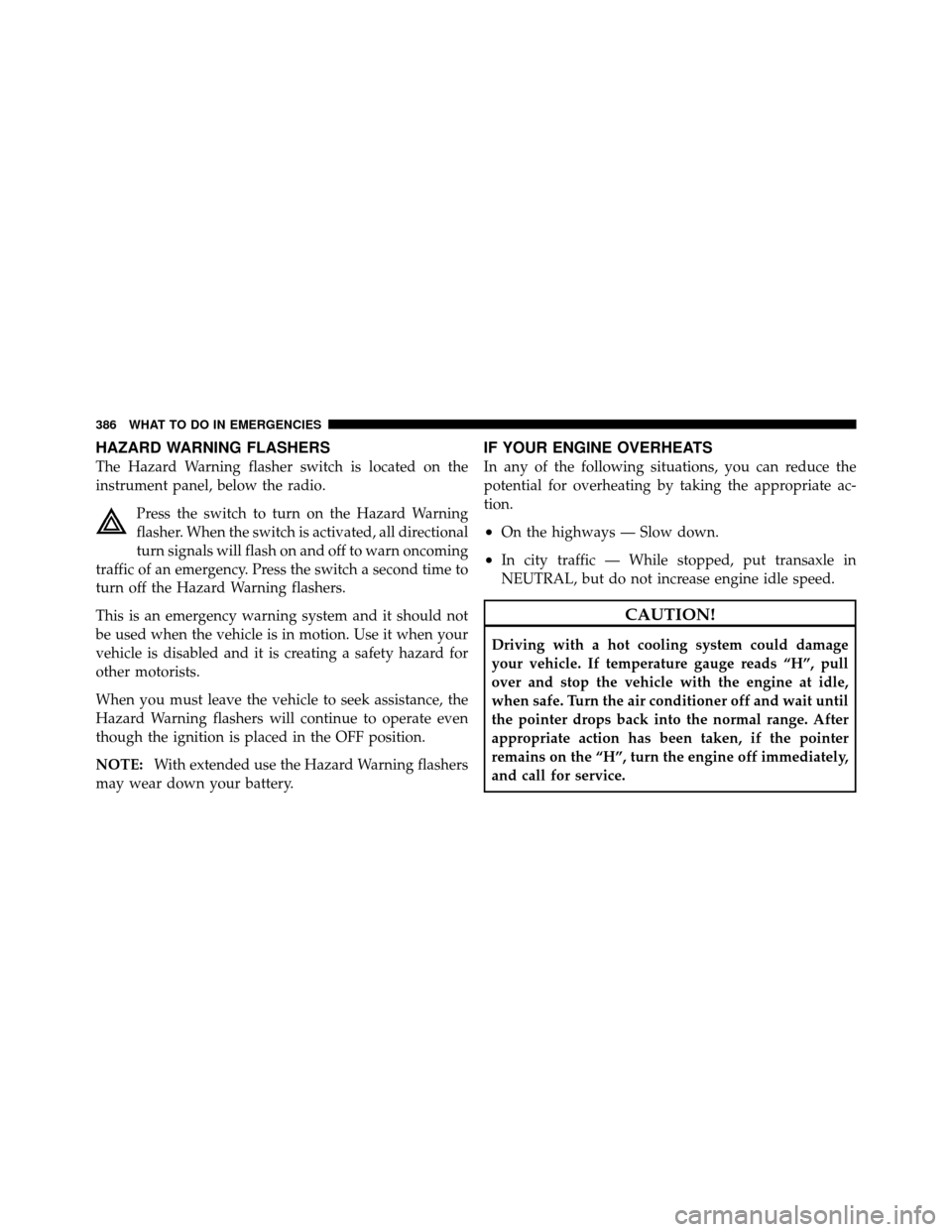
The Hazard Warning flasher switch is located on the
instrument panel, below the radio.Press the switch to turn on the Hazard Warning
flasher. When the switch is activated, all directional
turn signals will flash on and off to warn oncoming
traffic of an emergency. Press the switch a second time to
turn off the Hazard Warning flashers.
This is an emergency warning system and it should not
be used when the vehicle is in motion. Use it when your
vehicle is disabled and it is creating a safety hazard for
other motorists.
When you must leave the vehicle to seek assistance, the
Hazard Warning flashers will continue to operate even
though the ignition is placed in the OFF position.
NOTE: With extended use the Hazard Warning flashers
may wear down your battery.
IF YOUR ENGINE OVERHEATS
In any of the following situations, you can reduce the
potential for overheating by taking the appropriate ac-
tion.
•On the highways — Slow down.
•In city traffic — While stopped, put transaxle in
NEUTRAL, but do not increase engine idle speed.
CAUTION!
Driving with a hot cooling system could damage
your vehicle. If temperature gauge reads “H”, pull
over and stop the vehicle with the engine at idle,
when safe. Turn the air conditioner off and wait until
the pointer drops back into the normal range. After
appropriate action has been taken, if the pointer
remains on the “H”, turn the engine off immediately,
and call for service.
386 WHAT TO DO IN EMERGENCIES
Page 391 of 508
Preparations For Jacking
1. Park the vehicle on a firm, level surface. Avoid ice or
slippery areas.
WARNING!
Do not attempt to change a tire on the side of the
vehicle close to moving traffic, pull far enough off
the road to avoid the danger of being hit when
operating the jack or changing the wheel.
2. Turn on the Hazard Warning flashers.
3. Set the parking brake.
4. Place the shift lever into PARK (automatic transmis-
sion) or REVERSE (manual transmission).
5. Turn OFF the ignition.
Spare Tire and Jack Stowage6
WHAT TO DO IN EMERGENCIES 389

