Page 31 of 517

•Remote Start Aborted — Hood Ajar
•Remote Start Aborted — Trunk Ajar
•Remote Start Aborted — Fuel Low
•Remote Start Aborted — System Fault
The EVIC message stays active until the ignition is turned
to the RUN position.
To Enter Remote Start Mode
Press and release the REMOTE START button
on the RKE transmitter twice within five sec-
onds. The parking lights will flash and the horn
will chirp twice (if programmed). Then, the
engine will start and the vehicle will remain in the
Remote Start mode for a 15-minute cycle.
NOTE:
•For security, power window operation is disabled
when the vehicle is in the Remote Start mode.
•The engine can be started two consecutive times (two
15 minute cycles) with the RKE transmitter. However,
the ignition switch must be cycled to the ON/RUN
position before you can repeat the start sequence for a
third cycle.
•If an engine fault is present the vehicle will start and
then shut down 10 seconds later.
Remote start will also cancel if any of the following occur:
•The engine stalls or RPM exceeds 2500
•Any engine warning lamps come on
•Low Fuel Light turns on
•The hood is opened
•The hazard switch is pressed
•The transmission is moved out of PARK
•The brake pedal is pressed
2
THINGS TO KNOW BEFORE STARTING YOUR VEHICLE 29
Page 39 of 517

ears. Your vehicle may exhibit wind buffeting with one
window down in certain open or partially open posi-
tions. This is a normal occurrence and can be minimized.
If the buffeting occurs with one window open, then open
both windows together to minimize the buffeting.
TRUNK LOCK AND RELEASE
To unlatch the trunk lid from inside the vehicle, press and
release the TRUNK RELEASE Button located on the
instrument panel to the left of the steering wheel.
NOTE:The convertible top must be either closed and
latched or open and latched to release the trunk. The trunk release button on the dash
will be disabled if the vehicle is locked
by pressing the power door lock
switch or by pressing the LOCK but-
ton on the Remote Keyless Entry
(RKE) transmitter. The trunk release
button will be enabled when the ve-
hicle is unlocked by the RKE or if the
key is inserted into the ignition and
turned to ON/RUN or START.
NOTE: This provides a locked area in the vehicle even
if the convertible top is open.
To unlatch the trunk lid from outside the vehicle, press
and release the TRUNK RELEASE button on the RKE
transmitter two times.Trunk Release
Button
2
THINGS TO KNOW BEFORE STARTING YOUR VEHICLE 37
Page 40 of 517
With the ignition switch in the ON/RUN position, the
word “dECK” will display in the odometer indicating the
trunk is open. The odometer display will reappear once
the trunk is closed or if the trip button is pressed.
With the ignition switch in the LOCK position or with the
key out, the word “dECK” will display until the trunk is
closed.
On vehicles equipped with the Electronic Vehicle Infor-
mation Center (EVIC), the words “Trunk Ajar” will
display.TRUNK SAFETY WARNING
WARNING!
Do not allow children to have access to the trunk,
either by climbing into the trunk from outside, or
through the inside of the vehicle. Always close the
trunk lid when your vehicle is unattended. Once in
the trunk, young children may not be able to escape,
even if they entered through the rear seat. If trapped
in the trunk, children can die from suffocation or
heat stroke.
38 THINGS TO KNOW BEFORE STARTING YOUR VEHICLE
Page 41 of 517
Trunk Internal Emergency Release
As a security measure, a Trunk Internal Emergency
Release lever is built into the trunk latching mechanism.
In the event of an individual being locked inside the
trunk, the trunk can be simply opened by pulling on the
glow-in-the-dark handle attached to the trunk latching
mechanism.
OCCUPANT RESTRAINTS
Some of the most important safety features in your
vehicle are the restraint systems:
•Three-point lap and shoulder belts for all seating
positions
Trunk Internal Emergency Release
2
THINGS TO KNOW BEFORE STARTING YOUR VEHICLE 39
Page 78 of 517
tether anchors are underneath access covers in the carpet
covering the back of the seat where you see this symbol.
Many, but not all, restraint systems will be equipped with
separate straps on each side, with each having a hook or
connector for attachment to the lower anchorage and a
means of adjusting the tension in the strap. Forward-
facing toddler restraints and some rear-facing infant
restraints will also be equipped with a tether strap, a
hook for attachment to the tether strap anchorage and a
means of adjusting the tension of the strap.
You will first loosen the child seat adjusters on the lower
straps and on the tether strap so that you can more easily
attach the hooks or connectors to the vehicle anchorages.
Next, attach the lower hooks or connectors over the top
of the seat cover material. Then, rotate the tether anchor-
age cover directly behind the seat where you are placing
the child restraint, push the tether strap and hook
through the access port and down into the trunk. Openthe access cover on the carpet covering the back of the
seat and attach the tether strap hook to the anchor. Be
careful to route the tether strap to provide the most direct
path between the anchor and the child restraint. Finally,
tighten all three straps as you push the child restraint
rearward and downward into the seat, removing slack in
the straps according to the child restraint manufacturer’s
instructions.
NOTE:
When using the LATCH attaching system to
install a child restraint, please ensure that all seat belts
not being used for occupant restraints are stowed and out
of reach of children. It is recommended that before
installing the child restraint, buckle the seat belt so the
seat belt is tucked behind the child restraint and out of
reach. If the buckled seat belt interferes with the child
restraint installation, instead of tucking the seat belt
behind the child restraint, route the seat belt through the
child restraint belt path and then buckle it. This should
stow the seat belt out of the reach of an inquisitive child.
76 THINGS TO KNOW BEFORE STARTING YOUR VEHICLE
Page 81 of 517
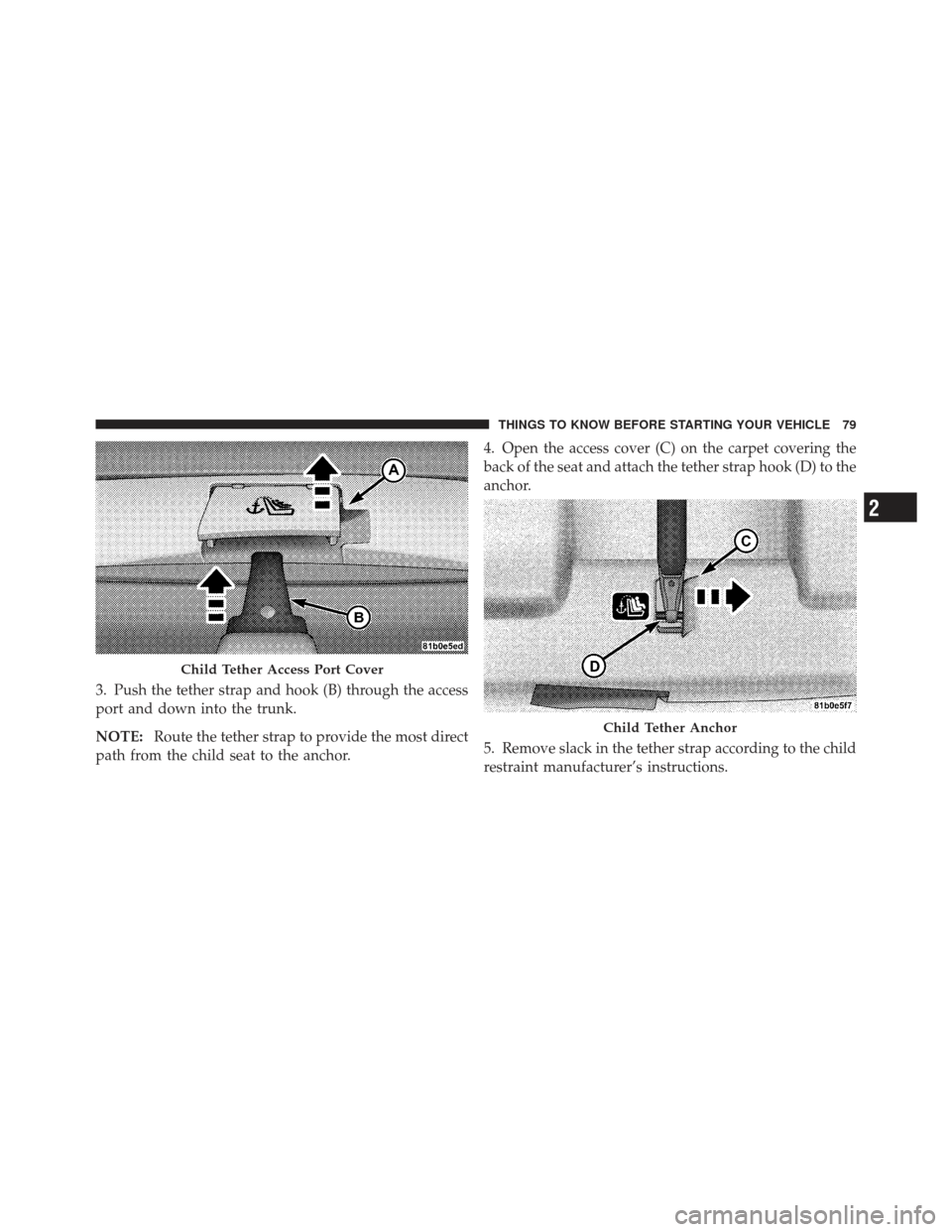
3. Push the tether strap and hook (B) through the access
port and down into the trunk.
NOTE:Route the tether strap to provide the most direct
path from the child seat to the anchor. 4. Open the access cover (C) on the carpet covering the
back of the seat and attach the tether strap hook (D) to the
anchor.
5. Remove slack in the tether strap according to the child
restraint manufacturer’s instructions.
Child Tether Access Port Cover
Child Tether Anchor
2
THINGS TO KNOW BEFORE STARTING YOUR VEHICLE 79
Page 84 of 517

Exhaust Gas
WARNING!
Exhaust gases can injure or kill. They contain carbon
monoxide (CO), which is colorless and odorless.
Breathing it can make you unconscious and can
eventually poison you. To avoid breathing (CO),
follow these safety tips:
•Do not run the engine in a closed garage or in
confined areas any longer than needed to move
your vehicle in or out of the area.
•If you are required to drive with the trunk/liftgate
open, make sure that all windows are closed and
the climate control BLOWER switch is set at high
speed. DO NOT use the recirculation mode.(Continued)
WARNING! (Continued)
•If it is necessary to sit in a parked vehicle with the
engine running, adjust your heating or cooling
controls to force outside air into the vehicle. Set
the blower at high speed.
The best protection against carbon monoxide entry into
the vehicle body is a properly maintained engine exhaust
system.
Whenever a change is noticed in the sound of the exhaust
system, when exhaust fumes can be detected inside the
vehicle, or when the underside or rear of the vehicle is
damaged, have a competent mechanic inspect the com-
plete exhaust system and adjacent body areas for broken,
damaged, deteriorated, or mispositioned parts. Open
seams or loose connections could permit exhaust fumes
to seep into the passenger compartment. In addition,
inspect the exhaust system each time the vehicle is raised
for lubrication or oil change. Replace as required.
82 THINGS TO KNOW BEFORE STARTING YOUR VEHICLE
Page 93 of 517

CONVERTIBLE TOP OPERATION
CAUTION!
Failure to follow these cautions may cause interior
water damage, stains or mildew on the top material:
•Avoid high-pressure car washes, as they can dam-
age the top material. Also, increased water pres-
sure may force water past the weather strips.
•Remove any standing water from the top and dry
the surface before opening it. Operating the top,
opening a door or lowering a window while the
top is wet may allow water to drip into the
vehicles interior.
•Use care when washing the vehicle, water pressure
directed at the weather strip seals may cause water
to leak into the vehicles interior.
WARNING!
The convertible top does not provide the structural
protection that a reinforced metal roof does and the
fabric top cannot be expected to prevent the ejection
of the occupants in a collision. Therefore, it is impor-
tant that all occupants wear their seat belts at all
times. Death or serious injuries could occur if you are
ejected from the vehicle during a collision.
You can lower or raise the power convertible top from
inside the vehicle or lower the top remotely using the
Remote Keyless Entry (RKE) transmitter. Either operation
takes approximately 30 seconds. The entire process, in-
cluding unlatching or latching the top at the windshield
header is automatic.
The top does take up some space in the trunk when
retracted. However, the trunk will still hold a significant
amount of cargo.
3
UNDERSTANDING THE FEATURES OF YOUR VEHICLE 91