Page 306 of 517

▫Selection Of Engine Oil For Flexible Fuel
Vehicles (E-85) And Gasoline Vehicles ...... 370
▫ Starting ........................... 371
▫ Cruising Range ...................... 371
▫ Replacement Parts ................... 371
▫ Maintenance ........................ 372
� Adding Fuel ......................... 372
▫ Fuel Filler Cap (Gas Cap) .............. 372
▫ Loose Filler Cap Message .............. 374
� Vehicle Loading ...................... 375
▫ Vehicle Certification Label .............. 375
▫ Gross Vehicle Weight Rating (GVWR) ...... 375
▫ Gross Axle Weight Rating (GAWR) ........ 375
▫ Overloading ........................ 376 ▫
Loading ........................... 376
� Trailer Towing ........................ 377
▫ Common Towing Definitions ............ 377
▫ Trailer Hitch Classification .............. 379
▫ Trailer Towing Weights (Maximum Trailer
Weight Ratings) ..................... 380
▫ Trailer And Tongue Weight ............. 381
▫ Towing Requirements ................. 382
▫ Towing Tips ........................ 386
� Recreational Towing (Behind
Motorhome, Etc.) ...................... 388
▫ Towing This Vehicle Behind Another
Vehicle ............................ 388
▫ Recreational Towing – All Models ........ 388
304 STARTING AND OPERATING
Page 317 of 517
WARNING!
Do not coast in NEUTRAL and never turn off the
ignition to coast down a hill. These are unsafe
practices that limit your response to changing traffic
or road conditions. You might lose control of the
vehicle and have a collision.
CAUTION!
Towing the vehicle, coasting, or driving for any other
reason with the transmission in NEUTRAL can result
in severe transmission damage. Refer to “Recre-
ational Towing” in “Starting And Operating” and
“Towing A Disabled Vehicle” in What To Do In
Emergencies” for further information.
DRIVE
This range should be used for most city and highway
driving. It provides the smoothest upshifts and down-
shifts, and the best fuel economy. The transmission
automatically upshifts through underdrive first, second,
third, and fourth gears, direct fifth gear and overdrive
sixth gear. The DRIVE position provides optimum driv-
ing characteristics under all normal operating conditions.
When frequent transmission shifting occurs (such as
when operating the vehicle under heavy loading condi-
tions, in hilly terrain, traveling into strong head winds, or
while towing heavy trailers), use the AutoStick�mode
(refer to “AutoStick�” in “Starting And Operating” for
further information) to select a lower gear range. Under
these conditions, using a lower gear range will improve
performance and extend transmission life by reducing
excessive shifting and heat buildup.
5
STARTING AND OPERATING 315
Page 320 of 517

AUTOSTICK�
AutoStick�is a driver-interactive feature providing
manual shift control, giving you more control of the
vehicle. AutoStick� allows you to maximize engine brak-
ing, eliminate undesirable upshifts and downshifts, and
improve overall vehicle performance. This system can
also provide you with more control during passing, city
driving, cold slippery conditions, mountain driving,
trailer towing, and many other situations.
Operation
When the shift lever is in the AutoStick� position (below
the DRIVE position), it can be moved from side to side.
This allows the driver to manually select the transmission
gear being used. Moving the shift lever to the left (-)
triggers a downshift and to the right (+) an upshift. The
gear position will display in the instrument cluster on the
transmission range indicator. NOTE:
In AutoStick� mode, the transmission will only
shift up or down when the driver moves the shift lever to
the right (+) or left (-), or as described below.
AutoStick� is deactivated when the shift lever is moved
from the AutoStick (+/-) position into the DRIVE
position.
General Information
•
You can start out, from a stop, in any gear except sixth.
The system will ignore attempts to upshift at too low
of a vehicle speed.
•If a ratio other than first gear is selected, and the
vehicle is brought to a stop, the transmission control
logic will automatically select the first gear ratio.
•Starting out in second gear is helpful in snowy or icy
conditions. To select second gear after the vehicle is
brought to a stop, tap the shift lever to the right (+)
once.
318 STARTING AND OPERATING
Page 343 of 517

Loading
The vehicle maximum load on the tire must not exceed
the load carrying capacity of the tire on your vehicle. You
will not exceed the tire’s load carrying capacity if you
adhere to the loading conditions, tire size, and cold tire
inflation pressures specified on the Tire and Loading
Information placard and in the “Vehicle Loading” section
of this manual.
NOTE:Under a maximum loaded vehicle condition,
gross axle weight ratings (GAWRs) for the front and rear
axles must not be exceeded. For further information on
GAWRs, vehicle loading, and trailer towing, refer to
“Vehicle Loading” in this section.
To determine the maximum loading conditions of your
vehicle, locate the statement “The combined weight of
occupants and cargo should never exceed XXX lbs or
XXX kg” on the Tire and Loading Information placard. The combined weight of occupants, cargo/luggage and
trailer tongue weight (if applicable) should never exceed
the weight referenced here.
Steps For Determining Correct Load Limit
1. Locate the statement “The combined weight of occu-
pants and cargo should never exceed XXX lbs or XXX kg”
on your vehicle’s placard.
2. Determine the combined weight of the driver and
passengers that will be riding in your vehicle.
3. Subtract the combined weight of the driver and pas-
sengers from XXX lbs or XXX kg.
4. The resulting figure equals the available amount of
cargo and luggage load capacity. For example, if “XXX”
amount equals 1,400 lbs (635 kg) and there will be five
150 lb (68 kg) passengers in your vehicle, the amount of
5
STARTING AND OPERATING 341
Page 344 of 517
available cargo and luggage load capacity is 650 lbs
(295 kg) (since 5 x 150 = 750, and 1400 – 750 = 650 lbs
[295 kg]).
5. Determine the combined weight of luggage and cargo
being loaded on the vehicle. That weight may not safely
exceed the available cargo and luggage load capacity
calculated in Step 4.
6. If your vehicle will be towing a trailer, load from your
trailer will be transferred to your vehicle. Consult this
manual to determine how this reduces the available
cargo and luggage load capacity of your vehicle.NOTE:
•The following table shows examples on how to calcu-
late total load, cargo/luggage, and towing capacities
of your vehicle with varying seating configurations
and number and size of occupants. This table is for
illustration purposes only and may not be accurate for
the seating and load carry capacity of your vehicle.
•For the following example, the combined weight of
occupants and cargo should never exceed 865 lbs
(392 kg).
342 STARTING AND OPERATING
Page 379 of 517
TRAILER TOWING
In this section, you will find safety tips and information
on limits to the type of towing you can reasonably do
with your vehicle. Before towing a trailer, carefully
review this information to tow your load as efficiently
and safely as possible.
To maintain warranty coverage, follow the requirements
and recommendations in this manual concerning ve-
hicles used for trailer towing.
If you have any questions or concerns after reviewing
this section, please consult your dealer to for full details
on the towing capabilities of the vehicle.
Common Towing Definitions
The following trailer towing related definitions will assist
you in understanding the following information:
Gross Vehicle Weight Rating (GVWR)
The GVWR is the total allowable weight of your vehicle.
This includes driver, passengers, cargo, and tongue
weight. The total load must be limited so that you do not
exceed the GVWR. Refer to “Vehicle Loading/Vehicle
Certification Label” in “Starting and Operating” for
further information.
Gross Trailer Weight (GTW)
The GTW is the weight of the trailer plus the weight of all
cargo, consumables and equipment (permanent or tem-
porary) loaded in or on the trailer in its�loaded and
ready for operation� condition.
The recommended way to measure GTW is to put your
fully loaded trailer on a vehicle scale. The entire weight
of the trailer must be supported by the scale.
Gross Combination Weight Rating (GCWR)
The GCWR is the total permissible weight of your vehicle
and trailer when weighed in combination.
5
STARTING AND OPERATING 377
Page 381 of 517
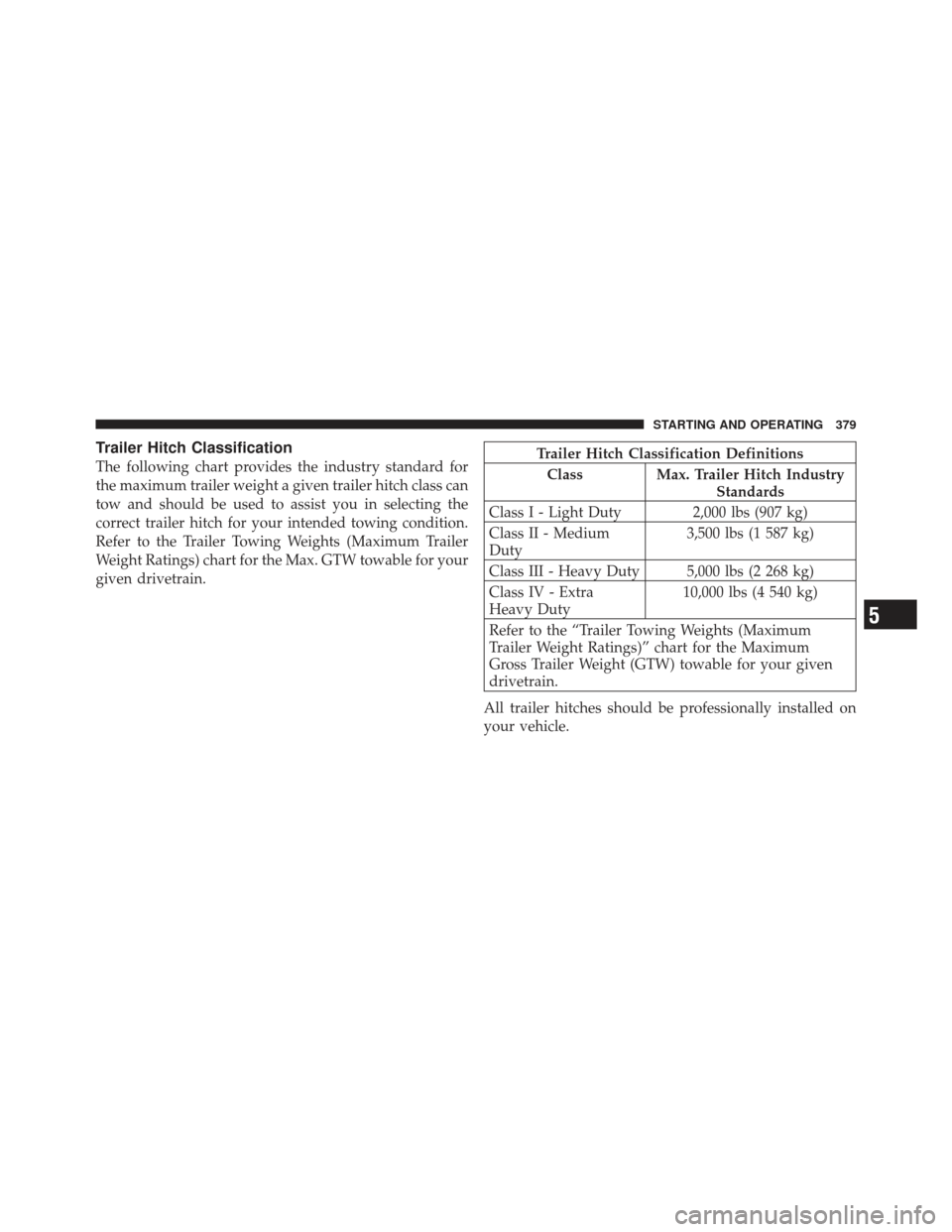
Trailer Hitch Classification
The following chart provides the industry standard for
the maximum trailer weight a given trailer hitch class can
tow and should be used to assist you in selecting the
correct trailer hitch for your intended towing condition.
Refer to the Trailer Towing Weights (Maximum Trailer
Weight Ratings) chart for the Max. GTW towable for your
given drivetrain.Trailer Hitch Classification DefinitionsClass Max. Trailer Hitch Industry Standards
Class I - Light Duty 2,000 lbs (907 kg)
Class II - Medium
Duty 3,500 lbs (1 587 kg)
Class III - Heavy Duty 5,000 lbs (2 268 kg)
Class IV - Extra
Heavy Duty 10,000 lbs (4 540 kg)
Refer to the “Trailer Towing Weights (Maximum
Trailer Weight Ratings)” chart for the Maximum
Gross Trailer Weight (GTW) towable for your given
drivetrain.
All trailer hitches should be professionally installed on
your vehicle.
5
STARTING AND OPERATING 379
Page 382 of 517
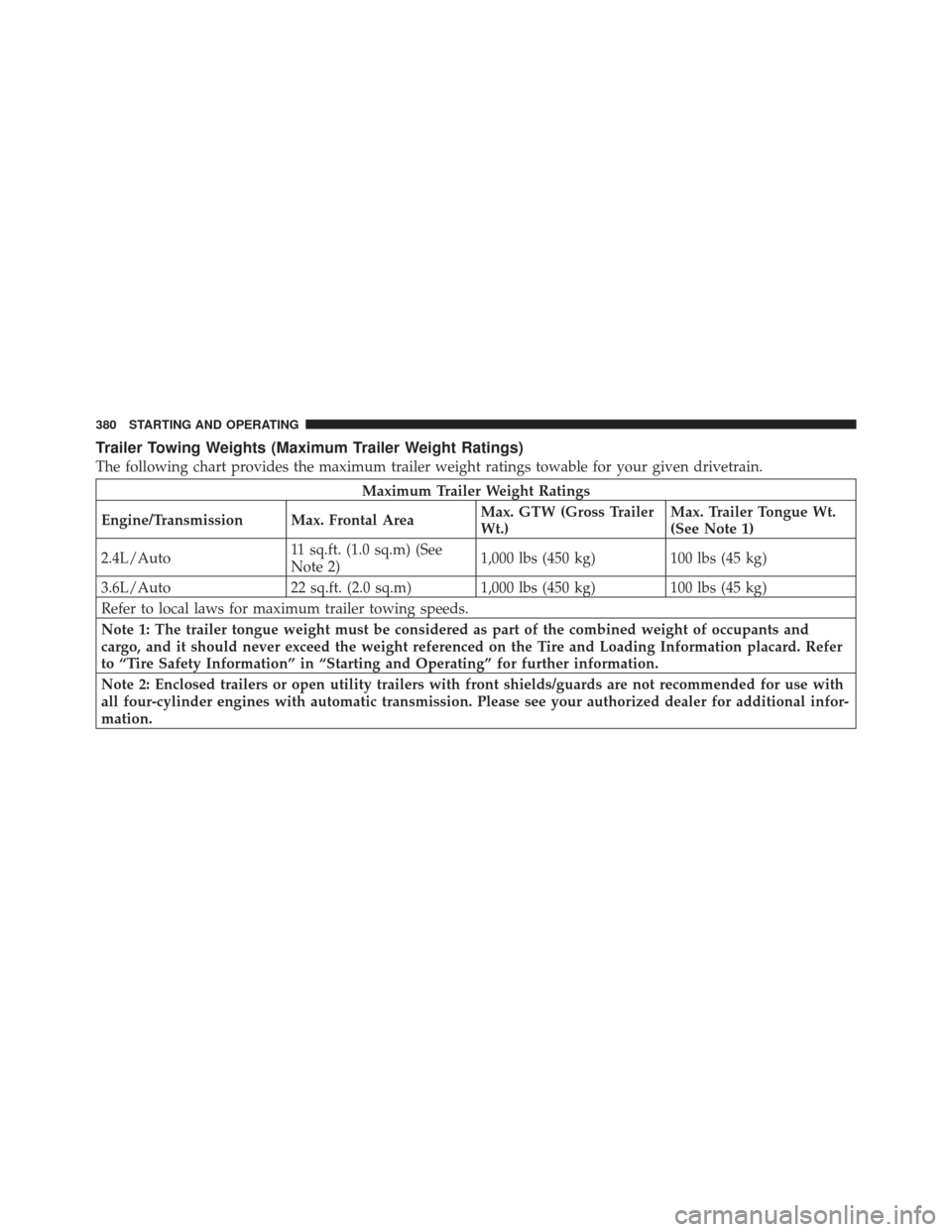
Trailer Towing Weights (Maximum Trailer Weight Ratings)
The following chart provides the maximum trailer weight ratings towable for your given drivetrain.
Maximum Trailer Weight Ratings
Engine/Transmission Max. Frontal Area Max. GTW (Gross Trailer
Wt.)Max. Trailer Tongue Wt.
(See Note 1)
2.4L/Auto 11 sq.ft. (1.0 sq.m) (See
Note 2)1,000 lbs (450 kg)
100 lbs (45 kg)
3.6L/Auto 22 sq.ft. (2.0 sq.m) 1,000 lbs (450 kg) 100 lbs (45 kg)
Refer to local laws for maximum trailer towing speeds.
Note 1: The trailer tongue weight must be considered as part of the combined weight of occupants and
cargo, and it should never exceed the weight referenced on the Tire and Loading Information placard. Refer
to “Tire Safety Information” in “Starting and Operating” for further information.
Note 2: Enclosed trailers or open utility trailers with front shields/guards are not recommended for use with
all four-cylinder engines with automatic transmission. Please see your authorized dealer for additional infor-
mation.
380 STARTING AND OPERATING
![CHRYSLER 200 CONVERTIBLE 2012 1.G Owners Manual available cargo and luggage load capacity is 650 lbs
(295 kg) (since 5 x 150 = 750, and 1400 – 750 = 650 lbs
[295 kg]).
5. Determine the combined weight of luggage and cargo
being loaded on the vehi](/manual-img/25/8446/w960_8446-343.png "CHRYSLER 200 CONVERTIBLE 2012 1.G Owners Manual available cargo and luggage load capacity is 650 lbs
(295 kg) (since 5 x 150 = 750, and 1400 – 750 = 650 lbs
[295 kg]).
5. Determine the combined weight of luggage and cargo
being loaded on the vehi")