2012 CHEVROLET VOLT parking brake
[x] Cancel search: parking brakePage 269 of 454

Black plate (31,1)Chevrolet Volt Owner Manual - 2012
Driving and Operating 9-31
{WARNING
It can be dangerous to get out of
the vehicle if the electric drive unit
shift lever is not fully in P (Park)
with the parking brake firmly set.
The vehicle can roll. Do not leave
the vehicle with the propulsion
system on unless you have to.
If you have left the propulsion
system on, the vehicle can move
suddenly. You or others could be
injured. To be sure the vehicle will
not move, even when you are on
level ground, always set the
parking brake and move the shift
lever to P (Park).
Follow the proper steps to be sure
the vehicle will not move. See
Shifting Into Park on page 9‑22.
Electric Drive Unit
The vehicle uses an electric drive
unit. The shift lever is on the
console between the seats.
P (Park): This position locks the
front wheels. It is the best position
to use when starting the propulsion
system because the vehicle cannot
move easily.
{WARNING
It is dangerous to get out of the
vehicle if the shift lever is not fully
in P (Park) with the parking brake
firmly set. The vehicle can roll.
Do not leave the vehicle when the
propulsion system is running
unless you have to. If you have
left the propulsion system
running, the vehicle can move
suddenly. You or others could be
injured. To be sure the vehicle will
not move, even when you are on
fairly level ground, always set the
parking brake and move the shift
lever to P (Park). See Shifting Into
Park on page 9‑22.
Make sure the shift lever is fully in
P (Park) before starting the
propulsion system. The vehicle has
an electric drive unit shift lock
control system. The regular brake
must be fully applied first and then
the shift lever button pressed before
Page 272 of 454
Black plate (34,1)Chevrolet Volt Owner Manual - 2012
9-34 Driving and Operating
Electric Parking Brake
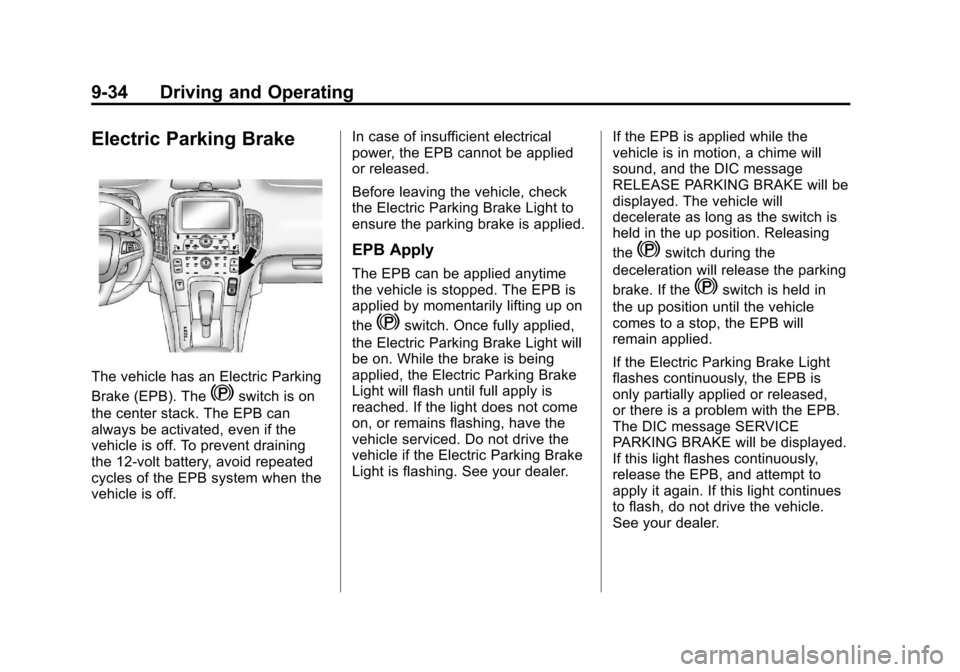
The vehicle has an Electric Parking
Brake (EPB). The
Yswitch is on
the center stack. The EPB can
always be activated, even if the
vehicle is off. To prevent draining
the 12‐volt battery, avoid repeated
cycles of the EPB system when the
vehicle is off. In case of insufficient electrical
power, the EPB cannot be applied
or released.
Before leaving the vehicle, check
the Electric Parking Brake Light to
ensure the parking brake is applied.
EPB Apply
The EPB can be applied anytime
the vehicle is stopped. The EPB is
applied by momentarily lifting up on
the
Yswitch. Once fully applied,
the Electric Parking Brake Light will
be on. While the brake is being
applied, the Electric Parking Brake
Light will flash until full apply is
reached. If the light does not come
on, or remains flashing, have the
vehicle serviced. Do not drive the
vehicle if the Electric Parking Brake
Light is flashing. See your dealer. If the EPB is applied while the
vehicle is in motion, a chime will
sound, and the DIC message
RELEASE PARKING BRAKE will be
displayed. The vehicle will
decelerate as long as the switch is
held in the up position. Releasing
the
Yswitch during the
deceleration will release the parking
brake. If the
Yswitch is held in
the up position until the vehicle
comes to a stop, the EPB will
remain applied.
If the Electric Parking Brake Light
flashes continuously, the EPB is
only partially applied or released,
or there is a problem with the EPB.
The DIC message SERVICE
PARKING BRAKE will be displayed.
If this light flashes continuously,
release the EPB, and attempt to
apply it again. If this light continues
to flash, do not drive the vehicle.
See your dealer.
Page 273 of 454

Black plate (35,1)Chevrolet Volt Owner Manual - 2012
Driving and Operating 9-35
If the Service Electric Parking Brake
Light is on, the EPB has detected a
system problem and is operating
with reduced functionality. To apply
the EPB when this light is on, lift up
on the
Yswitch and hold it in the
up position. Full application of the
parking brake by the EPB system
may take a longer period of time
than normal when this light is on.
Continue to hold the
Yswitch until
the Electric Parking Brake Light
remains on. If the Service Electric
Parking Brake Light is on, see your
dealer.
If the EPB fails to apply, the rear
wheels should be blocked to
prevent vehicle movement.
For maximum EPB force when
parking on a hill, pull the EPB
switch twice.
EPB Release
To release the EPB, place the
vehicle in ON/RUN, apply and hold
the brake pedal, and push down
momentarily on the
Yswitch.
If attempting to release the EPB
without the brake pedal applied, a
chime will sound, and the DIC
message STEP ON BRAKE TO
RELEASE PARK BRAKE will be
displayed. The EPB is released
when the Electric Parking Brake
Light is off.
If the Service Electric Parking Brake
Light is on, the EPB has detected a
system problem, and is operating
with reduced functionality. To
release the EPB when this light is
on, push down on the
Yswitch
and hold it in the down position.
EPB release may take a longer
period of time than normal when this
light is on. Continue to hold the
Y
switch until the Electric Parking
Brake Light is off. If the light is on,
see your dealer. Notice:
Driving with the parking
brake on can overheat the brake
system and cause premature
wear or damage to brake system
parts. Make sure that the parking
brake is fully released and the
Electric Parking Brake Light is off
before driving.
Automatic EPB Release
The EPB will automatically release if
the vehicle is running, placed into
gear, and an attempt is made to
drive away. Avoid rapid acceleration
when the EPB is applied, to
preserve parking brake lining life.
See Electric Parking Brake Light on
page 5‑22, Service Electric Parking
Brake Light on page 5‑23, and
Brake System Messages on
page 5‑48.
Page 280 of 454
Black plate (42,1)Chevrolet Volt Owner Manual - 2012
9-42 Driving and Operating
Using Cruise Control on Hills
How well the cruise control works
on hills depends upon the vehicle
speed, load, and the steepness of
the hills. When going up steep hills,
you might have to step on the
accelerator pedal to maintain the
vehicle speed. When going
downhill, you might have to brake or
shift to a lower gear to maintain the
vehicle speed. When the brakes are
applied the cruise control is
disengaged.Ending Cruise Control
There are three ways to end cruise
control:
.Step lightly on the brake pedal;
when cruise control disengages,
the indicator light will not be lit.
.Press*.
.Press1to turn the cruise
control system off completely.
The cruise control cannot be
resumed.
Erasing Speed Memory
The cruise control set speed is
erased from memory by pressing
1
or if the vehicle is turned off.
Object Detection
Systems
Ultrasonic Parking Assist
If available, the Ultrasonic Front and
Rear Parking Assist (UFRPA)
system assists the driver with
parking and avoiding objects.
UFRPA operates at speeds less
than 8 km/h (5 mph). The sensors
on the front and rear bumper detect
objects up to 1.2 m (4 ft) in front of
the vehicle, 2.5 m (8 ft) behind the
vehicle, and at least 25 cm (10 in)
off the ground.
Page 308 of 454

Black plate (4,1)Chevrolet Volt Owner Manual - 2012
10-4 Vehicle Care
Lifting the Vehicle with a
Service Jack
{WARNING
Lifting a vehicle can cause an
injury. The vehicle can slip off the
jack and roll over you or other
people. You and they could be
badly injured. Find a level place
to lift your vehicle. To help
prevent the vehicle from moving:1. Set the parking brake firmly.
2. Put the shift lever in P (Park).
3. Turn off the vehicle.
To be even more certain the
vehicle will not move, put blocks
in front of and behind the wheels.
{WARNING
Getting under a vehicle when it is
jacked up is dangerous. If the
vehicle slips off the jack, you
could be badly injured or killed.
Never get under a vehicle when it
is supported only by a jack.
{WARNING
Raising the vehicle with the jack
improperly positioned can
damage the vehicle or the vehicle
may fall and cause you or others
injury. When using a jack to lift the vehicle,
follow the instructions that came
with the jack and be sure to use the
correct lifting points to avoid
damaging the vehicle.
Notice:
Lifting the vehicle
improperly can cause damage
and result in costly repairs not
covered by the warranty. To lift
the vehicle properly, use this
procedure.
For additional information, see
your dealer and the service
manual.
Page 331 of 454

Black plate (27,1)Chevrolet Volt Owner Manual - 2012
Vehicle Care 10-27
Electric Drive Unit Shift
Lock Control Function
Check
{WARNING
When you are doing this
inspection, the vehicle could
move suddenly. If the vehicle
moves, you or others could be
injured.
1. Before starting this check, be sure there is enough room
around the vehicle. It should be
parked on a level surface.
2. Firmly apply the parking brake. See Electric Parking Brake on
page 9‑34.
Be ready to apply the regular
brake immediately if the vehicle
begins to move.
3. With the vehicle off and the brake not applied, press and
hold the POWER
Obutton for more than five seconds to place
the vehicle in Service Only
Mode. See
Power Button on
page 9‑18. Without applying the
regular brake, try to move the
shift lever out of P (Park) with
normal effort. If the shift lever
moves out of P (Park), contact
your dealer for service.
Park Brake and P (Park)
Mechanism Check
{WARNING
When you are doing this check,
the vehicle could begin to move.
You or others could be injured
and property could be damaged.
Make sure there is room in front
of the vehicle in case it begins to
roll. Be ready to apply the regular
brake at once should the vehicle
begin to move. Park on a fairly steep hill, with the
vehicle facing downhill. Keeping
your foot on the regular brake, set
the electric parking brake.
.To check the electric parking
brake's holding ability: With the
propulsion system active and the
electric drive unit in N (Neutral),
slowly remove foot pressure
from the regular brake pedal. Do
this until the vehicle is held by
the electric parking brake only.
.To check the P (Park)
mechanism's holding ability:
With the propulsion system
active, shift to P (Park). Then
release the electric parking
brake followed by the regular
brake.
Contact your dealer if service is
required.
Page 347 of 454

Black plate (43,1)Chevrolet Volt Owner Manual - 2012
Vehicle Care 10-43
FusesUsage
F5 Driver Door
Switches (Outside
Rearview Mirror/
Charge Port Door
Release/Refuel
Request/Driver
Window Switch)
F6 Fuel (Diurnal Valve
and Evap. Leak
Check Module)
F7 Accessory Power
Module Cooling Fan
F8 Amplifier
(If Equipped)
F9 Empty
F10 Regulated Voltage
Control/Ultrasonic
Front and Rear
Parking Assist
(If Equipped) Fuses
Usage
F11 Horn
F12 Rear Power
Windows
F13 Electric Parking
Brake
F14 Rear Defog
(Upper Grid)
F15 Empty
F16 Hatch Release
F17 Empty
F18 Empty Relays
Usage
R1 Rear Defog
(Upper Grid)
R2 Hatch Release
R3 Empty
R4 Empty
R5 Empty
R6 Empty
R7/R8 Horn
Diodes Usage DIODE Empty
Page 360 of 454

Black plate (56,1)Chevrolet Volt Owner Manual - 2012
10-56 Vehicle Care
Follow the TPMS sensor matching
process:
1. Set the parking brake.
2. Put the vehicle in ON/RUN andplace the vehicle in P (Park).
3. If the DIC display is minimized, press the SELECT knob to
maximize it.
4. Use the SELECT knob to scroll to the Tire Pressure display
screen.
5. Press and hold the SELECT knob for five seconds to begin
the sensor matching process.
A message displays confirming
to begin the process.
6. Use the SELECT knob to select YES with the highlighted
selection, and press the
SELECT knob again to confirm
the selection. The horn sounds twice to signal
the receiver is in relearn mode
and the TIRE LEARNING
ACTIVE message displays on
the DIC screen.
7. Start with the driver side front tire.
8. Place the relearn tool against the tire sidewall, near the valve
stem. Then press the button to
activate the TPMS sensor.
A horn chirp confirms that the
sensor identification code has
been matched to this tire and
wheel position.
9. Proceed to the passenger side front tire, and repeat the
procedure in Step 8.
10. Proceed to the passenger side rear tire, and repeat the
procedure in Step 8. 11. Proceed to the driver side rear
tire, and repeat the procedure
in Step 8. The horn sounds
two times to indicate the
sensor identification code has
been matched to the driver
side rear tire, and the TPMS
sensor matching process is no
longer active. The TIRE
LEARNING ACTIVE message
on the DIC display screen
goes off.
12. Turn the vehicle off.
13. Set all four tires to the recommended air pressure
level as indicated on the Tire
and Loading Information label.