2012 CHEVROLET VOLT brake light
[x] Cancel search: brake lightPage 272 of 454
Black plate (34,1)Chevrolet Volt Owner Manual - 2012
9-34 Driving and Operating
Electric Parking Brake
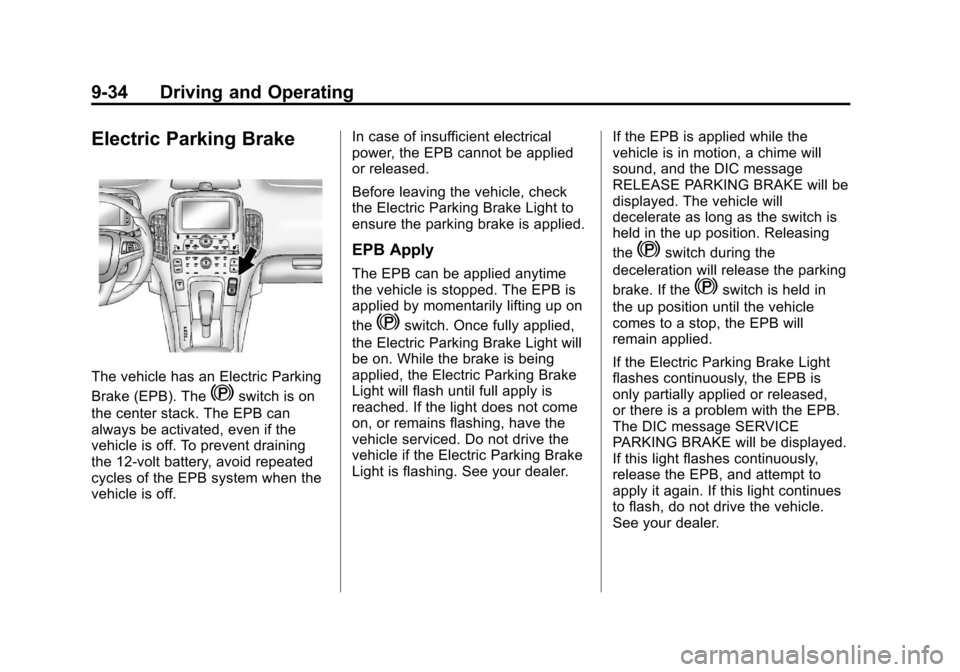
The vehicle has an Electric Parking
Brake (EPB). The
Yswitch is on
the center stack. The EPB can
always be activated, even if the
vehicle is off. To prevent draining
the 12‐volt battery, avoid repeated
cycles of the EPB system when the
vehicle is off. In case of insufficient electrical
power, the EPB cannot be applied
or released.
Before leaving the vehicle, check
the Electric Parking Brake Light to
ensure the parking brake is applied.
EPB Apply
The EPB can be applied anytime
the vehicle is stopped. The EPB is
applied by momentarily lifting up on
the
Yswitch. Once fully applied,
the Electric Parking Brake Light will
be on. While the brake is being
applied, the Electric Parking Brake
Light will flash until full apply is
reached. If the light does not come
on, or remains flashing, have the
vehicle serviced. Do not drive the
vehicle if the Electric Parking Brake
Light is flashing. See your dealer. If the EPB is applied while the
vehicle is in motion, a chime will
sound, and the DIC message
RELEASE PARKING BRAKE will be
displayed. The vehicle will
decelerate as long as the switch is
held in the up position. Releasing
the
Yswitch during the
deceleration will release the parking
brake. If the
Yswitch is held in
the up position until the vehicle
comes to a stop, the EPB will
remain applied.
If the Electric Parking Brake Light
flashes continuously, the EPB is
only partially applied or released,
or there is a problem with the EPB.
The DIC message SERVICE
PARKING BRAKE will be displayed.
If this light flashes continuously,
release the EPB, and attempt to
apply it again. If this light continues
to flash, do not drive the vehicle.
See your dealer.
Page 273 of 454

Black plate (35,1)Chevrolet Volt Owner Manual - 2012
Driving and Operating 9-35
If the Service Electric Parking Brake
Light is on, the EPB has detected a
system problem and is operating
with reduced functionality. To apply
the EPB when this light is on, lift up
on the
Yswitch and hold it in the
up position. Full application of the
parking brake by the EPB system
may take a longer period of time
than normal when this light is on.
Continue to hold the
Yswitch until
the Electric Parking Brake Light
remains on. If the Service Electric
Parking Brake Light is on, see your
dealer.
If the EPB fails to apply, the rear
wheels should be blocked to
prevent vehicle movement.
For maximum EPB force when
parking on a hill, pull the EPB
switch twice.
EPB Release
To release the EPB, place the
vehicle in ON/RUN, apply and hold
the brake pedal, and push down
momentarily on the
Yswitch.
If attempting to release the EPB
without the brake pedal applied, a
chime will sound, and the DIC
message STEP ON BRAKE TO
RELEASE PARK BRAKE will be
displayed. The EPB is released
when the Electric Parking Brake
Light is off.
If the Service Electric Parking Brake
Light is on, the EPB has detected a
system problem, and is operating
with reduced functionality. To
release the EPB when this light is
on, push down on the
Yswitch
and hold it in the down position.
EPB release may take a longer
period of time than normal when this
light is on. Continue to hold the
Y
switch until the Electric Parking
Brake Light is off. If the light is on,
see your dealer. Notice:
Driving with the parking
brake on can overheat the brake
system and cause premature
wear or damage to brake system
parts. Make sure that the parking
brake is fully released and the
Electric Parking Brake Light is off
before driving.
Automatic EPB Release
The EPB will automatically release if
the vehicle is running, placed into
gear, and an attempt is made to
drive away. Avoid rapid acceleration
when the EPB is applied, to
preserve parking brake lining life.
See Electric Parking Brake Light on
page 5‑22, Service Electric Parking
Brake Light on page 5‑23, and
Brake System Messages on
page 5‑48.
Page 274 of 454

Black plate (36,1)Chevrolet Volt Owner Manual - 2012
9-36 Driving and Operating
Regenerative Braking
Regenerative braking takes some of
the energy from the moving vehicle
and turns it back into electrical
energy. This energy is then stored
back into the high voltage battery
system, contributing to increased
energy efficiency.
The hydraulic disc brakes work with
the regenerative braking to ensure
effective braking, such as when a
high braking demand is requested.
The braking system is computer
controlled and blends the
regenerative braking with the
conventional hydraulic disc brakes
to meet any requirements for
deceleration. The controllerinterprets the braking request and
uses regenerative braking,
conventional hydraulic braking, or a
combination of both as necessary.
Because the controller applies the
hydraulic brakes through its high
pressure accumulator, you may
occasionally hear the motor‐driven
pump when it recharges the system.
This is normal.
See
Warning Lights, Gauges, and
Indicators on page 5‑8 andDriver
Information Center (DIC) on
page 5‑45. In the event of a
controller problem, the brake pedal
may be harder to push and the
stopping distance may be longer.
Ride Control Systems
Traction Control
System (TCS)
The vehicle has a Traction Control
System (TCS) that limits wheel spin.
The system operates if it senses
that one or both of the drive wheels
are slipping or beginning to lose
traction. When this happens, the
system brakes the spinning wheel(s)
and/or reduces power to limit
wheel spin.
The system may be heard or felt
while it is working, but this is
normal.
To assist with directional control of
the vehicle, TCS automatically
comes on whenever the vehicle is
turned on. To limit wheel spin,
especially in slippery road
conditions, the system should
always be left on. But, TCS can be
turned off if needed.
Page 275 of 454

Black plate (37,1)Chevrolet Volt Owner Manual - 2012
Driving and Operating 9-37
When the vehicle is started and
begins to move, the system
performs several diagnostic checks
to ensure there are no problems.
The system may be heard or felt
while it is working. This is normal
and does not mean there is a
problem with the vehicle. The
system should initialize before the
vehicle reaches 32 km/h (20 mph).
In some cases, it may take
approximately 3.2 km (2 mi) of
driving before the system initializes.
The TCS may activate on dry or
rough roads or under conditions
such as heavy acceleration while
turning or abrupt changes in output
from the electric drive unit. When
this happens, a reduction in
acceleration may be noticed, or a
noise or vibration may be heard.
This is normal.dflashes to indicate that TCS is
active. See Traction Control System
(TCS)/StabiliTrak
®Light on
page 5‑25 for more information.
If there is a problem detected with
TCS, SERVICE TRACTION
CONTROL is displayed on the
Driver Information Center (DIC).
See Ride Control System Messages
on page 5‑53. When this message
is displayed and
dcomes on and
stays on, the vehicle is safe to drive
but the system is not operational.
Driving should be adjusted
accordingly.
If
dcomes on and stays on, reset
the system:
1. Stop the vehicle.
2. Turn the engine off and wait 15 seconds.
3. Start the engine.
If
dstill comes on and stays on, the
vehicle needs service. Notice:
Do not repeatedly brake
or accelerate heavily when TCS is
off. The vehicle's driveline could
be damaged.
TCS can be turned off by pressing
and releasing the TCS/ESC button
located on the overhead console.
When TCS is turned off,
icomes
on, and the appropriate DIC
message also displays. See Ride
Control System Messages on
page 5‑53. With TCS turned off, the
system does not limit wheel spin.
Page 276 of 454

Black plate (38,1)Chevrolet Volt Owner Manual - 2012
9-38 Driving and Operating
Driving should be adjusted
accordingly. SeeTraction Off Light
on page 5‑24 for more information.
Press and release the TCS/ESC
button again to turn the system
back on.
It may be necessary to turn the
system off if the vehicle gets stuck
in sand, mud, or snow and rocking
the vehicle is required. See If the
Vehicle Is Stuck on page 9‑12 for
more information. See also Winter
Driving on page 9‑10 for information
on using TCS when driving in snowy
or icy conditions.
Adding non‐GM accessories can
affect vehicle performance. See
Accessories and Modifications on
page 10‑3 for more information.Electronic Stability
Control (ESC)
The vehicle has an Electronic
Stability Control system called
StabiliTrak. It is an advanced
computer-controlled system that
assists with directional control of the
vehicle in difficult driving conditions.
StabiliTrak comes on automatically
whenever the vehicle is turned on.
To assist with directional control of
the vehicle, the system should
always be left on.
The system may be heard or felt
while it is working, but this is
normal.
StabiliTrak activates when the
computer senses a difference
between the intended path and the
direction the vehicle is actually
traveling. StabiliTrak selectively
applies braking pressure to the
vehicle brakes to help steer the
vehicle in the intended direction. When the vehicle is started and
begins to move, the system
performs several diagnostic checks
to ensure there are no problems.
The system may be heard or felt
while it is working. This is normal
and does not mean there is a
problem with the vehicle. The
system should initialize before the
vehicle reaches 32 km/h (20 mph).
In some cases, it may take
approximately 3.2 km (2 mi) of
driving before the system initializes.
When StabiliTrak activates,
d
flashes on the instrument cluster.
This also occurs when traction
control is activated. This is normal.
Continue to steer the vehicle in the
intended direction. A noise may be
heard or vibration may be felt in the
brake pedal. This is normal.
Continue to steer the vehicle in the
intended direction. See
Traction
Control System (TCS)/StabiliTrak
®
Light on page 5‑25 for more
information.
Page 280 of 454
Black plate (42,1)Chevrolet Volt Owner Manual - 2012
9-42 Driving and Operating
Using Cruise Control on Hills
How well the cruise control works
on hills depends upon the vehicle
speed, load, and the steepness of
the hills. When going up steep hills,
you might have to step on the
accelerator pedal to maintain the
vehicle speed. When going
downhill, you might have to brake or
shift to a lower gear to maintain the
vehicle speed. When the brakes are
applied the cruise control is
disengaged.Ending Cruise Control
There are three ways to end cruise
control:
.Step lightly on the brake pedal;
when cruise control disengages,
the indicator light will not be lit.
.Press*.
.Press1to turn the cruise
control system off completely.
The cruise control cannot be
resumed.
Erasing Speed Memory
The cruise control set speed is
erased from memory by pressing
1
or if the vehicle is turned off.
Object Detection
Systems
Ultrasonic Parking Assist
If available, the Ultrasonic Front and
Rear Parking Assist (UFRPA)
system assists the driver with
parking and avoiding objects.
UFRPA operates at speeds less
than 8 km/h (5 mph). The sensors
on the front and rear bumper detect
objects up to 1.2 m (4 ft) in front of
the vehicle, 2.5 m (8 ft) behind the
vehicle, and at least 25 cm (10 in)
off the ground.
Page 305 of 454

Black plate (1,1)Chevrolet Volt Owner Manual - 2012
Vehicle Care 10-1
Vehicle Care
General Information
General Information . . . . . . . . . . 10-2
California Proposition65 Warning . . . . . . . . . . . . . . . . . 10-2
California Perchlorate Materials Requirements . . . . 10-2
Accessories and Modifications . . . . . . . . . . . . . . . 10-3
Lifting the Vehicle . . . . . . . . . . . . 10-3
Vehicle Checks
Doing Your Own Service Work . . . . . . . . . . . . . . . 10-6
Hood . . . . . . . . . . . . . . . . . . . . . . . . 10-7
Engine Compartment Overview . . . . . . . . . . . . . . . . . . . 10-8
Engine Oil . . . . . . . . . . . . . . . . . . . 10-9
Engine Oil Life System . . . . . 10-12
Engine Air Cleaner/Filter . . . . 10-13
Cooling System (Engine) . . . 10-15
Cooling System (High Voltage Battery) . . . . . . . . . . . 10-16
Cooling System (Power Electronics and Charger
Modules) . . . . . . . . . . . . . . . . . . 10-17
Engine Coolant . . . . . . . . . . . . . 10-18 Engine Overheating . . . . . . . . 10-21
Washer Fluid . . . . . . . . . . . . . . . 10-21
Brakes . . . . . . . . . . . . . . . . . . . . . 10-22
Brake Fluid . . . . . . . . . . . . . . . . . 10-23
Battery . . . . . . . . . . . . . . . . . . . . . 10-25
Electric Drive Unit Shift Lock
Control Function Check . . . 10-27
Park Brake and P (Park) Mechanism Check . . . . . . . . 10-27
Wiper Blade Replacement . . . . . . . . . . . . . . 10-28
Headlamp Aiming
Headlamp Aiming . . . . . . . . . . 10-28
Bulb Replacement
Bulb Replacement . . . . . . . . . . 10-29
Halogen Bulbs . . . . . . . . . . . . . . 10-29
LED Lighting . . . . . . . . . . . . . . . 10-29
Headlamps . . . . . . . . . . . . . . . . . 10-29
Back-Up Lamps . . . . . . . . . . . . 10-31
License Plate Lamp . . . . . . . . 10-31
Replacement Bulbs . . . . . . . . . 10-32
Electrical System
High Voltage Devices andWiring . . . . . . . . . . . . . . . . . . . . . 10-32
Electrical System Overload . . . . . . . . . . . . . . . . . . 10-33 Engine Compartment Fuse
Block . . . . . . . . . . . . . . . . . . . . . 10-34
Instrument Panel Fuse Block (Left Side) . . . . . . . . . . . . . . . . 10-38
Instrument Panel Fuse Block
(Right Side) . . . . . . . . . . . . . . . 10-40
Rear Compartment Fuse Block . . . . . . . . . . . . . . . . . . . . . 10-42
Wheels and Tires
Tires . . . . . . . . . . . . . . . . . . . . . . . . 10-44
Winter Tires . . . . . . . . . . . . . . . . 10-45
Tire Sidewall Labeling . . . . . . 10-45
Tire Designations . . . . . . . . . . . 10-46
Tire Terminology andDefinitions . . . . . . . . . . . . . . . . 10-47
Tire Pressure . . . . . . . . . . . . . . . 10-50
Tire Pressure Monitor
System . . . . . . . . . . . . . . . . . . . 10-51
Tire Pressure Monitor Operation . . . . . . . . . . . . . . . . . 10-53
Tire Inspection . . . . . . . . . . . . . . 10-57
Tire Rotation . . . . . . . . . . . . . . . 10-57
When It Is Time for New Tires . . . . . . . . . . . . . . . . . . . . . . 10-58
Buying New Tires . . . . . . . . . . . 10-59
Different Size Tires and Wheels . . . . . . . . . . . . . . . . . . . 10-61
Page 326 of 454

Black plate (22,1)Chevrolet Volt Owner Manual - 2012
10-22 Vehicle Care
Notice
.When using concentrated
washer fluid, follow the
manufacturer's instructions
for adding water.
.Do not mix water with
ready-to-use washer fluid.
Water can cause the solution
to freeze and damage the
washer fluid tank and other
parts of the washer system.
Also, water does not clean as
well as washer fluid.
.Fill the washer fluid tank only
three-quarters full when it is
very cold. This allows for
fluid expansion if freezing
occurs, which could damage
the tank if it is
completely full.
.Do not use engine coolant
(antifreeze) in the windshield
washer. It can damage the
windshield washer system
and paint.
Brakes
This vehicle has disc brakes. Disc
brake pads have built-in wear
indicators that make a high-pitched
warning sound when the brake pads
are worn and new pads are needed.
The sound can come and go or be
heard all the time the vehicle is
moving, except when applying the
brake pedal firmly.
{WARNING
The brake wear warning sound
means that soon the brakes will
not work well. That could lead to
a crash. When the brake wear
warning sound is heard, have the
vehicle serviced.
Notice: Continuing to drive with
worn-out brake pads could result
in costly brake repair. Some driving conditions or climates
can cause a brake squeal when the
brakes are first applied or lightly
applied. This does not mean
something is wrong with the brakes.
Properly torqued wheel nuts are
necessary to help prevent brake
pulsation. When tires are rotated,
inspect brake pads for wear and
evenly tighten wheel nuts in the
proper sequence to torque
specifications in
Capacities and
Specifications on page 12‑2.
Brake linings should always be
replaced as complete axle sets.