Page 340 of 454
Black plate (36,1)Chevrolet Volt Owner Manual - 2012
10-36 Vehicle Care
Mini Fuses Usage39 Rechargeable
Energy Storage
System (High
Voltage Battery)
Control Module
40 Front Windshield
Washer
41 Right High‐Beam
Headlamp
46 Empty
47 Empty
49 Empty
50 Run/Crank
–Rear
Vision Camera,
Accessory Power
Module Mini Fuses Usage
51 Run/Crank for ABS/
Rechargeable
Energy Storage
System (High
Voltage Battery)
52 Engine Control
Module/
Transmission
Control
Module
–Run/Crank
53 Traction Power
Inverter
Module
–Run/Crank
54 Run/Crank
–Fuel
System Control
Module, Air
Conditioning Control
Module, On Board
Charger J‐Case
Fuses Usage
16 AIR Solenoid
(PZEV Only)
18 Empty
19 Power
Window
–Front
20 Empty
21 Antilock Brake
System Electronic
Control Unit
23 Charge Port Door
27 AIR Pump
(PZEV Only)
Page 342 of 454
Black plate (38,1)Chevrolet Volt Owner Manual - 2012
10-38 Vehicle Care
Instrument Panel Fuse
Block (Left Side)
The left instrument panel fuse block
is on the left side end of the
instrument panel. To access the
fuses, open the fuse panel door by
pulling out.
To reinstall the door, insert the
bottom tab first, then push the door
back into its original location.
Instrument Panel Fuse Block
A fuse puller is located in the engine
compartment fuse block.
The vehicle may not be equipped
with all of the fuses, relays, and
features shown. Fuses Usage
F1 Power Outlet
–Top
of IP Storage Bin
F2 Radio Fuses Usage
F3 Instrument Cluster
F4 Infotainment Display
F5 Heating, Ventilation
& Air Conditioning/
Integrated Center
Stack Switches
F6 Airbag (Sensing
Diagnostic Module/
Passenger Sensing
Module)
Page 344 of 454
Black plate (40,1)Chevrolet Volt Owner Manual - 2012
10-40 Vehicle Care
Instrument Panel Fuse
Block (Right Side)
The right instrument panel fuse
block is on the right side end of the
instrument panel. To access the
fuses, open the fuse panel door by
pulling out.
To reinstall the door, insert the
bottom tab first, then push the door
back into its original location.
Instrument Panel Fuse Block
A fuse puller is located in the engine
compartment fuse block.
The vehicle may not be equipped
with all of the fuses, relays, and
features shown. Fuses Usage
F1 Steering Wheel
Switch Backlighting
F2 Empty
F3 Empty Fuses Usage
F4 Body Control
Module 3/Right
Headlamp
F5 Body Control
Module 2/Body
Control Module
Electronics/Hatch
Lamp/Right Daytime
Running Lamp/
Shifter Lock/Switch
Backlighting
Page 346 of 454
Black plate (42,1)Chevrolet Volt Owner Manual - 2012
10-42 Vehicle Care
Rear Compartment Fuse
Block
The rear compartment fuse block is
on the left side of the rear
compartment behind a removable
cover. Open the latch to remove the
cover and access the fuse block.
A fuse puller is located in the engine
compartment fuse block.
The vehicle may not have all of the
fuses, relays, and features shown.Fuses Usage
F1 Empty
F2 Fuel System Control
Module Fuses
Usage
F3 Passive Start/
Passive Entry
Module
F4 Heated Seats
(If Equipped)
Page 350 of 454
Black plate (46,1)Chevrolet Volt Owner Manual - 2012
10-46 Vehicle Care
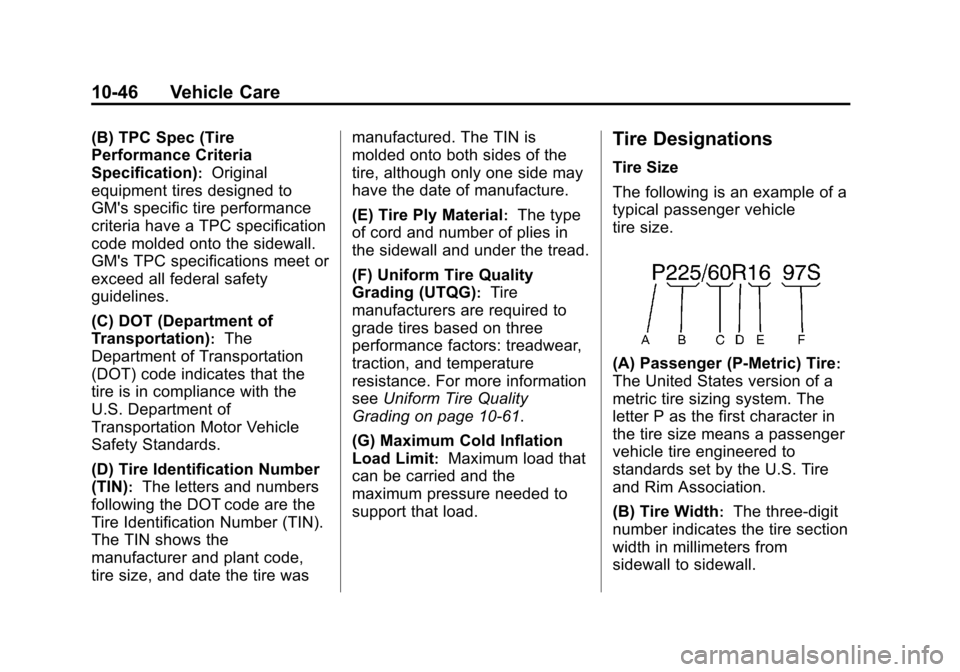
(B) TPC Spec (Tire
Performance Criteria
Specification)
:Original
equipment tires designed to
GM's specific tire performance
criteria have a TPC specification
code molded onto the sidewall.
GM's TPC specifications meet or
exceed all federal safety
guidelines.
(C) DOT (Department of
Transportation)
:The
Department of Transportation
(DOT) code indicates that the
tire is in compliance with the
U.S. Department of
Transportation Motor Vehicle
Safety Standards.
(D) Tire Identification Number
(TIN)
:The letters and numbers
following the DOT code are the
Tire Identification Number (TIN).
The TIN shows the
manufacturer and plant code,
tire size, and date the tire was manufactured. The TIN is
molded onto both sides of the
tire, although only one side may
have the date of manufacture.
(E) Tire Ply Material
:The type
of cord and number of plies in
the sidewall and under the tread.
(F) Uniform Tire Quality
Grading (UTQG)
:Tire
manufacturers are required to
grade tires based on three
performance factors: treadwear,
traction, and temperature
resistance. For more information
see Uniform Tire Quality
Grading on page 10‑61.
(G) Maximum Cold Inflation
Load Limit
:Maximum load that
can be carried and the
maximum pressure needed to
support that load.
Tire Designations
Tire Size
The following is an example of a
typical passenger vehicle
tire size.
(A) Passenger (P‐Metric) Tire:
The United States version of a
metric tire sizing system. The
letter P as the first character in
the tire size means a passenger
vehicle tire engineered to
standards set by the U.S. Tire
and Rim Association.
(B) Tire Width
:The three‐digit
number indicates the tire section
width in millimeters from
sidewall to sidewall.
Page 370 of 454

Black plate (66,1)Chevrolet Volt Owner Manual - 2012
10-66 Vehicle Care
A rear blowout, particularly on a
curve, acts much like a skid and
may require the same correction as
used in a skid. Stop pressing the
accelerator pedal and steer to
straighten the vehicle. It may be
very bumpy and noisy. Gently brake
to a stop, well off the road,
if possible.
{WARNING
Driving on a flat tire will cause
permanent damage to the tire.
Re-inflating a tire after it has been
driven on while severely
underinflated or flat may cause a
blowout and a serious crash.
Never attempt to re-inflate a tire
that has been driven on while
severely underinflated or flat.
Have your dealer or an authorized
tire service center repair or
replace the flat tire as soon as
possible.If a tire goes flat, avoid further tire
and wheel damage by driving slowly
to a level place and stopping, well
off the road, if possible.
1. Turn on the hazard warning
flashers. See Hazard Warning
Flashers on page 6‑3.
2. Set the parking brake firmly.
3. Put the shift lever in P (Park). See Shifting Into Park on
page 9‑22.
4. Turn off the engine.
5. Inspect the flat tire. If the tire has been separated from
the wheel, has damaged sidewalls,
or has a puncture larger than
6 mm (¼ in), the tire is too severely
damaged for the tire sealant and
compressor kit to be effective. See
Roadside Assistance Program on
page 13‑6.
If the tire has a puncture less than
6 mm (¼ in) in the tread area of the
tire, see
Tire Sealant and
Compressor Kit on page 10‑67.
Page 371 of 454

Black plate (67,1)Chevrolet Volt Owner Manual - 2012
Vehicle Care 10-67
Tire Sealant and
Compressor Kit
{WARNING
Running the engine in Extended
Range Mode in an enclosed area
with poor ventilation is dangerous.
Engine exhaust may enter the
vehicle. Engine exhaust contains
carbon monoxide (CO) which
cannot be seen or smelled. It can
cause unconsciousness and even
death. Never run the engine in
Extended Range Mode in an
enclosed area that has no fresh
air ventilation. For more
information, seeEngine Exhaust
on page 9‑30.
{WARNING
Overinflating a tire could cause
the tire to rupture and you or
others could be injured. Be sure
to read and follow the tire sealant
and compressor kit instructions
and inflate the tire to its
recommended pressure. Do not
exceed the recommended
pressure.
{WARNING
Storing the tire sealant and
compressor kit or other
equipment in the passenger
compartment of the vehicle could
cause injury. In a sudden stop or
collision, loose equipment could
strike someone. Store the tire
sealant and compressor kit in its
original location. If this vehicle has a tire sealant and
compressor kit, there may not be a
spare tire, tire changing equipment,
and on some vehicles there may not
be a place to store a tire.
The tire sealant and compressor
can be used to temporarily seal
punctures up to 6 mm (¼ in) in the
tread area of the tire. It can also be
used to inflate an underinflated tire.
If the tire has been separated from
the wheel, has damaged sidewalls,
or has a large puncture, the tire is
too severely damaged for the tire
sealant and compressor kit to be
effective. See
Roadside Assistance
Program on page 13‑6.
Read and follow all of the tire
sealant and compressor kit
instructions.
Page 379 of 454

Black plate (75,1)Chevrolet Volt Owner Manual - 2012
Vehicle Care 10-75
Jump Starting
Jump starting is connecting jumper
cables between the two vehicles to
enable vehicle starting. If the Volt or
another vehicle has a run‐down
12‐volt battery, it can be jump
started using good condition jumper
cables. There are different
procedures depending on if the Volt
has a run‐down battery or another
vehicle has a run‐down battery.
Read the appropriate procedures
that follow.
{WARNING
The high voltage battery cannot
be jump started either with
another vehicle or battery
charger. Personal injury, death,
or damage to the vehicle could
result.
{WARNING
Batteries are dangerous and can
cause injury. Batteries contain
acid and can explode or ignite.
They contain electricity that can
burn. Follow the exact steps
provided or injuries could occur.
Using an open flame near a
battery can cause battery gas to
explode; you or others could be
hurt. Battery acid can cause
blindness.
Be sure the battery in the other
vehicle has enough water. Add
water if the level is low. A low
water level could cause explosive
gas to be present.
Battery fluid contains acid that
can burn. If battery fluid gets in
eyes or on skin; flush with water
and get medical help immediately.
{WARNING
Electric fans can start up even
when the engine is not running
and can cause injury. Keep
hands, clothing, and tools away
from any underhood electric fans.
Notice: Ignoring these steps
could result in costly damage to
the vehicle that would not be
covered by the warranty.
Trying to start the vehicle by
pushing or pulling it will not
work, and it could damage the
vehicle.


