Page 334 of 430
Black plate (70,1)Chevrolet Express Owner Manual - 2012
10-70 Vehicle Care
Wheel Replacement
Replace any wheel that is bent,
cracked, or badly rusted or
corroded. If wheel nuts keep coming
loose, the wheel, wheel bolts, and
wheel nuts should be replaced.
If the wheel leaks air, replace it.
Some aluminum wheels can be
repaired. See your dealer if any of
these conditions exist.
Your dealer will know the kind of
wheel that is needed.
Each new wheel should have the
same load-carrying capacity,
diameter, width, offset, and be
mounted the same way as the
one it replaces.
Replace wheels, wheel bolts, wheel
nuts, or Tire Pressure Monitor
System (TPMS) sensors with new
GM original equipment parts.{WARNING
Using the wrong replacement
wheels, wheel bolts, or wheel
nuts can be dangerous. It could
affect the braking and handling of
the vehicle. Tires can lose air,
and cause loss of control, causing
a crash. Always use the correct
wheel, wheel bolts, and wheel
nuts for replacement.
Notice: The wrong wheel can
also cause problems with bearing
life, brake cooling, speedometer
or odometer calibration,
headlamp aim, bumper height,
vehicle ground clearance, and tire
or tire chain clearance to the
body and chassis.
See If a Tire Goes Flat on
page 10‑72 for more information.
Used Replacement Wheels
{WARNING
Replacing a wheel with a used
one is dangerous. How it has
been used or how far it has been
driven may be unknown. It could
fail suddenly and cause a crash.
When replacing wheels, use a
new GM original equipment
wheel.
Page 335 of 430
Black plate (71,1)Chevrolet Express Owner Manual - 2012
Vehicle Care 10-71
Tire Chains
{WARNING
Tire chains used on a vehicle
without the proper amount of
clearance can cause damage to
the brakes, suspension, or other
vehicle parts. The area damaged
by the tire chains could cause you
to lose control of the vehicle and
you or others may be injured in a
crash. To help avoid damage to
the vehicle, drive slowly, readjust,
or remove the device if it is
contacting the vehicle. Do not
spin the vehicle's tires. Follow the
manufacturer's instructions.Notice:
Use tire chains only
where legal and only when you
must. Use chains that are the
proper size for the tires. Install
them on the tires of the rear axle.
Do not use chains on the tires of
the front axle. Tighten them as
tightly as possible with the
ends securely fastened. Drive
slowly and follow the chain
manufacturer's instructions.
If you can hear the chains
contacting the vehicle, stop and
retighten them. If the contact
continues, slow down until it
stops. Driving too fast or
spinning the wheels with chains
on will damage the vehicle. For Cutaway models with LT245/
75R16, LT225/75R16 or LT215/
85R16 size single or dual rear tires,
use Low Profile Z-Chain or SAE
Class S cables.
For Cargo or Passenger models
with P245/70R17, LT225/75R16 or
LT245/75R16 size tires, use Low
Profile Z-Chain cables. SAE Class S
chains are not recommended.
If the vehicle has dual rear tires,
do not use individual tire chains.
Use tire chains that fit across both
dual tires.
Page 336 of 430
Black plate (72,1)Chevrolet Express Owner Manual - 2012
10-72 Vehicle Care
If a Tire Goes Flat
It is unusual for a tire to blow out
while driving, especially if the tires
are maintained properly. If air goes
out of a tire, it is much more likely to
leak out slowly. But if there ever is a
blowout, here are a few tips about
what to expect and what to do:
If a front tire fails, the flat tire
creates a drag that pulls the vehicle
toward that side. Take your foot off
the accelerator pedal and grip the
steering wheel firmly. Steer to
maintain lane position, and then
gently brake to a stop, well off the
road, if possible.
A rear blowout, particularly on a
curve, acts much like a skid and
may require the same correction as
used in a skid. Stop pressing the
accelerator pedal and steer to
straighten the vehicle. It may be
very bumpy and noisy. Gently brake
to a stop, well off the road,
if possible.{WARNING
Driving on a flat tire will cause
permanent damage to the tire.
Re-inflating a tire after it has
been driven on while severely
underinflated or flat may cause a
blowout and a serious crash.
Never attempt to re-inflate a tire
that has been driven on while
severely underinflated or flat.
Have your dealer or an authorized
tire service center repair or
replace the flat tire as soon as
possible.
{WARNING
Lifting a vehicle and getting
under it to do maintenance or
repairs is dangerous without the
appropriate safety equipment and
training. If a jack is provided with
the vehicle, it is designed only for
changing a flat tire. If it is used for
anything else, you or others could
be badly injured or killed if the
vehicle slips off the jack. If a jack
is provided with the vehicle, only
use it for changing a flat tire.
If a tire goes flat, avoid further tire
and wheel damage by driving slowly
to a level place, well off the road,
if possible. Turn on the hazard
warning flashers. See Hazard
Warning Flashers on page 6‑5.
Page 337 of 430
Black plate (73,1)Chevrolet Express Owner Manual - 2012
Vehicle Care 10-73
{WARNING
Changing a tire can be
dangerous. The vehicle can slip
off the jack and roll over or fall
causing injury or death. Find a
level place to change the tire.
To help prevent the vehicle
from moving:1. Set the parking brake firmly.
2. Put an automatic transmission in P (Park) or a
manual transmission in
1 (First) or R (Reverse).
(Continued)
WARNING (Continued)
3. Turn off the engine and donot restart while the vehicle
is raised.
4. Do not allow passengers to remain in the vehicle.
5. Place wheel blocks on both sides of the tire at the
opposite corner of the tire
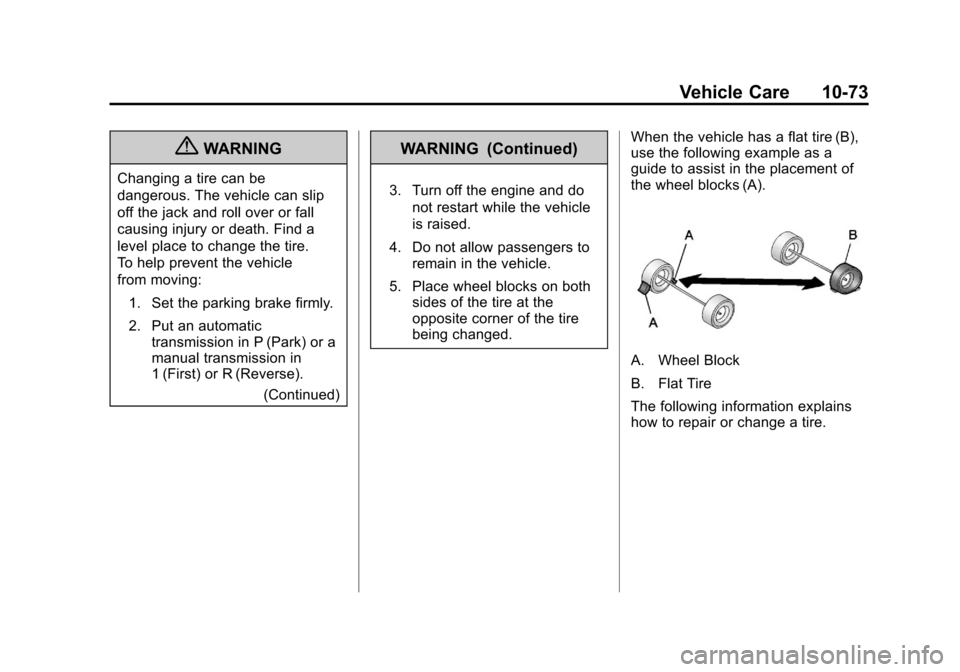
being changed. When the vehicle has a flat tire (B),
use the following example as a
guide to assist in the placement of
the wheel blocks (A).
A. Wheel Block
B. Flat Tire
The following information explains
how to repair or change a tire.
Page 338 of 430
Black plate (74,1)Chevrolet Express Owner Manual - 2012
10-74 Vehicle Care
Tire Changing
Removing the Spare Tire and
Tools
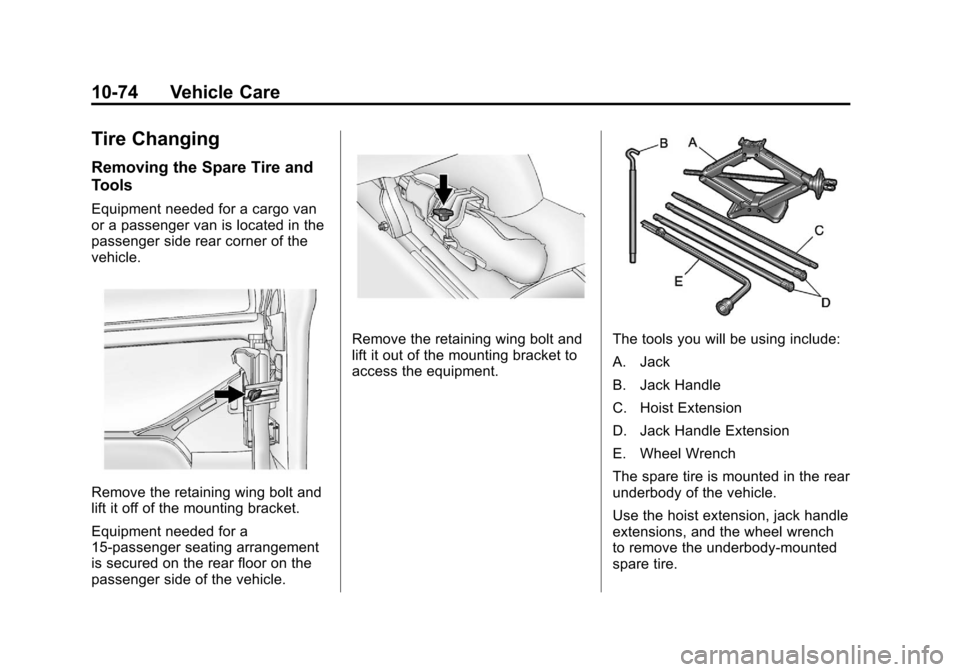
Equipment needed for a cargo van
or a passenger van is located in the
passenger side rear corner of the
vehicle.
Remove the retaining wing bolt and
lift it off of the mounting bracket.
Equipment needed for a
15‐passenger seating arrangement
is secured on the rear floor on the
passenger side of the vehicle.
Remove the retaining wing bolt and
lift it out of the mounting bracket to
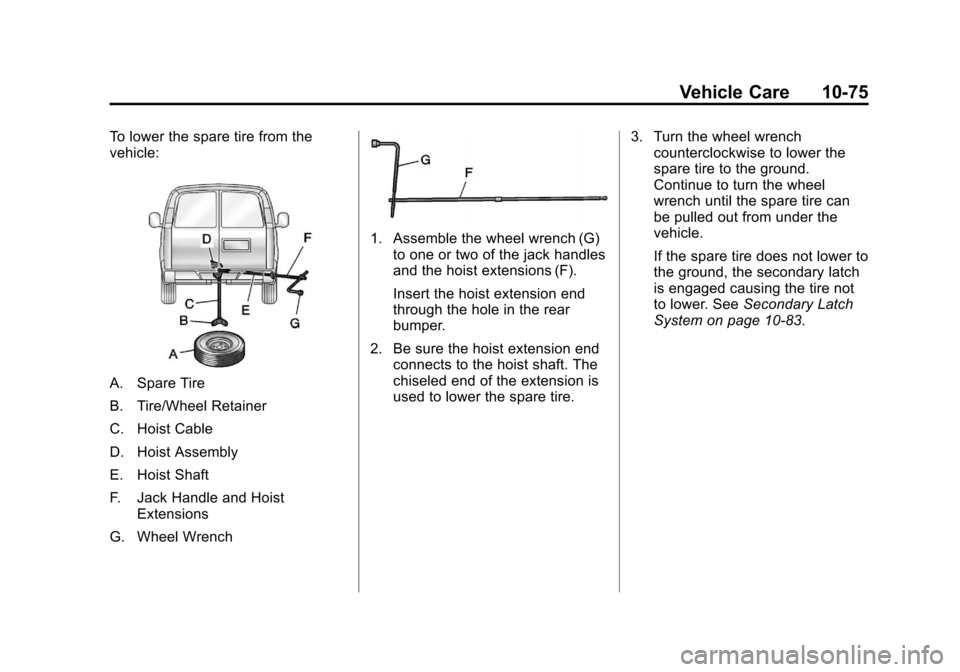
access the equipment.The tools you will be using include:
A. Jack
B. Jack Handle
C. Hoist Extension
D. Jack Handle Extension
E. Wheel Wrench
The spare tire is mounted in the rear
underbody of the vehicle.
Use the hoist extension, jack handle
extensions, and the wheel wrench
to remove the underbody‐mounted
spare tire.
Page 339 of 430
Black plate (75,1)Chevrolet Express Owner Manual - 2012
Vehicle Care 10-75
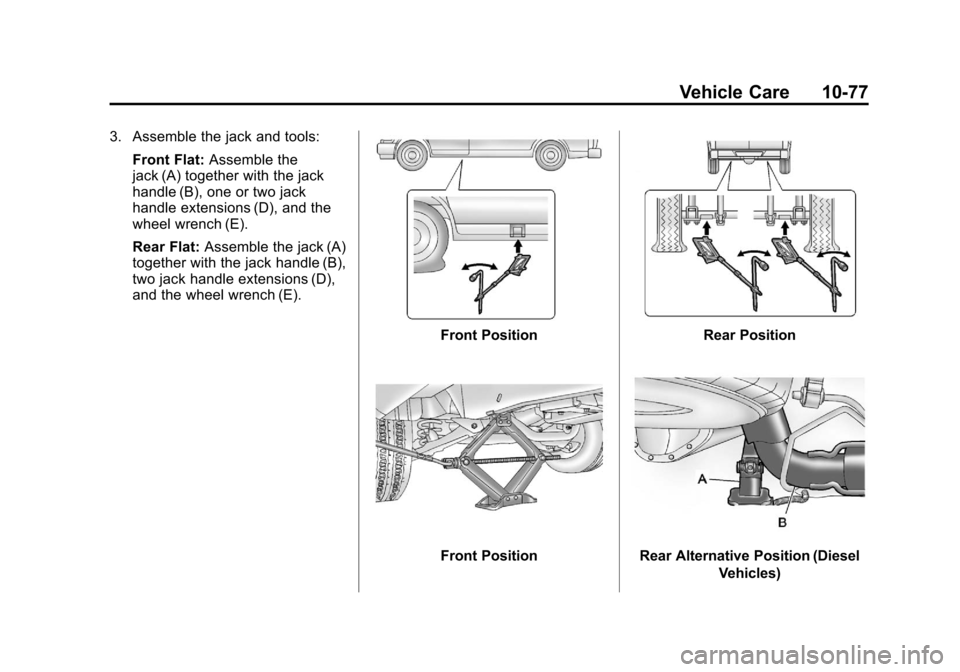
To lower the spare tire from the
vehicle:
A. Spare Tire
B. Tire/Wheel Retainer
C. Hoist Cable
D. Hoist Assembly
E. Hoist Shaft
F. Jack Handle and HoistExtensions
G. Wheel Wrench
1. Assemble the wheel wrench (G) to one or two of the jack handles
and the hoist extensions (F).
Insert the hoist extension end
through the hole in the rear
bumper.
2. Be sure the hoist extension end connects to the hoist shaft. The
chiseled end of the extension is
used to lower the spare tire. 3. Turn the wheel wrench
counterclockwise to lower the
spare tire to the ground.
Continue to turn the wheel
wrench until the spare tire can
be pulled out from under the
vehicle.
If the spare tire does not lower to
the ground, the secondary latch
is engaged causing the tire not
to lower. See Secondary Latch
System on page 10‑83.
Page 340 of 430

Black plate (76,1)Chevrolet Express Owner Manual - 2012
10-76 Vehicle Care
4. When the tire has been lowered,pull it closer to reach the tire
retainer and pull it up through
the wheel opening.
For a vehicle that was
completed from a cab and
chassis, refer to the information
from the body supplier/installer.
The spare tire is a full‐size tire,
like the other tires on the
vehicle.
5. Put the spare tire near the flat tire.
Removing the Flat Tire and
Installing the Spare Tire
If the vehicle has plastic wheel nut
caps, loosen them by turning the
wheel wrench counterclockwise.
The wheel nut caps are designed
to remain with the center cap.
Remove the center cap.
If the wheel has a smooth center
piece, place the chisel end of the
wheel wrench in the slot on the
wheel and gently pry it out.
1. Do a safety check beforeproceeding. See If a Tire Goes
Flat on page 10‑72 for more
information.
2. Loosen all the wheel nuts with the wheel wrench. Do not
remove them yet.
A. Jack
B. Jack Handle
C. Hoist Extension
D. Jack Handle Extension
E. Wheel Wrench
Page 341 of 430
Black plate (77,1)Chevrolet Express Owner Manual - 2012
Vehicle Care 10-77
3. Assemble the jack and tools:Front Flat: Assemble the
jack (A) together with the jack
handle (B), one or two jack
handle extensions (D), and the
wheel wrench (E).
Rear Flat: Assemble the jack (A)
together with the jack handle (B),
two jack handle extensions (D),
and the wheel wrench (E).
Front Position
Front Position
Rear Position
Rear Alternative Position (Diesel
Vehicles)