2012 CHEVROLET EXPRESS CARGO VAN tow
[x] Cancel search: towPage 261 of 430
Black plate (55,1)Chevrolet Express Owner Manual - 2012
Driving and Operating 9-55
It is important that the vehicle
does not exceed any of its
ratings—GCWR, GVWR, RGAWR,
Maximum Trailer Rating or Tongue
Weight. The only way to be sure it is
not exceeding any of these ratings
is to weigh the vehicle and trailer.
Total Weight on the Vehicle's
Tires
Be sure the vehicle tires are inflated
to the upper limit for cold tires.
These numbers can be found on the
Certification label at the rear edge of
the driver door, or see Vehicle Load
Limits on page 9‑11. Make sure not
to go over the GVW limit for the
vehicle, or the GAWR, including the
weight of the trailer tongue. If using
a weight distributing hitch, make
sure not to go over the rear axle
limit before applying the weight
distribution spring bars.
Towing Equipment
Hitches
It is important to have the correct
hitch equipment. Crosswinds, large
trucks going by and rough roads are
a few reasons why the right hitch is
needed.
Weight‐Distributing Hitches
and Weight Carrying Hitches
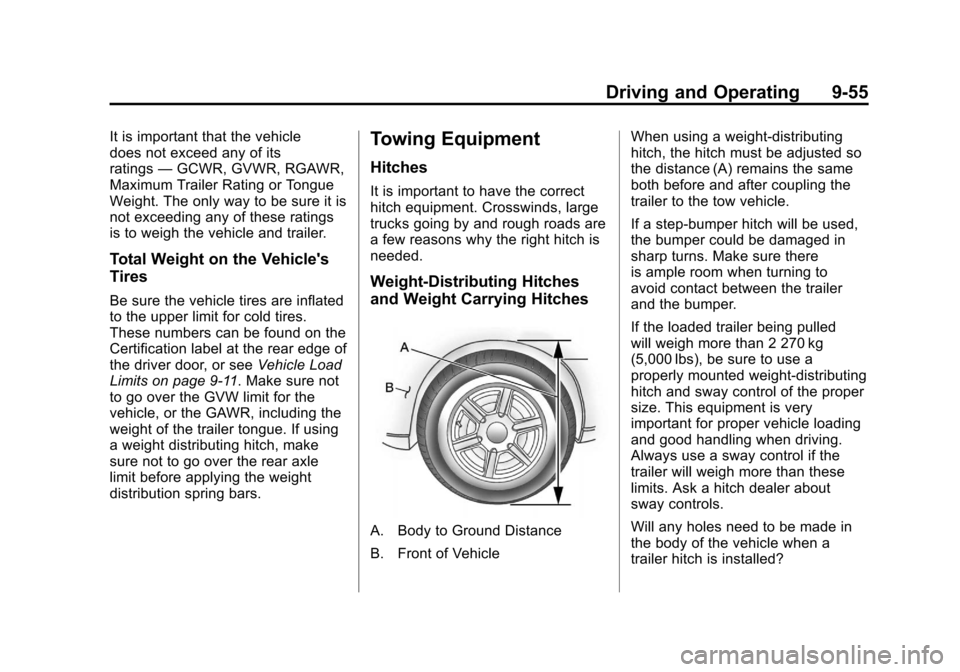
A. Body to Ground Distance
B. Front of Vehicle When using a weight-distributing
hitch, the hitch must be adjusted so
the distance (A) remains the same
both before and after coupling the
trailer to the tow vehicle.
If a step-bumper hitch will be used,
the bumper could be damaged in
sharp turns. Make sure there
is ample room when turning to
avoid contact between the trailer
and the bumper.
If the loaded trailer being pulled
will weigh more than 2 270 kg
(5,000 lbs), be sure to use a
properly mounted weight-distributing
hitch and sway control of the proper
size. This equipment is very
important for proper vehicle loading
and good handling when driving.
Always use a sway control if the
trailer will weigh more than these
limits. Ask a hitch dealer about
sway controls.
Will any holes need to be made in
the body of the vehicle when a
trailer hitch is installed?
Page 263 of 430
Black plate (57,1)Chevrolet Express Owner Manual - 2012
Driving and Operating 9-57
The four-wire harness (without
connector) contains the following
circuits:
.Black: Ground
.Red/White: Battery Feed
.Dark Blue: Trailer Brake Signal
.Light Blue: CHMSL/Stoplamp
Supply Voltage
* If the vehicle is a cutaway with
trailer provisions, a 15 amp fuse will
be shared for both left/stop trailer
turn and right/stop trailer turn
signals. However, the cutaway
lighting connector will have a
10 amp fuse for each signal.
** If the vehicle is a cutaway with
trailer provisions, a 15 amp fuse will
be shared for trailer park lamps and
cutaway rear lighting connector park
lamps. Also, a 10 amp fuse will be
shared for trailer back-up lamps and
cutaway rear lighting connector
back-up lamps.
Tow/Haul Mode
This button is on the instrument
panel, to the right of the steering
wheel.
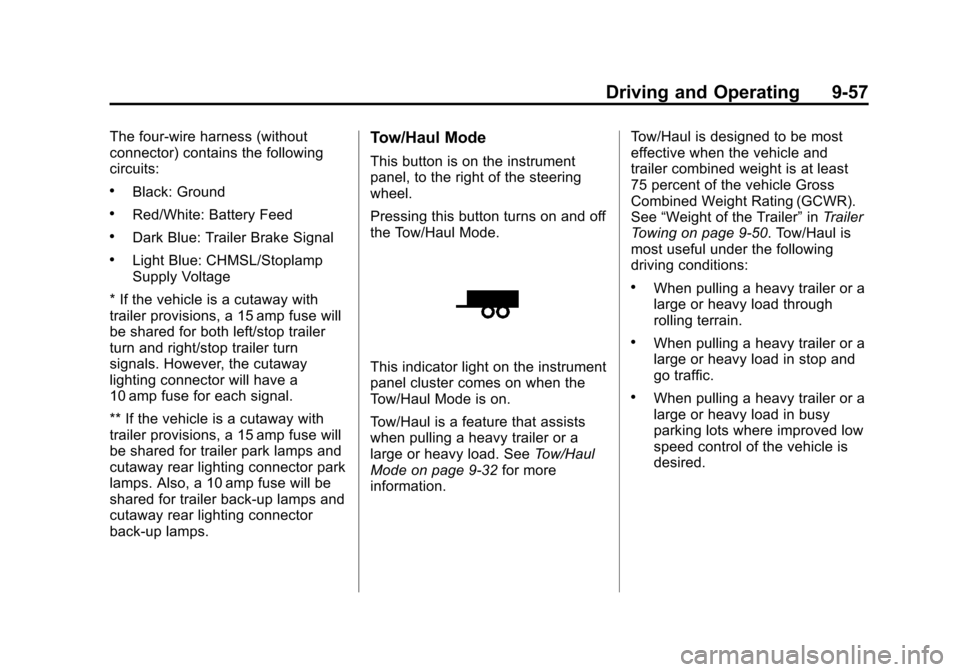
Pressing this button turns on and off
the Tow/Haul Mode.
This indicator light on the instrument
panel cluster comes on when the
Tow/Haul Mode is on.
Tow/Haul is a feature that assists
when pulling a heavy trailer or a
large or heavy load. See Tow/Haul
Mode on page 9‑32 for more
information. Tow/Haul is designed to be most
effective when the vehicle and
trailer combined weight is at least
75 percent of the vehicle Gross
Combined Weight Rating (GCWR).
See
“Weight of the Trailer” inTrailer
Towing on page 9‑50. Tow/Haul is
most useful under the following
driving conditions:
.When pulling a heavy trailer or a
large or heavy load through
rolling terrain.
.When pulling a heavy trailer or a
large or heavy load in stop and
go traffic.
.When pulling a heavy trailer or a
large or heavy load in busy
parking lots where improved low
speed control of the vehicle is
desired.
Page 264 of 430
Black plate (58,1)Chevrolet Express Owner Manual - 2012
9-58 Driving and Operating
Operating the vehicle in Tow/Haul
when lightly loaded or with no trailer
at all will not cause damage.
However, there is no benefit to the
selection of Tow/Haul when the
vehicle is unloaded. Such a
selection when unloaded may
result in unpleasant engine and
transmission driving characteristics
and reduced fuel economy. Tow/
Haul is recommended only when
pulling a heavy trailer or a large or
heavy load.Conversions and
Add-Ons
Add-On Electrical
Equipment
Notice:Do not add anything
electrical to the vehicle unless
you check with your dealer first.
Some electrical equipment can
damage the vehicle and the
damage would not be covered by
the vehicle's warranty. Some
add-on electrical equipment can
keep other components from
working as they should. Add-on equipment can drain the
vehicle's 12‐volt battery, even if
the vehicle is not operating.
The vehicle has an airbag system.
Before attempting to add anything
electrical to the vehicle, see
Servicing the Airbag-Equipped
Vehicle on page 3‑35
andAdding
Equipment to the Airbag-Equipped
Vehicle on page 3‑35.
Page 266 of 430
Black plate (2,1)Chevrolet Express Owner Manual - 2012
10-2 Vehicle Care
When It Is Time for NewTires . . . . . . . . . . . . . . . . . . . . . . 10-64
Buying New Tires . . . . . . . . . . . 10-65
Different Size Tires and Wheels . . . . . . . . . . . . . . . . . . . 10-67
Uniform Tire Quality Grading . . . . . . . . . . . . . . . . . . . 10-68
Wheel Alignment and Tire Balance . . . . . . . . . . . . . . . . . . . 10-69
Wheel Replacement . . . . . . . . 10-70
Tire Chains . . . . . . . . . . . . . . . . . 10-71
If a Tire Goes Flat . . . . . . . . . . 10-72
Tire Changing . . . . . . . . . . . . . . 10-74
Secondary Latch System . . . 10-83
Full-Size Spare Tire . . . . . . . . 10-85
Jump Starting
Jump Starting . . . . . . . . . . . . . . 10-86
Towing
Towing the Vehicle . . . . . . . . . 10-90
Recreational Vehicle Towing . . . . . . . . . . . . . . . . . . . . 10-90
Appearance Care
Exterior Care . . . . . . . . . . . . . . . 10-93
Interior Care . . . . . . . . . . . . . . . . 10-97
Floor Mats . . . . . . . . . . . . . . . . . . 10-99
General Information
For service and parts needs, visit
your dealer. You will receive
genuine GM parts and GM-trained
and supported service people.
Genuine GM parts have one of
these marks:
California Proposition
65 Warning
Most motor vehicles, including this
one, contain and/or emit chemicals
known to the State of California to
cause cancer and birth defects or
other reproductive harm. Engine
exhaust, many parts and systems,
many fluids, and some component
wear by-products contain and/or
emit these chemicals.
California Perchlorate
Materials Requirements
Certain types of automotive
applications, such as airbag
initiators, seat belt pretensioners,
and lithium batteries contained in
Remote Keyless Entry transmitters,
may contain perchlorate materials.
Special handling may be necessary.
For additional information, see
www.dtsc.ca.gov/hazardouswaste/
perchlorate.
Page 272 of 430
Black plate (8,1)Chevrolet Express Owner Manual - 2012
10-8 Vehicle Care
Checking Engine Oil
It is a good idea to check the engine
oil level at each fuel fill. In order to
get an accurate reading, the vehicle
must be on level ground. The
engine oil dipstick handle is a yellow
loop. SeeEngine Compartment
Overview on page 10‑6 for the
location of the engine oil dipstick.
Obtaining an accurate oil level
reading is essential:
1. If the engine has been running recently, turn off the engine and
allow several minutes for the oil
to drain back into the oil pan.
Checking the oil level too soon
after engine shutoff will not
provide an accurate oil level
reading.
2. Pull out the dipstick and clean it with a paper towel or cloth, then
push it back in all the way.
Remove it again, keeping the
tip down, and check the level.
When to Add Engine Oil
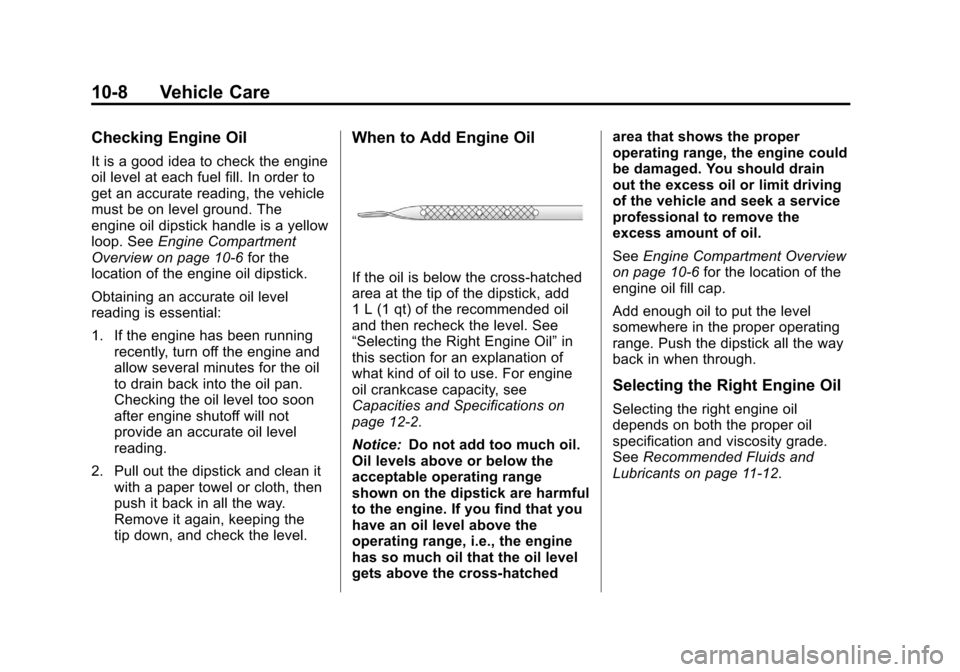
If the oil is below the cross-hatched
area at the tip of the dipstick, add
1 L (1 qt) of the recommended oil
and then recheck the level. See
“Selecting the Right Engine Oil” in
this section for an explanation of
what kind of oil to use. For engine
oil crankcase capacity, see
Capacities and Specifications on
page 12‑2.
Notice: Do not add too much oil.
Oil levels above or below the
acceptable operating range
shown on the dipstick are harmful
to the engine. If you find that you
have an oil level above the
operating range, i.e., the engine
has so much oil that the oil level
gets above the cross-hatched area that shows the proper
operating range, the engine could
be damaged. You should drain
out the excess oil or limit driving
of the vehicle and seek a service
professional to remove the
excess amount of oil.
See
Engine Compartment Overview
on page 10‑6 for the location of the
engine oil fill cap.
Add enough oil to put the level
somewhere in the proper operating
range. Push the dipstick all the way
back in when through.
Selecting the Right Engine Oil
Selecting the right engine oil
depends on both the proper oil
specification and viscosity grade.
See Recommended Fluids and
Lubricants on page 11‑12.
Page 276 of 430
Black plate (12,1)Chevrolet Express Owner Manual - 2012
10-12 Vehicle Care
A cold fluid check can be made
after the vehicle has been sitting for
eight hours or more with the engine
off, but this is used only as a
reference. Let the engine run
at idle for five minutes if outside
temperatures are 10°C (50°F) or
more. If it is colder than 10°C
(50°F), the engine may have to idle
longer. Should the fluid level be low
during this cold check, the fluid must
be checked hot before adding fluid.
Checking the fluid hot will give a
more accurate reading of the
fluid level.
Checking the Fluid Level
Prepare the vehicle as follows:
1. Park the vehicle on a levelplace. Keep the engine running.
2. With the parking brake applied, place the shift lever in P (Park). 3. With your foot on the brake
pedal, move the shift lever
through each gear range,
pausing for about three seconds
in each range. Then, position
the shift lever in P (Park).
4. Let the engine run at idle for three minutes or more.
Then, without shutting off the
engine, follow these steps:
The transmission dipstick is located
near the center of the engine
compartment and will be labeled
with the graphic shown.
See Engine Compartment Overview
on page 10‑6 for more information.
1. Flip the handle up and then pull out the dipstick and wipe it with
a clean rag or paper towel. 2. Push it back in all the way, wait
three seconds and then pull it
back out again.
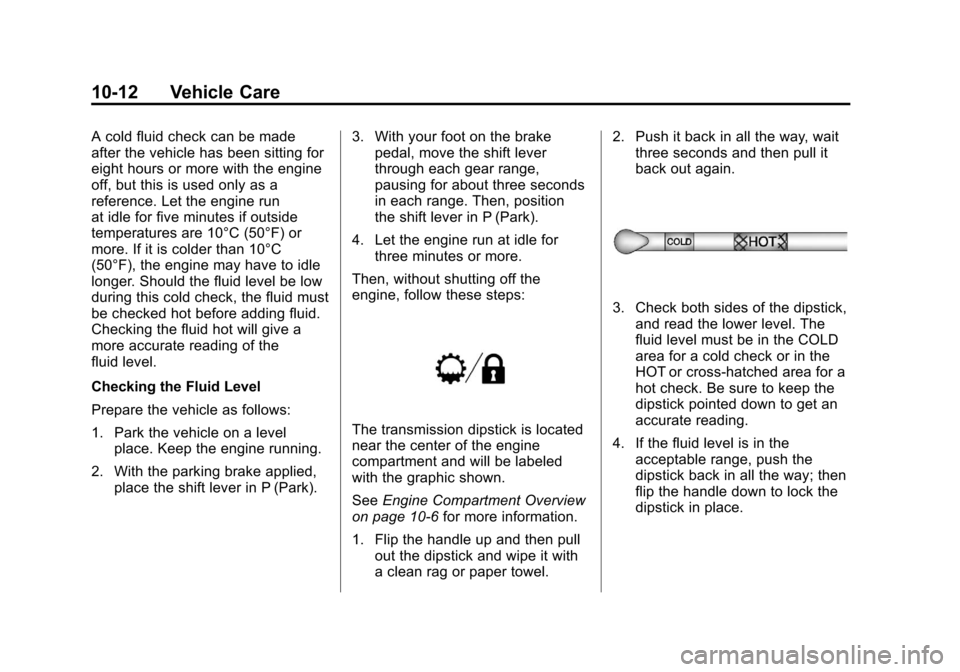
3. Check both sides of the dipstick,
and read the lower level. The
fluid level must be in the COLD
area for a cold check or in the
HOT or cross-hatched area for a
hot check. Be sure to keep the
dipstick pointed down to get an
accurate reading.
4. If the fluid level is in the acceptable range, push the
dipstick back in all the way; then
flip the handle down to lock the
dipstick in place.
Page 277 of 430
Black plate (13,1)Chevrolet Express Owner Manual - 2012
Vehicle Care 10-13
How to Add Automatic
Transmission Fluid
Refer toRecommended Fluids and
Lubricants on page 11‑12 to
determine what kind of transmission
fluid to use.
Using a funnel, add fluid down the
transmission dipstick tube only after
checking the transmission fluid
while it is hot. A cold check is used
only as a reference. If the fluid level
is low, add only enough of the
proper fluid to bring the level up to
the HOT area for a hot check.
It does not take much fluid,
generally less than 0.5 L (1 pt).
Do not overfill.
Notice: Use of the incorrect
automatic transmission fluid may
damage the vehicle, and the
damages may not be covered by
the vehicle warranty. Always use
the automatic transmission fluid
listed in Recommended Fluids
and Lubricants on page 11‑12.
.After adding fluid, recheck the
fluid level as described under
“How to Check Automatic
Transmission Fluid,” earlier in
this section.
.When the correct fluid level is
obtained, push the dipstick back
in all the way; then flip the
handle down to lock the dipstick
in place.
Automatic Transmission
Fluid (6-Speed
Transmission)
When to Check and Change
Automatic Transmission Fluid
It is usually not necessary to
check the transmission fluid level.
The only reason for fluid loss is a
transmission leak or overheating
the transmission. If a small leak is
suspected, use the following
procedures to check the fluid level. However, if there is a large leak,
then it may be necessary to have
the vehicle towed to a dealer and
have it repaired before driving the
vehicle further.
Change the fluid and filter at the
intervals listed in
Maintenance
Schedule on page 11‑3, and be sure
to use the transmission fluid listed in
Recommended Fluids and
Lubricants on page 11‑12.
How to Check Automatic
Transmission Fluid
Because this operation can be
difficult, it is recommended to have
this check done at the dealer,
which can monitor the transmission
temperature. The transmission fluid
level increases with temperature. To
obtain a highly accurate fluid level
check, the transmission temperature
must be measured.
Page 279 of 430
Black plate (15,1)Chevrolet Express Owner Manual - 2012
Vehicle Care 10-15
Checking the Fluid Level
Prepare the vehicle as follows:
1. Park the vehicle on a levelplace. Keep the engine running.
2. With the parking brake applied, place the shift lever in P (Park).
3. With foot on the brake pedal, move the shift lever through
each gear range, pausing for
about three seconds in each
range. When M is reached,
move the selector from M1
through M3. Then, position the
shift lever in P (Park).
4. Let the engine run at idle for two minutes or more.
Then, without shutting off the
engine:The transmission dipstick is located
near the center of the engine
compartment and will be labeled
with the graphic shown.
See Engine Compartment Overview
on page 10‑6 for more information
on location.
1. Flip the handle up and then pull out the dipstick and wipe it with
a clean rag or paper towel.
2. Push it back in all the way, wait three seconds and then pull it
back out again.
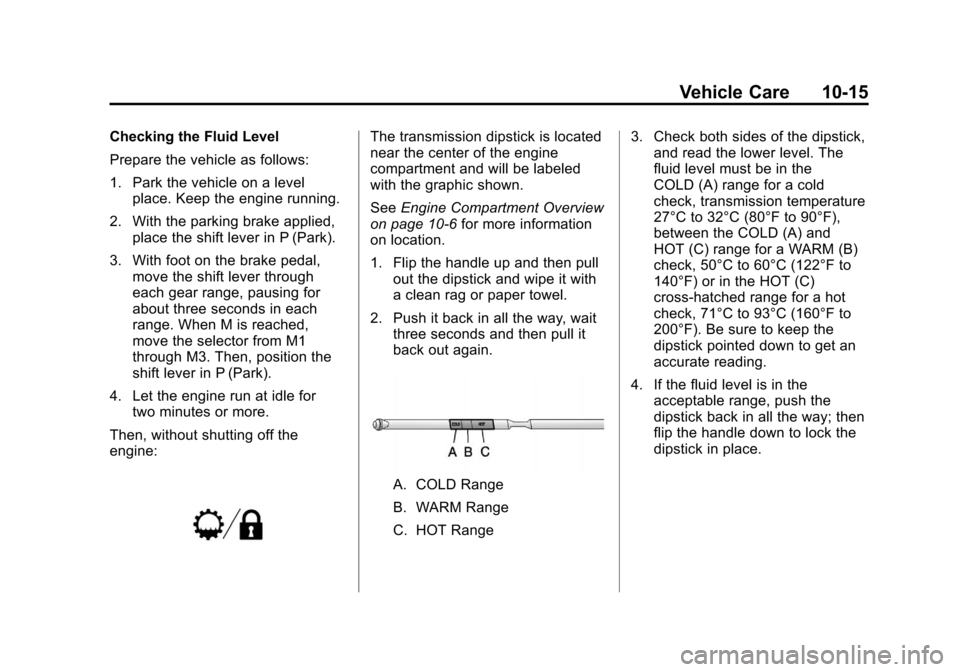
A. COLD Range
B. WARM Range
C. HOT Range 3. Check both sides of the dipstick,
and read the lower level. The
fluid level must be in the
COLD (A) range for a cold
check, transmission temperature
27°C to 32°C (80°F to 90°F),
between the COLD (A) and
HOT (C) range for a WARM (B)
check, 50°C to 60°C (122°F to
140°F) or in the HOT (C)
cross-hatched range for a hot
check, 71°C to 93°C (160°F to
200°F). Be sure to keep the
dipstick pointed down to get an
accurate reading.
4. If the fluid level is in the acceptable range, push the
dipstick back in all the way; then
flip the handle down to lock the
dipstick in place.