Page 287 of 430
Black plate (23,1)Chevrolet Express Owner Manual - 2012
Vehicle Care 10-23
Notice:If the engine catches fire
because of being driven with no
coolant, the vehicle can be badly
damaged. The costly repairs
would not be covered by the
vehicle warranty.
If Steam is Coming from the
Engine Compartment
{WARNING
Steam from an overheated engine
can burn you badly, even if you
just open the hood. Stay away
from the engine if you see or hear
steam coming from it. Just turn it
off and get everyone away from
the vehicle until it cools down.
Wait until there is no sign of
steam or coolant before you
open the hood.
(Continued)
WARNING (Continued)
If you keep driving when the
engine is overheated, the liquids
in it can catch fire. You or others
could be badly burned. Stop the
engine if it overheats, and get out
of the vehicle until the engine
is cool.
If No Steam is Coming from
the Engine Compartment
If an engine overheat warning is
displayed but no steam can be seen
or heard, the problem may not be
too serious. Sometimes the engine
can get a little too hot when the
vehicle:
.Climbs a long hill on a hot day.
.Stops after high-speed driving.
.Idles for long periods in traffic.
.Tows a trailer. See“Driving on
Grades” underTrailer Towing on
page 9‑50. If the overheat warning is displayed
with no sign of steam:
1. Turn the air off.
2. Turn the heater on to the highest
temperature and to the highest
fan speed. Open the windows as
necessary.
3. In heavy traffic, let the engine idle in N (Neutral) while stopped.
If it is safe to do so, pull off
the road, shift to P (Park) or
N (Neutral) and let the
engine idle.
If the temperature overheat gauge is
no longer in the overheat zone or an
overheat warning no longer
displays, the vehicle can be driven.
Continue to drive the vehicle slowly
for about 10 minutes. Keep a safe
vehicle distance from the vehicle in
front. If the warning does not come
back on, continue to drive normally.
If the warning continues, pull over,
stop, and park the vehicle
right away.
Page 288 of 430
Black plate (24,1)Chevrolet Express Owner Manual - 2012
10-24 Vehicle Care
If there is still no sign of steam,
push down the accelerator until the
engine speed is about twice as fast
as normal idle speed for at least
three minutes while you are parked.
If the warning is still on, turn off the
engine until it cools down.
If the decision is made not to lift the
hood, get service help right away.
Engine Fan
The vehicle has a clutched engine
cooling fan. When the clutch is
engaged, the fan spins faster to
provide more air to cool the engine.
In most everyday driving conditions,
the fan is spinning slower and the
clutch is not fully engaged. This
improves fuel economy and reduces
fan noise. Under heavy vehicle
loading, trailer towing, and/or high
outside temperatures, the fan speed
increases as the clutch more fully
engages, so an increase in fan
noise may be heard. This is normal
and should not be mistaken as thetransmission slipping or making
extra shifts. It is merely the cooling
system functioning properly. The fan
will slow down when additional
cooling is not required and the
clutch partially disengages.
This fan noise may be heard when
starting the engine. It will go away
as the fan clutch partially
disengages.Power Steering Fluid
The power steering fluid reservoir is
located in the engine compartment
on the driver side of the vehicle.
See
Engine Compartment Overview
on page 10‑6 for reservoir location.
When to Check Power Steering
Fluid
It is not necessary to regularly
check power steering fluid unless
there is a leak suspected in the
system or an unusual noise is
heard. A fluid loss in this system
could indicate a problem. Have the
system inspected and repaired.
How to Check Power Steering
Fluid
Notice:Extremely small amounts
of contamination can cause
steering system damage and
cause it to not work properly.
Do not allow contaminants to
contact the fluid side of the
reservoir cap/dipstick or from
entering the reservoir.
To check the power steering fluid,
do the following:
1. Turn the key off and let the engine compartment cool down.
2. Wipe the cap and the top of the reservoir clean.
Page 307 of 430
Black plate (43,1)Chevrolet Express Owner Manual - 2012
Vehicle Care 10-43
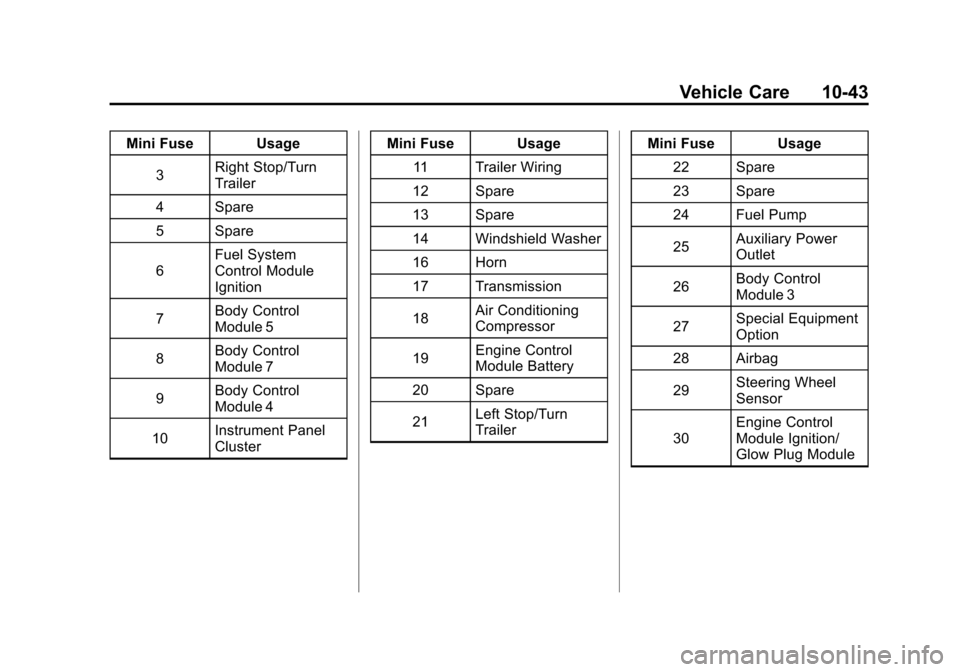
Mini Fuse Usage3 Right Stop/Turn
Trailer
4 Spare
5 Spare
6 Fuel System
Control Module
Ignition
7 Body Control
Module 5
8 Body Control
Module 7
9 Body Control
Module 4
10 Instrument Panel
Cluster Mini Fuse Usage
11 Trailer Wiring
12 Spare
13 Spare
14 Windshield Washer
16 Horn
17 Transmission
18 Air Conditioning
Compressor
19 Engine Control
Module Battery
20 Spare
21 Left Stop/Turn
Trailer Mini Fuse Usage
22 Spare
23 Spare
24 Fuel Pump
25 Auxiliary Power
Outlet
26 Body Control
Module 3
27 Special Equipment
Option
28 Airbag
29 Steering Wheel
Sensor
30 Engine Control
Module Ignition/
Glow Plug Module
Page 308 of 430
Black plate (44,1)Chevrolet Express Owner Manual - 2012
10-44 Vehicle Care
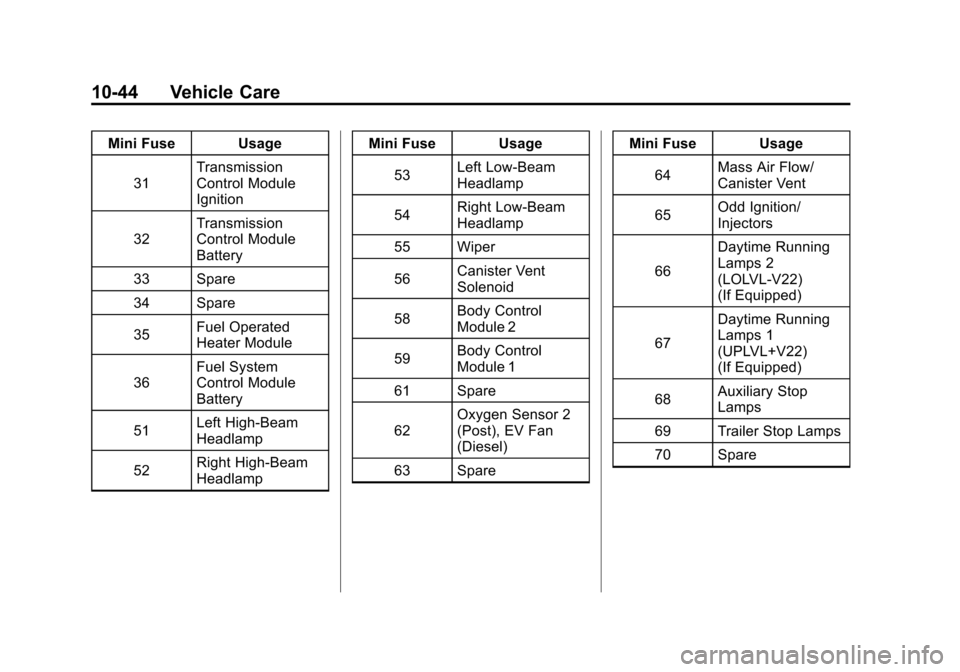
Mini Fuse Usage31 Transmission
Control Module
Ignition
32 Transmission
Control Module
Battery
33 Spare
34 Spare
35 Fuel Operated
Heater Module
36 Fuel System
Control Module
Battery
51 Left High‐Beam
Headlamp
52 Right High‐Beam
Headlamp Mini Fuse Usage
53 Left Low‐Beam
Headlamp
54 Right Low‐Beam
Headlamp
55 Wiper
56 Canister Vent
Solenoid
58 Body Control
Module 2
59 Body Control
Module 1
61 Spare
62 Oxygen Sensor 2
(Post), EV Fan
(Diesel)
63 Spare Mini Fuse Usage
64 Mass Air Flow/
Canister Vent
65 Odd Ignition/
Injectors
66 Daytime Running
Lamps 2
(LOLVL‐V22)
(If Equipped)
67 Daytime Running
Lamps 1
(UPLVL+V22)
(If Equipped)
68 Auxiliary Stop
Lamps
69 Trailer Stop Lamps
70 Spare
Page 309 of 430
Black plate (45,1)Chevrolet Express Owner Manual - 2012
Vehicle Care 10-45
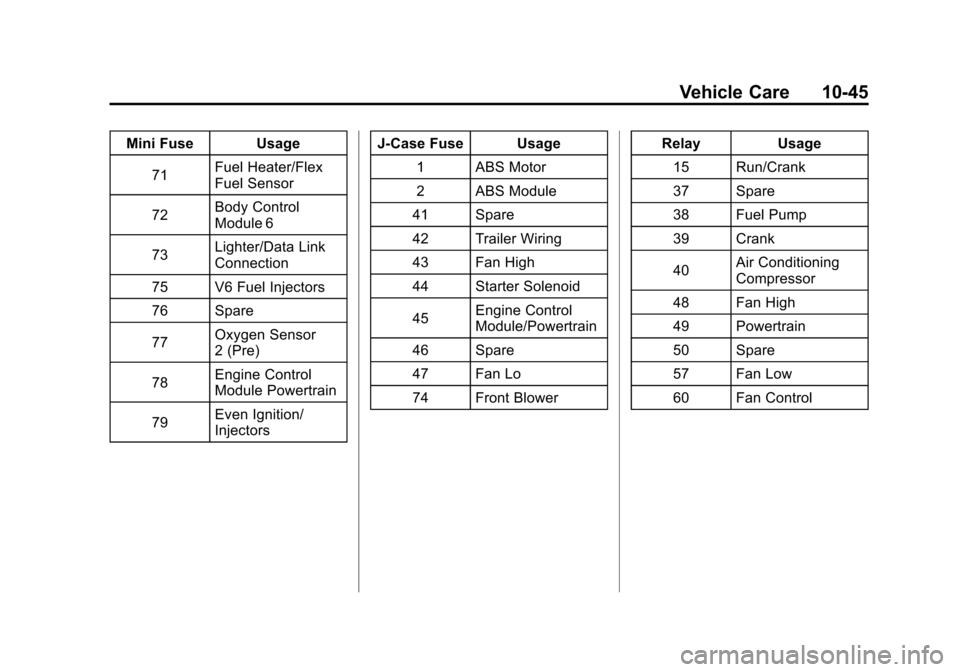
Mini Fuse Usage71 Fuel Heater/Flex
Fuel Sensor
72 Body Control
Module 6
73 Lighter/Data Link
Connection
75 V6 Fuel Injectors
76 Spare
77 Oxygen Sensor
2 (Pre)
78 Engine Control
Module Powertrain
79 Even Ignition/
Injectors J‐Case Fuse Usage
1 ABS Motor
2 ABS Module
41 Spare
42 Trailer Wiring
43 Fan High
44 Starter Solenoid
45 Engine Control
Module/Powertrain
46 Spare
47 Fan Lo
74 Front Blower Relay Usage
15 Run/Crank
37 Spare
38 Fuel Pump
39 Crank
40 Air Conditioning
Compressor
48 Fan High
49 Powertrain
50 Spare
57 Fan Low
60 Fan Control
Page 311 of 430
Black plate (47,1)Chevrolet Express Owner Manual - 2012
Vehicle Care 10-47
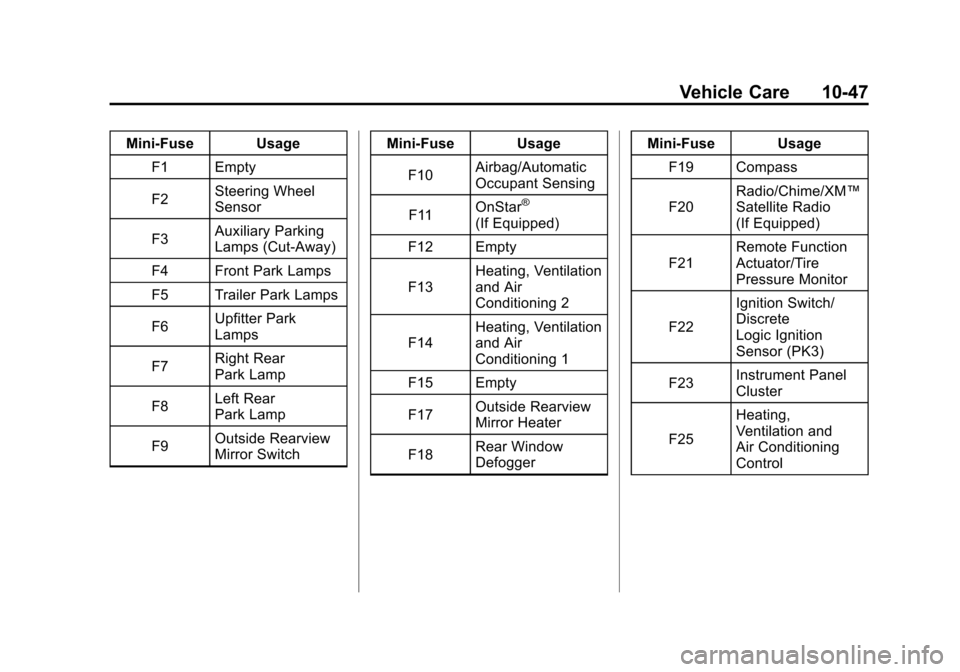
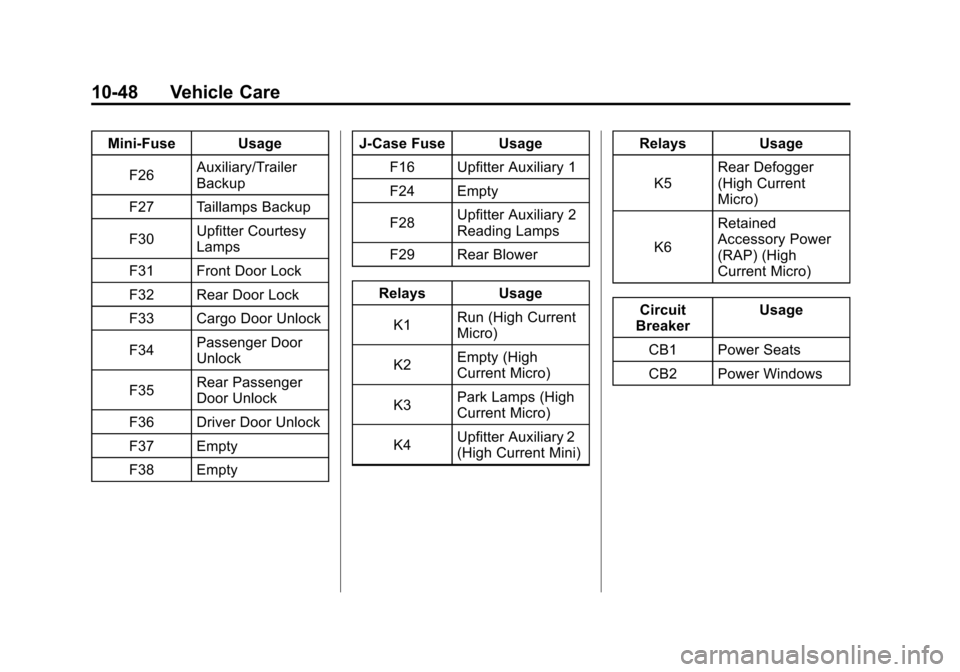
Mini‐Fuse UsageF1 Empty
F2 Steering Wheel
Sensor
F3 Auxiliary Parking
Lamps (Cut‐Away)
F4 Front Park Lamps
F5 Trailer Park Lamps
F6 Upfitter Park
Lamps
F7 Right Rear
Park Lamp
F8 Left Rear
Park Lamp
F9 Outside Rearview
Mirror Switch Mini‐Fuse Usage
F10 Airbag/Automatic
Occupant Sensing
F11 OnStar
®
(If Equipped)
F12 Empty
F13 Heating, Ventilation
and Air
Conditioning 2
F14 Heating, Ventilation
and Air
Conditioning 1
F15 Empty
F17 Outside Rearview
Mirror Heater
F18 Rear Window
Defogger Mini‐Fuse Usage
F19 Compass
F20 Radio/Chime/XM™
Satellite Radio
(If Equipped)
F21 Remote Function
Actuator/Tire
Pressure Monitor
F22 Ignition Switch/
Discrete
Logic Ignition
Sensor (PK3)
F23 Instrument Panel
Cluster
F25 Heating,
Ventilation and
Air Conditioning
Control
Page 312 of 430
Black plate (48,1)Chevrolet Express Owner Manual - 2012
10-48 Vehicle Care
Mini‐Fuse UsageF26 Auxiliary/Trailer
Backup
F27 Taillamps Backup
F30 Upfitter Courtesy
Lamps
F31 Front Door Lock
F32 Rear Door Lock
F33 Cargo Door Unlock
F34 Passenger Door
Unlock
F35 Rear Passenger
Door Unlock
F36 Driver Door Unlock
F37 Empty
F38 Empty J‐Case Fuse Usage
F16 Upfitter Auxiliary 1
F24 Empty
F28 Upfitter Auxiliary 2
Reading Lamps
F29 Rear Blower
Relays Usage K1 Run (High Current
Micro)
K2 Empty (High
Current Micro)
K3 Park Lamps (High
Current Micro)
K4 Upfitter Auxiliary 2
(High Current Mini) Relays Usage
K5 Rear Defogger
(High Current
Micro)
K6 Retained
Accessory Power
(RAP) (High
Current Micro)
Circuit
Breaker Usage
CB1 Power Seats
CB2 Power Windows
Page 354 of 430
Black plate (90,1)Chevrolet Express Owner Manual - 2012
10-90 Vehicle Care
Towing
Towing the Vehicle
Notice:To avoid damage, the
disabled vehicle should be towed
with all four wheels off the
ground. Care must be taken with
vehicles that have low ground
clearance and/or special
equipment. Always flatbed on a
car carrier.
Consult your dealer or a
professional towing service if the
disabled vehicle must be towed.
See Roadside Assistance Program
(U.S. and Canada) on page 13‑8 or
Roadside Assistance Program
(Mexico) on page 13‑10.
To tow the vehicle behind another
vehicle for recreational purposes,
such as behind a motor home, see
“Recreational Vehicle Towing” in
this section.
Recreational Vehicle
Towing
Recreational vehicle towing means
towing the vehicle behind another
vehicle –such as behind a motor
home. The two most common types
of recreational vehicle towing are
known as dinghy towing and dolly
towing. Dinghy towing is towing the
vehicle with all four wheels on the
ground. Dolly towing is towing the
vehicle with two wheels on the
ground and two wheels up on a
device known as a dolly.
Here are some important things
to consider before recreational
vehicle towing:
.What is the towing capacity of
the towing vehicle? Be sure to
read the tow vehicle
manufacturer's
recommendations.
.What is the distance that will be
travelled? Some vehicles have
restrictions on how far and how
long they can tow.
.Is the proper towing equipment
going to be used? See your
dealer or trailering professional
for additional advice and
equipment recommendations.
.Is the vehicle ready to be
towed? Just as preparing the
vehicle for a long trip, make sure
the vehicle is prepared to be
towed.