Page 245 of 400
Black plate (47,1)Chevrolet Cruze Owner Manual - 2012
Driving and Operating 9-47
Do not release the cap too soon or
it will spring back. Reinstall the cap
by turning it clockwise until it clicks.
If the cap is not properly installed,
the malfunction indicator lamp will
come on. SeeMalfunction Indicator
Lamp on page 5‑13 for more
information.
{WARNING
Fuel can spray out on you if you
open the fuel cap too quickly.
If you spill fuel and then
something ignites it, you could be
badly burned. This spray can
happen if the tank is nearly full,
and is more likely in hot weather.
(Continued)
WARNING (Continued)
Open the fuel cap slowly and wait
for any hiss noise to stop. Then
unscrew the cap all the way.
Do not top off or overfill the tank.
Wait a few seconds before removing
the nozzle. Clean fuel from painted
surfaces as soon as possible. See
Exterior Care on page 10‑86.
{WARNING
If a fire starts while you are
refueling, do not remove the
nozzle. Shut off the flow of fuel by
shutting off the pump or by
notifying the station attendant.
Leave the area immediately. Notice:
If a new fuel cap is
needed, be sure to get the right
type of cap from your dealer. The
wrong type of fuel cap might not
fit properly, might cause the
malfunction indicator lamp to
light, and could damage the fuel
tank and emissions system. See
Malfunction Indicator Lamp on
page 5‑13.
Page 273 of 400
Black plate (19,1)Chevrolet Cruze Owner Manual - 2012
Vehicle Care 10-19
WARNING (Continued)
and it will burn if the engine parts
are hot enough. Do not spill
coolant on a hot engine.
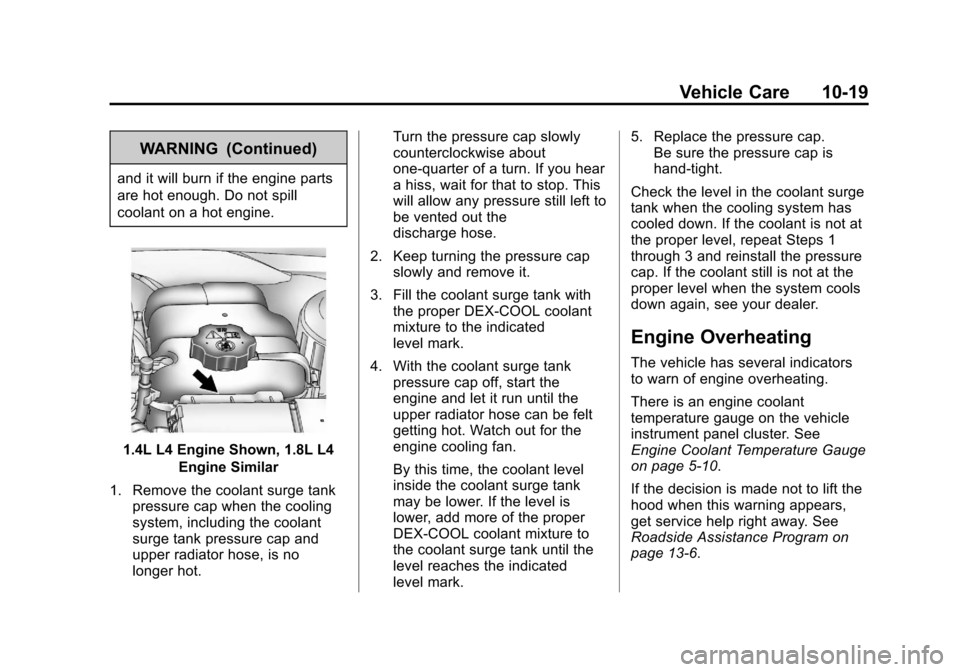
1.4L L4 Engine Shown, 1.8L L4Engine Similar
1. Remove the coolant surge tank pressure cap when the cooling
system, including the coolant
surge tank pressure cap and
upper radiator hose, is no
longer hot. Turn the pressure cap slowly
counterclockwise about
one-quarter of a turn. If you hear
a hiss, wait for that to stop. This
will allow any pressure still left to
be vented out the
discharge hose.
2. Keep turning the pressure cap slowly and remove it.
3. Fill the coolant surge tank with the proper DEX-COOL coolant
mixture to the indicated
level mark.
4. With the coolant surge tank pressure cap off, start the
engine and let it run until the
upper radiator hose can be felt
getting hot. Watch out for the
engine cooling fan.
By this time, the coolant level
inside the coolant surge tank
may be lower. If the level is
lower, add more of the proper
DEX-COOL coolant mixture to
the coolant surge tank until the
level reaches the indicated
level mark. 5. Replace the pressure cap.
Be sure the pressure cap is
hand-tight.
Check the level in the coolant surge
tank when the cooling system has
cooled down. If the coolant is not at
the proper level, repeat Steps 1
through 3 and reinstall the pressure
cap. If the coolant still is not at the
proper level when the system cools
down again, see your dealer.
Engine Overheating
The vehicle has several indicators
to warn of engine overheating.
There is an engine coolant
temperature gauge on the vehicle
instrument panel cluster. See
Engine Coolant Temperature Gauge
on page 5‑10.
If the decision is made not to lift the
hood when this warning appears,
get service help right away. See
Roadside Assistance Program on
page 13‑6.
Page 284 of 400
Black plate (30,1)Chevrolet Cruze Owner Manual - 2012
10-30 Vehicle Care
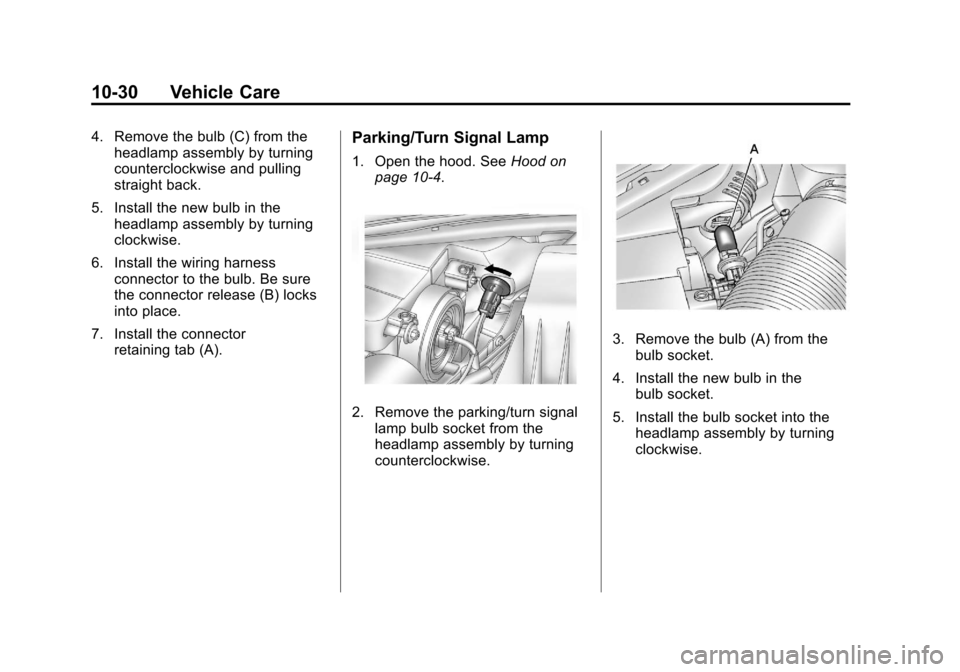
4. Remove the bulb (C) from theheadlamp assembly by turning
counterclockwise and pulling
straight back.
5. Install the new bulb in the headlamp assembly by turning
clockwise.
6. Install the wiring harness connector to the bulb. Be sure
the connector release (B) locks
into place.
7. Install the connector retaining tab (A).Parking/Turn Signal Lamp
1. Open the hood. See Hood on
page 10‑4.
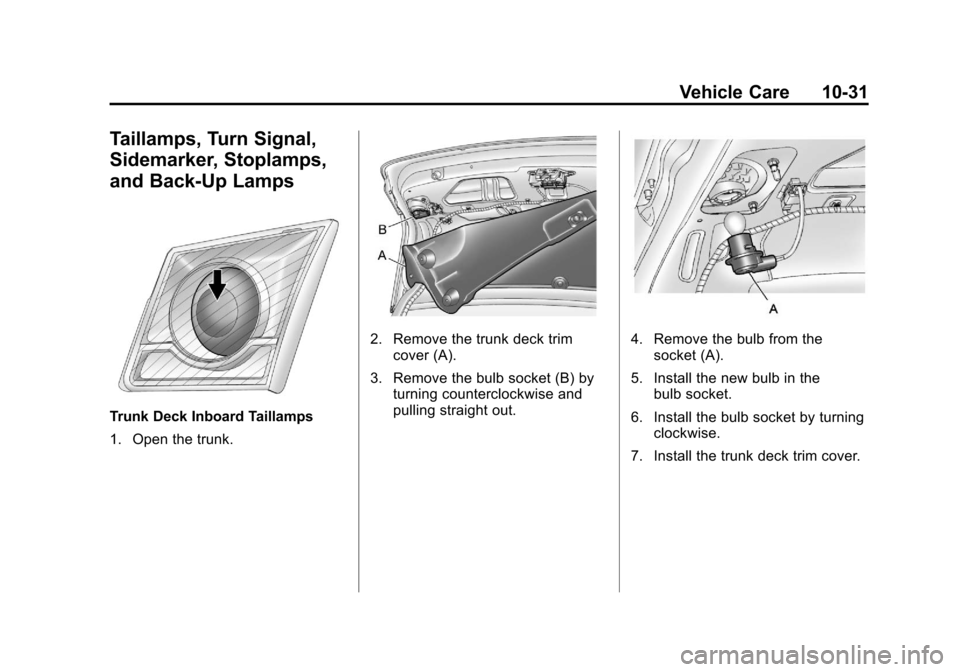
2. Remove the parking/turn signal lamp bulb socket from the
headlamp assembly by turning
counterclockwise.
3. Remove the bulb (A) from thebulb socket.
4. Install the new bulb in the bulb socket.
5. Install the bulb socket into the headlamp assembly by turning
clockwise.
Page 285 of 400
Black plate (31,1)Chevrolet Cruze Owner Manual - 2012
Vehicle Care 10-31
Taillamps, Turn Signal,
Sidemarker, Stoplamps,
and Back-Up Lamps
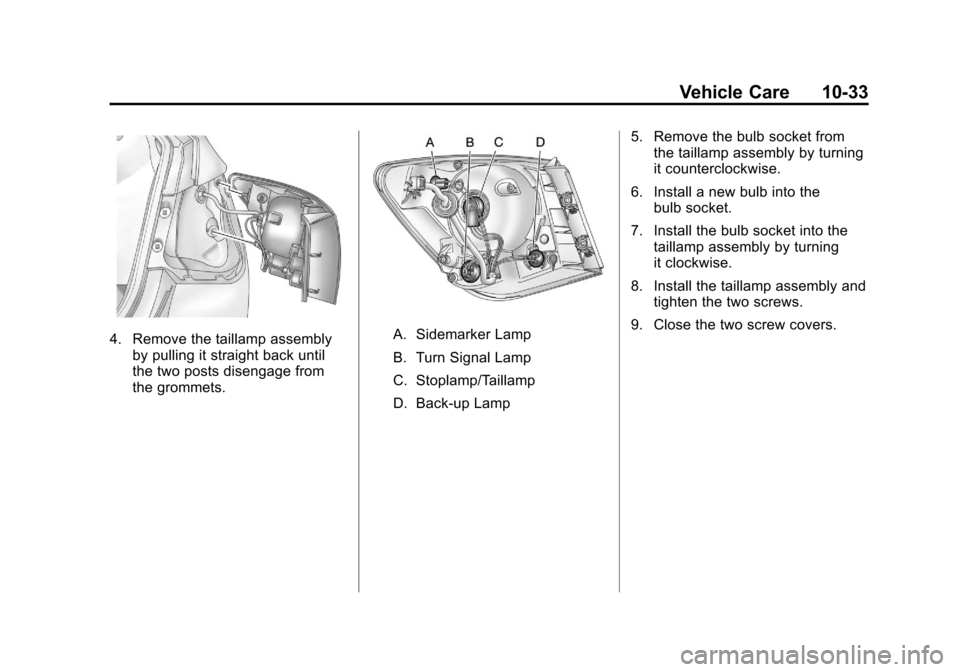
Trunk Deck Inboard Taillamps
1. Open the trunk.
2. Remove the trunk deck trimcover (A).
3. Remove the bulb socket (B) by turning counterclockwise and
pulling straight out.4. Remove the bulb from thesocket (A).
5. Install the new bulb in the bulb socket.
6. Install the bulb socket by turning clockwise.
7. Install the trunk deck trim cover.
Page 287 of 400
Black plate (33,1)Chevrolet Cruze Owner Manual - 2012
Vehicle Care 10-33
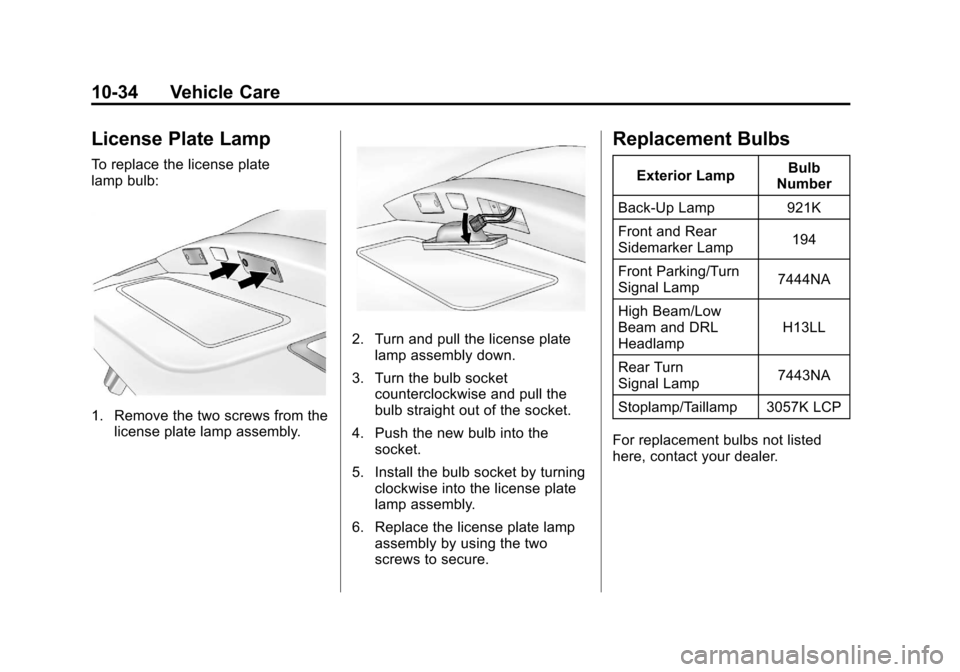
4. Remove the taillamp assemblyby pulling it straight back until
the two posts disengage from
the grommets.A. Sidemarker Lamp
B. Turn Signal Lamp
C. Stoplamp/Taillamp
D. Back-up Lamp 5. Remove the bulb socket from
the taillamp assembly by turning
it counterclockwise.
6. Install a new bulb into the bulb socket.
7. Install the bulb socket into the taillamp assembly by turning
it clockwise.
8. Install the taillamp assembly and tighten the two screws.
9. Close the two screw covers.
Page 288 of 400
Black plate (34,1)Chevrolet Cruze Owner Manual - 2012
10-34 Vehicle Care
License Plate Lamp
To replace the license plate
lamp bulb:
1. Remove the two screws from thelicense plate lamp assembly.
2. Turn and pull the license platelamp assembly down.
3. Turn the bulb socket counterclockwise and pull the
bulb straight out of the socket.
4. Push the new bulb into the socket.
5. Install the bulb socket by turning clockwise into the license plate
lamp assembly.
6. Replace the license plate lamp assembly by using the two
screws to secure.
Replacement Bulbs
Exterior Lamp Bulb
Number
Back-Up Lamp 921K
Front and Rear
Sidemarker Lamp 194
Front Parking/Turn
Signal Lamp 7444NA
High Beam/Low
Beam and DRL
Headlamp H13LL
Rear Turn
Signal Lamp 7443NA
Stoplamp/Taillamp 3057K LCP
For replacement bulbs not listed
here, contact your dealer.
Page 321 of 400
Black plate (67,1)Chevrolet Cruze Owner Manual - 2012
Vehicle Care 10-67
If a tire goes flat, avoid further tire
and wheel damage by driving slowly
to a level place. Turn on the hazard
warning flashers. SeeHazard
Warning Flashers on page 6‑3.
See If a Tire Goes Flat on
page 10‑63 for other important
safety warnings.
Do not remove any objects that
have penetrated the tire.
1. Remove the tire sealant and compressor kit from its storage
location. See Storing the Tire
Sealant and Compressor Kit on
page 10‑72.
Make sure the on/off button (D)
is in the off O position.
2. Unwrap the sealant/air hose (G) and the power plug (C).
3. Place the kit on the ground.
Make sure the tire valve stem is
positioned close to the ground
so the hose will reach it. 4. Remove the valve stem cap from
the flat tire by turning it
counterclockwise.
5. Attach the sealant/air hose (G) onto the tire valve stem. Turn it
clockwise until it is tight.
6. Plug the power plug (C) into the accessory power outlet in the
vehicle. Unplug all items from
other accessory power outlets.
See Power Outlets on page 5‑5.
If the vehicle has an accessory
power outlet, do not use the
cigarette lighter.
If the vehicle only has a cigarette
lighter, use the cigarette lighter.
Do not pinch the power plug
cord in the door or window.
7. Start the vehicle. The vehicle must be running while using the
air compressor.
8. Press the on/off button (D) to turn the tire sealant and
compressor kit on. The compressor will inject
sealant and air into the tire.
The pressure gauge (E) will
initially show a high pressure
while the compressor pushes the
sealant into the tire. Once the
sealant is completely dispersed
into the tire, the pressure will
quickly drop and start to rise
again as the tire inflates with
air only.
9. Inflate the tire to the recommended inflation pressure
using the pressure gauge (E).
The recommended inflation
pressure can be found on the
Tire and Loading Information
label. See Tire Pressure on
page 10‑49.
The pressure gauge (E) may
read higher than the actual tire
pressure while the compressor is
on. Turn the compressor off to
get an accurate pressure
reading. The compressor may
be turned on/off until the correct
pressure is reached.
Page 322 of 400
Black plate (68,1)Chevrolet Cruze Owner Manual - 2012
10-68 Vehicle Care
Notice:If the recommended
pressure cannot be reached after
approximately 25 minutes, the
vehicle should not be driven
farther. The tire is too severely
damaged and the tire sealant and
compressor kit cannot inflate the
tire. Remove the power plug from
the accessory power outlet and
unscrew the inflating hose from
the tire valve. See Roadside
Assistance Program on
page 13‑6.
10. Press the on/off button (D) to turn the tire sealant and
compressor kit off.
The tire is not sealed and will
continue to leak air until the
vehicle is driven and the
sealant is distributed in the tire.
Therefore, Steps 11 through
17 must be done immediately
after Step 10.
Be careful while handling the
tire sealant and compressor kit
as it could be warm after
usage. 11. Unplug the power plug (C) from
the accessory power outlet in
the vehicle.
12. Turn the sealant/air hose (G) counterclockwise to remove it
from the tire valve stem.
13. Replace the tire valve stem cap.
14. Replace the sealant/air hose (G), and the power
plug (C) back in their
original location.
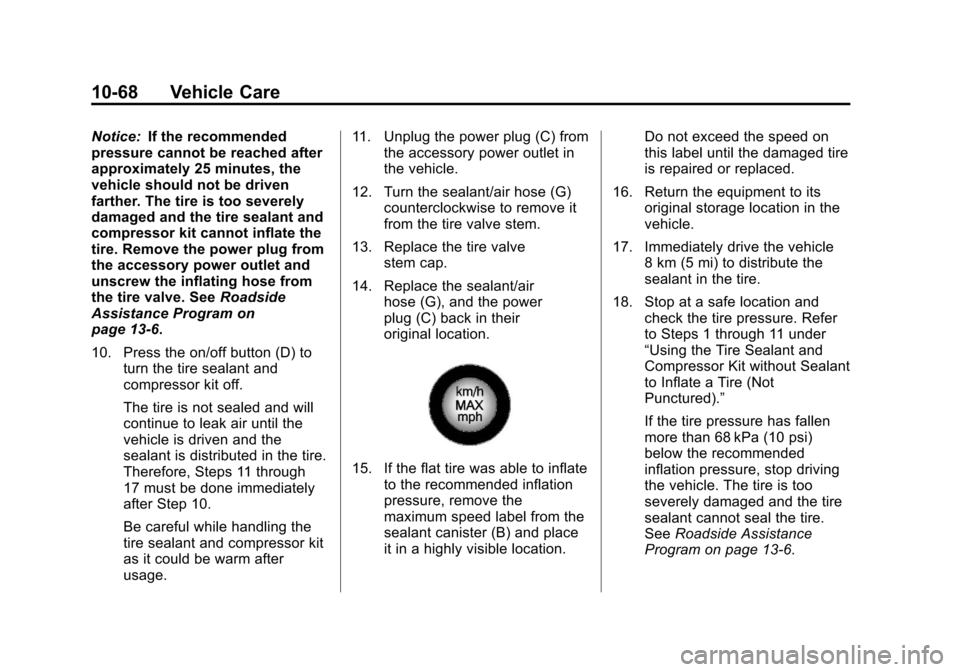
15. If the flat tire was able to inflateto the recommended inflation
pressure, remove the
maximum speed label from the
sealant canister (B) and place
it in a highly visible location. Do not exceed the speed on
this label until the damaged tire
is repaired or replaced.
16. Return the equipment to its original storage location in the
vehicle.
17. Immediately drive the vehicle 8 km (5 mi) to distribute the
sealant in the tire.
18. Stop at a safe location and check the tire pressure. Refer
to Steps 1 through 11 under
“Using the Tire Sealant and
Compressor Kit without Sealant
to Inflate a Tire (Not
Punctured).”
If the tire pressure has fallen
more than 68 kPa (10 psi)
below the recommended
inflation pressure, stop driving
the vehicle. The tire is too
severely damaged and the tire
sealant cannot seal the tire.
SeeRoadside Assistance
Program on page 13‑6.