2012 CHEVROLET COLORADO tow
[x] Cancel search: towPage 201 of 394
Black plate (27,1)Chevrolet Colorado Owner Manual - 2012
Driving and Operating 9-27
Retained Accessory
Power (RAP)
These vehicle accessories can be
used for up to 20 minutes after the
engine is turned off:
.Audio System
.Wipers
.Power Windows
These features work when the
key is in ON/RUN or ACC/
ACCESSORY. Once the key is
turned from ON/RUN to LOCK/OFF,
power to these features continue to
work for up to 20 minutes or until a
door is opened.
Shifting Into Park
(Automatic Transmission)
{WARNING
It can be dangerous to get out of
the vehicle if the shift lever is not
fully in P (Park) with the parking
brake firmly set. The vehicle can
roll. If you have left the engine
running, the vehicle can move
suddenly. You or others could be
injured. To be sure the vehicle will
not move, even when you are on
fairly level ground, use the steps
that follow. If you are pulling a
trailer, see Driving Characteristics
and Towing Tips on page 9‑53.
1. Hold the brake pedal down with your right foot and set the
parking brake.
See Parking Brake on page 9‑41
for more information.
{WARNING
If you have four-wheel drive, the
vehicle will be free to roll —even
if the shift lever is in P (Park) —if
the transfer case is in Neutral. So,
be sure the transfer case is in a
drive gear, two-wheel high (2H)
or four-wheel high (4H) or
four-wheel low (4L) —not in
Neutral.
2. Move the shift lever into P (Park) by pulling the lever toward you
and moving it up as far as it
will go.
3. Turn the ignition key to LOCK/OFF.
4. Remove the key and take it with you. If you can leave the vehicle
with the key, the vehicle is in
P (Park).
Page 202 of 394
Black plate (28,1)Chevrolet Colorado Owner Manual - 2012
9-28 Driving and Operating
Leaving the Vehicle With the
Engine Running (Automatic
Transmission)
{WARNING
It can be dangerous to leave the
vehicle with the engine running.
The vehicle could move suddenly
if the shift lever is not fully in
P (Park) with the parking brake
firmly set. And, if you leave the
vehicle with the engine running, it
could overheat and even catch
fire. You or others could be
injured. Do not leave the vehicle
with the engine running.
If you have to leave the vehicle with
the engine running, be sure the
vehicle is in P (Park) and the
parking brake is firmly set before
you leave it. After you have moved
the shift lever into P (Park), hold the
regular brake pedal down. Then,
see if you can move the shift lever
away from P (Park) without first pulling it toward you. If you can, the
shift lever was not fully locked into
P (Park).
Torque Lock (Automatic
Transmission)
If you are parking on a hill and
you do not shift the transmission
into P (Park) properly, the weight
of the vehicle may put too much
force on the parking pawl in the
transmission. You may find it difficult
to pull the shift lever out of P (Park).
This is called torque lock. To
prevent torque lock, set the parking
brake and then shift into P (Park)
properly before you leave the driver
seat. To find out how, see
“Shifting
Into Park (Automatic Transmission)”
in this section.
When you are ready to drive, move
the shift lever out of P (Park) before
you release the parking brake.
If torque lock does occur, you may
need to have another vehicle push
yours a little uphill to take some of the pressure from the parking pawl
in the transmission, so you can pull
the shift lever out of P (Park).
Shifting out of Park
(Automatic Transmission)
The vehicle has an automatic
transmission shift lock control
system. You have to fully apply the
brake pedal before you can shift
from P (Park) when the ignition
is ON/RUN. See
Automatic
Transmission on page 9‑31.
The shift lock control system is
designed to do the following:
.Prevent the ignition key from
being removed unless the shift
lever is in P (Park).
.Prevent movement of the shift
lever out of P (Park), unless the
ignition is in ON/RUN and the
brake pedal is applied.
The shift lock control system is
always functional except in the case
of a dead battery or low voltage
(less than 9 V) battery.
Page 203 of 394
Black plate (29,1)Chevrolet Colorado Owner Manual - 2012
Driving and Operating 9-29
If the vehicle has an uncharged
battery or a battery with low voltage,
try charging or jump starting the
battery. SeeJump Starting on
page 10‑84 for more information.
To shift out of P (Park) use the
following:
1. Apply the brake pedal.
2. Move the shift lever to the desired position.
If you still are unable to shift out of
P (Park):
1. Ease the pressure on the shift lever.
2. While holding down the brake pedal, push the shift lever all the
way into P (Park).
3. Move the shift lever to the desired position.
If you are still having a problem
shifting, then have the vehicle
serviced.Parking (Manual
Transmission)
If the vehicle has a manual
transmission, before you get out of
the vehicle, move the shift lever into
R (Reverse), and firmly apply the
parking brake. Once the shift lever
has been placed into R (Reverse)
with the clutch pedal pressed in,
turn the ignition key to LOCK/OFF,
remove the key and release the
clutch.
If you are parking on a hill, or if
the vehicle is pulling a trailer, see
Driving Characteristics and Towing
Tips on page 9‑53.
Parking over Things
That Burn
{WARNING
Things that can burn could touch
hot exhaust parts under the
vehicle and ignite. Do not park
over papers, leaves, dry grass,
or other things that can burn.
Page 205 of 394
Black plate (31,1)Chevrolet Colorado Owner Manual - 2012
Driving and Operating 9-31
{WARNING
It can be dangerous to get out
of the vehicle if the automatic
transmission shift lever is not fully
in P (Park) with the parking brake
firmly set. The vehicle can roll. Do
not leave the vehicle when the
engine is running unless you
have to. If you have left the
engine running, the vehicle can
move suddenly. You or others
could be injured. To be sure the
vehicle will not move, even when
it is on fairly level ground, always
set the parking brake and move
the automatic transmission shift
lever to P (Park), or the manual
transmission shift lever to Neutral.
{WARNING
Four-wheel drive vehicles with the
transfer case in N (Neutral) will
allow the vehicle to roll, even if
the automatic transmission shift
lever is in P (Park). So, be sure
the transfer case is in a drive
gear—not in N (Neutral). Always
set the parking brake.
Follow the proper steps to be sure
the vehicle will not move. See
Shifting Into Park (Automatic
Transmission) on page 9‑27.
If pulling a trailer, see Driving
Characteristics and Towing Tips on
page 9‑53.
Automatic
Transmission
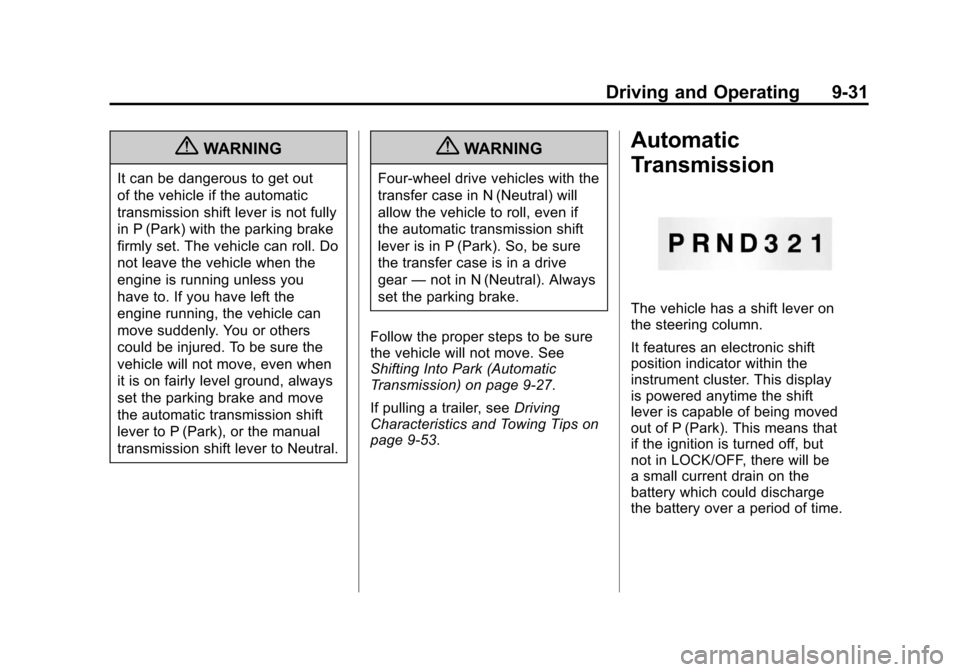
The vehicle has a shift lever on
the steering column.
It features an electronic shift
position indicator within the
instrument cluster. This display
is powered anytime the shift
lever is capable of being moved
out of P (Park). This means that
if the ignition is turned off, but
not in LOCK/OFF, there will be
a small current drain on the
battery which could discharge
the battery over a period of time.
Page 206 of 394

Black plate (32,1)Chevrolet Colorado Owner Manual - 2012
9-32 Driving and Operating
If you need to leave the key in the
ignition but not in LOCK/OFF for an
extended period, it is recommended
that you disconnect the battery
cable from the battery to prevent
discharging the battery.
There are several different positions
for the shift lever.
P (Park):This position locks the
rear wheels. It is the best position
to use when you start the engine
because the vehicle cannot move
easily.
{WARNING
It is dangerous to get out of the
vehicle if the shift lever is not fully
in P (Park) with the parking brake
firmly set. The vehicle can roll.
(Continued)
WARNING (Continued)
Do not leave the vehicle when
the engine is running unless
you have to. If you have left the
engine running, the vehicle can
move suddenly. You or others
could be injured. To be sure the
vehicle will not move, even when
you are on fairly level ground,
always set the parking brake and
move the shift lever to P (Park).
SeeShifting Into Park (Automatic
Transmission) on page 9‑27.
If you are pulling a trailer, see
Driving Characteristics and
Towing Tips on page 9‑53. Make sure the shift lever is fully in
P (Park) before starting the engine.
The vehicle has an automatic
transmission shift lock control
system. You must fully apply the
brake pedal before you can shift
from P (Park) when the ignition key
is in ON/RUN. If you cannot shift out
of P (Park), ease pressure on the
shift lever by pushing the shift lever
all the way into P (Park) as you
maintain brake application. Then
move the shift lever into another
gear. See
Shifting out of Park
(Automatic Transmission) on
page 9‑28.
R (Reverse): Use this gear to
back up.
Notice: Shifting to R (Reverse)
while the vehicle is moving
forward could damage the
transmission. The repairs would
not be covered by the vehicle
warranty. Shift to R (Reverse) only
after the vehicle is stopped.
Page 207 of 394

Black plate (33,1)Chevrolet Colorado Owner Manual - 2012
Driving and Operating 9-33
To rock your vehicle back and forth
to get out of snow, ice, or sand
without damaging the transmission,
seeIf the Vehicle Is Stuck on
page 9‑15.
N (Neutral): In this position, the
engine does not connect with the
wheels. To restart the engine when
the vehicle is are already moving,
use N (Neutral) only.
{WARNING
Shifting into a drive gear while the
engine is running at high speed is
dangerous. Unless your foot is
firmly on the brake pedal, the
vehicle could move very rapidly.
You could lose control and hit
people or objects. Do not shift
into a drive gear while the engine
is running at high speed. Notice:
Shifting out of P (Park)
or N (Neutral) with the engine
running at high speed may
damage the transmission. The
repairs would not be covered by
the vehicle warranty. Be sure the
engine is not running at high
speed when shifting the vehicle.
D (Drive): This position is for
normal driving. It provides the best
fuel economy. If you need more
power for passing, and you are:.Going less than about 55 km/h
(35 mph), push the accelerator
pedal about halfway down.
.Going about 55 km/h (35 mph) or
more, push the accelerator all
the way down.
The transmission will shift down
to the next gear and the vehicle
will have more power. Downshifting the transmission in
slippery road conditions could result
in skidding, see
“Skidding”under
Loss of Control on page 9‑5.
3 (Third): This position is also used
for normal driving. However, it
reduces vehicle speed more than
D (Drive) without using the brakes.
You might choose 3 (Third) instead
of D (Drive) when driving on hilly,
winding roads, or when towing a
trailer, so there is less shifting
between gears and when going
down a steep hill.
2 (Second): This position reduces
vehicle speed even more than
3 (Third) without using the brakes.
You can use 2 (Second) to help
control vehicle speed on steep
mountain roads, but then you would
also want to use the brakes off
and on.
Page 211 of 394

Black plate (37,1)Chevrolet Colorado Owner Manual - 2012
Driving and Operating 9-37
Recommended Transfer Case Settings
Driving ConditionsTransfer Case Settings
2m4m4nN
Normal YES Severe YES
Extreme YES
Vehicle in Tow* YES
*See Recreational Vehicle Towing on page 10‑89 orTowing the Vehicle on
page 10‑89 for further information.
Shifting into Four‐Wheel Low
will turn Traction Control and
StabiliTrak
®off. See Traction
Control System (TCS) on page 9‑42
and StabiliTrak
®System on
page 9‑44 for more information. Use these buttons to shift into and
out of four-wheel drive. You can
choose from the following:
2m(Two-Wheel High):
This setting
is for driving in most street and
highway situations. The front axle is
not engaged in two-wheel drive.
{WARNING
Shifting the transfer case to
N (Neutral) can cause the vehicle
to roll even if the transmission is
in P (Park). You or someone else
could be seriously injured. Be
sure to set the parking brake
before placing the transfer case in
N (Neutral). See Parking Brake on
page 9‑41.
N (Neutral): Shift the vehicle's
transfer case to N (Neutral) only
when towing the vehicle.
4
m(Four-Wheel High): This setting
engages the front axle to help drive
the vehicle. Use four-wheel high
when you need extra traction, such
as on snowy or icy roads, or in most
off-road situations.
Page 213 of 394
Black plate (39,1)Chevrolet Colorado Owner Manual - 2012
Driving and Operating 9-39
Shifting from Four-Wheel
Low to Two-Wheel High or
Four-Wheel High
To shift from Four-Wheel Low to
Two-Wheel High or Four-Wheel
High, the vehicle must be stopped
or moving less than 5 km/h (3 mph)
with the transmission in N (Neutral)
for an automatic transmission or the
clutch pedal pressed for a manual
transmission. The preferred method
for shifting out of Four-Wheel Low
is to have your vehicle moving
1.6 to 3.2 km/h (1 to 2 mph).
Press and release the Four-Wheel
High or Two-Wheel High button. You
must wait for the Four-Wheel High
or Two-Wheel High indicator light to
stop flashing and stay on before
shifting the transmission into gear or
releasing the clutch pedal.
If the Four-Wheel High or
Two-Wheel High button is pressed
when the vehicle is in gear and/or
moving faster than 5 km/h (3 mph),
the Four-Wheel High or Two-WheelHigh indicator light will flash for
30 seconds but not complete the
shift.
Shifting to Neutral
Use N (Neutral) when you plan to
tow the vehicle. See
Recreational
Vehicle Towing on page 10‑89 for
towing instructions. To shift the
transfer case into N (Neutral) do
the following:
1. Set the parking brake.
2. Start the vehicle.
3. Press the regular brake pedal and shift the transmission in
N (Neutral), or press in the
clutch for vehicles with a manual
transmission.
4. Shift the transfer case to Two-Wheel High.
5. Press and hold the Two-Wheel High and Four-Wheel Low
buttons at the same time for
10 seconds. The N (Neutral) light will come on when the transfer
case shift to N (Neutral) is
complete.
6. Press and hold the regular brake pedal and shift the transmission
to R (Reverse) for one second,
then shift the transmission
to D (Drive) for one second,
or 1 (First) for vehicles with
manual transmissions, and let
out the clutch to insure the
transfer case is in N (Neutral).
If the transfer case is not
in N (Neutral), repeat this
procedure starting at Step 3.
7. Turn the engine off by turning the key to ACC/ACCESSORY.
8. Place the transmission shift lever in P (Park), or 1 (First) for
vehicles that have a manual
transmission.
9. Turn the ignition to LOCK/OFF.