2012 CADILLAC ESCALADE HYBRID wheel
[x] Cancel search: wheelPage 65 of 90

Black plate (23,1)Cadillac Escalade Hybrid - 2012
Vehicle Care 10-23Read and follow all of the tire
sealant and compressor kit
instructions.
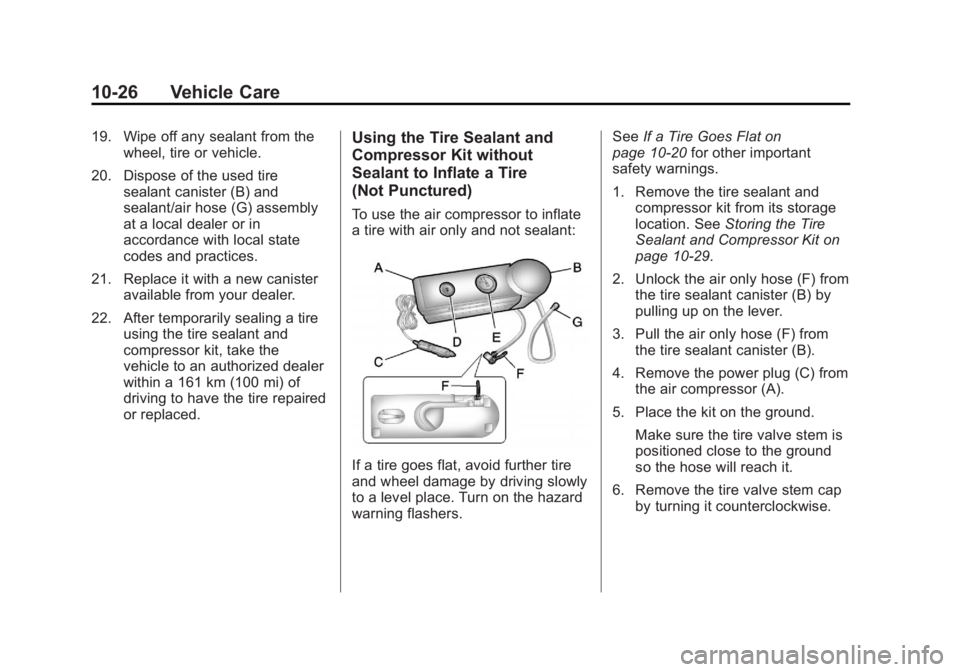
The kit includes:
A. Air Compressor
B. Tire Sealant Canister
C. Power Plug
D. On/Off Button
E. Pressure Gauge
F. Air Only Hose (Black)
G. Sealant/Air Hose (Clear) Tire Sealant Read and follow the safe handling
instructions on the label adhered to
the sealant canister.
Check the tire sealant expiration
date on the sealant canister.
The sealant canister should be
replaced before its expiration date.
Replacement sealant canisters are
available at your local dealer. See
“ Removal and Installation of the
Sealant Canister ” following.
There is only enough sealant to seal
one tire. After usage, the sealant
canister and sealant/air hose
assembly must be replaced. See
“ Removal and Installation of the
Sealant Canister ” following.
Using the Tire Sealant
and Compressor Kit to
Temporarily Seal and Inflate
a Punctured Tire
Follow the directions closely for
correct sealant usage. When using the tire sealant and
compressor kit during cold
temperatures, warm the kit in a
heated environment for five minutes.
This will help to inflate the tire
faster.
If a tire goes flat, avoid further tire
and wheel damage by driving slowly
to a level place. Turn on the hazard
warning flashers.
See If a Tire Goes Flat on
page 10 ‑ 20 for other important
safety warnings.
Page 68 of 90
Black plate (26,1)Cadillac Escalade Hybrid - 2012
10-26 Vehicle Care 19. Wipe off any sealant from the
wheel, tire or vehicle.
20. Dispose of the used tire
sealant canister (B) and
sealant/air hose (G) assembly
at a local dealer or in
accordance with local state
codes and practices.
21. Replace it with a new canister
available from your dealer.
22. After temporarily sealing a tire
using the tire sealant and
compressor kit, take the
vehicle to an authorized dealer
within a 161 km (100 mi) of
driving to have the tire repaired
or replaced. Using the Tire Sealant and
Compressor Kit without
Sealant to Inflate a Tire
(Not Punctured) To use the air compressor to inflate
a tire with air only and not sealant:
If a tire goes flat, avoid further tire
and wheel damage by driving slowly
to a level place. Turn on the hazard
warning flashers. See If a Tire Goes Flat on
page 10 ‑ 20 for other important
safety warnings.
1. Remove the tire sealant and
compressor kit from its storage
location. See Storing the Tire
Sealant and Compressor Kit on
page 10 ‑ 29 .
2. Unlock the air only hose (F) from
the tire sealant canister (B) by
pulling up on the lever.
3. Pull the air only hose (F) from
the tire sealant canister (B).
4. Remove the power plug (C) from
the air compressor (A).
5. Place the kit on the ground.
Make sure the tire valve stem is
positioned close to the ground
so the hose will reach it.
6. Remove the tire valve stem cap
by turning it counterclockwise.
Page 71 of 90

Black plate (29,1)Cadillac Escalade Hybrid - 2012
Vehicle Care 10-29
Storing the Tire Sealant
and Compressor Kit The tire sealant and compressor kit
is located under the storage tray on
the driver side trim panel (over the
rear wheelhouse).
To access the tire sealant and
compressor kit:
1. Remove the tray by pulling up
on the finger depression to
access the tire sealant and
compressor kit. 2. Locate the tire sealant and
compressor kit.
3. Remove the sealant and
compressor kit by pulling the
velcro strip up and back.
4. Remove the sealant and
compressor kit from its plastic
tray assembly.
To store the tire sealant and
compressor kit, reverse the steps. Jump Starting
{ WARNINGPersonal injury, death, or damage
to the vehicle can result if you try
jump starting or using a battery
charger on the high voltage
hybrid battery. Use only the
12-volt battery for jump starting
and charging.
For more information about the
vehicle battery, see Battery on
page 10 ‑ 11 .
Page 72 of 90

Black plate (30,1)Cadillac Escalade Hybrid - 2012
10-30 Vehicle Care If the vehicle's 12 ‐ volt battery has
run down, you may want to use
another vehicle and some jumper
cables to start your vehicle. Use the
following steps to do it safely.
{ WARNINGBatteries can hurt you. They can
be dangerous because: .
They contain acid that can
burn you. .
They contain gas that can
explode or ignite. .
They contain enough
electricity to burn you.
If you do not follow these steps
exactly, some or all of these
things can hurt you.
Notice: Ignoring these steps
could result in costly damage to
the vehicle that would not be
covered by the warranty. Trying to start the vehicle by
pushing or pulling it will not
work, and it could damage the
vehicle.
1. Check the other vehicle. It must
have a 12 ‐ volt battery with a
negative ground system.
Notice: Only use a vehicle that
has a 12-volt system with a
negative ground for jump
starting. If the other vehicle does
not have a 12-volt system with a
negative ground, both vehicles
can be damaged.
2. Get the vehicles close enough
so the jumper cables can reach,
but be sure the vehicles are not
touching each other. It could
cause a ground connection you
do not want. You would not be
able to start your vehicle, and
the bad grounding could damage
the electrical systems.
To avoid the possibility of the
vehicles rolling, set the parking
brake firmly on both vehicles
involved in the jump start procedure. Put the automatic
transmission in P (Park) or
a manual transmission in
N (Neutral) before setting the
parking brake. If you have a
four-wheel-drive vehicle, be sure
the transfer case is in a drive
gear, not in N (Neutral).
Notice: If any accessories are left
on or plugged in during the jump
starting procedure, they could be
damaged. The repairs would
not be covered by the vehicle
warranty. Whenever possible,
turn off or unplug all accessories
on either vehicle when jump
starting the vehicle.
3. Turn off the ignition on both
vehicles. Unplug unnecessary
accessories plugged into the
cigarette lighter or the accessory
power outlets. Turn off the radio
and all the lamps that are not
needed.
This avoids sparks and helps
save both batteries. It could
save the radio!
Page 75 of 90

Black plate (33,1)Cadillac Escalade Hybrid - 2012
Vehicle Care 10-33Jumper Cable Removal
A. Heavy, Unpainted Metal Engine
Part or Remote Negative ( − )
Terminal
B. Good Battery or Remote
Positive (+) and Remote
Negative ( − ) Terminals
C. Dead Battery or Remote
Positive (+) Terminal To disconnect the jumper cables
from both vehicles:
1. Disconnect the black
negative ( − ) cable from the
vehicle that had the bad battery.
2. Disconnect the black
negative ( − ) cable from the
vehicle with the good battery.
3. Disconnect the red positive (+)
cable from the vehicle with the
good battery.
4. Disconnect the red positive (+)
cable from the other vehicle.
5. Return the remote positive (+)
terminal cover to its original
position. Towing Recreational Vehicle
Towing Recreational vehicle towing
means towing the vehicle behind
another vehicle – such as behind
a motorhome. The two most
common types of recreational
vehicle towing are known as dinghy
towing and dolly towing. Dinghy
towing is towing the vehicle with all
four wheels on the ground. Dolly
towing is towing the vehicle with
two wheels on the ground and
two wheels up on a device known
as a dolly.
Page 76 of 90

Black plate (34,1)Cadillac Escalade Hybrid - 2012
10-34 Vehicle Care Here are some important things to
consider before recreational vehicle
towing: .
What is the towing capacity
of the towing vehicle? Be
sure to read the tow
vehicle manufacturer's
recommendations. .
What is the distance that will be
travelled? Some vehicles have
restrictions on how far and how
long they can tow. .
Is the proper towing equipment
going to be used? See your
dealer or trailering professional
for additional advice and
equipment recommendations. .
Is the vehicle ready to be
towed? Just as preparing the
vehicle for a long trip, make sure
the vehicle is prepared to be
towed. Dinghy Towing
Notice: If the vehicle is
towed with all four wheels
on the ground, the drivetrain
components could be damaged.
The repairs would not be
covered by the vehicle warranty.
Do not tow the vehicle with all
four wheels on the ground.
The vehicle should not be towed
with all four wheels on the ground. Dolly Towing – Front Towing
(Front Wheels Off the Ground) Two-Wheel Drive Vehicles
Notice: If a two-wheel drive
vehicle is towed with the rear
wheels on the ground, the
transmission could be damaged.
The repairs would not be covered
by the vehicle warranty. Never
tow the vehicle with the rear
wheels on the ground.
Page 77 of 90

Black plate (35,1)Cadillac Escalade Hybrid - 2012
Vehicle Care 10-35Two-wheel drive vehicles should
not be towed with the rear wheels
on the ground. Two-wheel drive
transmissions have no provisions
for internal lubrication while being
towed.
To dolly tow a two ‐ wheel ‐ drive
vehicle, the vehicle must be towed
with the rear wheels on the dolly.
See “ Rear Towing (Rear Wheels Off
the Ground) ” later in this section for
more information. Four-Wheel Drive Vehicles
Use the following procedure to dolly
tow a four-wheel drive vehicle from
the front:
1. Attach the dolly to the tow
vehicle following the dolly
manufacturer's instructions.
2. Drive the front wheels onto the
dolly.
3. Shift the transmission to
P (Park).
4. Firmly set the parking brake.
See “ Parking Brake ” in the
owner manual.{ WARNINGShifting a four-wheel-drive
vehicle's transfer case into
N (Neutral) can cause the vehicle
to roll even if the transmission is
in P (Park). The driver or others
could be injured. Make sure the
parking brake is firmly set before
the transfer case is shifted to
N (Neutral).
5. Shift the transfer case to
N (Neutral). See “ Shifting into
N (Neutral) ” under Four-Wheel
Drive on page 9 ‑ 11 .
6. Secure the vehicle to the dolly
following the manufacturer's
instructions.
7. Release the parking brake only
after the vehicle being towed is
firmly attached to the towing
vehicle.
8. Turn the ignition to LOCK/OFF.
Page 78 of 90

Black plate (36,1)Cadillac Escalade Hybrid - 2012
10-36 Vehicle Care After towing, see “ Shifting Out of
N (Neutral) ” under Four-Wheel Drive
on page 9 ‑ 11 .
Dolly Towing – Rear Towing
(Rear Wheels Off the Ground)
Two ‐ Wheel Drive Vehicles
Use the following procedure to dolly
tow a two-wheel drive vehicle from
the rear:
1. Attach the dolly to the tow
vehicle following the dolly
manufacturer's instructions. 2. Drive the rear wheels onto the
dolly.
3. Firmly set the parking brake.
See “ Parking Brake ” in the
owner manual.
4. Put the transmission in P (Park).
5. Secure the vehicle to the dolly
following the manufacturer's
instructions.
6. Use an adequate clamping
device designed for towing to
ensure that the front wheels are
locked into the straight position.
7. Turn the ignition to LOCK/OFF. Four ‐ Wheel ‐ Drive Vehicles
Use the following procedure to dolly
tow a four-wheel-drive vehicle from
the rear:
1. Attach the dolly to the tow
vehicle following the dolly
manufacturer's instructions.
2. Drive the rear wheels onto the
dolly.
3. Firmly set the parking brake.
See “ Parking Brake ” in the
owner manual.
4. Put the transmission in P (Park).
5. Secure the vehicle to the dolly
following the manufacturer's
instructions.
6. Use an adequate clamping
device designed for towing to
ensure that the front wheels are
locked into the straight position.