2012 CADILLAC ESCALADE HYBRID tow
[x] Cancel search: towPage 47 of 90
Black plate (5,1)Cadillac Escalade Hybrid - 2012
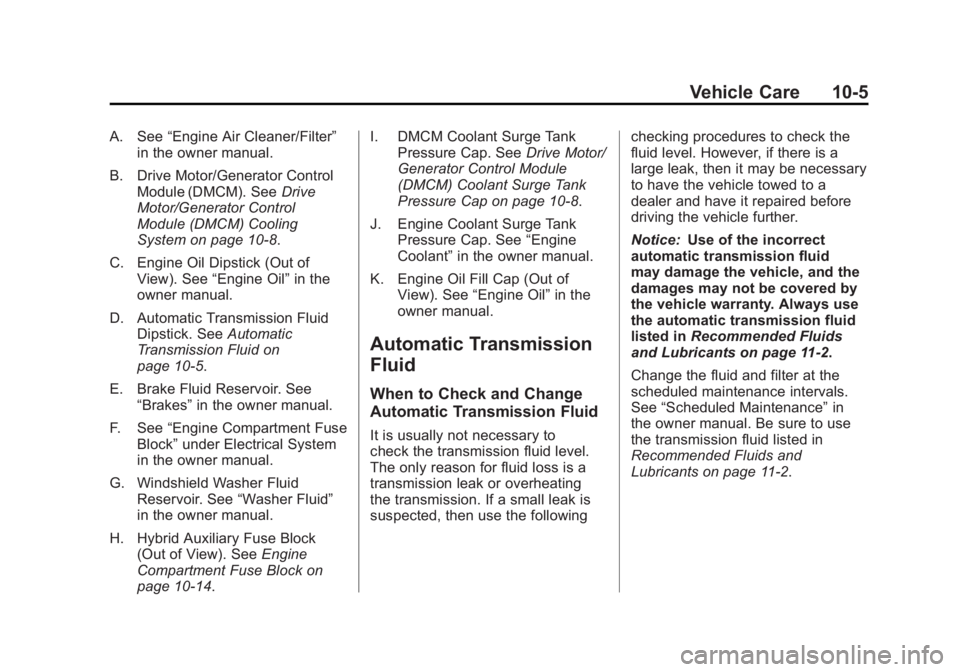
Vehicle Care 10-5A. See “ Engine Air Cleaner/Filter ”
in the owner manual.
B. Drive Motor/Generator Control
Module (DMCM). See Drive
Motor/Generator Control
Module (DMCM) Cooling
System on page 10 ‑ 8 .
C. Engine Oil Dipstick (Out of
View). See “ Engine Oil ” in the
owner manual.
D. Automatic Transmission Fluid
Dipstick. See Automatic
Transmission Fluid on
page 10 ‑ 5 .
E. Brake Fluid Reservoir. See
“ Brakes ” in the owner manual.
F. See “ Engine Compartment Fuse
Block ” under Electrical System
in the owner manual.
G. Windshield Washer Fluid
Reservoir. See “ Washer Fluid ”
in the owner manual.
H. Hybrid Auxiliary Fuse Block
(Out of View). See Engine
Compartment Fuse Block on
page 10 ‑ 14 . I. DMCM Coolant Surge Tank
Pressure Cap. See Drive Motor/
Generator Control Module
(DMCM) Coolant Surge Tank
Pressure Cap on page 10 ‑ 8 .
J. Engine Coolant Surge Tank
Pressure Cap. See “ Engine
Coolant ” in the owner manual.
K. Engine Oil Fill Cap (Out of
View). See “ Engine Oil ” in the
owner manual.
Automatic Transmission
Fluid When to Check and Change
Automatic Transmission Fluid It is usually not necessary to
check the transmission fluid level.
The only reason for fluid loss is a
transmission leak or overheating
the transmission. If a small leak is
suspected, then use the following checking procedures to check the
fluid level. However, if there is a
large leak, then it may be necessary
to have the vehicle towed to a
dealer and have it repaired before
driving the vehicle further.
Notice: Use of the incorrect
automatic transmission fluid
may damage the vehicle, and the
damages may not be covered by
the vehicle warranty. Always use
the automatic transmission fluid
listed in Recommended Fluids
and Lubricants on page 11 ‑ 2 .
Change the fluid and filter at the
scheduled maintenance intervals.
See “ Scheduled Maintenance ” in
the owner manual. Be sure to use
the transmission fluid listed in
Recommended Fluids and
Lubricants on page 11 ‑ 2 .
Page 49 of 90

Black plate (7,1)Cadillac Escalade Hybrid - 2012
Vehicle Care 10-7See Engine Compartment
Overview on page 10 ‑ 4 for more
information.
2. Pull out the dipstick and wipe it
with a clean rag or paper towel.
3. Install the dipstick by pushing
it back in all the way, wait
three seconds, and then pull it
back out again.
4. Check both sides of the dipstick
and read the lower level. Repeat
the check procedure to verify the
reading.
5. If the fluid level is below the
COLD check band, add only
enough fluid as necessary to
bring the level into the COLD
band. It does not take much
fluid, generally less than 0.5 Liter
(1 Pint). Do not overfill. 6. Perform a hot check at
the first opportunity after
the transmission reaches a
normal operating temperature
between 60°C and 75°C
(140°F and 167°F).
7. If the fluid level is in the
acceptable range, push the
dipstick back in all the way.
Hot Check Procedure
Use this procedure to check the
transmission fluid level when the
transmission fluid temperature
is between 60°C and 75°C
(140°F and 167°F).
The hot check is the most accurate
method to check the fluid level. The
hot check should be performed at
the first opportunity in order to verify
the cold check. The fluid level rises
as fluid temperature increases,
so it is important to ensure the
transmission temperature is within
range. 1. Locate the transmission dipstick
at the rear of the engine
compartment, on the passenger
side of the vehicle.
See Engine Compartment
Overview on page 10 ‑ 4 for more
information.
2. Pull out the dipstick and wipe it
with a clean rag or paper towel.
3. Install the dipstick by pushing
it back in all the way, wait
three seconds, and then pull it
back out again.
4. Check both sides of the dipstick
and read the lower level. Repeat
the check procedure to verify the
reading.
Page 63 of 90

Black plate (21,1)Cadillac Escalade Hybrid - 2012
Vehicle Care 10-21It is unusual for a tire to blowout
while driving, especially if the tires
are maintained properly. If air goes
out of a tire, it is much more likely to
leak out slowly. But if there ever is a
blowout, here are a few tips about
what to expect and what to do:
If a front tire fails, the flat tire
creates a drag that pulls the vehicle
toward that side. Take your foot off
the accelerator pedal and grip the
steering wheel firmly. Steer to
maintain lane position, and then
gently brake to a stop, well off the
road, if possible.
A rear blowout, particularly on a
curve, acts much like a skid and
may require the same correction as
used in a skid. Stop pressing the
accelerator pedal and steer to
straighten the vehicle. It may be
very bumpy and noisy. Gently
brake to a stop, well off the road,
if possible. { WARNINGDriving on a flat tire will cause
permanent damage to the tire.
Re-inflating a tire after it has
been driven on while severely
underinflated or flat may cause
a blowout and a serious crash.
Never attempt to re-inflate a tire
that has been driven on while
severely underinflated or flat.
Have your dealer or an authorized
tire service center repair or
replace the flat tire as soon as
possible.
If a tire goes flat, avoid further tire
and wheel damage by driving slowly
to a level place and stopping, well
off the road, if possible. Then
do this:
1. Turn on the hazard warning
flashers.
2. Park the vehicle. Set the parking
brake firmly and put the shift
lever in P (Park). 3. Turn off the engine.
4. Inspect the flat tire.
If the tire has been separated from
the wheel or has damaged sidewalls
or large tears that allow rapid air
loss, call a tire repair facility. See
“ Roadside Assistance Program ” or
“ Roadside Service ” in the owner
manual.
If the flat tire is due to a slow leak
caused by a nail or other similar
road hazard, the tire inflator kit may
be used to repair the damaged tire
temporarily. The kit uses a liquid tire
sealant to seal small punctures in
the tread area of the tire.
After repairing a tire with the tire
inflator kit, take the vehicle to an
authorized dealer to have the tire
inspected and repaired as soon
as possible. The tire sealant is a
temporary repair only. See Tire
Sealant and Compressor Kit on
page 10 ‑ 22 .
Page 70 of 90
Black plate (28,1)Cadillac Escalade Hybrid - 2012
10-28 Vehicle Care Removal and Installation of the
Sealant Canister To remove the sealant canister:
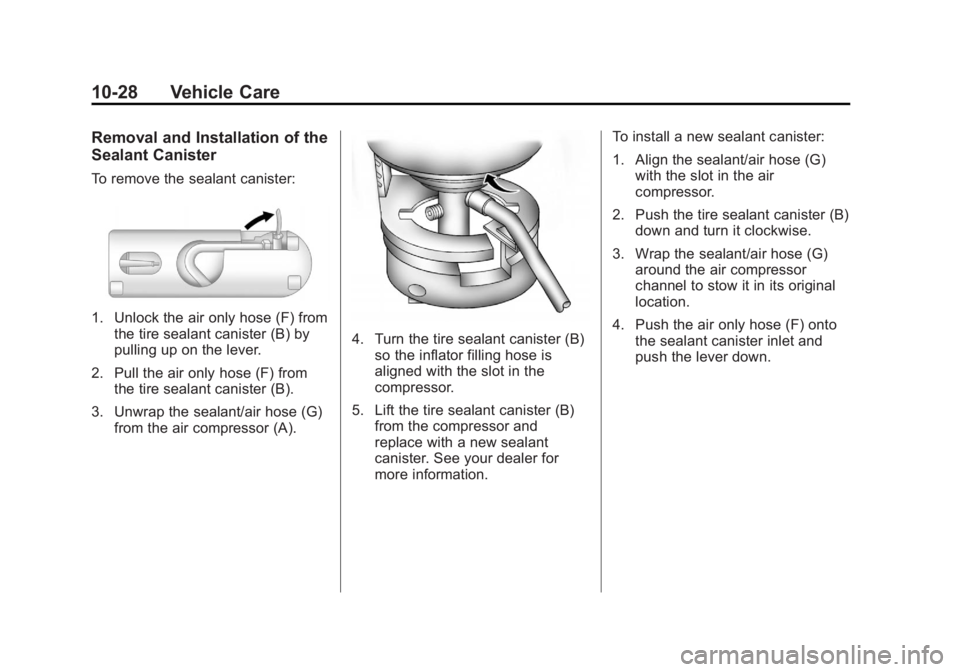
1. Unlock the air only hose (F) from
the tire sealant canister (B) by
pulling up on the lever.
2. Pull the air only hose (F) from
the tire sealant canister (B).
3. Unwrap the sealant/air hose (G)
from the air compressor (A). 4. Turn the tire sealant canister (B)
so the inflator filling hose is
aligned with the slot in the
compressor.
5. Lift the tire sealant canister (B)
from the compressor and
replace with a new sealant
canister. See your dealer for
more information. To install a new sealant canister:
1. Align the sealant/air hose (G)
with the slot in the air
compressor.
2. Push the tire sealant canister (B)
down and turn it clockwise.
3. Wrap the sealant/air hose (G)
around the air compressor
channel to stow it in its original
location.
4. Push the air only hose (F) onto
the sealant canister inlet and
push the lever down.
Page 75 of 90

Black plate (33,1)Cadillac Escalade Hybrid - 2012
Vehicle Care 10-33Jumper Cable Removal
A. Heavy, Unpainted Metal Engine
Part or Remote Negative ( − )
Terminal
B. Good Battery or Remote
Positive (+) and Remote
Negative ( − ) Terminals
C. Dead Battery or Remote
Positive (+) Terminal To disconnect the jumper cables
from both vehicles:
1. Disconnect the black
negative ( − ) cable from the
vehicle that had the bad battery.
2. Disconnect the black
negative ( − ) cable from the
vehicle with the good battery.
3. Disconnect the red positive (+)
cable from the vehicle with the
good battery.
4. Disconnect the red positive (+)
cable from the other vehicle.
5. Return the remote positive (+)
terminal cover to its original
position. Towing Recreational Vehicle
Towing Recreational vehicle towing
means towing the vehicle behind
another vehicle – such as behind
a motorhome. The two most
common types of recreational
vehicle towing are known as dinghy
towing and dolly towing. Dinghy
towing is towing the vehicle with all
four wheels on the ground. Dolly
towing is towing the vehicle with
two wheels on the ground and
two wheels up on a device known
as a dolly.
Page 76 of 90

Black plate (34,1)Cadillac Escalade Hybrid - 2012
10-34 Vehicle Care Here are some important things to
consider before recreational vehicle
towing: .
What is the towing capacity
of the towing vehicle? Be
sure to read the tow
vehicle manufacturer's
recommendations. .
What is the distance that will be
travelled? Some vehicles have
restrictions on how far and how
long they can tow. .
Is the proper towing equipment
going to be used? See your
dealer or trailering professional
for additional advice and
equipment recommendations. .
Is the vehicle ready to be
towed? Just as preparing the
vehicle for a long trip, make sure
the vehicle is prepared to be
towed. Dinghy Towing
Notice: If the vehicle is
towed with all four wheels
on the ground, the drivetrain
components could be damaged.
The repairs would not be
covered by the vehicle warranty.
Do not tow the vehicle with all
four wheels on the ground.
The vehicle should not be towed
with all four wheels on the ground. Dolly Towing – Front Towing
(Front Wheels Off the Ground) Two-Wheel Drive Vehicles
Notice: If a two-wheel drive
vehicle is towed with the rear
wheels on the ground, the
transmission could be damaged.
The repairs would not be covered
by the vehicle warranty. Never
tow the vehicle with the rear
wheels on the ground.
Page 77 of 90

Black plate (35,1)Cadillac Escalade Hybrid - 2012
Vehicle Care 10-35Two-wheel drive vehicles should
not be towed with the rear wheels
on the ground. Two-wheel drive
transmissions have no provisions
for internal lubrication while being
towed.
To dolly tow a two ‐ wheel ‐ drive
vehicle, the vehicle must be towed
with the rear wheels on the dolly.
See “ Rear Towing (Rear Wheels Off
the Ground) ” later in this section for
more information. Four-Wheel Drive Vehicles
Use the following procedure to dolly
tow a four-wheel drive vehicle from
the front:
1. Attach the dolly to the tow
vehicle following the dolly
manufacturer's instructions.
2. Drive the front wheels onto the
dolly.
3. Shift the transmission to
P (Park).
4. Firmly set the parking brake.
See “ Parking Brake ” in the
owner manual.{ WARNINGShifting a four-wheel-drive
vehicle's transfer case into
N (Neutral) can cause the vehicle
to roll even if the transmission is
in P (Park). The driver or others
could be injured. Make sure the
parking brake is firmly set before
the transfer case is shifted to
N (Neutral).
5. Shift the transfer case to
N (Neutral). See “ Shifting into
N (Neutral) ” under Four-Wheel
Drive on page 9 ‑ 11 .
6. Secure the vehicle to the dolly
following the manufacturer's
instructions.
7. Release the parking brake only
after the vehicle being towed is
firmly attached to the towing
vehicle.
8. Turn the ignition to LOCK/OFF.
Page 78 of 90

Black plate (36,1)Cadillac Escalade Hybrid - 2012
10-36 Vehicle Care After towing, see “ Shifting Out of
N (Neutral) ” under Four-Wheel Drive
on page 9 ‑ 11 .
Dolly Towing – Rear Towing
(Rear Wheels Off the Ground)
Two ‐ Wheel Drive Vehicles
Use the following procedure to dolly
tow a two-wheel drive vehicle from
the rear:
1. Attach the dolly to the tow
vehicle following the dolly
manufacturer's instructions. 2. Drive the rear wheels onto the
dolly.
3. Firmly set the parking brake.
See “ Parking Brake ” in the
owner manual.
4. Put the transmission in P (Park).
5. Secure the vehicle to the dolly
following the manufacturer's
instructions.
6. Use an adequate clamping
device designed for towing to
ensure that the front wheels are
locked into the straight position.
7. Turn the ignition to LOCK/OFF. Four ‐ Wheel ‐ Drive Vehicles
Use the following procedure to dolly
tow a four-wheel-drive vehicle from
the rear:
1. Attach the dolly to the tow
vehicle following the dolly
manufacturer's instructions.
2. Drive the rear wheels onto the
dolly.
3. Firmly set the parking brake.
See “ Parking Brake ” in the
owner manual.
4. Put the transmission in P (Park).
5. Secure the vehicle to the dolly
following the manufacturer's
instructions.
6. Use an adequate clamping
device designed for towing to
ensure that the front wheels are
locked into the straight position.