2012 CADILLAC ESCALADE HYBRID service
[x] Cancel search: servicePage 53 of 90

Black plate (11,1)Cadillac Escalade Hybrid - 2012
Vehicle Care 10-11surge tank pressure cap and
DMCM cooling hoses, are no
longer hot. Turn the DMCM
coolant surge tank pressure cap
slowly counterclockwise (left)
about one full turn. Wait
30 seconds.
2. Then keep turning the DMCM
coolant surge tank pressure cap
slowly, and remove it.
3. Add the pre ‐ mixed DEX ‐ COOL,
available at your dealer, to the
DMCM coolant surge tank until
the level reaches the FULL
COLD mark. 4. Turn the ignition to ON/RUN
without starting the engine. The
hybrid cooling pumps will run
and any trapped air will purge to
the surge tank.
5. Add the pre ‐ mixed DEX ‐ COOL,
available at your dealer, until the
coolant level is maintained at the
FULL COLD mark. This should
take no longer than two minutes
of hybrid cooling pump
operation.
If the level cannot be kept at the
FULL COLD level, the vehicle
may need service. See your
dealer.
6. Then replace the DMCM coolant
surge tank pressure cap. Be
sure the pressure cap is
hand-tight and fully seated. Notice: Using tap water, cooling
system sealers or conditioners in
an attempt to stop coolant leaks
can damage the DMCM and
engine cooling systems. Never
use tap water, cooling system
sealers or conditioners in your
cooling system.
Battery This vehicle has a standard 12 ‐ volt
battery and a high voltage hybrid
battery.
Refer to the replacement number on
the original battery label when a
new standard 12 ‐ volt battery is
needed.
Only a trained service technician
with the proper knowledge and
tools should inspect, test, or replace
the hybrid battery. See your dealer
if the hybrid battery needs service.
The dealer has information on how
to recycle the hybrid battery. There
is also information available at
http://www.recyclemybattery.com.
Page 55 of 90

Black plate (13,1)Cadillac Escalade Hybrid - 2012
Vehicle Care 10-13When to Change Lubricant
See “ Scheduled Maintenance ” in the
owner manual to determine how
often to change the lubricant.
What to Use
Refer to the Recommended Fluids
and Lubricants on page 11 ‑ 2 to
determine what kind of lubricant
to use.
Electrical System High Voltage Devices and
Wiring
{ WARNINGExposure to high voltage can
cause shock, burns, and even
death. The high voltage
components in the vehicle can
only be serviced by technicians
with special training.
High voltage components are
identified by labels. Do not
remove, open, take apart,
or modify these components.
High voltage cable or wiring has
orange covering. Do not probe,
tamper with, cut, or modify high
voltage cable or wiring. Fuses and Circuit
Breakers The wiring circuits in the vehicle
are protected from short circuits
by a combination of fuses, circuit
breakers and fusible thermal links.
This greatly reduces the chance of
fires caused by electrical problems.
Be sure you replace a bad fuse with
a new one of the identical size and
rating.
If you ever have a problem on the
road and do not have a spare fuse,
you can borrow one that has the
same amperage. Just pick some
feature of the vehicle that you can
get along without, like the radio or
cigarette lighter, and use its fuse,
if it is the correct amperage.
Replace it as soon as you can.
Page 56 of 90

Black plate (14,1)Cadillac Escalade Hybrid - 2012
10-14 Vehicle Care The vehicle also has a special fuse
in the battery box for the 300-volt
batteries. If this fuse has failed and
needs to be replaced, the vehicle
will be disabled and you will need
to have the vehicle repaired by
your dealer. Do not attempt to
self-service this fuse.
Engine Compartment
Fuse Block Hybrid Auxiliary Engine
Compartment Fuse Block The hybrid auxiliary engine
compartment fuse block is located
in the engine compartment near the
front of the vehicle. Lift the cover for
access to the fuse/relay block. See
Engine Compartment Overview on
page 10 ‑ 4 for more information on
its location. For more information on
the main underhood fuse block, see
“ Engine Compartment Fuse Block ”
in the owner manual. Fuses Usage
1 ACPO (SUV Only)
2 BECM FAN
3 ACCM
4 CAB HTR PMP Fuses Usage
5 EMPTY
6 COOL PUMP
7 EPS
Page 60 of 90

Black plate (18,1)Cadillac Escalade Hybrid - 2012
10-18 Vehicle Care The TPMS can warn about a
low tire pressure condition but
it does not replace normal tire
maintenance. See “ Tire Inspection, ”
“ Tire Rotation ” and “ Tires ” in the
owner manual for more information.
Notice: Tire sealant materials are
not all the same. A non-approved
tire sealant could damage the
TPMS sensors. TPMS sensor
damage caused by using an
incorrect tire sealant is not
covered by the vehicle
warranty. Always use only
the GM-approved tire sealant
available through your dealer or
included in the vehicle.
Factory-installed Tire Inflator Kits
use a GM approved liquid tire
sealant. Using non-approved tire
sealants could damage the TPMS
sensors. See Tire Sealant and
Compressor Kit on page 10 ‑ 22 for
information regarding the inflator kit
materials and instructions. TPMS Malfunction Light and
Message The TPMS will not function properly
if one or more of the TPMS sensors
are missing or inoperable. When the
system detects a malfunction, the
low tire warning light flashes for
about one minute and then stays on
for the remainder of the ignition
cycle. A DIC warning message also
displays. The malfunction light and
DIC warning message come on at
each ignition cycle until the problem
is corrected. Some of the conditions
that can cause these to come
on are: .
The TPMS sensor matching
process was not done or
not completed successfully
after rotating the tires. The
malfunction light and the DIC
message should go off after
successfully completing the
sensor matching process. See
"TPMS Sensor Matching
Process" later in this section. .
One or more TPMS sensors
are missing or damaged. The
malfunction light and the DIC
message should go off when the
TPMS sensors are installed and
the sensor matching process is
performed successfully. See
your dealer for service. .
Replacement tires or wheels do
not match the original equipment
tires or wheels. Tires and wheels
other than those recommended
could prevent the TPMS from
functioning properly. See
“ Buying New Tires ” in the owner
manual. .
Operating electronic devices or
being near facilities using radio
wave frequencies similar to the
TPMS could cause the TPMS
sensors to malfunction.
If the TPMS is not functioning
properly, it cannot detect or signal a
low tire condition. See your dealer
for service if the TPMS malfunction
light and DIC message comes on
and stays on.
Page 61 of 90

Black plate (19,1)Cadillac Escalade Hybrid - 2012
Vehicle Care 10-19TPMS Sensor Matching
Process Each TPMS sensor has a unique
identification code. The identification
code needs to be matched to a new
tire/wheel position after rotating the
vehicle ’ s tires or replacing one or
more of the TPMS sensors. Also,
the TPMS sensor matching process
should be performed after replacing
a spare tire with a road tire
containing the TPMS sensor. The
malfunction light and the DIC
message should go off at the next
ignition cycle. The sensors are
matched to the tire/wheel positions,
using a TPMS relearn tool, in the
following order: driver side front tire,
passenger side front tire, passenger
side rear tire, and driver side rear.
See your dealer for service or to
purchase a relearn tool.
There are two minutes to match
the first tire/wheel position, and
five minutes overall to match all
four tire/wheel positions. If it takes
longer, the matching process stops
and must be restarted. The TPMS sensor matching
process is:
1. Set the parking brake.
2. Turn the ignition to ON/RUN with
the engine off.
3. Press
Q and
K on the
Remote Keyless Entry (RKE)
transmitter at the same time for
approximately five seconds. The
horn sounds twice to signal the
receiver is in relearn mode and
TIRE LEARNING ACTIVE
message displays on the DIC
screen.
4. Start with the driver side
front tire.
5. Place the relearn tool against
the tire sidewall, near the valve
stem. Then press the button to
activate the TPMS sensor.
A horn chirp confirms that the
sensor identification code has
been matched to this tire and
wheel position. 6. Proceed to the passenger
side front tire, and repeat the
procedure in Step 5.
7. Proceed to the passenger side
rear tire, and repeat the
procedure in Step 5.
8. Proceed to the driver side rear
tire, and repeat the procedure
in Step 5. The horn sounds
two times to indicate the sensor
identification code has been
matched to the driver side rear
tire, and the TPMS sensor
matching process is no longer
active. The TIRE LEARNING
ACTIVE message on the DIC
display screen goes off.
9. Turn the ignition to LOCK/OFF.
10. Set all four tires to the
recommended air pressure
level as indicated on the Tire
and Loading Information label.
Page 63 of 90

Black plate (21,1)Cadillac Escalade Hybrid - 2012
Vehicle Care 10-21It is unusual for a tire to blowout
while driving, especially if the tires
are maintained properly. If air goes
out of a tire, it is much more likely to
leak out slowly. But if there ever is a
blowout, here are a few tips about
what to expect and what to do:
If a front tire fails, the flat tire
creates a drag that pulls the vehicle
toward that side. Take your foot off
the accelerator pedal and grip the
steering wheel firmly. Steer to
maintain lane position, and then
gently brake to a stop, well off the
road, if possible.
A rear blowout, particularly on a
curve, acts much like a skid and
may require the same correction as
used in a skid. Stop pressing the
accelerator pedal and steer to
straighten the vehicle. It may be
very bumpy and noisy. Gently
brake to a stop, well off the road,
if possible. { WARNINGDriving on a flat tire will cause
permanent damage to the tire.
Re-inflating a tire after it has
been driven on while severely
underinflated or flat may cause
a blowout and a serious crash.
Never attempt to re-inflate a tire
that has been driven on while
severely underinflated or flat.
Have your dealer or an authorized
tire service center repair or
replace the flat tire as soon as
possible.
If a tire goes flat, avoid further tire
and wheel damage by driving slowly
to a level place and stopping, well
off the road, if possible. Then
do this:
1. Turn on the hazard warning
flashers.
2. Park the vehicle. Set the parking
brake firmly and put the shift
lever in P (Park). 3. Turn off the engine.
4. Inspect the flat tire.
If the tire has been separated from
the wheel or has damaged sidewalls
or large tears that allow rapid air
loss, call a tire repair facility. See
“ Roadside Assistance Program ” or
“ Roadside Service ” in the owner
manual.
If the flat tire is due to a slow leak
caused by a nail or other similar
road hazard, the tire inflator kit may
be used to repair the damaged tire
temporarily. The kit uses a liquid tire
sealant to seal small punctures in
the tread area of the tire.
After repairing a tire with the tire
inflator kit, take the vehicle to an
authorized dealer to have the tire
inspected and repaired as soon
as possible. The tire sealant is a
temporary repair only. See Tire
Sealant and Compressor Kit on
page 10 ‑ 22 .
Page 64 of 90

Black plate (22,1)Cadillac Escalade Hybrid - 2012
10-22 Vehicle Care
Tire Sealant and
Compressor Kit
{ WARNINGIdling a vehicle in an enclosed
area with poor ventilation is
dangerous. Engine exhaust may
enter the vehicle. Engine exhaust
contains Carbon Monoxide (CO)
which cannot be seen or smelled.
It can cause unconsciousness
and even death. Never run the
engine in an enclosed area that
has no fresh air ventilation. For
more information, see ” Engine
Exhaust ” in the owner manual. { WARNINGOverinflating a tire could cause
the tire to rupture and you or
others could be injured. Be
sure to read and follow the tire
sealant and compressor kit
instructions and inflate the tire to
its recommended pressure. Do
not exceed the recommended
pressure.
{ WARNINGStoring the tire sealant and
compressor kit or other
equipment in the passenger
compartment of the vehicle could
cause injury. In a sudden stop or
collision, loose equipment could
strike someone. Store the tire
sealant and compressor kit in its
original location. If this vehicle has a tire sealant and
compressor kit, there may not be a
spare tire, tire changing equipment,
and on some vehicles there may not
be a place to store a tire.
The tire sealant and compressor
can be used to temporarily seal
punctures up to 6 mm (¼ inch) in
the tread area of the tire. It can
also be used to inflate an under
inflated tire.
If the tire has been separated from
the wheel, has damaged sidewalls,
or has a large puncture, the tire is
too severely damaged for the tire
sealant and compressor kit to be
effective. See “ Roadside Assistance
Program ” or “ Roadside Service ” in
the owner manual.
Page 67 of 90
Black plate (25,1)Cadillac Escalade Hybrid - 2012
Vehicle Care 10-25the accessory power outlet and
unscrew the inflating hose from
the tire valve. See “ Roadside
Assistance Program ” or
“ Roadside Service ” in the owner
manual.
10. Press the on/off button (D) to
turn the tire sealant and
compressor kit off.
The tire is not sealed and
will continue to leak air until
the vehicle is driven and
the sealant is distributed in
the tire, therefore, Steps 11
through 17 must be done
immediately after Step 10.
Be careful while handling the
tire sealant and compressor kit
as it could be warm after
usage.
11. Unplug the power plug (C) from
the accessory power outlet in
the vehicle.
12. Turn the sealant/air hose (G)
counterclockwise to remove it
from the tire valve stem. 13. Replace the tire valve
stem cap.
14. Replace the sealant/air
hose (G), and the power
plug (C) back in their original
location.
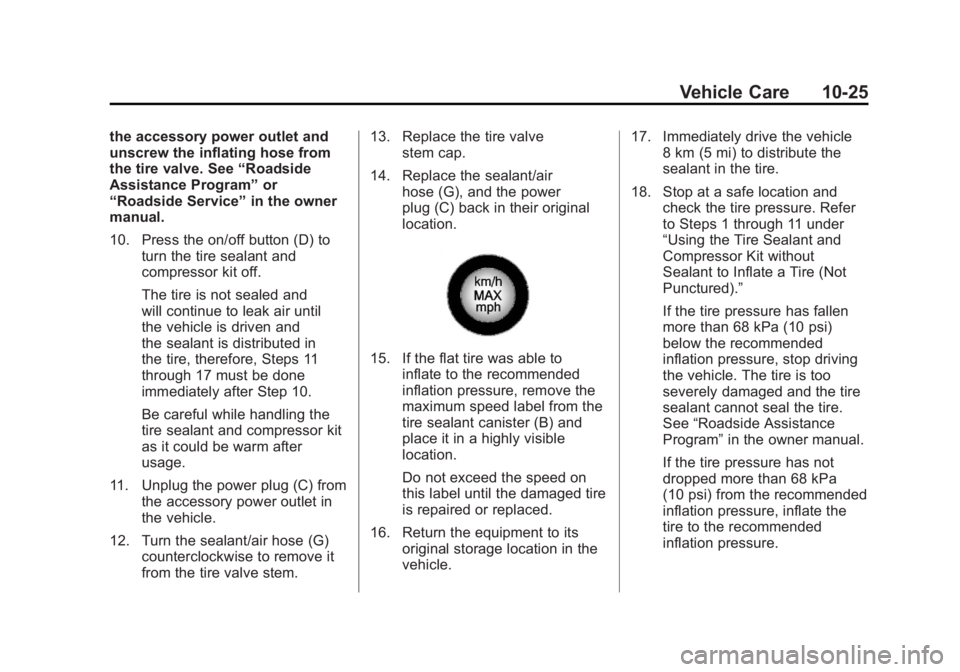
15. If the flat tire was able to
inflate to the recommended
inflation pressure, remove the
maximum speed label from the
tire sealant canister (B) and
place it in a highly visible
location.
Do not exceed the speed on
this label until the damaged tire
is repaired or replaced.
16. Return the equipment to its
original storage location in the
vehicle. 17. Immediately drive the vehicle
8 km (5 mi) to distribute the
sealant in the tire.
18. Stop at a safe location and
check the tire pressure. Refer
to Steps 1 through 11 under
“ Using the Tire Sealant and
Compressor Kit without
Sealant to Inflate a Tire (Not
Punctured). ”
If the tire pressure has fallen
more than 68 kPa (10 psi)
below the recommended
inflation pressure, stop driving
the vehicle. The tire is too
severely damaged and the tire
sealant cannot seal the tire.
See “ Roadside Assistance
Program ” in the owner manual.
If the tire pressure has not
dropped more than 68 kPa
(10 psi) from the recommended
inflation pressure, inflate the
tire to the recommended
inflation pressure.