2012 CADILLAC ESCALADE HYBRID lock
[x] Cancel search: lockPage 67 of 90
Black plate (25,1)Cadillac Escalade Hybrid - 2012
Vehicle Care 10-25the accessory power outlet and
unscrew the inflating hose from
the tire valve. See “ Roadside
Assistance Program ” or
“ Roadside Service ” in the owner
manual.
10. Press the on/off button (D) to
turn the tire sealant and
compressor kit off.
The tire is not sealed and
will continue to leak air until
the vehicle is driven and
the sealant is distributed in
the tire, therefore, Steps 11
through 17 must be done
immediately after Step 10.
Be careful while handling the
tire sealant and compressor kit
as it could be warm after
usage.
11. Unplug the power plug (C) from
the accessory power outlet in
the vehicle.
12. Turn the sealant/air hose (G)
counterclockwise to remove it
from the tire valve stem. 13. Replace the tire valve
stem cap.
14. Replace the sealant/air
hose (G), and the power
plug (C) back in their original
location.
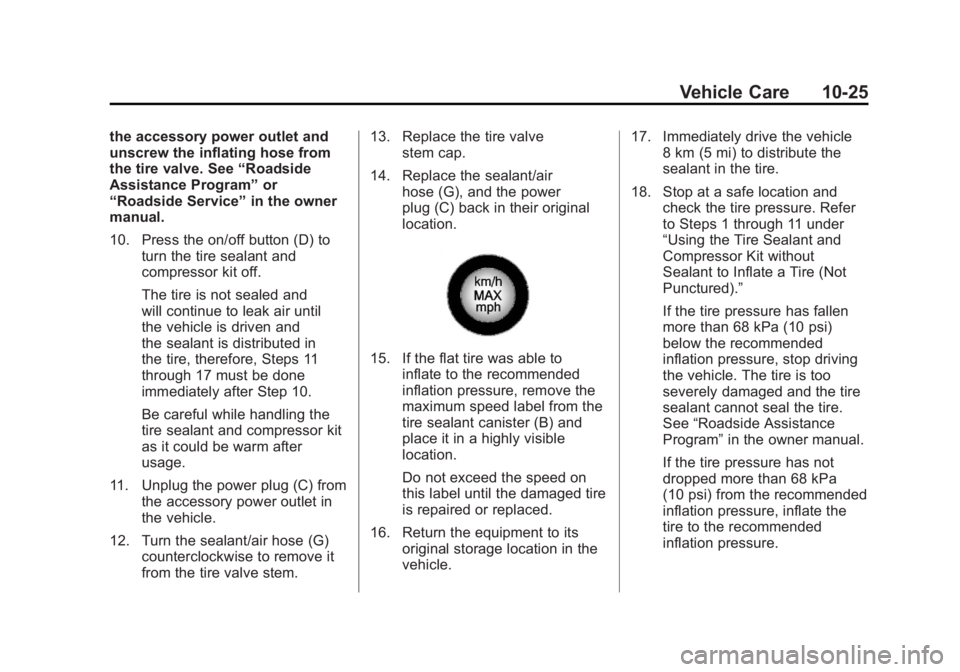
15. If the flat tire was able to
inflate to the recommended
inflation pressure, remove the
maximum speed label from the
tire sealant canister (B) and
place it in a highly visible
location.
Do not exceed the speed on
this label until the damaged tire
is repaired or replaced.
16. Return the equipment to its
original storage location in the
vehicle. 17. Immediately drive the vehicle
8 km (5 mi) to distribute the
sealant in the tire.
18. Stop at a safe location and
check the tire pressure. Refer
to Steps 1 through 11 under
“ Using the Tire Sealant and
Compressor Kit without
Sealant to Inflate a Tire (Not
Punctured). ”
If the tire pressure has fallen
more than 68 kPa (10 psi)
below the recommended
inflation pressure, stop driving
the vehicle. The tire is too
severely damaged and the tire
sealant cannot seal the tire.
See “ Roadside Assistance
Program ” in the owner manual.
If the tire pressure has not
dropped more than 68 kPa
(10 psi) from the recommended
inflation pressure, inflate the
tire to the recommended
inflation pressure.
Page 68 of 90
Black plate (26,1)Cadillac Escalade Hybrid - 2012
10-26 Vehicle Care 19. Wipe off any sealant from the
wheel, tire or vehicle.
20. Dispose of the used tire
sealant canister (B) and
sealant/air hose (G) assembly
at a local dealer or in
accordance with local state
codes and practices.
21. Replace it with a new canister
available from your dealer.
22. After temporarily sealing a tire
using the tire sealant and
compressor kit, take the
vehicle to an authorized dealer
within a 161 km (100 mi) of
driving to have the tire repaired
or replaced. Using the Tire Sealant and
Compressor Kit without
Sealant to Inflate a Tire
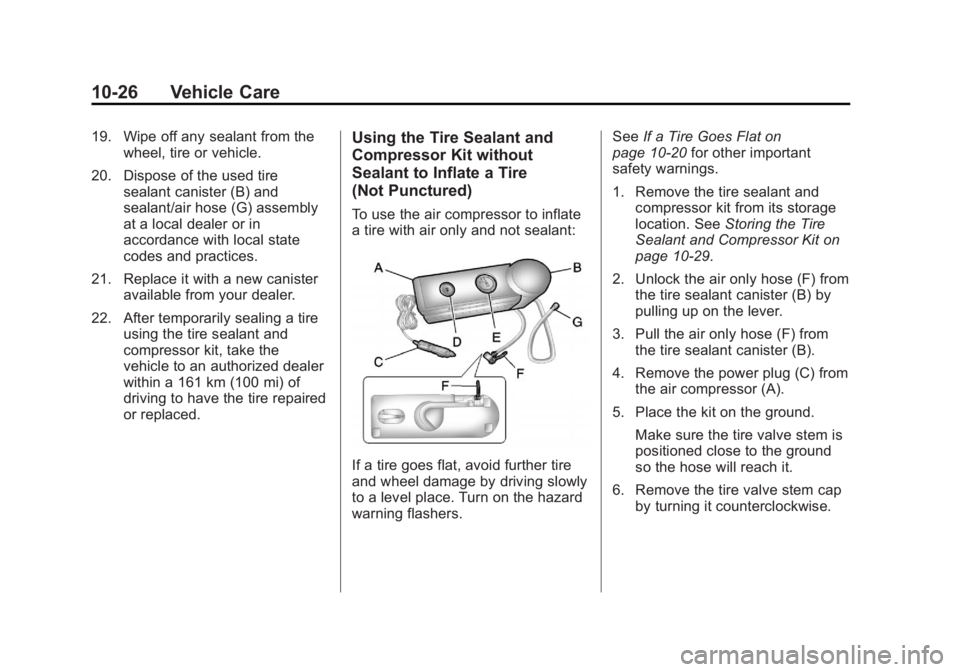
(Not Punctured) To use the air compressor to inflate
a tire with air only and not sealant:
If a tire goes flat, avoid further tire
and wheel damage by driving slowly
to a level place. Turn on the hazard
warning flashers. See If a Tire Goes Flat on
page 10 ‑ 20 for other important
safety warnings.
1. Remove the tire sealant and
compressor kit from its storage
location. See Storing the Tire
Sealant and Compressor Kit on
page 10 ‑ 29 .
2. Unlock the air only hose (F) from
the tire sealant canister (B) by
pulling up on the lever.
3. Pull the air only hose (F) from
the tire sealant canister (B).
4. Remove the power plug (C) from
the air compressor (A).
5. Place the kit on the ground.
Make sure the tire valve stem is
positioned close to the ground
so the hose will reach it.
6. Remove the tire valve stem cap
by turning it counterclockwise.
Page 69 of 90

Black plate (27,1)Cadillac Escalade Hybrid - 2012
Vehicle Care 10-277. Attach the air only hose (F) onto
the tire valve stem and press the
lever down to secure it.
8. Plug the power plug (C) into the
accessory power outlet in the
vehicle. Unplug all items from
other accessory power outlets.
See “ Power Outlets ” in the
owner manual.
If the vehicle has an accessory
power outlet, do not use the
cigarette lighter.
If the vehicle only has a cigarette
lighter, use the cigarette lighter.
Do not pinch the power plug
cord in the door or window.
9. Start the vehicle. The vehicle
must be running while using the
air compressor. 10. Press the on/off (D) button to
turn the compressor on.
The compressor will inflate the
tire with air only.
11. Inflate the tire to the
recommended inflation
pressure using the pressure
gauge (E). The recommended
inflation pressure can be found
on the Tire and Loading
Information label. See Tire
Pressure on page 10 ‑ 16 .
The pressure gauge (E) may
read higher than the actual tire
pressure while the compressor
is on. Turn the compressor off
to get an accurate reading.
The compressor may be turned
on/off until the correct pressure
is reached. 12. Press the on/off button (D) to
turn the tire sealant and
compressor kit off.
Be careful while handling the
tire sealant and compressor
kit as it could be warm after
usage.
13. Unplug the power plug (C) from
the accessory power outlet in
the vehicle.
14. Disconnect the air only
hose (F) from the tire
valve stem, by turning it
counterclockwise, and replace
the tire valve stem cap.
15. Replace the air only hose (F)
and the power plug (C) back in
its original location.
16. Place the equipment in the
original storage location in the
vehicle.
Page 70 of 90
Black plate (28,1)Cadillac Escalade Hybrid - 2012
10-28 Vehicle Care Removal and Installation of the
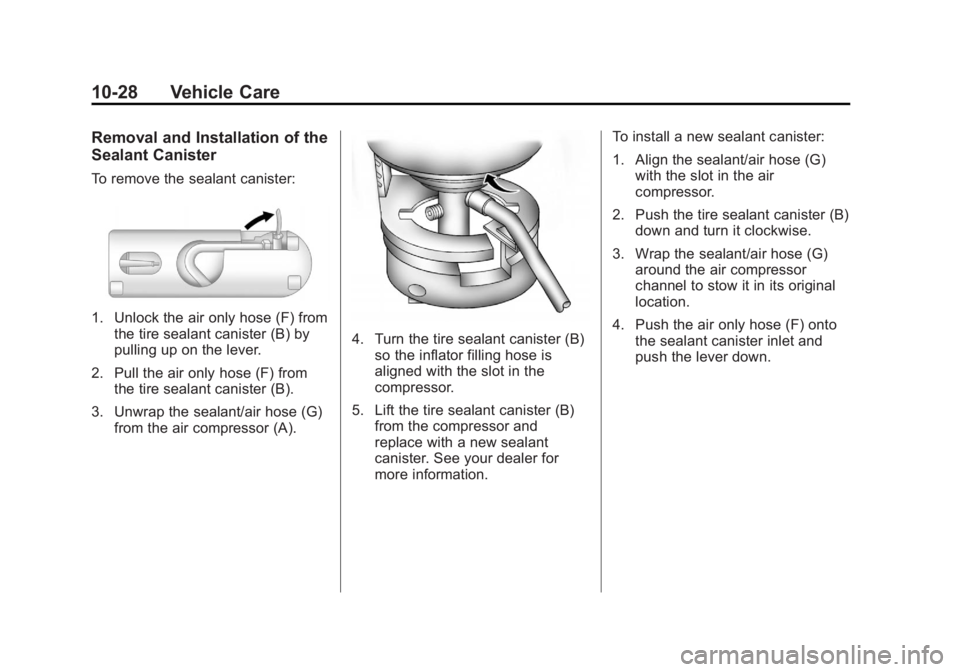
Sealant Canister To remove the sealant canister:
1. Unlock the air only hose (F) from
the tire sealant canister (B) by
pulling up on the lever.
2. Pull the air only hose (F) from
the tire sealant canister (B).
3. Unwrap the sealant/air hose (G)
from the air compressor (A). 4. Turn the tire sealant canister (B)
so the inflator filling hose is
aligned with the slot in the
compressor.
5. Lift the tire sealant canister (B)
from the compressor and
replace with a new sealant
canister. See your dealer for
more information. To install a new sealant canister:
1. Align the sealant/air hose (G)
with the slot in the air
compressor.
2. Push the tire sealant canister (B)
down and turn it clockwise.
3. Wrap the sealant/air hose (G)
around the air compressor
channel to stow it in its original
location.
4. Push the air only hose (F) onto
the sealant canister inlet and
push the lever down.
Page 77 of 90

Black plate (35,1)Cadillac Escalade Hybrid - 2012
Vehicle Care 10-35Two-wheel drive vehicles should
not be towed with the rear wheels
on the ground. Two-wheel drive
transmissions have no provisions
for internal lubrication while being
towed.
To dolly tow a two ‐ wheel ‐ drive
vehicle, the vehicle must be towed
with the rear wheels on the dolly.
See “ Rear Towing (Rear Wheels Off
the Ground) ” later in this section for
more information. Four-Wheel Drive Vehicles
Use the following procedure to dolly
tow a four-wheel drive vehicle from
the front:
1. Attach the dolly to the tow
vehicle following the dolly
manufacturer's instructions.
2. Drive the front wheels onto the
dolly.
3. Shift the transmission to
P (Park).
4. Firmly set the parking brake.
See “ Parking Brake ” in the
owner manual.{ WARNINGShifting a four-wheel-drive
vehicle's transfer case into
N (Neutral) can cause the vehicle
to roll even if the transmission is
in P (Park). The driver or others
could be injured. Make sure the
parking brake is firmly set before
the transfer case is shifted to
N (Neutral).
5. Shift the transfer case to
N (Neutral). See “ Shifting into
N (Neutral) ” under Four-Wheel
Drive on page 9 ‑ 11 .
6. Secure the vehicle to the dolly
following the manufacturer's
instructions.
7. Release the parking brake only
after the vehicle being towed is
firmly attached to the towing
vehicle.
8. Turn the ignition to LOCK/OFF.
Page 78 of 90

Black plate (36,1)Cadillac Escalade Hybrid - 2012
10-36 Vehicle Care After towing, see “ Shifting Out of
N (Neutral) ” under Four-Wheel Drive
on page 9 ‑ 11 .
Dolly Towing – Rear Towing
(Rear Wheels Off the Ground)
Two ‐ Wheel Drive Vehicles
Use the following procedure to dolly
tow a two-wheel drive vehicle from
the rear:
1. Attach the dolly to the tow
vehicle following the dolly
manufacturer's instructions. 2. Drive the rear wheels onto the
dolly.
3. Firmly set the parking brake.
See “ Parking Brake ” in the
owner manual.
4. Put the transmission in P (Park).
5. Secure the vehicle to the dolly
following the manufacturer's
instructions.
6. Use an adequate clamping
device designed for towing to
ensure that the front wheels are
locked into the straight position.
7. Turn the ignition to LOCK/OFF. Four ‐ Wheel ‐ Drive Vehicles
Use the following procedure to dolly
tow a four-wheel-drive vehicle from
the rear:
1. Attach the dolly to the tow
vehicle following the dolly
manufacturer's instructions.
2. Drive the rear wheels onto the
dolly.
3. Firmly set the parking brake.
See “ Parking Brake ” in the
owner manual.
4. Put the transmission in P (Park).
5. Secure the vehicle to the dolly
following the manufacturer's
instructions.
6. Use an adequate clamping
device designed for towing to
ensure that the front wheels are
locked into the straight position.
Page 79 of 90

Black plate (37,1)Cadillac Escalade Hybrid - 2012
Vehicle Care 10-37
{ WARNINGShifting a four-wheel-drive
vehicle's transfer case into
N (Neutral) can cause the vehicle
to roll even if the transmission is
in P (Park). The driver or others
could be injured. Make sure the
parking brake is firmly set before
the transfer case is shifted to
N (Neutral). 7. Shift the transfer case to
N (Neutral). See “ Shifting into
N (Neutral) ” under Four-Wheel
Drive on page 9 ‑ 11 .
8. Turn the ignition to LOCK/OFF.
After towing, see “ Shifting Out of
N (Neutral) ” under Four-Wheel Drive
on page 9 ‑ 11 .
Appearance Care Exterior Care When scraping the windshield glass
to remove ice and snow, stay clear
of the hybrid decal.
To have the hybrid decals removed
from the vehicle, please see your
dealer.
Page 88 of 90

Black plate (2,1)Cadillac Escalade Hybrid - 2012
i-2 INDEX
EElectrical System
Engine Compartment
Fuse Block . . . . . . . . . . . . . . . . 10-14
Fuses and Circuit
Breakers . . . . . . . . . . . . . . . . . . 10-13
Engine
Compartment Overview . . . . . . . 10-4
Coolant Heater . . . . . . . . . . . . . . . . 9-4
Drive Belt Routing . . . . . . . . . . . . 12-3
Pressure Light . . . . . . . . . . . . . . . . . 5-4
Running While Parked . . . . . . . . . 9-7
Engine Oil
Messages . . . . . . . . . . . . . . . . . . . . . 5-7
Equipment, Towing . . . . . . . . . . . . 9-17 F Flat Tire . . . . . . . . . . . . . . . . . . . . . . 10-20
Fluid
Automatic Transmission . . . . . . 10-5
Four-Wheel Drive
Transfer Case . . . . . . . . . . . . . . . 9-11
Four-Wheel Drive . . . . . . . 9-11, 10-12
Fuel Economy Gauge . . . . . . . . . . 5-3
Fuses
Engine Compartment
Fuse Block . . . . . . . . . . . . . . . . 10-14
Fuses and Circuit
Breakers . . . . . . . . . . . . . . . . . . 10-13
G Gauges
Fuel Economy . . . . . . . . . . . . . . . . . 5-3
Tachometer . . . . . . . . . . . . . . . . . . . . 5-3 H Heater
Engine Coolant . . . . . . . . . . . . . . . . 9-4
Heating and Air Conditioning . . . 8-1
High Voltage Devices and
Wiring . . . . . . . . . . . . . . . . . . . . . . . 10-13
I Infotainment . . . . . . . . . . . . . . . . . . . . 7-1
Instrument Cluster . . . . . . . . . . . . . . 5-2
Introduction . . . . . . . . . . . . . . . . . . . . . . . . ii
J Jump Starting . . . . . . . . . . . . . . . . . 10-29
L Lights
Charging System . . . . . . . . . . . . . . 5-4
Engine Oil Pressure . . . . . . . . . . . 5-4