2012 CADILLAC CTS parking brake
[x] Cancel search: parking brakePage 359 of 496

Black plate (47,1)Cadillac CTS/CTS-V Owner Manual (Include Mex) - 2012
Vehicle Care 10-47
J-CaseFuses Usage
6 Cooling Fan 2
7 Cooling Fan 1
8 Starter
9 Not Used
10 Antilock Brake
System Motor
13 Not Used
14 Electric Parking
Brake
15 Not Used
16 Not Used
17 Blower Motor
18 Rear Window
Defogger
37 Magnetic Ride/
Suspension Control Relays Usage
1 Cooling Fan 2
2 Cooling Fan 1
3 Starter
4 Rear Window
Defogger
5 Instrument Panel
Auxiliary Power
Outlet
12 Horn
20 Headlamp Washer
(HID Only)
21 Cooling Fan (Series/
Parallel)
32 Air Conditioning
Compressor Clutch
39 Windshield
Washer Pump
42 Right Daytime
Running Lamp
44 Left Daytime
Running Lamp (HID) Relays Usage
45 Front Fog Lamps
(HID Only)
48 High‐Beam
Headlamps
49 Low‐Beam
Headlamps (HID)
53 Not Used
63 Main Ignition
66 Windshield Wipers
67 Powertrain
68 Windshield Wipers
High Speed
Engine Compartment
Fuse Block (CTS Wagon)
This fuse block is on the left side of
the engine compartment.
Page 362 of 496

Black plate (50,1)Cadillac CTS/CTS-V Owner Manual (Include Mex) - 2012
10-50 Vehicle Care
Mini‐Fuses Usage60 Instrument Panel
Auxiliary Power
Outlet
61 Air Quality Sensor,
Inside Rear View
Mirror, Rear
Camera
62 Ignition
64 Steering Wheel
Illumination
65 Front Fog Lamps
(HID Only)
69 Body Control
Module 6, Body
Control Module 7
70 Emissions 1
71 Even Ignition Coils
72 Engine Control
Module
73 Emissions 2
74 Odd Ignition Coils Mini‐Fuses Usage
75 Transmission
Output Speed
Sensor, Brake
Vacuum Relay
76 Spare
77 Spare
78 Spare
79 Spare
80 Spare
81 Spare
J-Case Fuses Usage
6 Cooling Fan 2
7 Cooling Fan 1
8 Starter
9 Brake
Vacuum Pump
10 Antilock Brake
System Motor J-Case
Fuses Usage
13 Not Used
14 Electric Parking
Brake
15 Not Used
16 Not Used
17 Blower Motor
18 Transmission
Control Module
Battery
37 Trailer (Export Only)
Relays Usage 1 Cooling Fan 2
2 Cooling Fan 1
3 Starter
4 Rear Window
Defogger
5 Instrument Panel
Auxiliary Power
Outlet
Page 366 of 496

Black plate (54,1)Cadillac CTS/CTS-V Owner Manual (Include Mex) - 2012
10-54 Vehicle Care
J-CaseFuses Usage
9 Not Used
10 Antilock Brake
System Motor
13 Not Used
14 Electric Parking
Brake
15 Not Used
16 Not Used
17 Blower Motor
18 Rear Window
Defogger
37 Magnetic Ride/
Suspension Control
Relays Usage 1 Cooling Fan 2
2 Cooling Fan 1
3 Starter Relays Usage
4 Rear Window
Defogger
5 Instrument Panel
Auxiliary Power
Outlet
12 Horn
20 Headlamp Washer
(HID Only)
21 Cooling Fan
(Series/Parallel)
32 Air Conditioning
Compressor Clutch
39 Not Used
42 Right Daytime
Running Lamp
44 Left Daytime
Running Lamp (HID)
45 Front Fog Lamps
(HID Only)
48 High‐Beam
Headlamps Relays Usage
49 Low‐Beam
Headlamps (HID)
53 Not Used
63 Main Ignition
66 Windshield Wipers
67 Powertrain
68 Windshield Wipers
High Speed
Rear Compartment Fuse
Block (CTS Coupe and
Sedan)
The rear compartment fuse block is
located on top of the battery, on the
right side of the trunk. The battery
access door must be removed to
access the fuse block.
The vehicle may not be equipped
with all of the fuses, relays, and
features shown.
Page 388 of 496

Black plate (76,1)Cadillac CTS/CTS-V Owner Manual (Include Mex) - 2012
10-76 Vehicle Care
using a TPMS relearn tool, in the
following order: driver side front tire,
passenger side front tire, passenger
side rear tire, and driver side rear.
See your dealer for service or to
purchase a relearn tool.
There are two minutes to match
the first tire/wheel position, and
five minutes overall to match all
four tire/wheel positions. If it takes
longer, the matching process stops
and must be restarted.
The TPMS matching process is:
1. Set the parking brake.
2. Turn the ignition to ON/RUN withthe engine off.
3. Press the Remote Keyless Entry (RKE) transmitter's lock and
unlock buttons at the same time
for approximately five seconds.
The horn sounds twice to signal
the receiver is in relearn mode
and Tire Learning Active
message displays on the DIC
screen. 4. Start with the driver side
front tire.
5. Place the relearn tool against the tire sidewall, near the valve
stem. Then press the button to
activate the TPMS sensor.
A horn chirp confirms that the
sensor identification code has
been matched to this tire and
wheel position.
6. Proceed to the passenger side front tire, and repeat the
procedure in Step 5.
7. Proceed to the passenger side rear tire, and repeat the
procedure in Step 5.
8. Proceed to the driver side rear tire, and repeat the procedure in
Step 5. After hearing the
confirming horn chirp, for the
driver side rear tire, the horn
sounds two more times to signal
the tire learning mode is no
longer active.
9. Turn the ignition to LOCK/OFF. 10. Set all four tires to the
recommended air pressure
level as indicated on the tire
and loading information label.
Tire Inspection
We recommend that the tires,
including the spare tire, if the
vehicle has one, be inspected
for signs of wear or damage at
least once a month.
Replace the tire if:
.The indicators at three or
more places around the tire
can be seen.
.There is cord or fabric
showing through the tire's
rubber.
.The tread or sidewall is
cracked, cut, or snagged
deep enough to show cord or
fabric.
.The tire has a bump, bulge,
or split.
Page 391 of 496

Black plate (79,1)Cadillac CTS/CTS-V Owner Manual (Include Mex) - 2012
Vehicle Care 10-79
maintenance affect how fast aging
takes place. Tires will typically
need to be replaced due to wear
before they may need to be
replaced due to age. Consult the tire
manufacturer for more information
on when tires should be replaced.
Vehicle Storage
Tires age when stored normally
mounted on a parked vehicle. Park
a vehicle that will be stored for at
least a month in a cool, dry, clean
area away from direct sunlight to
slow aging. This area should be
free of grease, gasoline, or other
substances that can deteriorate
rubber.
Parking for an extended period can
cause flat spots on the tires that
may result in vibrations while
driving. When storing a vehicle for
at least a month, remove the tires or
raise the vehicle to reduce the
weight from the tires.
Buying New Tires
GM has developed and matched
specific tires for the vehicle. The
original equipment tires installed
were designed to meet General
Motors Tire Performance Criteria
Specification (TPC Spec) system
rating. When replacement tires are
needed, GM strongly recommends
buying tires with the same TPC
Spec rating.
GM's exclusive TPC Spec system
considers over a dozen critical
specifications that impact the
overall performance of the
vehicle, including brake system
performance, ride and handling,
traction control, and tire pressure
monitoring performance. GM's TPC
Spec number is molded onto the
tire's sidewall near the tire size.
If the tires have an all‐season tread
design, the TPC Spec number will
be followed by MS for mud and
snow. SeeTire Sidewall Labeling on
page 10‑65, for additional
information. GM recommends replacing all the
tires at the same time. Uniform tread
depth on all tires will help to
maintain the performance of the
vehicle. Braking and handling
performance may be adversely
affected if all the tires are not
replaced at the same time. See
Tire
Inspection on page 10‑76 andTire
Rotation on page 10‑77.
{WARNING
Tires could explode during
improper service. Attempting
to mount or dismount a tire
could cause injury or death.
Only your dealer or authorized
tire service center should
mount or dismount the tires.
Winter tires with the same speed
rating as the original equipment tires
may not be available for H, V, W,
and ZR speed rated tires. Never
Page 397 of 496

Black plate (85,1)Cadillac CTS/CTS-V Owner Manual (Include Mex) - 2012
Vehicle Care 10-85
{WARNING
Changing a tire can be
dangerous. The vehicle can slip
off the jack and roll over or fall
causing injury or death. Find a
level place to change the tire. To
help prevent the vehicle from
moving:1. Set the parking brake firmly.
2. Put an automatic transmission in P (Park) or a
manual transmission in
1 (First) or R (Reverse).
3. Turn off the engine and do not restart while the vehicle
is raised.
(Continued)
WARNING (Continued)
4. Do not allow passengers toremain in the vehicle.
5. Place wheel blocks on both sides of the tire at the
opposite corner of the tire
being changed.
This vehicle may come with a jack
and spare tire or a tire sealant and
compressor kit. To use the jacking
equipment to change a spare tire
safely, follow the instructions below.
Then see Tire Changing on
page 10‑95. To use the tire sealant
and compressor kit, see Tire
Sealant and Compressor Kit on
page 10‑86. When the vehicle has a flat tire (B),
use the following example as a
guide to assist you in the placement
of wheel blocks (A).
A. Wheel Block
B. Flat Tire
Page 416 of 496

Black plate (104,1)Cadillac CTS/CTS-V Owner Manual (Include Mex) - 2012
10-104 Vehicle Care
Jump Starting
For more information about the
vehicle battery, seeBattery on
page 10‑29.
If the vehicle battery has run down,
you may want to use another
vehicle and some jumper cables to
start your vehicle. Be sure to use
the following steps to do it safely.
{WARNING
Batteries can hurt you. They can
be dangerous because:
.They contain acid that can
burn you.
.They contain gas that can
explode or ignite.
.They contain enough
electricity to burn you.
If you do not follow these steps
exactly, some or all of these
things can hurt you. Notice:
Ignoring these steps
could result in costly damage to
the vehicle that would not be
covered by the warranty.
Trying to start the vehicle by
pushing or pulling it will not
work, and it could damage the
vehicle.
1. Check the other vehicle. It must
have a 12-volt battery with a
negative ground system.
Notice: Only use a vehicle that
has a 12-volt system with a
negative ground for jump
starting. If the other vehicle does
not have a 12-volt system with a
negative ground, both vehicles
can be damaged.
2. Get the vehicles close enough so the jumper cables can reach,
but be sure the vehicles are not
touching each other. If they are,
it could cause a ground
connection you do not want. You
would not be able to start your vehicle and the bad grounding
could damage the electrical
systems.
To avoid the possibility of the
vehicles rolling, set the parking
brake firmly on both vehicles
involved in the jump start
procedure. Put an automatic
transmission in P (Park) or a
manual transmission in Neutral
before setting the parking brake.
Notice: If any accessories are left
on or plugged in during the jump
starting procedure, they could be
damaged. The repairs would not
be covered by the vehicle
warranty. Whenever possible,
turn off or unplug all accessories
on either vehicle when jump
starting the vehicle.
3. Turn off the ignition on both
vehicles. Unplug unnecessary
accessories plugged into the
cigarette lighter or the accessory
power outlets. Turn off the radio
and all lamps that are not
Page 421 of 496
Black plate (109,1)Cadillac CTS/CTS-V Owner Manual (Include Mex) - 2012
Vehicle Care 10-109
.Is the proper towing equipment
going to be used? See your
dealer or trailering professional
for additional advice and
equipment recommendations.
.Is the vehicle ready to be
towed? Just as preparing the
vehicle for a long trip, make sure
the vehicle is prepared to be
towed.
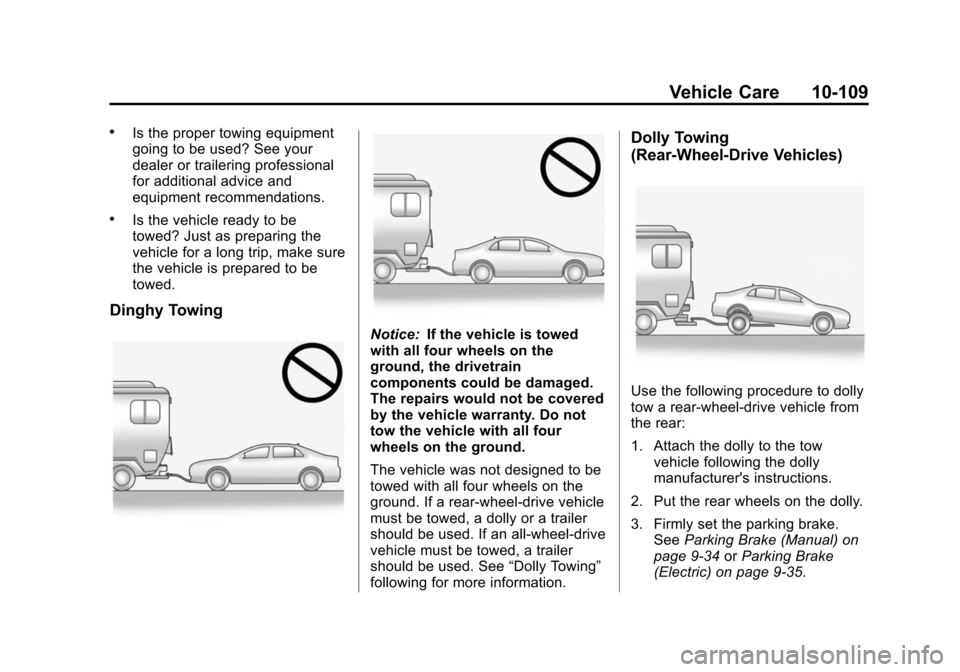
Dinghy Towing
Notice:If the vehicle is towed
with all four wheels on the
ground, the drivetrain
components could be damaged.
The repairs would not be covered
by the vehicle warranty. Do not
tow the vehicle with all four
wheels on the ground.
The vehicle was not designed to be
towed with all four wheels on the
ground. If a rear-wheel-drive vehicle
must be towed, a dolly or a trailer
should be used. If an all-wheel-drive
vehicle must be towed, a trailer
should be used. See “Dolly Towing”
following for more information.
Dolly Towing
(Rear-Wheel-Drive Vehicles)
Use the following procedure to dolly
tow a rear-wheel-drive vehicle from
the rear:
1. Attach the dolly to the tow vehicle following the dolly
manufacturer's instructions.
2. Put the rear wheels on the dolly.
3. Firmly set the parking brake. See Parking Brake (Manual) on
page 9‑34 orParking Brake
(Electric) on page 9‑35.