Page 383 of 512
Black plate (45,1)Buick LaCrosse Owner Manual - 2012
Vehicle Care 10-45
The vehicle may not be equipped
with all of the fuses, relays, and
features shown.Mini Fuses Usage
5 Not Used
6 Heated Steering
Wheel
—Run/Crank
(without eAssist) Mini Fuses Usage
7 Not Used
8 Not Used
12 Not Used
15 Not Used
16 Not Used Mini Fuses Usage
17 Not Used
18 Passive Entry/
Passive Start
Module
—Battery 1
(without eAssist)
19 Not Used
20 Run/Crank for Rear
Sunshade (without
eAssist), Ventilated
Seats (without
eAssist)
21 Not Used
22 Not Used
23 Not Used
24 Not Used
25 Not Used
26 Not Used
27 Not Used
28 Not Used
29 Not Used
Page 384 of 512
Black plate (46,1)Buick LaCrosse Owner Manual - 2012
10-46 Vehicle Care
Mini Fuses Usage30 Not Used
31 Electronic
Suspension Control
(without eAssist)
32 Rear Seat
Infotainment (without
eAssist)
33 All‐Wheel Drive
(without eAssist)
J‐Case Fuses Usage
1 Not Used
2 Not Used
3 Not Used
4 Not Used J‐Case
Fuses Usage
9 Not Used
10 Not Used 11 Not Used
13 Not Used
14 Not Used
34 Not Used
35 Passive Entry/
Passive Start
Module
—Battery 2
(without eAssist)
36 Not Used
37 Not Used Relays
Usage
K1 Not Used
K2 Run/Crank Relay for
Seat Ventilation
(without eAssist),
Sunshade (without
eAssist)
K3 Run Relay for
Heated Steering
Wheel (without
eAssist)
K4 Not Used
Page 432 of 512
Black plate (94,1)Buick LaCrosse Owner Manual - 2012
10-94 Vehicle Care
Jump Starting
Jump Starting (On-board
with eAssist Only)
If the vehicle fails to crank, it may
be jump started by using the eAssist
battery to charge the 12-volt battery.
Use the following procedure to
activate the on‐board jump start
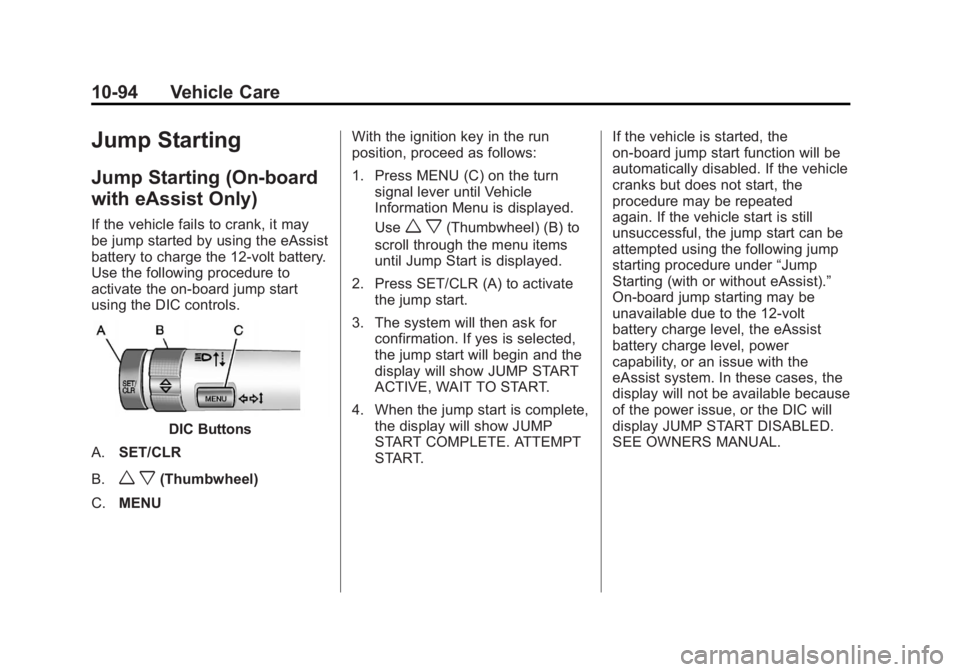
using the DIC controls.
DIC Buttons
A. SET/CLR
B.
w x(Thumbwheel)
C. MENU With the ignition key in the run
position, proceed as follows:
1. Press MENU (C) on the turn
signal lever until Vehicle
Information Menu is displayed.
Use
w x(Thumbwheel) (B) to
scroll through the menu items
until Jump Start is displayed.
2. Press SET/CLR (A) to activate the jump start.
3. The system will then ask for confirmation. If yes is selected,
the jump start will begin and the
display will show JUMP START
ACTIVE, WAIT TO START.
4. When the jump start is complete, the display will show JUMP
START COMPLETE. ATTEMPT
START. If the vehicle is started, the
on‐board jump start function will be
automatically disabled. If the vehicle
cranks but does not start, the
procedure may be repeated
again. If the vehicle start is still
unsuccessful, the jump start can be
attempted using the following jump
starting procedure under
“Jump
Starting (with or without eAssist).”
On‐board jump starting may be
unavailable due to the 12-volt
battery charge level, the eAssist
battery charge level, power
capability, or an issue with the
eAssist system. In these cases, the
display will not be available because
of the power issue, or the DIC will
display JUMP START DISABLED.
SEE OWNERS MANUAL.
Page 433 of 512
Black plate (95,1)Buick LaCrosse Owner Manual - 2012
Vehicle Care 10-95
Jump Starting (with or
without eAssist)
For more information about the
vehicle battery, seeBattery on
page 10‑25.
If the battery has run down, try to
use another vehicle and some
jumper cables to start your vehicle.
Be sure to use the following steps to
do it safely.
{WARNING
Batteries can hurt you. They can
be dangerous because:
.They contain acid that can
burn you.
.They contain gas that can
explode or ignite.
.They contain enough
electricity to burn you.
If you do not follow these steps
exactly, some or all of these
things can hurt you.
Notice: Ignoring these steps
could result in costly damage to
the vehicle that would not be
covered by the warranty.
Trying to start the vehicle by
pushing or pulling it will not
work, and it could damage the
vehicle.
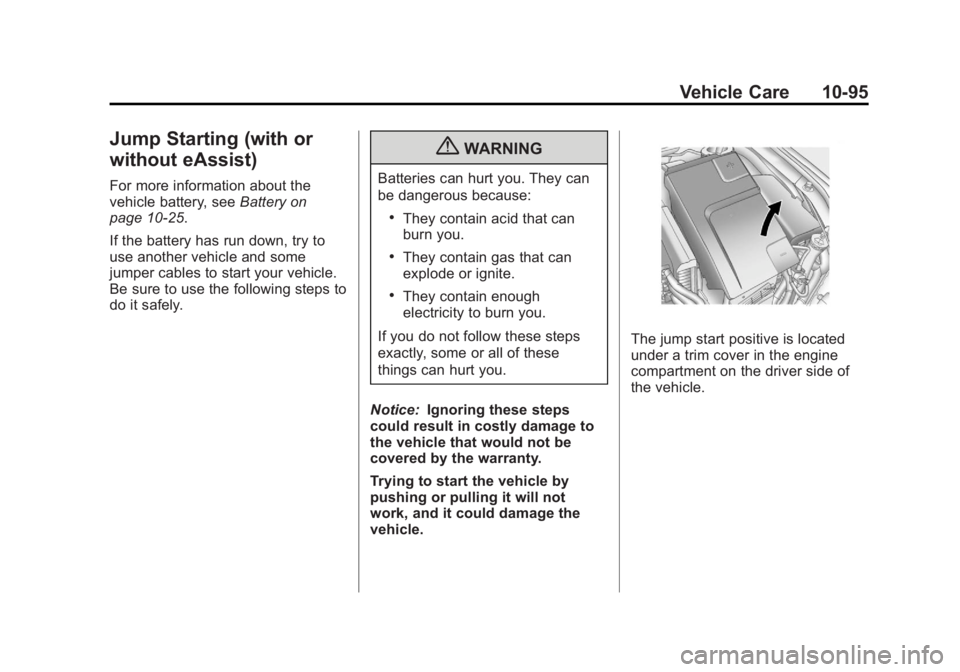
The jump start positive is located
under a trim cover in the engine
compartment on the driver side of
the vehicle.
Page 434 of 512

Black plate (96,1)Buick LaCrosse Owner Manual - 2012
10-96 Vehicle Care
This post (A) is used instead of a
direct connection to the battery.
1. Check the other vehicle. It musthave a 12-volt battery with a
negative ground system.
Notice: Only use a vehicle that
has a 12-volt system with a
negative ground for jump
starting. If the other vehicle does
not have a 12-volt system with a
negative ground, both vehicles
can be damaged.
2. Position the two vehicles so that they are not touching. 3. Set the parking brake firmly and
put the shift lever in P (Park).
See Shifting Into Park on
page 9‑27.
Notice: If any accessories are left
on or plugged in during the jump
starting procedure, they could be
damaged. The repairs would not
be covered by the vehicle
warranty. Whenever possible,
turn off or unplug all accessories
on either vehicle when jump
starting the vehicle.
4. Turn the ignition to LOCK/OFF
and switch off all lights and
accessories in both vehicles,
except the hazard warning
flashers if needed.
{WARNING
An electric fan can start up even
when the engine is not running
and can injure you. Keep hands,
clothing and tools away from any
underhood electric fan.
{WARNING
Using a match near a battery can
cause battery gas to explode.
People have been hurt doing this,
and some have been blinded.
Use a flashlight if you need more
light.
Be sure the battery has enough
water. You do not need to add
water to the battery installed in
your new vehicle. But if a battery
has filler caps, be sure the right
amount of fluid is there. If it is low,
(Continued)
Page 435 of 512
Black plate (97,1)Buick LaCrosse Owner Manual - 2012
Vehicle Care 10-97
WARNING (Continued)
add water to take care of that
first. If you do not, explosive gas
could be present.
Battery fluid contains acid that
can burn you. Do not get it on
you. If you accidentally get it in
your eyes or on your skin, flush
the place with water and get
medical help immediately.
{WARNING
Fans or other moving engine
parts can injure you badly. Keep
your hands away from moving
parts once the engine is running.
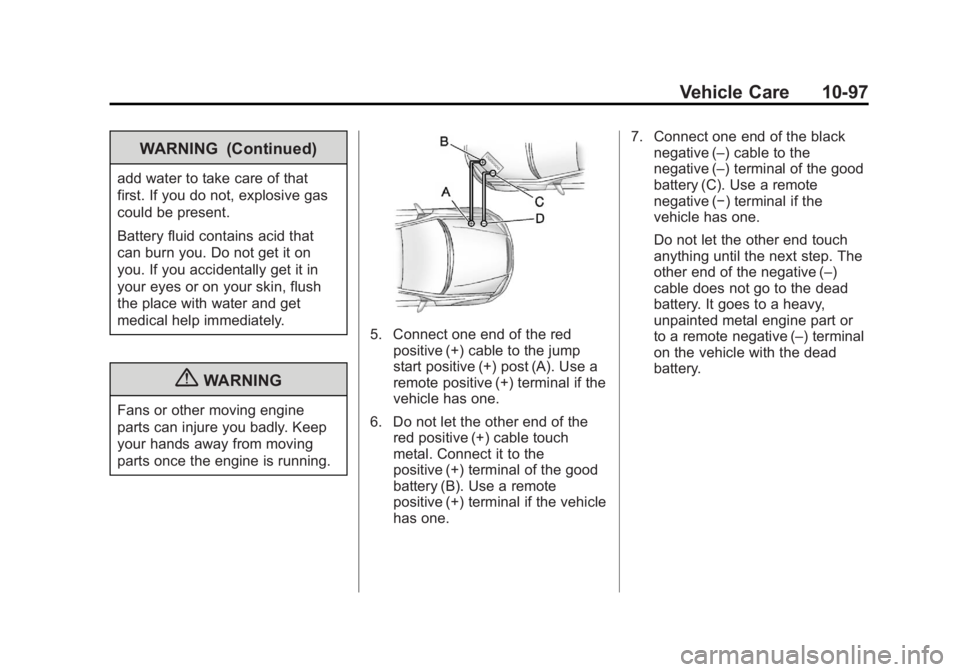
5. Connect one end of the redpositive (+) cable to the jump
start positive (+) post (A). Use a
remote positive (+) terminal if the
vehicle has one.
6. Do not let the other end of the red positive (+) cable touch
metal. Connect it to the
positive (+) terminal of the good
battery (B). Use a remote
positive (+) terminal if the vehicle
has one. 7. Connect one end of the black
negative (–) cable to the
negative (–) terminal of the good
battery (C). Use a remote
negative (−) terminal if the
vehicle has one.
Do not let the other end touch
anything until the next step. The
other end of the negative (–)
cable does not go to the dead
battery. It goes to a heavy,
unpainted metal engine part or
to a remote negative (–) terminal
on the vehicle with the dead
battery.
Page 436 of 512
Black plate (98,1)Buick LaCrosse Owner Manual - 2012
10-98 Vehicle Care
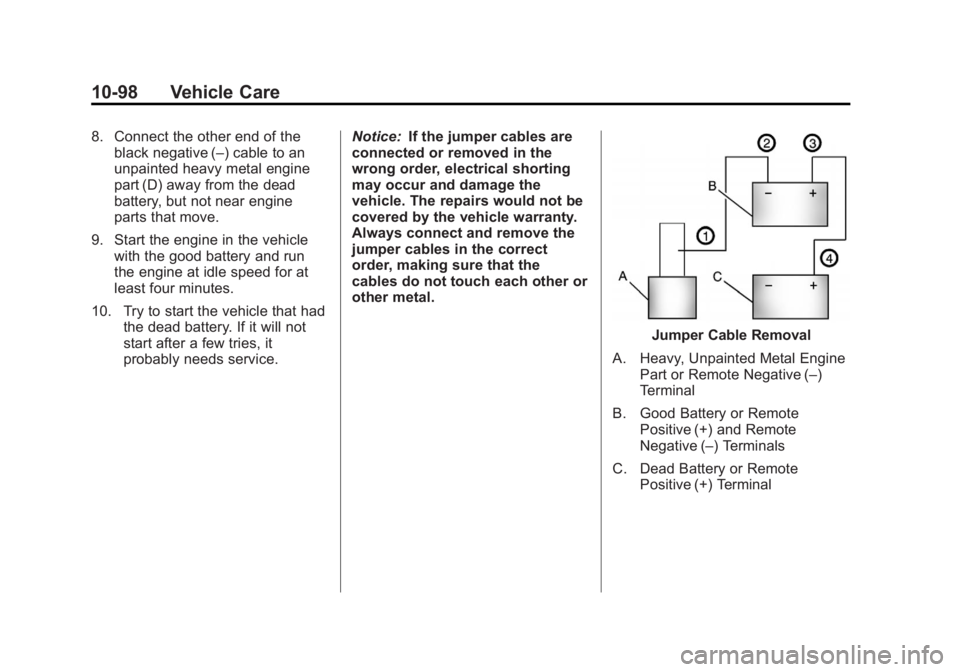
8. Connect the other end of theblack negative (–) cable to an
unpainted heavy metal engine
part (D) away from the dead
battery, but not near engine
parts that move.
9. Start the engine in the vehicle with the good battery and run
the engine at idle speed for at
least four minutes.
10. Try to start the vehicle that had the dead battery. If it will not
start after a few tries, it
probably needs service. Notice:
If the jumper cables are
connected or removed in the
wrong order, electrical shorting
may occur and damage the
vehicle. The repairs would not be
covered by the vehicle warranty.
Always connect and remove the
jumper cables in the correct
order, making sure that the
cables do not touch each other or
other metal.
Jumper Cable Removal
A. Heavy, Unpainted Metal Engine Part or Remote Negative (–)
Terminal
B. Good Battery or Remote Positive (+) and Remote
Negative (–) Terminals
C. Dead Battery or Remote Positive (+) Terminal
Page 437 of 512
Black plate (99,1)Buick LaCrosse Owner Manual - 2012
Vehicle Care 10-99
To disconnect the jumper cables
from both vehicles:
1. Disconnect the blacknegative (−) cable from the
vehicle that had the dead
battery.
2. Disconnect the black negative (−) cable from the
vehicle with the good battery.
3. Disconnect the red positive (+) cable from the vehicle with the
good battery.
4. Disconnect the red positive (+) cable from the other vehicle.
5. Return the caps over the positive (+) and negative (–)
terminals to their original
positions.Towing
Towing the Vehicle
Notice: To avoid damage, the
disabled vehicle should be towed
with all four wheels off the
ground. Care must be taken with
vehicles that have low ground
clearance and/or special
equipment. Always flatbed on a
car carrier.
Consult your dealer or a
professional towing service if the
disabled vehicle must be towed.
See Roadside Assistance Program
(U.S. and Canada) on page 13‑7 or
Roadside Assistance Program
(Mexico) on page 13‑10.
To tow the vehicle behind another
vehicle for recreational purposes,
such as behind a motor home, see
“Recreational Vehicle Towing” in this
section.
Recreational Vehicle
Towing
Recreational vehicle towing means
towing the vehicle behind another
vehicle such as a motor home. The
two most common types of
recreational vehicle towing are
known as dinghy towing and dolly
towing. Dinghy towing is towing the
vehicle with all four wheels on the
ground. Dolly towing is towing the
vehicle with two wheels on the
ground and two wheels up on a
device known as a dolly.