2012 BUICK LACROSSE fuel
[x] Cancel search: fuelPage 328 of 512

Black plate (54,1)Buick LaCrosse Owner Manual - 2012
9-54 Driving and Operating
However, some gasolines contain
only the minimum amount of
additive required to meet U.S.
Environmental Protection Agency
regulations. To help keep fuel
injectors and intake valves clean
and avoid problems due to dirty
injectors or valves, look for gasoline
that is advertised as TOP TIER
Detergent Gasoline. Look for the
TOP TIER label on the fuel pump to
ensure gasoline meets enhanced
detergency standards developed by
the auto companies. A list of
marketers providing TOP TIER
Detergent Gasoline can be found at
www.toptiergas.com.
For customers who do not use TOP
TIER Detergent Gasoline regularly,
one bottle of GM Fuel System
Treatment PLUS, added to the fuel
tank at every engine oil change, can
help clean deposits from fuel
injectors and intake valves. GM Fuel
System Treatment PLUS is the only
gasoline additive recommended by
General Motors. It is available at
your dealer.Gasolines containing oxygenates,
such as ethers and ethanol, and
reformulated gasolines might be
available in your area. We
recommend that you use these
gasolines, if they comply with the
specifications described earlier.
However, E85 (85% ethanol) and
other fuels containing more than
15% ethanol must not be used in
vehicles that were not designed for
those fuels.
Notice:
This vehicle was not
designed for fuel that contains
methanol. Do not use fuel
containing methanol. It can
corrode metal parts in the fuel
system and also damage plastic
and rubber parts. That damage
would not be covered under the
vehicle warranty. Some gasolines that are
not reformulated for low
emissions can contain an
octane-enhancing additive called
methylcyclopentadienyl manganese
tricarbonyl (MMT); ask the attendant
where you buy gasoline whether the
fuel contains MMT. We recommend
against the use of such gasolines.
Fuels containing MMT can reduce
spark plug life and affect emission
control system performance. The
malfunction indicator lamp might
turn on. If this occurs, return to your
dealer for service.
Page 329 of 512
Black plate (55,1)Buick LaCrosse Owner Manual - 2012
Driving and Operating 9-55
Filling the Tank
{WARNING
Fuel vapor burns violently and a
fuel fire can cause bad injuries.
To help avoid injuries to you and
others, read and follow all the
instructions on the fuel pump
island. Turn off the engine when
refueling. Do not smoke near fuel
or when refueling the vehicle. Do
not use cellular phones. Keep
sparks, flames, and smoking
materials away from fuel. Do not
leave the fuel pump unattended
when refueling the vehicle. This is
against the law in some places.
Do not re-enter the vehicle while
pumping fuel. Keep children away
from the fuel pump; never let
children pump fuel.
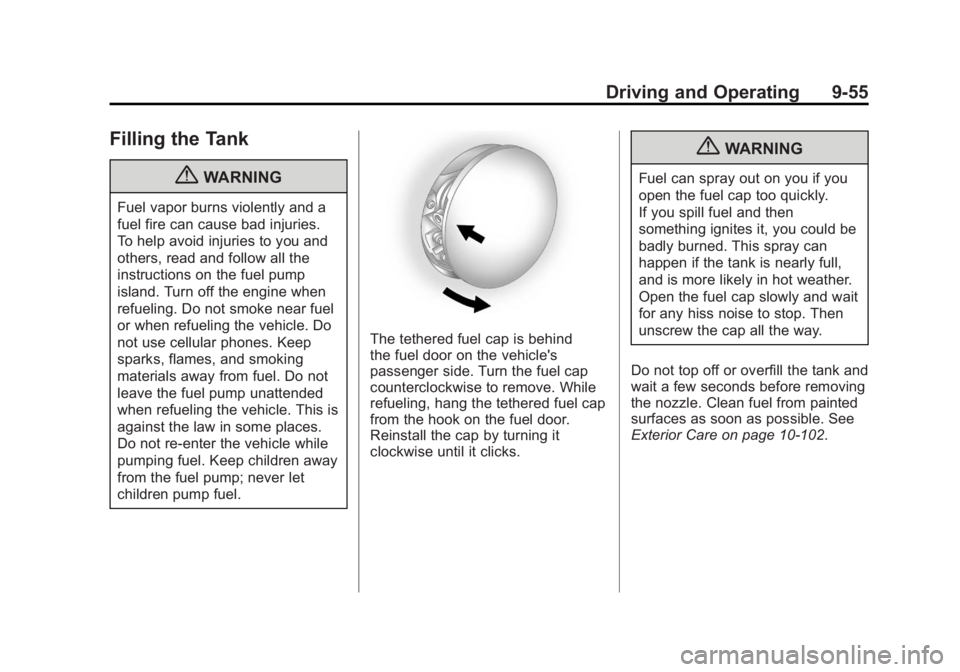
The tethered fuel cap is behind
the fuel door on the vehicle's
passenger side. Turn the fuel cap
counterclockwise to remove. While
refueling, hang the tethered fuel cap
from the hook on the fuel door.
Reinstall the cap by turning it
clockwise until it clicks.
{WARNING
Fuel can spray out on you if you
open the fuel cap too quickly.
If you spill fuel and then
something ignites it, you could be
badly burned. This spray can
happen if the tank is nearly full,
and is more likely in hot weather.
Open the fuel cap slowly and wait
for any hiss noise to stop. Then
unscrew the cap all the way.
Do not top off or overfill the tank and
wait a few seconds before removing
the nozzle. Clean fuel from painted
surfaces as soon as possible. See
Exterior Care on page 10‑102.
Page 330 of 512
Black plate (56,1)Buick LaCrosse Owner Manual - 2012
9-56 Driving and Operating
{WARNING
If a fire starts while you are
refueling, do not remove the
nozzle. Shut off the flow of fuel by
shutting off the pump or by
notifying the station attendant.
Leave the area immediately.
Notice: If a new fuel cap is
needed, be sure to get the right
type of cap from your dealer. The
wrong type of fuel cap might not
fit properly, might cause the
malfunction indicator lamp to
light, and could damage the fuel
tank and emissions system. See
Malfunction Indicator Lamp on
page 5‑17.
Filling a Portable Fuel
Container
{WARNING
Never fill a portable fuel container
while it is in the vehicle. Static
electricity discharge from the
container can ignite the fuel
vapor. You can be badly burned
and the vehicle damaged if this
occurs. To help avoid injury to you
and others:
.Dispense fuel only into
approved containers.
.Do not fill a container while it
is inside a vehicle, in a
vehicle's trunk, pickup bed,
or on any surface other than
the ground.
(Continued)
WARNING (Continued)
.Bring the fill nozzle in contact
with the inside of the fill
opening before operating the
nozzle. Contact should be
maintained until the filling is
complete.
.Do not smoke while
pumping fuel.
.Do not use a cellular phone
while pumping fuel.
Page 331 of 512
Black plate (57,1)Buick LaCrosse Owner Manual - 2012
Driving and Operating 9-57
Towing
General Towing
Information
Only use towing equipment that has
been designed for the vehicle.
Contact your dealer or trailering
dealer for assistance with preparing
the vehicle for towing a trailer.
See the following trailer towing
information in this section:
.For information on driving while
towing a trailer, see“Driving
Characteristics and
Towing Tips.”
.For maximum vehicle and trailer
weights, see “Trailer Towing.”
.For information on equipment to
tow a trailer, see “Towing
Equipment.”
For information on towing a disabled
vehicle, see Towing the Vehicle on
page 10‑99. For information on
towing the vehicle behind another vehicle such as a motor home, see
Recreational Vehicle Towing on
page 10‑99.
Driving Characteristics
and Towing Tips
{WARNING
The driver can lose control when
pulling a trailer if the correct
equipment is not used or the
vehicle is not driven properly. For
example, if the trailer is too
heavy, the brakes may not work
well
—or even at all. The driver
and passengers could be
seriously injured. The vehicle may
also be damaged; the resulting
repairs would not be covered by
the vehicle warranty. Pull a trailer
only if all the steps in this section
have been followed. Ask your
dealer for advice and information
about towing a trailer with the
vehicle. The vehicle can tow a trailer when
equipped with the proper trailer
towing equipment. For trailering
capacity, see
Trailer Towing (Except
eAssist) on page 9‑61 orTrailer
Towing (eAssist) on page 9‑62.
Trailering changes handling,
acceleration, braking, durability, and
fuel economy. With the added
weight, the engine, transmission,
wheel assemblies, and tires are
forced to work harder and under
greater loads. The trailer also adds
wind resistance, increasing the
pulling requirements. For safe
trailering, correctly use the proper
trailering equipment.
The following information has
important trailering tips and rules for
your safety and that of your
passengers. Read this section
carefully before pulling a trailer.
Page 348 of 512
Black plate (10,1)Buick LaCrosse Owner Manual - 2012
10-10 Vehicle Care
Checking Engine Oil
It is a good idea to check the engine
oil level at each fuel fill. In order to
get an accurate reading, the vehicle
must be on level ground. The
engine oil dipstick handle is a yellow
loop. SeeEngine Compartment
Overview on page 10‑6 for the
location of the engine oil dipstick.
Obtaining an accurate oil level
reading is essential:
1. If the engine has been running recently, turn off the engine and
allow several minutes for the oil
to drain back into the oil pan.
Checking the oil level too soon
after engine shutoff will not
provide an accurate oil level
reading.
2. Pull out the dipstick and clean it with a paper towel or cloth, then
push it back in all the way.
Remove it again, keeping the tip
down, and check the level.
When to Add Engine Oil
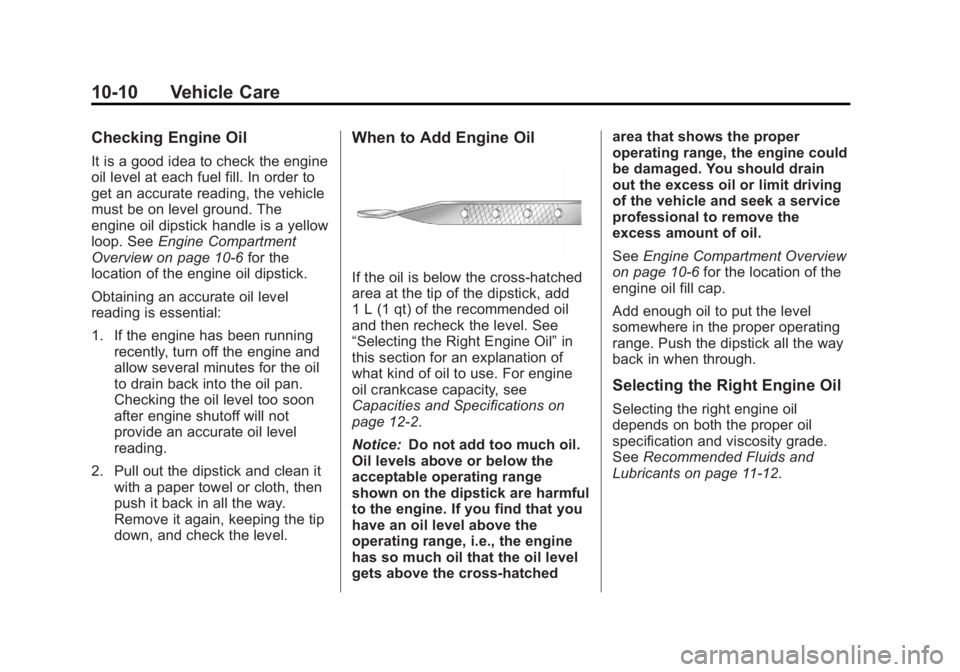
If the oil is below the cross-hatched
area at the tip of the dipstick, add
1 L (1 qt) of the recommended oil
and then recheck the level. See
“Selecting the Right Engine Oil” in
this section for an explanation of
what kind of oil to use. For engine
oil crankcase capacity, see
Capacities and Specifications on
page 12‑2.
Notice: Do not add too much oil.
Oil levels above or below the
acceptable operating range
shown on the dipstick are harmful
to the engine. If you find that you
have an oil level above the
operating range, i.e., the engine
has so much oil that the oil level
gets above the cross-hatched area that shows the proper
operating range, the engine could
be damaged. You should drain
out the excess oil or limit driving
of the vehicle and seek a service
professional to remove the
excess amount of oil.
See
Engine Compartment Overview
on page 10‑6 for the location of the
engine oil fill cap.
Add enough oil to put the level
somewhere in the proper operating
range. Push the dipstick all the way
back in when through.
Selecting the Right Engine Oil
Selecting the right engine oil
depends on both the proper oil
specification and viscosity grade.
See Recommended Fluids and
Lubricants on page 11‑12.
Page 368 of 512
Black plate (30,1)Buick LaCrosse Owner Manual - 2012
10-30 Vehicle Care
Headlamp Aiming
The headlamp aiming system has
been preset at the factory.
If the vehicle is damaged in an
accident, the aim of the headlamps
may be affected and adjustment
may be necessary.
It is recommended that a dealer
adjust the headlamps. To re-aim the
headlamps yourself, use the
following procedure.
The vehicle should be properly
prepared as follows:
.The vehicle should be placed so
the headlamps are 7.6 m (25 ft)
from a light‐colored wall.
.The vehicle must have all four
tires on a level surface which is
level all the way to the wall.
.The vehicle should be placed so
it is perpendicular to the wall or
other flat surface.
.The vehicle should not have any
snow, ice, or mud on it.
.The vehicle should be fully
assembled and all other work
stopped while headlamp aiming
is being performed.
.The vehicle should be normally
loaded with a full tank of fuel and
one person or 75 kg (160 lbs)
sitting in the driver seat.
.Tires should be properly inflated.
Headlamp aiming is done with the
vehicle's low-beam headlamps. The
high-beam headlamps will be
correctly aimed if the low-beam
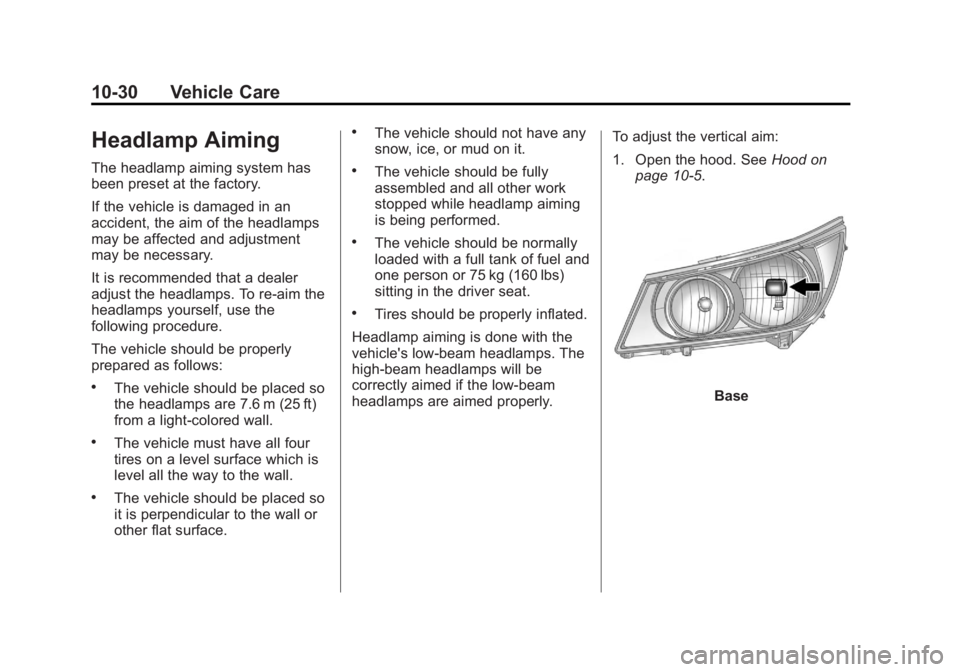
headlamps are aimed properly. To adjust the vertical aim:
1. Open the hood. See
Hood on
page 10‑5.
Base
Page 378 of 512

Black plate (40,1)Buick LaCrosse Owner Manual - 2012
10-40 Vehicle Care
Mini Fuses Usage1 Transmission
Control
Module
—Battery
2 Engine Control
Module Battery
3 Air Conditioning
Compressor Clutch
5 Engine Control
Module Run/Crank
8 Ignition
Coils
—Even (Six
Cylinder Engine),
Ignition Coils —All
(Four Cylinder
Engine
9 Ignition Coils
—Odd
(Six Cylinder
Engine)
10 Engine Control
Module
—Switched
Battery (from Engine
Control Module
Relay) Mini Fuses Usage
11 Six Cylinder Engine:
Post Catalytic
Converter Oxygen
Sensor Heater,
Mass Air Flow
Sensor, Flex Fuel
Sensor
13 Run/Crank for
Transmission
Control Module and
Fuel System Control
Module
14 Cabin Heater
Coolant Pump
(eAssist)
15 Motor Generator
Unit Coolant Pump
(eAssist)
16 Run/Crank for
eAssist Power
Inverter Module
17 Airbag
Module
—Run/
Crank Mini Fuses Usage
18 Vented Seats
(eAssist)
23 Variable Effort
Steering
(if equipped) or
eAssist Power
Inverter Module
29 Power Lumbar, Left
30 Power Lumbar,
Right or Power Pack
Cooling Fan
(eAssist)
31 Passive Entry/
Passive Start
Module
—Battery 1
(eAssist)
32 Body Control
Module 6
33 Heated
Seat
—Front
34 Antilock Brake
System Valves
35 Amplifier
Page 379 of 512

Black plate (41,1)Buick LaCrosse Owner Manual - 2012
Vehicle Care 10-41
Mini Fuses Usage36 Adaptive Forward
Lighting (AFL)
Motors
—Battery
37 Right High Beam
38 Left High Beam
46 Cooling Fan Relay
47 Six Cylinder Engine:
Pre Catalytic
Converter Oxygen
Sensor Heater,
Canister Purge
Solenoid. Four
Cylinder Engine: Pre
and Post Catalytic
Converter Oxygen
Sensor Heaters,
Canister Purge
Solenoid, Mass Air
Flow Sensor.
48 Fog Lamps
49 Right High Intensity
Discharge
Headlamp Mini Fuses Usage
50 Left High Intensity
Discharge
Headlamp
51 Horn
52 Cluster Run/Crank
53 Run/Crank for Inside
Rearview Mirror,
Rear Vision Camera
54 Run/Crank for:
Heating, Ventilation
and Air Conditioning
55 Outside Rearview
Mirror, Universal
Garage Door
Opener, Front
Window Switches
56 Windshield Washer
60 Heated Mirror
62 Canister Vent
64 Adaptive Forward
Lighting (AFL)
Module
—Battery Mini Fuses Usage
65 Not Used
66 AIR Solenoid
(eAssist)
67 Fuel System Control
Module
69 Regulated Voltage
Control Sensor
70 Ultrasonic Parking
Assist/Side
Blind Zone
Mini Relays Usage 7 Engine Control
Module
9 Cooling Fan
13 Cooling Fan
15 Run/Crank
16 AIR Pump
17 Rear Window
Defogger