2012 BMW 550I XDRIVE GRAN TURISMO tires
[x] Cancel search: tiresPage 159 of 321
Do not remove the heat shields installed and
never apply undercoating to them. When driv‐
ing, standing at idle and while parking, take care
to avoid possible contact between the hot ex‐
haust system and any highly flammable materi‐
als such as hay, leaves, grass, etc. Such contact
could lead to a fire, and with it the risk of serious
personal injury as well as property damage.
Do not touch hot exhaust pipes; otherwise, there
is the danger of getting burned.◀
Climate control windshield
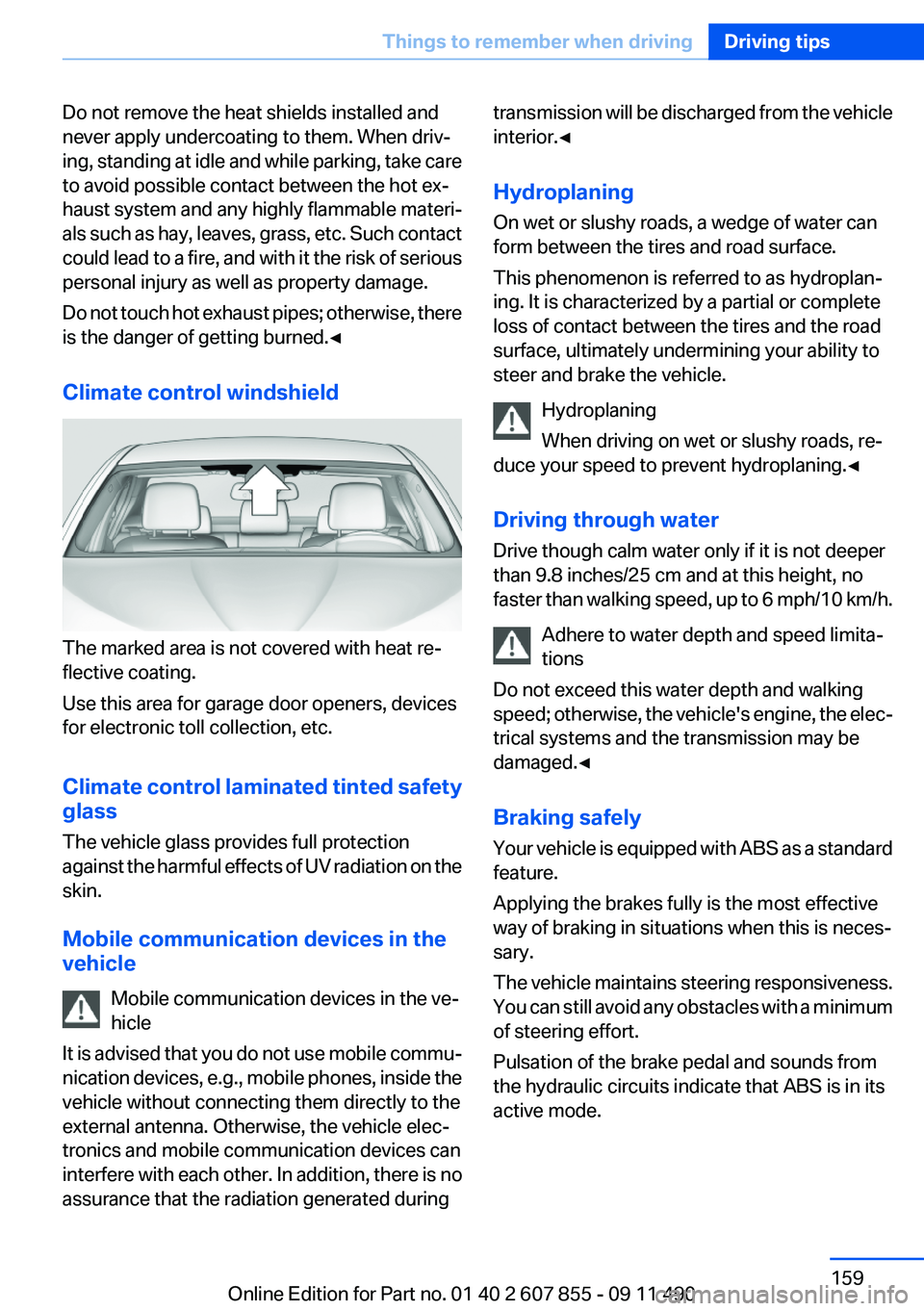
The marked area is not covered with heat re‐
flective coating.
Use this area for garage door openers, devices
for electronic toll collection, etc.
Climate control laminated tinted safety
glass
The vehicle glass provides full protection
against the harmful effects of UV radiation on the
skin.
Mobile communication devices in the
vehicle
Mobile communication devices in the ve‐
hicle
It is advised that you do not use mobile commu‐
nication devices, e.g., mobile phones, inside the
vehicle without connecting them directly to the
external antenna. Otherwise, the vehicle elec‐
tronics and mobile communication devices can
interfere with each other. In addition, there is no
assurance that the radiation generated during
transmission will be discharged from the vehicle
interior.◀
Hydroplaning
On wet or slushy roads, a wedge of water can
form between the tires and road surface.
This phenomenon is referred to as hydroplan‐
ing. It is characterized by a partial or complete
loss of contact between the tires and the road
surface, ultimately undermining your ability to
steer and brake the vehicle.
Hydroplaning
When driving on wet or slushy roads, re‐
duce your speed to prevent hydroplaning.◀
Driving through water
Drive though calm water only if it is not deeper
than 9.8 inches/25 cm and at this height, no
faster than walking speed, up to 6 mph/10 km/h.
Adhere to water depth and speed limita‐
tions
Do not exceed this water depth and walking
speed; otherwise, the vehicle's engine, the elec‐
trical systems and the transmission may be
damaged.◀
Braking safely
Your vehicle is equipped with ABS as a standard
feature.
Applying the brakes fully is the most effective
way of braking in situations when this is neces‐
sary.
The vehicle maintains steering responsiveness.
You can still avoid any obstacles with a minimum
of steering effort.
Pulsation of the brake pedal and sounds from
the hydraulic circuits indicate that ABS is in its
active mode.Seite 159Things to remember when drivingDriving tips159
Online Edition for Part no. 01 40 2 607 855 - 09 11 490
Page 161 of 321
LoadingVehicle equipment
All standard, country-specific and optional
equipment that is offered in the model series is
described in this chapter. Therefore, equipment
is also described that is not available in a vehicle,
e. g., because of the selected optional equip‐
ment or country variant. This also applies for
safety-related functions and systems.
General information Overloading the vehicle
To avoid exceeding the approved carrying
capacity of the tires, never overload the vehicle.
Overloading can lead to overheating and in‐
creases the rate at which damage develops in‐
side the tires. This could result in a sudden loss
of tire inflation pressure.◀
No fluids in the trunk
Make sure that fluids do not leak into the
trunk; otherwise, the vehicle may be damaged. ◀
Determining the load limit1.Locate the following statement on your ve‐
hicle’s placard:▷The combined weight of occupants and
cargo should never exceed XXX kg or
YYY lbs. Otherwise, damage to the ve‐hicle and unstable driving situations may
result.2.Determine the combined weight of the
driver and passengers that will be riding in
your vehicle.3.Subtract the combined weight of the driver
and passengers from XXX kilograms or YYY
pounds.4.The resulting figure equals the available
amount of cargo and luggage load capacity.
For example, if the YYY amount equals
1,000 lbs and there will be four 150 lbs pas‐
sengers in your vehicle, the amount of avail‐
able cargo and luggage load capacity is
400 lbs: 1,000 lbs minus 600 lbs = 400 lbs.5.Determine the combined weight of luggage
and cargo being loaded on the vehicle. That
weight may not safely exceed the available
cargo and luggage load capacity calculated
in Step 4.
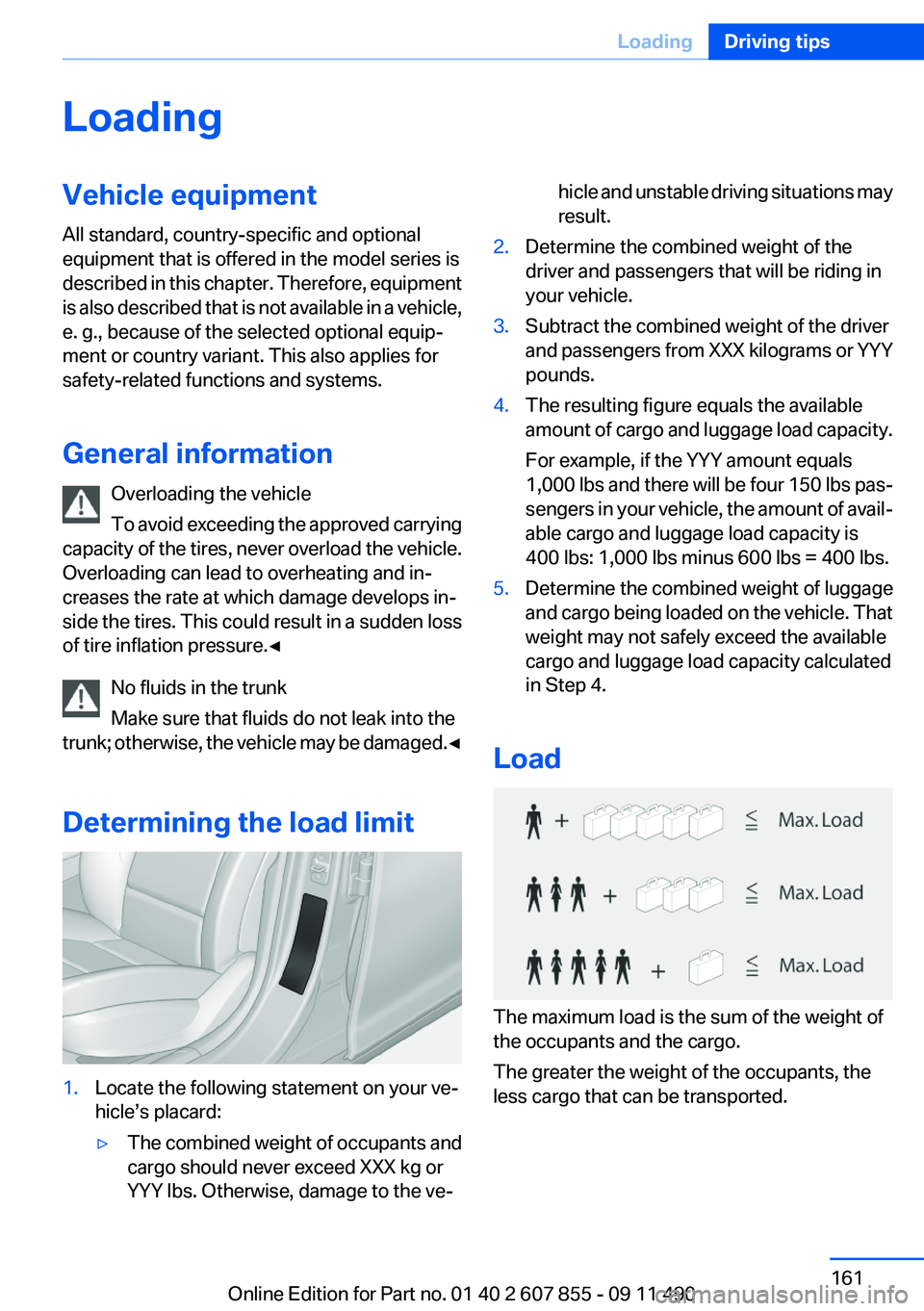
Load
The maximum load is the sum of the weight of
the occupants and the cargo.
The greater the weight of the occupants, the
less cargo that can be transported.
Seite 161LoadingDriving tips161
Online Edition for Part no. 01 40 2 607 855 - 09 11 490
Page 257 of 321
Mobility
To ensure that you remain mobile at all times, this chapter supplies you with important information
on the topics of fuels and lubricants, wheels and tires, service, maintenance, and Roadside Assistance.Online Edition for Part no. 01 40 2 607 855 - 09 11 490
Page 261 of 321
Wheels and tiresVehicle equipment
All standard, country-specific and optional
equipment that is offered in the model series is
described in this chapter. Therefore, equipment
is also described that is not available in a vehicle,
e. g., because of the selected optional equip‐
ment or country variant. This also applies for
safety-related functions and systems.
Tire inflation pressure
Safety information
The tire characteristics and tire inflation pres‐
sure influence the following:▷The service life of the tires.▷Road safety.▷Driving comfort.
Checking the pressure
Only check the tire inflation pressure when the
tires are cold. This means after driving no more
than 1.25 miles/2 km or when the vehicle has
been parked for at least 2 hours. When the tires
are warm, the tire inflation pressure is higher.
Check the tire inflation pressure regularly
Regularly check the tire inflation pressure
and correct it as needed: at least twice a month
and before a long trip. If you fail to observe this
precaution, you may be driving on tires with in‐
correct tire pressures, a condition that may not
only compromise your vehicle's driving stability,
but also lead to tire damage and the risk of an
accident.◀
After correcting the tire inflation pressure:
▷Reinitialize the Flat Tire Monitor.▷Reinitialize the Tire Pressure Monitor.Pressure specifications
The tire inflation pressure table, refer to
page 262, contains all pressure specifications
for the specified tire sizes at the ambient tem‐
perature. Pressure specifications apply to ap‐
proved tire sizes and recommended tire brands.
This information can be obtained from your
service center.
To identify the correct tire inflation pressure,
please note the following:▷Tire sizes of your vehicle.▷Maximum allowable driving speed.
Tire inflation pressures up to 100 mph/
160 km/h
For speeds of up to 100 mph/160 km/h and for
optimum driving comfort, note the pressure val‐
ues in the tire inflation pressure table, refer to
page 262, and adjust as necessary.
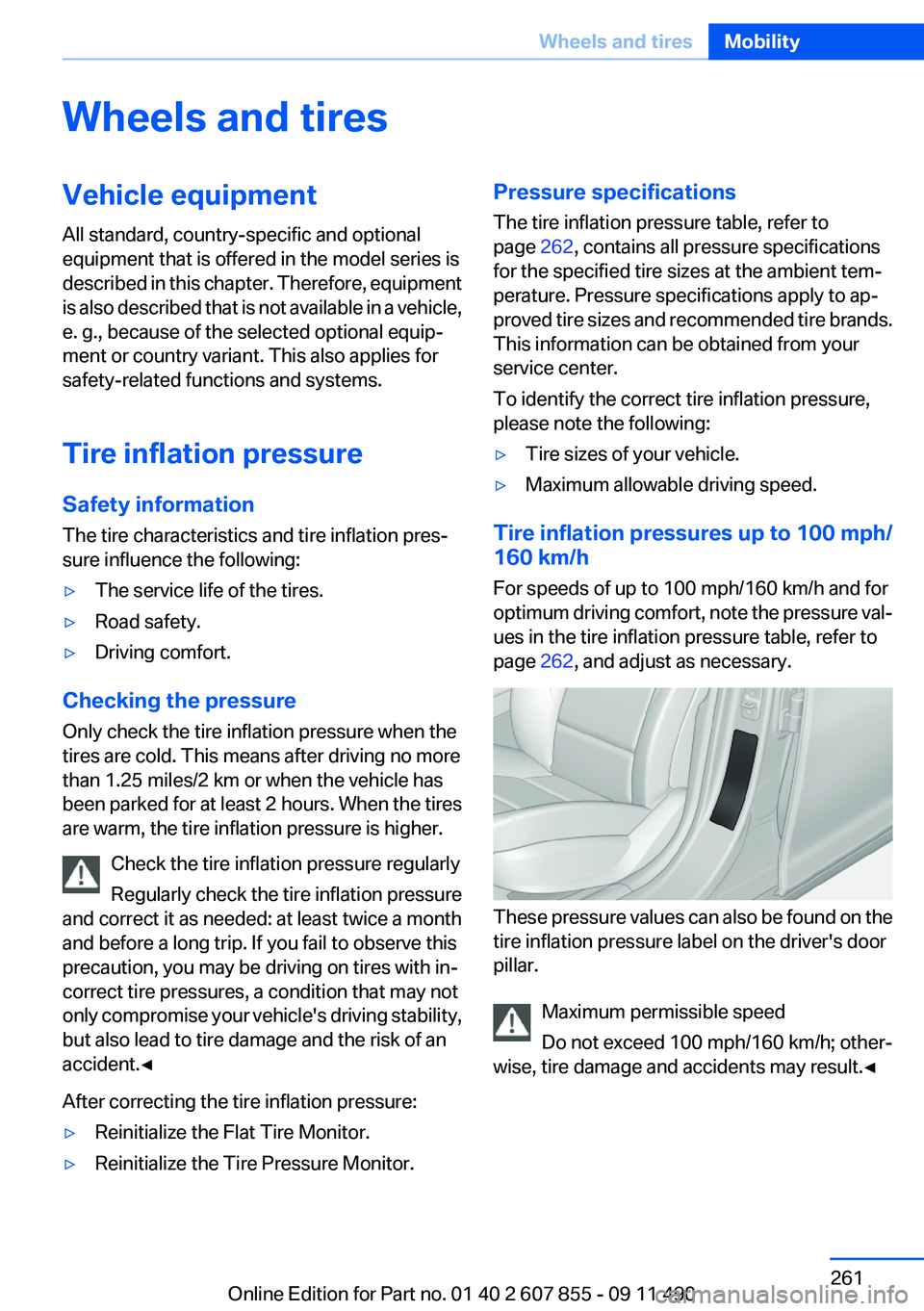
These pressure values can also be found on the
tire inflation pressure label on the driver's door
pillar.
Maximum permissible speed
Do not exceed 100 mph/160 km/h; other‐
wise, tire damage and accidents may result.◀
Seite 261Wheels and tiresMobility261
Online Edition for Part no. 01 40 2 607 855 - 09 11 490
Page 262 of 321
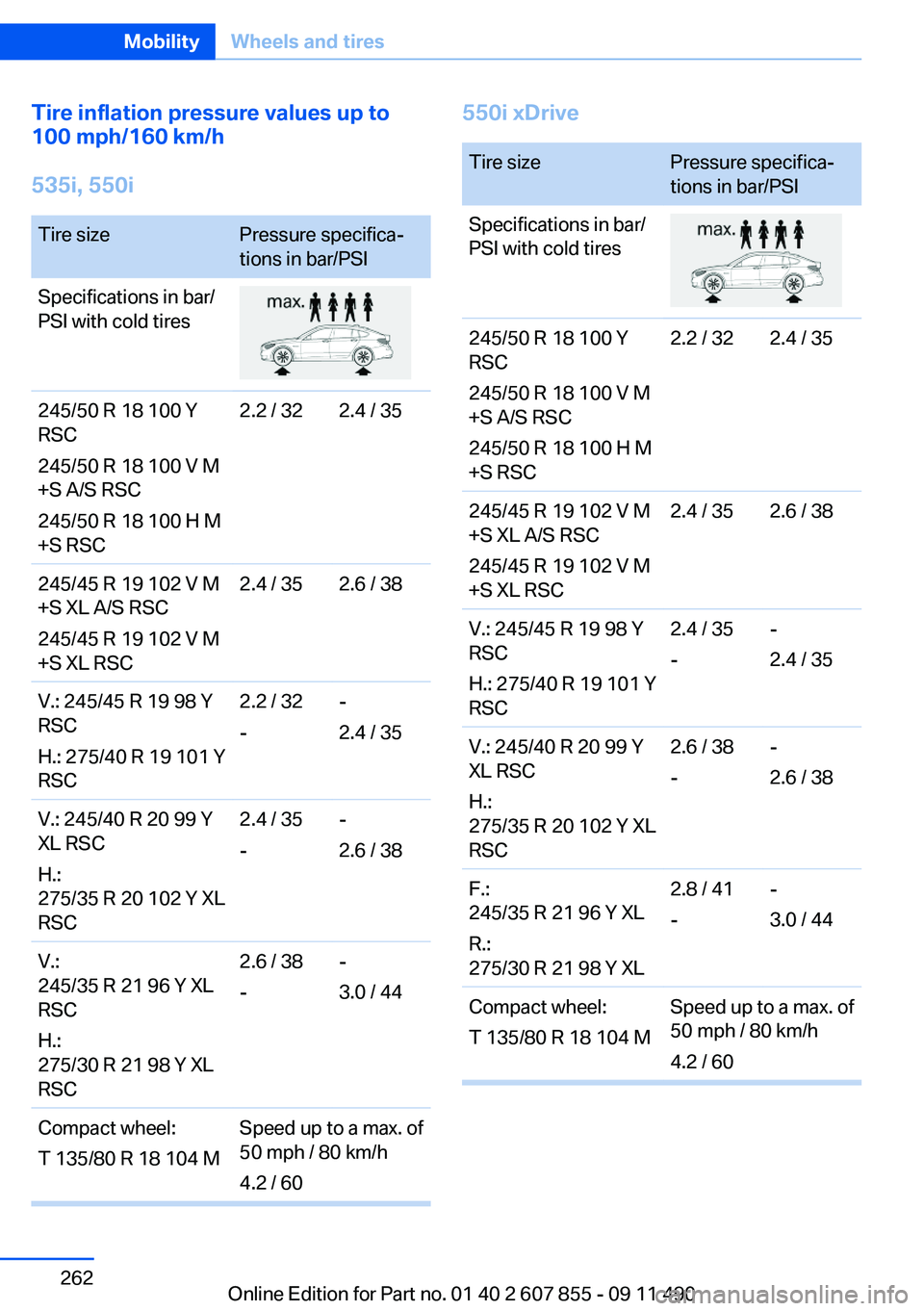
Tire inflation pressure values up to
100 mph/160 km/h
535i, 550iTire sizePressure specifica‐
tions in bar/PSISpecifications in bar/
PSI with cold tires245/50 R 18 100 Y
RSC
245/50 R 18 100 V M
+S A/S RSC
245/50 R 18 100 H M
+S RSC2.2 / 322.4 / 35245/45 R 19 102 V M
+S XL A/S RSC
245/45 R 19 102 V M
+S XL RSC2.4 / 352.6 / 38V.: 245/45 R 19 98 Y
RSC
H.: 275/40 R 19 101 Y
RSC2.2 / 32
--
2.4 / 35V.: 245/40 R 20 99 Y
XL RSC
H.:
275/35 R 20 102 Y XL
RSC2.4 / 35
--
2.6 / 38V.:
245/35 R 21 96 Y XL
RSC
H.:
275/30 R 21 98 Y XL
RSC2.6 / 38
--
3.0 / 44Compact wheel:
T 135/80 R 18 104 MSpeed up to a max. of
50 mph / 80 km/h
4.2 / 60550i xDriveTire sizePressure specifica‐
tions in bar/PSISpecifications in bar/
PSI with cold tires245/50 R 18 100 Y
RSC
245/50 R 18 100 V M
+S A/S RSC
245/50 R 18 100 H M
+S RSC2.2 / 322.4 / 35245/45 R 19 102 V M
+S XL A/S RSC
245/45 R 19 102 V M
+S XL RSC2.4 / 352.6 / 38V.: 245/45 R 19 98 Y
RSC
H.: 275/40 R 19 101 Y
RSC2.4 / 35
--
2.4 / 35V.: 245/40 R 20 99 Y
XL RSC
H.:
275/35 R 20 102 Y XL
RSC2.6 / 38
--
2.6 / 38F.:
245/35 R 21 96 Y XL
R.:
275/30 R 21 98 Y XL2.8 / 41
--
3.0 / 44Compact wheel:
T 135/80 R 18 104 MSpeed up to a max. of
50 mph / 80 km/h
4.2 / 60Seite 262MobilityWheels and tires262
Online Edition for Part no. 01 40 2 607 855 - 09 11 490
Page 263 of 321
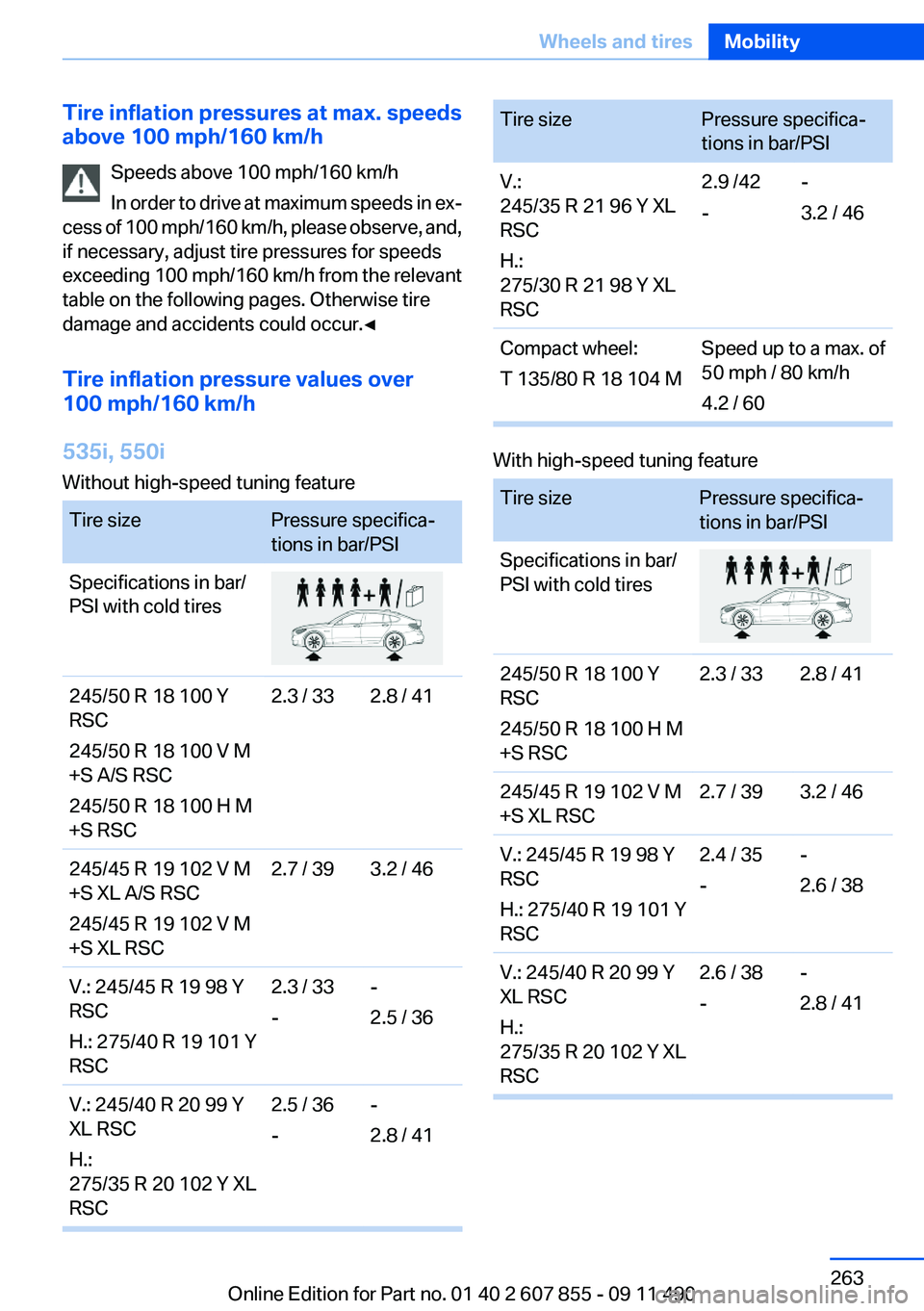
Tire inflation pressures at max. speeds
above 100 mph/160 km/h
Speeds above 100 mph/160 km/h
In order to drive at maximum speeds in ex‐
cess of 100 mph/160 km/h, please observe, and,
if necessary, adjust tire pressures for speeds
exceeding 100 mph/160 km/h from the relevant
table on the following pages. Otherwise tire
damage and accidents could occur.◀
Tire inflation pressure values over
100 mph/160 km/h
535i, 550i
Without high-speed tuning featureTire sizePressure specifica‐
tions in bar/PSISpecifications in bar/
PSI with cold tires245/50 R 18 100 Y
RSC
245/50 R 18 100 V M
+S A/S RSC
245/50 R 18 100 H M
+S RSC2.3 / 332.8 / 41245/45 R 19 102 V M
+S XL A/S RSC
245/45 R 19 102 V M
+S XL RSC2.7 / 393.2 / 46V.: 245/45 R 19 98 Y
RSC
H.: 275/40 R 19 101 Y
RSC2.3 / 33
--
2.5 / 36V.: 245/40 R 20 99 Y
XL RSC
H.:
275/35 R 20 102 Y XL
RSC2.5 / 36
--
2.8 / 41Tire sizePressure specifica‐
tions in bar/PSIV.:
245/35 R 21 96 Y XL
RSC
H.:
275/30 R 21 98 Y XL
RSC2.9 /42
--
3.2 / 46Compact wheel:
T 135/80 R 18 104 MSpeed up to a max. of
50 mph / 80 km/h
4.2 / 60
With high-speed tuning feature
Tire sizePressure specifica‐
tions in bar/PSISpecifications in bar/
PSI with cold tires245/50 R 18 100 Y
RSC
245/50 R 18 100 H M
+S RSC2.3 / 332.8 / 41245/45 R 19 102 V M
+S XL RSC2.7 / 393.2 / 46V.: 245/45 R 19 98 Y
RSC
H.: 275/40 R 19 101 Y
RSC2.4 / 35
--
2.6 / 38V.: 245/40 R 20 99 Y
XL RSC
H.:
275/35 R 20 102 Y XL
RSC2.6 / 38
--
2.8 / 41Seite 263Wheels and tiresMobility263
Online Edition for Part no. 01 40 2 607 855 - 09 11 490
Page 264 of 321
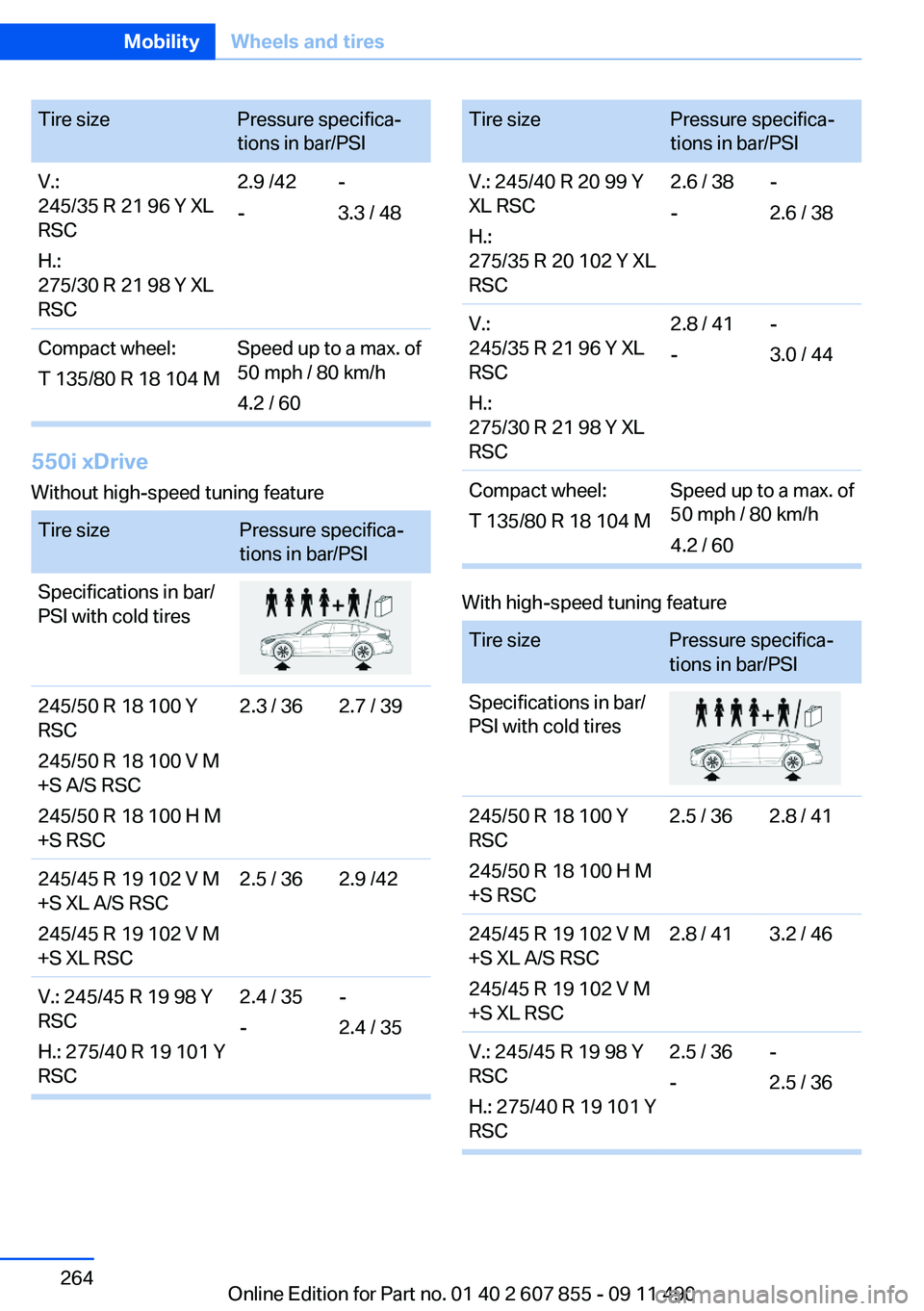
Tire sizePressure specifica‐
tions in bar/PSIV.:
245/35 R 21 96 Y XL
RSC
H.:
275/30 R 21 98 Y XL
RSC2.9 /42
--
3.3 / 48Compact wheel:
T 135/80 R 18 104 MSpeed up to a max. of
50 mph / 80 km/h
4.2 / 60
550i xDrive
Without high-speed tuning feature
Tire sizePressure specifica‐
tions in bar/PSISpecifications in bar/
PSI with cold tires245/50 R 18 100 Y
RSC
245/50 R 18 100 V M
+S A/S RSC
245/50 R 18 100 H M
+S RSC2.3 / 362.7 / 39245/45 R 19 102 V M
+S XL A/S RSC
245/45 R 19 102 V M
+S XL RSC2.5 / 362.9 /42V.: 245/45 R 19 98 Y
RSC
H.: 275/40 R 19 101 Y
RSC2.4 / 35
--
2.4 / 35Tire sizePressure specifica‐
tions in bar/PSIV.: 245/40 R 20 99 Y
XL RSC
H.:
275/35 R 20 102 Y XL
RSC2.6 / 38
--
2.6 / 38V.:
245/35 R 21 96 Y XL
RSC
H.:
275/30 R 21 98 Y XL
RSC2.8 / 41
--
3.0 / 44Compact wheel:
T 135/80 R 18 104 MSpeed up to a max. of
50 mph / 80 km/h
4.2 / 60
With high-speed tuning feature
Tire sizePressure specifica‐
tions in bar/PSISpecifications in bar/
PSI with cold tires245/50 R 18 100 Y
RSC
245/50 R 18 100 H M
+S RSC2.5 / 362.8 / 41245/45 R 19 102 V M
+S XL A/S RSC
245/45 R 19 102 V M
+S XL RSC2.8 / 413.2 / 46V.: 245/45 R 19 98 Y
RSC
H.: 275/40 R 19 101 Y
RSC2.5 / 36
--
2.5 / 36Seite 264MobilityWheels and tires264
Online Edition for Part no. 01 40 2 607 855 - 09 11 490
Page 265 of 321
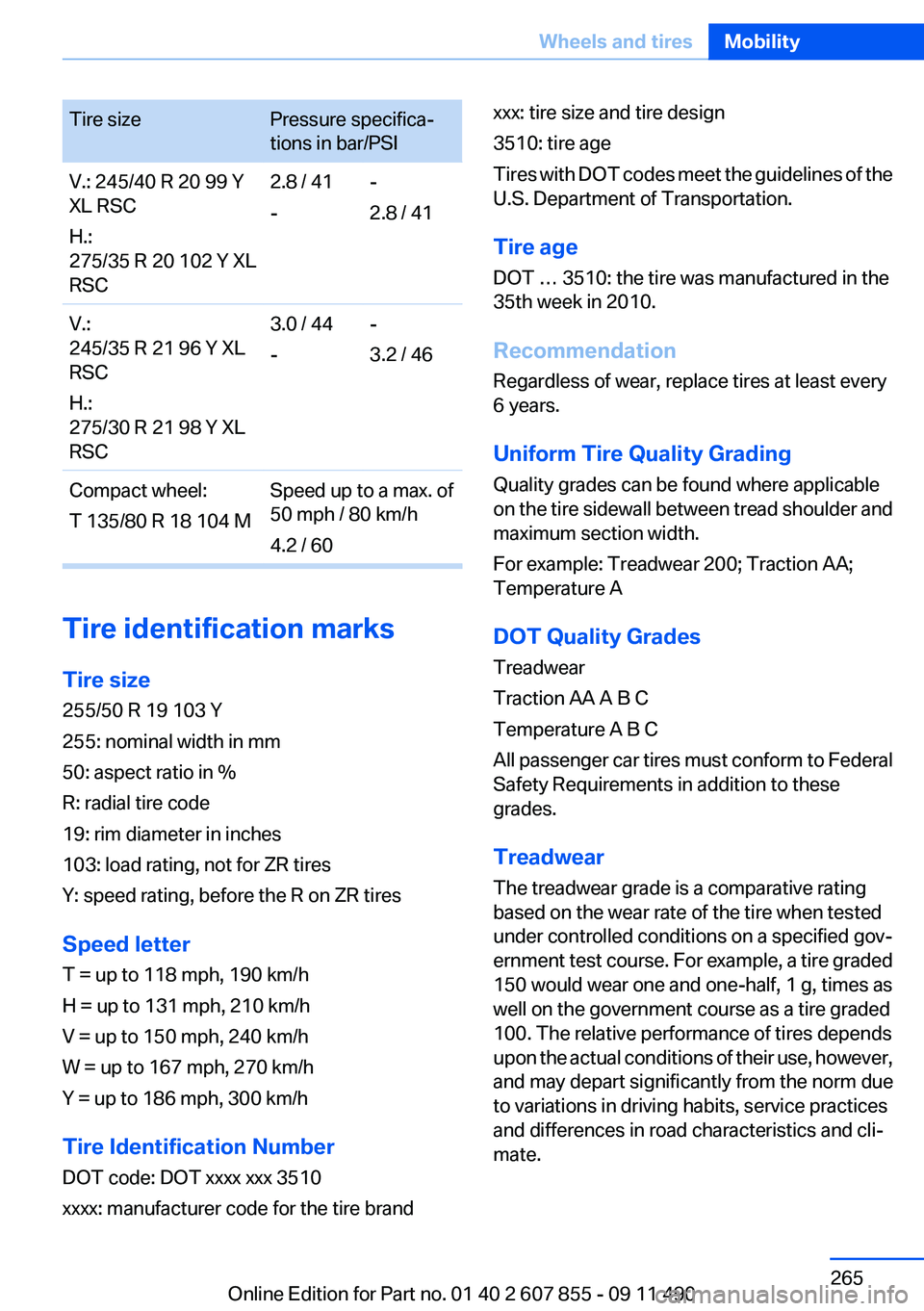
Tire sizePressure specifica‐
tions in bar/PSIV.: 245/40 R 20 99 Y
XL RSC
H.:
275/35 R 20 102 Y XL
RSC2.8 / 41
--
2.8 / 41V.:
245/35 R 21 96 Y XL
RSC
H.:
275/30 R 21 98 Y XL
RSC3.0 / 44
--
3.2 / 46Compact wheel:
T 135/80 R 18 104 MSpeed up to a max. of
50 mph / 80 km/h
4.2 / 60
Tire identification marks
Tire size
255/50 R 19 103 Y
255: nominal width in mm
50: aspect ratio in %
R: radial tire code
19: rim diameter in inches
103: load rating, not for ZR tires
Y: speed rating, before the R on ZR tires
Speed letter
T = up to 118 mph, 190 km/h
H = up to 131 mph, 210 km/h
V = up to 150 mph, 240 km/h
W = up to 167 mph, 270 km/h
Y = up to 186 mph, 300 km/h
Tire Identification Number
DOT code: DOT xxxx xxx 3510
xxxx: manufacturer code for the tire brand
xxx: tire size and tire design
3510: tire age
Tires with DOT codes meet the guidelines of the
U.S. Department of Transportation.
Tire age
DOT … 3510: the tire was manufactured in the
35th week in 2010.
Recommendation
Regardless of wear, replace tires at least every
6 years.
Uniform Tire Quality Grading
Quality grades can be found where applicable
on the tire sidewall between tread shoulder and
maximum section width.
For example: Treadwear 200; Traction AA;
Temperature A
DOT Quality Grades
Treadwear
Traction AA A B C
Temperature A B C
All passenger car tires must conform to Federal
Safety Requirements in addition to these
grades.
Treadwear
The treadwear grade is a comparative rating
based on the wear rate of the tire when tested
under controlled conditions on a specified gov‐
ernment test course. For example, a tire graded
150 would wear one and one-half, 1 g, times as
well on the government course as a tire graded
100. The relative performance of tires depends
upon the actual conditions of their use, however,
and may depart significantly from the norm due
to variations in driving habits, service practices
and differences in road characteristics and cli‐
mate.Seite 265Wheels and tiresMobility265
Online Edition for Part no. 01 40 2 607 855 - 09 11 490