2012 AUDI S8 suspension
[x] Cancel search: suspensionPage 198 of 300

196 Driving and en vironm ent
Driving through water
on roads
Note the following to avoid vehicle damage
when driving through water, for example on
flooded roads:
- The water must not be any higher than the
bottom of the vehicle body.
- Do not drive faster than wa lking speed.
A WARNING
After driving through water, mud, slush,
etc., the brakes may be slow to take effect
because of wet brake rotors and pads. Dry
the brakes first by braking carefully to re
sto re the full braking effect.
@) Note
Vehicle components such as the engine,
transmiss ion, suspension or electrical sys
tem can be severely damaged by driving
through water.
- Check the depth of the water before dr iv
i ng through it.
- Do not stop the vehicle, drive in reverse
or switch the engine off when driving
through water .
- Keep in mind that oncoming vehicles
may create waves that raise the water
level and make it too deep for your vehi
cle to drive through safely.
- Avoid dr iving through salt water because
i t can cause corrosion.
Operate your vehicle
economically and
minimize pollution
General
Your personal style of driving will determine
the economy of your vehicle, as well as ex
haust and noise levels.
Fuel economy, environmenta l impact, and
wear on your engine, brakes and tires largely
depend on three factors:
- your personal driving style
- operating conditions
- technical limitations
If you anticipate what you need to do next and
drive economically, you can easily cut your
fuel consumpt ion by 10-15 percent . This sec
t ion will give you some tips on how you can
help the env ironment and your pocketbook.
@ Tips
The consumption estimates as published
by ENVIRONMENTAL PROTECTION AGENCY
(EPA) and Transport Canada may not corre
spond to your actual consumption on the
road, which will vary depending upon vehi
cle load and speed, road and weather con
ditions, trip length, etc.
Drive smoothly and keep a lookout
ahead
Vehicles use the most fuel when they are ac
celerating.
.,. Avoid unnecessary accelerating and braking.
Vehicles use the most fuel when they are ac
ce lerating. If you anticipate what is going to
happen next, you will need to brake less and,
thus, acce lerate less . Let the vehicle coast
whenever possible - for example when you see
that the next traffic light is red.
Page 253 of 300

The speed rating letter code (c::> page 23 7) is
on the side wall of the tire
c::> page 246.
A WARNING
Winter tires have maximum speed limits
that may be lower than your vehicle's max
imum speed . Always know the maximum
speed before driving off. Never drive faster
than the speed permitted for your specific
winter tires . This will cause damage to the
tires leading to an accident and serious
personal injury to you and your passen
gers.
A WARNING
Driving faster than the maximum speed
for which the winter tires on your vehicle
were designed can cause tire failure in cluding a blowout and sudden deflation,
loss of control, crashes and serious per
sonal injuries . Have worn or damaged tires
replaced immediately.
- Winter tires have maximum speed rating
that may be lower than your vehicle's
maximum speed .
- Never drive faster than the speed for
which the winter or other tires installed
on your vehicle are rated .
A WARNING
Always adjust your driving to the road and
traffic conditions. Never let the good ac
celeration of the winter tires and all-wheel
drive tempt you into taking extra risks . Al
ways remember :
- When braking, an all-wheel drive vehicle
handles in the same way as a front drive
vehicle.
- Drive carefully and reduce your speed on
icy and slippery roads, even winter tires
cannot help under black ice conditions.
@l For the sake of the environment
Use summer tires when weather condi
tions permit. They are quieter, do not wear
as quickly and reduce fuel consumption.
-
Tires and wheels
Snow chains
Snow chains may be fitted only to the front
wheels , and only to certain tire sizes. Ask your
authorized Audi dealer on which tire sizes
snow chains can be used.
If you are going to use snow chains, then you
must install them on the front wheels at
least.
The snow chains must have low-profile links
and must not be thicker than 0.4 inch
(10,S mm) , including the lock.
Remove wheel center covers and trim discs
before putting snow chains on your vehicle
c::> (]) . For safety reasons cover caps must then
be fitted over the wheel bolts. These are avail
able from authorized Audi dealers.
A WARNING ,..__
Using the wrong snow chains for your vehi
cle or installing them incorrectly can in
crease the risk of loss of control leading to
serious personal injury.
- Snow chains are available in different
sizes . Always make sure to follow the in
structions provided by the snow chain manufacturer .
- When driving with snow chains never
drive faster than the speed permitted for
your specific snow chains .
- Always observe local regulations.
(D Note
- Remove snow chains before driving on
roads not covered with snow to avoid
damaging tires and wearing the snow
chains down unnecessarily.
- Snow chains, which come into direct con
tact with the wheel rim, can scratch or
damage it. Therefore, make sure that the
snow chains are suitably covered . Check
the position of the snow chains after
driving a few yards and correct if neces
sary. Follow the instructions from the
snow chain manufacturer when doing so.
- If the Adaptive Air Suspension should
malfunction, do not mount or use snow ..,.
251
•
•
Page 269 of 300

Fuse s and bulb s 267
Luggage compartment fuse assignment
Fig. 207 Luggage compartment: fuse pa nel with plastic bracket
Fuse panel @ (black ) Fuse panel @ (b la ck)
No . Equi pment Amps No. Equipment Amps
[ru button, data logger, diag-
11 Dynamic
steering
5
l nostic connector, BCM -1,
5
Selector lever, BCM-2 5
adaptive light ing system
Audi side assist
5
2 Networking gateway 5
Engine control module 5
3 adaptive air suspension
5
Starter 40
4 Parking system 5
Left headlight/Headlight
16 10/5
5 Steer
ing column lever
5
range control system
Suspension control system
6 5 Fuse panel @ (red ) sensor
Belt tensioners, airbag con-
No. Equipment Amps
7
trol module 5 1 Left
reversible be lt tens ione r
25
Heated washer fluid nozzles, 2 Right reversible belt ten-
25
Homelink (garage door sioner
8 opener), night vision system
5 3 Starter diagnosis 5
control module, sport differ- 4 DC/DC converter
7,5
ential, ioni zer
5 Adaptive cruise contro l 7,5
9
Electromechan ica l parking
5 Right headlight (headlight
brake contro l modu le
6 with adaptive light) 10 -
10 Rear seat heating, cooler, in-
5 7 ESC co ntrol modu le 5 ... terior rearview mirror
Page 270 of 300

268 Fuses and bulbs
Fuse panel
® (red)
No. Equipment
=
I a
Sound actuator, AEM control module
9 Adaptive cruise control
Transmission control mod-
10 ule
---11 Climate control system sen-
sors
Fuse panel © (brown)
No. Equipment
1 Electromechanical parking
brake
2 Suspension control system
sensor
3 Right rear door control mod-
ule
4 Smart modul tank
5 Front cl
imate control system
controls
6
Rear climate control system
controls
-
7 Networking gateway
8 Cooler
9
Interface for specia l func-
tions
10 Cell phone adapter, Blue-
tooth handset
11 AEM contro l module
12 Selector lever
13 Ambient
lighting
14 Rear exterior lighting
15 Fue
l pump
1 16 Electromechanical
parking
brake
Fuse panel @ (black )
Equipment
3 Rear sockets adaptive air suspension
115-V socket
Amps
s
10
s
s
=
Amps
5
s
7,5
s
15
10
5
15
5
5
15
10
10
20
25
-
30
Amps
20 15
25
Fuse panel @ (black)
No. Equipment
7
Electromechanical parking
brake
8 Rear seat heating
9 Rear exterior lighting
10 Rear climate control system
blower
Rear sun shade, closing aid,
11 luggage compartment lock,
keyless go/entry, fuel filler
door
12 Luggage compartment
lid
control module
Fuse panel © (red)
No. Equipment
1 Rear seat adjustment but-
tons
3 Left rear seat (pneumatics)
5 Tra
iler hitch control module*
6 Left rear seat
7 Right rear seat
8 Trailer hitch control module *
9 Tra iler hitch control module*
10 Right rear seat (pneumatics)
Fuse panel
® (brown)
No. Equipment
1 Radio
receiver/sound ampli-
fier
2 Sound amplifier
3 Rear Seat
Entertainment, ra -
dio receiver/sound amplifier
Automatic dimming interior
s rearview mirror
6 DVD changer
T V tuner
MMI unit/drives
Instrument cluster, analog
9 clock
10 MMI Display
Amps
30
25
20
20
20
30
Amps
5
7,5
20
30
30
20 15
7,5
Amps
30
30
10
5
s
5
7,5 5
5
Page 276 of 300

2 7 4 Emergency situations
@ Tips
Check carefully to make sure the hook-up
is secure before moving the car up the flat
bed truck ramp.
Vehicle transport
Whenever you have your vehicle transported,
be sure to note the following:
(D Note
Mount the tie-down chains/cables over the
running surface (circumference) of the
tires. Never secure the vehicle by the axle,
the suspension struts or the front or rear
towline eye. For technical reasons, the
pressure in the suspension struts may
change during the transport and this will
adversely affect vehicle handling.
Lifting vehicle
Lifting with workshop hoist and with
floor jack
The vehicle may only be lifted at the lifting
points illustrated.
Fig. 215 Front lift in g po int
Fig. 216 Rear lifti ng point
.,. Read and heed WARNING ¢ _&.
.,. Activate the vehicle jack mode in the MMI :
!CARI function button > Car systems control
button
> Servicing & checks > Air susp.:
jack mode
> On.
.,. Locate lifting points ¢ fig . 215 and
¢fig. 216 .
.,. Adjust lifting arms of workshop hoist or
floor jack to match veh icle lifting points .
.,. Insert a rubber pad between the floor jack/
wo rkshop hoist and the lifting points.
The vehicle jack mode must be act ivated so
that the automat ic adjustment of the Adap
tive Ai r Suspens ion does not make it more dif
ficult to raise the vehicle with the floor jack.
If you must lift your vehicle with a floor jack
to work underneath, be sure the vehicle is
safely supported on stand s intended for this
purpose.
Front lifting point
The lifting point is located on the floor pan re
i nforcement about at the same level as the
jack mounting point
¢ fig. 215 . Do not lift
the vehicle at the vertical sill reinforcement.
Rear lifting point
The lifting point is located on the vertical rein
forcement of the lower sill for the on-board
jack
¢fig. 216.
Lifting with vehicle jack
Refer to ¢page 262.
A WARNING ,= -
-To reduce the risk of serious injury and
veh icle damage.
- Always lift the vehicle only at the spe
cia l workshop hoist and floor jack lift
points illustrated
¢ fig . 215 and
¢ fig. 216 .
-Failure to lift the vehicle at these
points could cause the vehicle to tilt or
fall from a lift if there is a change in ve
hicle weight distribution and balance.
This might happen, for example, when heavy components such as the eng ine
block or transmission are removed .
Page 287 of 300

A
Accessories .................. ... ... 282
AC (automatic climate control) ... .. .. .. 76
Adaptive air suspension/sport ......... 103
adaptive cruise control Stop-and-go traffic ................. 91
Adaptive cruise control . . . . . . . . . . . . . . . . 87
Messages . . . . . . . . . . . . . . . . . . . . . . . . . 94
Request for driver intervention . . . . . . . . 92
Sensoren/Kamera reinigen .......... 205
Adaptive Light (defective) ... .......... 21
Adding Engine coolant .............. ... ... 228
Eng ine oil ........................ 225
Windshield washer fluid ............ 234
Additives Engine oil .. ................. .. ... 225
Adjustable steering column ............ 79
Adjusting Air distribution (automatic climate con-
trol) . . . . . . . . . . . . . . . . . . . . . . . . . . . . . . 77
Front seats . . . . . . . . . . . . . . . . . . . . . . . . 54
Instrument illumination ............. 47
Steer ing column .............. ...... 79
Temperature (automatic climate control) 77
Airbag system . . . . . . . . . . . . . . . . . 142, 161
Advanced Airbag System ............ 146
Advanced Airbag System components . 149
Care ........................ ..... 155
Ch ildren ......................... 167
Ch ild restra ints ............... ..... 168
Components (front airbags) . ... .. .. . 149
Danger of fitting a child seat on the front
passenger seat .................... 144
Disposal . . . . . . . . . . . . . . . . . . . . . . . . . 155
Front airbags . . . . . . . . . . . . . . . . 146, 147
How do the front airbags work? ... .. . 151
How many airbags does my vehicle
have? ... ..... ........... ...... .. 149
H ow the Advanced Airbag System com-
ponents work together ............. 150
I mportant safety instructions on the
knee airbag system .......... ... .. . 159
Important things to know ... ... .. .. . 142
Knee airbags ...................... 157
Monitoring . . . . . . . . . . . . . . . . . . . . . . . 153
PASSENGER AIR BAG OFF light ...... . 153
Index 285
Repairs .......................... 155
Safety instructions .. .............. . 155
Side a irbags ... .. .. ............... 160
Side curtain airbags ................ 163
Warning/indicator lights ............. 18
Warning/Indicator lights .......... . 153
Weight-sensing mat ... .. ..... ..... 167
When must the system be inspected? 153
Aircraft Transporting your vehicle ........... 274
Alloy wheels .. .... .. ............... 208
All Wheel Drive ..................... 191
Winter tires ...................... 250
Ambience lighting ................... 46
Anti-freeze
refer to Engine coolant ............ . 227
Anti-lock braking system ............. 187
Warning/ind icator lights ............. 19
Anti-slip regulation ................. 187
Anti-theft systems Electronic immobilizer ............... 29
Audi braking guard
refer to b rak ing guard ............... 87
Audi drive select
refer to drive select 103
Audi Service Repair Manuals and Litera-
ture .............................. 280
AUTO Automat ic climat e control ............ 76
Automatic headlights ............... 43
Auto Lock . . . . . . . . . . . . . . . . . . . . . . . . . . 30
Automatic belt retractor ............. 137
Automat ic car wash ................. 204
Automatic climate control Air vents . . . . . . . . . . . . . . . . . . . . . . . . . . 77
Automatic recirculation .............. 78
Operation . . . . . . . . . . . . . . . . . . . . . . . . . 76
Setup ............................ 78
Automatic climate control system
synchronizing . . . . . . . . . . . . . . . . . . . . . . 77
Automat ic transmission (t iptronic) ..... 109
Emergency mode .................. 112
Kick-down ... ..................... 112
Manual shifting .. .. . .. .. ..... ..... 112
Parking lock emergency release ...... 113
Se lector lever positions ............. 109
Automatic wipers .................... 48
•
•
Page 290 of 300
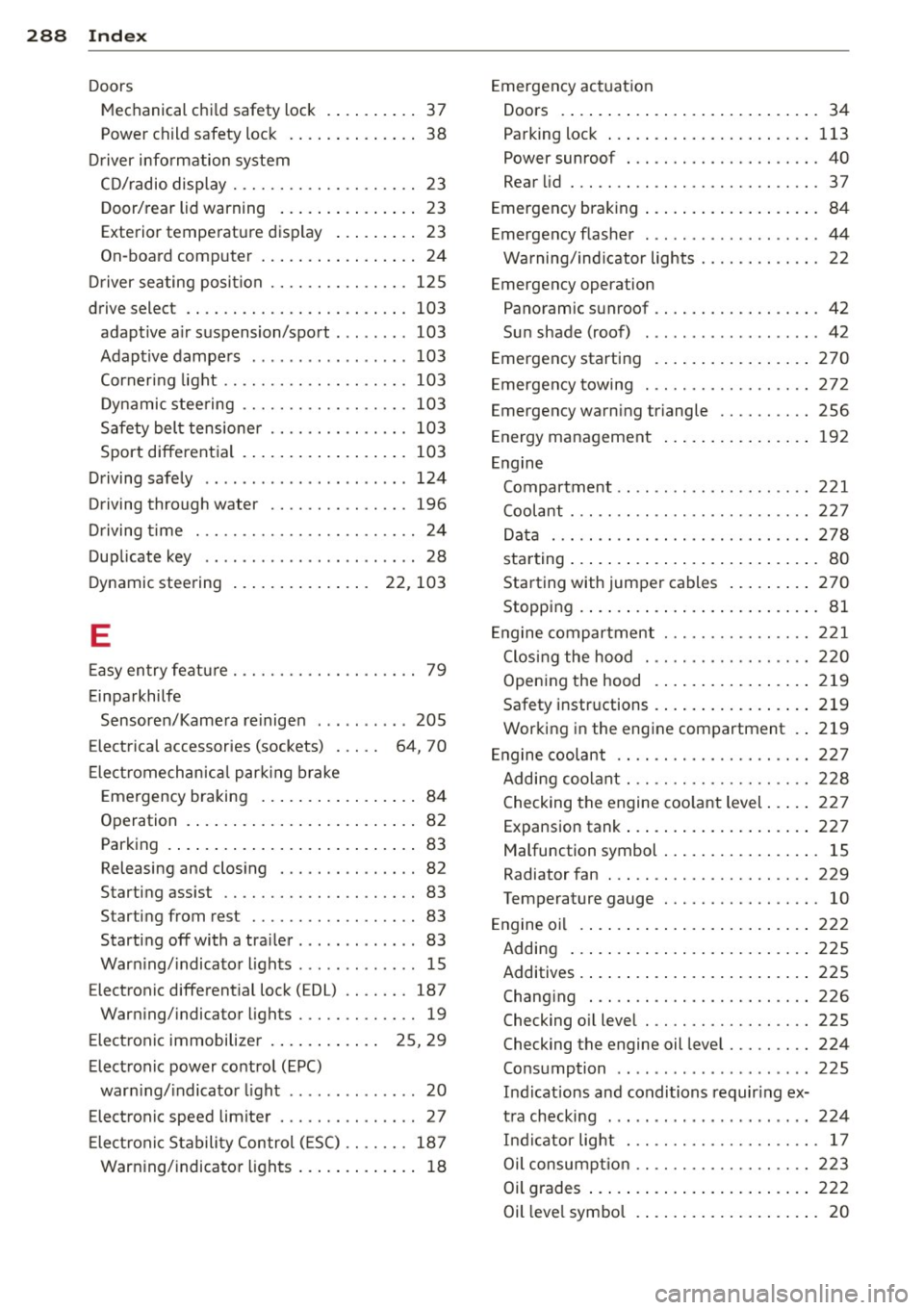
288 Index
Doors
M echanical child safety lock .. .... .. .. 37
Power child safety lock . . . . . . . . . . . . . . 38
Driver information system
CD/radio display . . . . . . . . . . . . . . . . . . . . 23
Door/r ear lid warning . . . . . . . . . . . . . . . 23
Exterior temperature display ....... .. 23
On-board computer . . . . . . . . . . . . . . . . . 24
Driver seating position ............... 125
drive select .. .. . .......... .. .. .... . 103
adaptive a ir suspension/sport ........ 103
Adaptive dampers ................. 103
Cornering light ........... .. .. .... . 103
Dynamic steering .................. 103
Safety belt tensioner ............... 103
Sport differential .......... ... .... . 103
Driving safely . . . . . . . . . . . . . . . . . . . . . . 124
Driving through water ............... 196
Driving time . . . . . . . . . . . . . . . . . . . . . . . . 24
Duplicate key . . . . . . . . . . . . . . . . . . . . . . . 28
Dynam ic steering . . . . . . . . . . . . . . . 22, 103
E
Easy entry feature .......... .... .... .. 79
Einparkhilfe Sensoren/Kamera reinigen ...... .... 205
Elect rical accessories (sockets) . . . . . 64, 70
E lectromechanical park ing brake
Emergency braking . . . . . . . . . . . . . . . . . 84
Operation . . . . . . . . . . . . . . . . . . . . . . . . . 82
Parking .................... ..... .. 83
Releasing and closing ..... .. .. .. .. . . 82
Starting assist ........... .. .. .... .. 83
Starting from rest .......... .. .... .. 83
Starting
off with a tra iler . . . . . . . . . . . . . 83
Warning/indicator lights ..... .. .. .. . . 15
E lectronic different ial lock ( EDL) .. .... . 187
Warning/indicator lights ... .. .. .. .. . . 19
Electronic immobilizer . . . . . . . . . . . . 25, 29
Electronic power control (EPC)
warning/indicator light ..... .... ..... 20
Electronic speed limiter ......... .... .. 27
Electronic Stability Control (ESC) .. ..... 187
Warn ing/indicator lights ....... .. .. .. 18 Emergency
actuation
Doors ... ..... .. .. .............. .. 34
Parking lock ... .. ................. 113
Power sunroof . .. ............. .... . 40
Rear lid ... .... .. ............. .... . 37
Emerg ency braking ................... 84
Emergency flasher ................. .. 44
Warning/ind icator lights ........ .. .. . 22
Emergency operation Panoramic sunroof ... .......... .. .. . 42
Sun shade (roof) ................... 42
Emergency starting ................ . 270
Emergency towing .. ............ .. .. 272
Emergency warning triangle .......... 256
En ergy management ................ 192
Engine Compartment ..................... 221
Coolant ... .. .. .. .. ... ........ .. .. 227
Data ..... .... .. ............. .... 278
starting ......... .. .............. .. 80
Starting with jumper cables ......... 270
Stopping . ..... .. .. .............. .. 81
Engine compartment ................ 221
Closing the hood . ... .......... .. .. 220
Opening the hood ............. .... 219
Safety instructions ................ . 219
Working in the engine compartment .. 219
Engine coolant ..................... 22 7
Adding coolant . .. ... .......... .. .. 228
Check ing the engine coolant level ..... 227
Expansion tank ... ................. 227
Malfunction symbol ................. 15
Radiator fan ... .. ............. .... 229
Temperature gauge ............ .... . 10
Engine oil ...... .. .. .............. . 222
Adding ......... .. .............. . 225
Additives . ..... .. ............. .... 225
Changing . .. .. .. ............. .. .. 226
Checking oil level .... .......... .. .. 225
Checking the engine oil level ....... .. 224
Consumption .. ................... 225
I ndications and conditions requiring ex-
tra checking . ...... .. ...... ....... 224
Indicator light ... ............. .... . 17
Oil consumpt ion .. ............. .... 223
Oil grad es ..... .. ................ . 222
Oil level symbol . . . . . . . . . . . . . . . . . . . . 20