2012 AUDI S6 height
[x] Cancel search: heightPage 161 of 298

-Work on the pyrotechnic circu it inter
rupter must on ly be performed by a
qualified technic ians who have the ex
perience, information and special tools necessary to perform the work safely.
- If the veh icle or the circuit interrupter
is sc rapped, all applicable safety pre
cautions must be followed.
@) For the sake of the environment
Undep loyed airbag modules and preten
sioners might be classified as Perchlorate Mate rial -special handling may apply, see
www.dtsc.ca .gov/haza rdo uswaste/per
chlorate. When the vehicle or parts of the
restrai nt system inclu ding airbag modules
a nd safety bel ts w ith pretens ioners are
scrapped, a ll applicable laws and regula
tions must be observed. Your authorized
Aud i dea ler is familiar w ith these require
ments and we recommend that you have
your dea ler perform this serv ice for you.
Other things that can affect Advanced
Airbag performance
C hanging the vehicle's suspension system can
ch ange the way that the Advanced A irbag Sys
tem pe rforms in a crash. For example, us ing
tire-rim combinations not app rove d by Audi,
lowe ring the vehicle, changing the stiffness of
the suspension, incl uding the springs, suspen
sion struts, shock absorbers etc. can change
the forces that are measured by the a irbag
se nsors and sent to the electron ic control
un it . Some suspension changes can, for exam
p le, increase the force levels measured by the
se nsors and make the airbag system deploy in
crashes i n w hich it would not dep loy if the
ch an ges had not been made. Ot her kinds of
cha nges may reduce the force levels meas
ured by the sensors and prevent the airbag
from deploying when it shou ld.
The senso rs in the safety belt buckle fo r th e
d river and front passenger seat tell the elec
tronic control module if the safety belt is
l atched or not. If the safety belt is being used,
the front airbag will deploy at a slightly high-
A irba g sy stem 159
er rate of vehicle deceleration than i f the safe
ty belt is not being used. Therefore, in a par
ticu lar collis ion, it is possible t hat an airbag
will not deploy at a seating pos ition where the
safety belt is be ing used but w ill inflate at the
position w here the safety belt is not be ing
used. It is impo rtant that noth ing interfere
with the safety be lt b uckles so that the sen
sors can send the cor rec t info rmation abou t
sa fe ty belt use to the elec tronic con trol un it.
_&. WARNING ~-
Changing the vehicle's suspension includ-
ing use of unapprove d tire -rim combina
tions can change Advanced Airbag per
formance and increase the risk o f serious
personal injury in a crash.
- Never install s uspension components
that do not have the same performance
characteristics as the components origi
na lly installed on your vehicle .
- Never use tire-rim combinations that
have not been approved by Audi.
Knee airbags
Description of knee airbags
Appl ies to vehicles: wi th knee airbags
The knee airbag system can provide supple
mental prot ection to properly r estrain ed
front seat occupants.
Fi g. 14 8 Drive r's airbag
T he driver knee airbag is i n the instrument
panel underneath the steering wheel
i=> fig . 148, the airbag for the passenger is at
about the same height in the instrument pan-
el underneath the glove compartment . ..,_
Page 248 of 298
246 Tires and wheels
& WARNING
Sudden tire failure can lead to loss of con
trol, a crash and serious personal injury!
- Never drive a vehicle when the tread on
any tire is worn down to the wear indica
tors.
- Worn tires are a safety hazard, they do
not grip well on wet roads and increase
your risk of "hydroplaning" and loss of control.
- Always keep chemicals that can cause tire damage, such as grease, oil, gasoline
and brake fluid away from tires.
- Tires age even if they are not be ing used
and can fail suddenly, especially at high
speeds. Tires that are more than 6 years
old can only be used in an emergency
and then with special care and at lower
speeds.
- Never mount used tires on your vehicle if
you are not sure of their "previous histo
ry." Old used tires may have been dam
aged even though the damage cannot be
seen that can lead to sudden tire failure
and loss of vehicle control.
New tires and replacing tires and wheels
New tires and wheels have to be broken in .
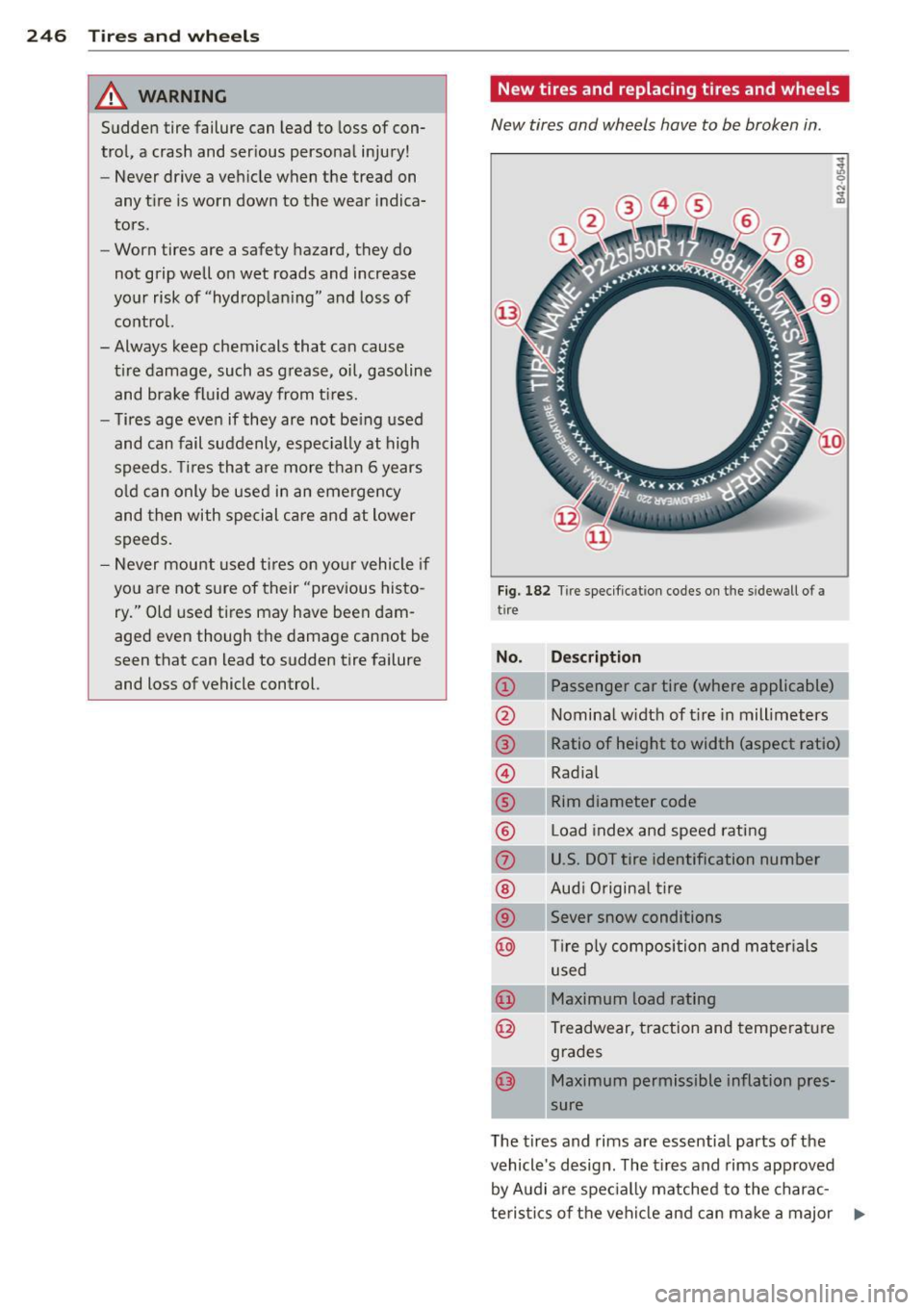
Fig. 182 Tir e specificat ion codes on the s idewall of a
t ire
No. Description
(!) Passenger car tire (where applicable)
@ Nominal width of t ire in millimeters
@ Ratio of height to width (aspect ratio)
© Rad ial
® Rim diameter code
@ L oad index and speed rating
(J) U.S. DOT tire identification number
@ Audi Original tire
@ Sever snow conditions
@ T ire ply composition and materials
used
Maximum load rating
Treadwear, traction and temperature
grades
Maximum permissible inflation pres
sure
T he tires and rims are essential parts of the
vehicle 's design . The tires and rims approved
by Audi are spec ially matched to the charac
teristics of the vehicle and can make a major .,..
Page 249 of 298

contribution to good road holding and safe
handling when in good condition and properly
inflated
¢ .&. .
We recommend that all work on t ires and
wheels be performed by an authorized A udi
dealer. They are familiar with recommended
procedures and have the necessary spec ial
too ls and spare parts as we ll as the proper fa
cilities for dispos ing of the old tires .
Authorized Audi dealers have the necessary information about techn ica l requ irements for
installing or changing tires and r ims.
R eplacing t ires and wheel s
Tires shou ld be rep laced at least in pairs and
not individua lly (for example both front tires
or both rear tires together).
Be s ure to read and heed the information to
the tire pressure monitoring system*
¢page 253.
Always buy rep lacement radial tires that have
the same specifications as the t ires approved
for your ve hicle by Audi. Replacement tires
must always have the same load rating speci
fication as the original equipment or approved
optional tires listed in the table
¢ page 239.
Audi-approved specification tires are specially
matched to your vehicle and its load limits,
and can contribute to the important road hold
ing, driving character istics, and safety of the
veh icle. The table
(¢page 239) lists spec ifica
tions of the tir es approved for the Audi mod
e ls covered by your Owner's Literature .
The tire pressure labe l located on dr iver's side
B-pillar (¢
page 239, fig. 179) lists the speci
fications of the orig inal equipment tires in
stalled on your veh icle at the time it was man
ufactured .
Federal law requires t ire manufacturers to
p lace standard ized information on the s ide
wall of all tires¢
fig. 182 . This information
i dent ifies and desc ribes the fundamental
characterist ics, the quality grade of the tire
and a lso provides a tire ide ntificat io n number
Tire s an d wheel s 24 7
for sa fety standard certification and in case of
a reca ll.
Tire specifications
Knowledge of tire specifications makes it eas
ier to choose the co rrec t tires . Radial ti res
have the tire specifications marked on the
sidewa ll, for examp le:
255 /40 R 19 100 H XL
This co nta ins the following information:
P Indicates the tire is for passenger cars
(where app licab le)
255 Nom inal tire width i n mm of the tire
from sidewall edge to sidewall edge. In
general, the larger the number, the wider
the tire
40 Height/w idth ratio in percent (aspect ra -
t io)
R Tire construct ion: Radial
1 9 Rim diameter code (i n inches)
100 Load ra ting code
H Speed ra ting letter code
XL (or "xl", "EXTRA LOAD" or "RF") Indicates
t h at the t ire is a "Reinfo rced" or an " Ext ra
Load " tir e
M+S (or "M/S") Indicates that the ti re has
some mud and snow capab ility
The tires could also have the informat ion of
direction of rotation ¢
page 235 .
Tire manufacturing d ate
The manufact uring date is also indicated on
the tire sidewall (possibly only on the
inner
s ide of the wheel):
"DOT ... 2211 .. . " means, for example, the tire
was produced in the 22nd week of 2011.
Speed rating (letter code )
The speed rating le tter code on the whee ls in
dicates the maximum permiss ible road speeds
¢ .&. in Winter tires on page 251.
P up to 93 mp h (150 km/h)
Q up to 99 mph (158 km/h)
R up to 106 mph (170 km/h)
S up to 110 mph (180 km/h)
•
•
Page 254 of 298

252 Tire s and wheel s
Where snow chains are mandatory oncer
tain roads, this normally also applies to ve
hicles with all-wheel drive.
Wheel bolts
Wheel bolts must always be tightened to the
correct torque .
The design of whee l bolts is matched to the
factory insta lled rims . If different rims are fit
ted, the correct wheel bolts with the r ight
length and correctly shaped bolt heads must
be used. This ensures that wheels are fitted
securely and that the brake system functions
correctly .
In certain circumstances, you may not use
wheel bolts from a different vehicle -even if it
is the same model
r=> page 280.
A WARNING
Imprope rly tightened o r maintained wheel
bolts can becom e loose ca using loss of
c ont ro l, a co llision and serious persona l in
Jury .
- Always keep the w heel bolts an d the
threads in the wheel hubs clean so the
w heel bolts can turn easily and be p rop
er ly tigh tened .
- N ever grease or oil the wheel bo lt s an d
the threads in the w heel hubs. They can
become loose while d riving if greased or
oi led, even if tightened to the specified
torq ue.
- Only use wheel bolts that belong to the
rim being installed.
- N ever use different whee ls bolts on your
vehicle.
- Alw ays maintain the co rrec t tighten ing
torq ue fo r th e wheel bo lts to reduce the
risk of a wheel loss . If the tightening tor
que of the wheel bo lts is too low, they
can loosen and come out w hen the veh i
cle is moving. If the tighteni ng torque is
too high, the whee l bolts and threads can be damaged and the whee
l can be
come loose.
@ Note
The specified torque for the whee l bolts is
90 ft lb (120 Nm) with a tolerance of± 7,4
ft lb(± 10 Nm) . Torque whee l bolts diago
nally. After changing a whee l, the torque
must be checked as soon as possible with a
torque w rench -preferably by an author
i zed Audi dealer or qualified workshop .
Low aspect ratio tires
Your A udi is facto ry-eq uipped w it h low aspect
ra tio tires. These tires have been tho roughly
tested and been se lected specific ally fo r your
model fo r their superb perfo rmance, road fee l
and hand ling under a variety of d riving condi
t ions . Ask your author ized A udi dealer for
more details.
T he low aspect ratio of these tires is ind icated
by a numera l of
55 or less in the tire's s ize
designation. The n umera l represents the ratio
of the tire's sidewa ll height in relation to its
tread width expressed in percentage. Conven
t iona l tires have a he ight/w idth rat io of 60 or
more .
The performance of low-aspect -ratio tires is
particularly sens iti ve to imp roper inflation
pressure. It is therefore important that low
a spect ratio tires are inflated to the specified
pre ssure and that the inflation pressure i s
regularly ch ecked and maintain ed. Tire pre s·
sure s should be checked at lea st once a
month and always before a long trip
r=> page 241, Checking tire pressure .
What you can do to avoid tire and rim
damage
Low aspect ra tio tires can be d amage d more
easily by impact w it h potholes, curbs, g ull ies
or ridges on t he road, particularly if the tire is
u nd eri nflated.
Page 264 of 298

262 What do I do now ?
-Make sure that passengers wait in a
safe p lace away from the vehicle and
well away from the road and traffic.
- Make sure jack position is correct, ad
just as necessary and then continue to ra ise the jack.
- Changes in temperature or load can af
fect the height of the vehicle.
Taking the wheel off/installing the spare
Follow th es e ins truc tions st ep-by-st ep for
changing the wheel.
F ig . 194 Chan gin g a w hee l: us ing t he sc rew drive r han ·
die (w ith t he bla de re moved) t o tu rn the b olts
Fig. 195 Chang ing a w hee l: alignm en t pin insid e t he
to p hole
Aft er you h ave loosened all wheel bol ts and
ra is ed the veh icle off the ground, remove and
replace the wheel as follows:
Removing the wheel
.. Use the hexagonal socket in the screwd riv ·
er handle to comp lete ly remove the top
mos t wheel bo lt and set it as ide on a
clean
surface ¢ fig . 194 .
.. Screw the threaded end of the alignment
pin from the too l kit hand-tig ht into the
empty bolt hole
r::;, fig. 195.
.. Then remove the other whee l bolts as de
scrib ed above.
.. Take off the whee l leaving the a lignment
pin in the bolt hole
¢ 0) .
Putting on th e spar e wheel
.. Lift the spare wheel and carefully s lide it
over the alignment pin to g uide it in place
¢ (D .
.. Use the hexagonal socket in the sc rewd river
handle to screw in and tig hten all whee l
bolts
slightly .
.. Remove the a lignment pi n and insert and
tighten the rema in ing wheel bolt slightly
like the rest .
.. Turn t he jack hand le co unter -cloc kwise to
lowe r the veh icle un til the jack is fully re
leased .
.. Use the wheel bo lt wrench to tighten all
wheel bo lts firm ly
r::;, page 260 . Tighten
them
crosswise, from one bolt to the (ap
proximately) opposi te one, to keep the
wheel cen tered.
(D Note
When remov ing or installing the whee l,
the rim cou ld hit the brake rotor and dam·
age the rotor . Work carefu lly and have a
second pe rson help you .
@ Tips
Never use the hexagonal socket in the han
d le of the screwdriver to loosen or tighten
the wheel bolts.
- Pull the revers ible blade from the screw·
dr iver before you use the hexagonal
sock et in the hand le to turn the w heel
bolts.
- Whe n mount ing tires w ith unidirectional
tread design make sure the tread pat·
t er n is po inted the right way
r::;, page 2 63.
- T he wh eel bolts s hou ld be cl ean and easy
t o tu rn . Chec k for dirt and corrosion on
t he m ating surfaces of bot h the wheel
an d t he hub . Remove all d irt from these
surfaces befo re remounting the whee l.
Page 293 of 298

_______________________________ I~ n~ d:::: e~x 291
Rear window heating (automatic climate
control) . . . . . . . . . . . . . . . . . . . . . . . . . . . . 67
Rear window heating (climate cont rol) . . . 65
Recirculation mode (automatic climate
control) . . . . . . . . . . . . . . . . . . . . . . . . . . . . 66
Recirculation mode (climate control) . ... 64
Refue lling ......................... 217
Remote control
Garage door opener (Homelink ®) .. .. . 120
Unlocking and locking ........ .. .... . 34
Remote rear lid release ............... 36
R . l epair manua s ............ .... .. .. . 278
Repairs Airbag system ........... .... .. .. .
158
Replacing Fuses .... .. .. ................ .... 264
Light bulbs .............. .... .. ... 267
Tires and wheels ......... .. .. .. .. . 247
Windshield wiper blades ... .. .. .. .. .. 47
Reporting Safety Defects ............. 131
Reset button . . . . . . . . . . . . . . . . . . . . . . . . 26
Retractor .. .. ............. .... .. .. . 136
Rims (cleaning) ................ .. ... 209
Roof rack .................... ... ... . 57
L oading .. ..... ........... ... ... ... 58
Roof weight .... .. .... .... . .. .. .. .. 58
s
SAFE ...... ... ................ .... . 26
Safe driving habits ................. . 123
Safety belt position . . . . . . . . . . . . . . . . . 13 7
Safety belt height adjustment .. .. .. . 139
Safety belts worn by pregnant women . 138
Safety belt pretens ioner . . . . . . . . . . . . . . 140
Service and disposal ........... .... 140
Safety belt pretensioners Pre sense 187
Safety belts . ... ............ ... .. ... 136
cleaning 213
Danger to passengers who do not wear a
safety belt . . . . . . . . . . . . . . . . . . . . . . . 134
Fastening .. .. .. ......... .. .. .. ... 136
H eight adjustment .. .. .... .. .. .. .. . 139
Improperly worn ............ .. .... 139
Not worn ................ ... ... .. 134
Safety belt position ....... .. .. .. .. . 13 7 Safety
instructions . ......... ..... .. 136
Securing child safety seats .......... 179
Spec ia l considerations for pregnant
women ... .. .. .. ................. 138
Unfastening . .. .. .... ............. 138
Warning/indicator light ............ . 133
Warning light . . . . . . . . . . . . . . . . . . . . . . 17
Why YOU MUST wear them .......... 133
Worn properly ... .. . .......... .... 135
Safety belt tens ioner
drive select ...... .. ..... ........... 95
Safety be lt warning light ............. 133
Safety compliance sticker ........ .. .. 274
Safety equ ipment .. .... ............. 123
Safety features for occ upant restraint and
protection . ... .... ... .... ........ .. 123
Safety gu idelines
Seat adjustment . . . . . . . . . . . . . . . . . . . . SO
Safety instructions
E . ngme compartment .............. . 220
for side curtain airbags ............ . 166
for using child safety seats ......... . 172
for using safety belts ........... .. . . 136
Monitoring the Advanced Airbag Sys-
tem ...... .. .. .. .. . .............. 157
Safety systems Warning/indicator lights ........... .. 18
Seat adjustment Controls .. .. .. .. .... ............. . 51
Driver's seat . . . . . . . . . . . . . . . . . . . . . . . SO
Front passenger's seat ............. .. 51
Front seats . . . . . . . . . . . . . . . . . . . . . . . . SO
Head restrai nts . . . . . . . . . . . . . . . 52, 12 7
Safety guidelines ..... ......... .... . SO
Seat belts WhyYOUMUSTwearthem .......... 133
Seat heating/ventilation (automatic cli -
mate control) ... .. .. ............... . 67
Seat heating (climate con trol) . . . . . . . . . . 65
Seating position
Driver ....... ... .. ..... .......... 124
Front passenger .................. . 125
How to adjust the front seats ...... .. 125
Incorrect seat position .......... .... 127
Occupants ... .... .. . .. .......... .. 124
Rear passengers .. .. . .......... .. .. 126
Seat memory . . . . . . . . . . . . . . . . . . . . . . . 53 •
•