2012 AUDI A6 SEN
[x] Cancel search: SENPage 236 of 298

234 Checking and filling
(D Note
Never use a fast charger as a booster to
start the engine. This will seriously dam
age sensitive electronic components, such
as control units, relays, radio, etc., as well
as the battery charger.
Battery replacement
The new battery must have the same specifi
cations and dimensions as the original equip
ment battery.
Intelligent energy management in your vehi
cle is responsible for distributing the electri
cal energy throughout your vehicle
~ page 194. The intell igent energy manage
ment system will keep the engine battery
charged better than vehicles without this sys
tem. To make sure the additional electrica l en
ergy is available once again after you have
changed the battery, we recommend that you install batteries of the same type and manu
facture only (the same as those installed at
the time your vehicle was delivered). Specifi
cations are listed on the battery housing. Your
author ized dealer must code the battery in
the energy management system to enable you
to use the energy management funct ions cor
rectly after replacing the battery .
The new battery must have the same capacity,
voltage (12 volts), amperage, construct ion
and plug sealing.
When installing the battery, make sure the ig
nition and all electr ical consumers are switch
ed off.
(D Note
Make sure the ventilation hose on the side
of the battery is connected, otherwise
fumes or battery ac id can leak out.
@ For the sake of the environment
Because of the problem of proper disposal
of a battery, we recommend your author
ized Audi dealer change the battery for
you . Batteries contain su lfuric acid and l
ead and must always be disposed of prop
erly in compliance with all environmental
regulations. Disposing of vehicle batter ies
i mproperly is very dangerous to the envi
ronment.
Windshield/head Light
washer container
Fig. 177 En g in e compart men t: w inds hield and head
lighr washer fluid reservoir
The washer fluid conta iner is marked w ith the
symbol~ on its cap.
"' Before you check anything in the engine
compartment,
always read and heed all
WARNINGS ~.&. in Working in the engine
compartment on page 220.
"' Lift the filler cap tongue to add washer flu
id. You can fill the container to the top.
"' Press the cap back onto the filler neck after
fi lling the container.
You can find the reservoir
capacity in the table
in
~ page 2 76.
Clean water should be used when filling up. If
possible, use soft water to prevent scaling on
washer jets. Always add a glass cleaner solu
tion (with frost protection in the winter).
@ Note
Do not mix engine coolan t ant ifreeze or
any other additives to fill up the wind
shield washer reservoir .
Page 240 of 298

238 Tires and wheels
Tread
means t hat port ion of a tire that comes into
con tact w it h t he road.
Tread separation
means pull ing away of the t read from the ti re
carcass .
Treadwear indicators (TWI)
means the projections within the pr inc ipal
grooves designed to give a v isua l ind ication of
the deg rees of wea r of the tread . See
~ page 245, Tread W ear Indicator (T WI) for
mo re info rmat io n on measu ring ti re wear.
Uniform Tire Quality Grading
is a tire information system developed by the
United States Nat io nal Highway Traffic Safety
Admi nistration (N HTSA) that is designed to
h e lp buye rs make relat ive compa risons among
tires. The UTQG is not a safety rating an d no t a
g ua ran tee t hat a tir e will las t fo r a presc ribed
nu mber of m iles (kilome ters) or perform in a
certain way. It s imply gives tire buye rs addi
tional informat ion to com bine with ot her con
side rat ions, s uch as pr ice, brand loya lty and
dea ler recommendations. Under UTQG, t ires
are g raded by t he tire manufacturers in th ree
areas: treadwear, tract io n, and temperature
res ista nce. Th e UTQG i nfo rmation on the tires ,
mo lded into t he s idewalls.
U.S . DOT Tire Identification Number (TIN)
This is the t ire 's "serial number". It begins
with the lette rs "DOT" and indicates that the t
ir e mee ts a ll fede ra l standards. The nex t two
numbe rs o r letters in dicate the plant where it
was man ufactu red, and the last four numbers
represent the wee k and year of man ufact ure.
For example,
DOT . .. 2211 ...
me ans th at the tire w as produ ced in t he 22nd
wee k of 2011. T he othe r num bers are m arket
ing co des that may or may not be used by the
t ir e manufacturer . This information is used to
contact consume rs if a tire defect requires a
recall.
Vehicle capacity weight
means the ra ted ca rgo an d luggage lo ad plus
150 lbs. ( 68 kilog rams) times the vehicle's to
ta l seating ca pacity as listed on the la bel lo
cated on the driver's side B-pilla r.
Vehicle maximum load on the tire
me ans tha t load on an individu al tire tha t is
de termined by dis tributi ng to eac h axl e its
share of the maxim um loa ded vehicle weight
and dividing by two .
Vehicle normal load on the tire
means th at l oad o n an individua l tire tha t is
de termined by dis trib uti ng to eac h axle its
share o f the cur b weight , accessory weight,
and normal occ upant weig ht (distr ibuted in
accordance with tab le be low ~
page 238)
and dividing by two.
Occupant loading and distribution for veh icle normal lo ad fo r variou s designated seating
capacities
Designated seating capacity,
number of occupants
5
Vehicle normal load, number Occupant distribution in a nor-
of occupants _____ malty loaded vehicle
3 2 in front , 1 in back s eat
Page 242 of 298

240 Tires and wheels
change. In the event of discrepancies, the tire
pressure labe l is located on the driver's side B
p ill ar a lways takes precedence.
The table below lists the recommended cold
tire inflation pressures for the Audi model covered
by your Owner's Literature at the vehi
cle's capacity weight and the tire sizes instal
l ed on the respective models as orig inal
equipment, or as a factory option.
I Engine Tire designation Tire pressure front Tire pressure rear I
(displace-
normal load full load normal load full load
ment
in li-condition condition condition condition
I
ter) PSI II kPA PSI JI kPA PSI II kPA PSI II kPA :
4-cylinder 225/55 Rl 7
97H
2.0 All 5eason
32 220 35 240 29 200 38 260
245/45 Rl8 lOOH XL '
32 220 35 240
29 200 38 260 All Season I
255/40 Rl9 lOOH XL
32 220 35 240 29 200 38 260
All Season
255/40 Rl9 lOOY XL
30 210
33 230
30 2 10 36 250
High Performance
255/35 R20 97V XL
35 240 38 260 32 220 41 280
High Performance
I 6-cylinder 225/55 Rl7
97H '
35 240 38 260 32 220 41 280
3.0 All Season .. -. • .. .. .. .. ..
All Season 35 240 38 260 32 220 41 280
245/45 Rl8 100H XL
255 /40 R19 lOOH XL
'
35 240 38 260 32 220 41 280 All Season I
255/40 Rl9 lOOY XL 36 250
39 270
33 230 42 290
High Performance
255/35
R20 97V
XL '
39 270 44 300 36 250 46 320
High Performance
I
XL= reinforced or extra load tire. It may also appear as xl, EXTRA LOAD, or RF on the tire side
wall.
The correct tire pressure for the
spare wheel i s
located on a label on the driver's side B-pillar.
Because technical changes may be made to
vehicle equipment during the model year, a l
ways compare the tire size designation on the
tire pressure label on your vehicle with the
tires on your vehicle. Make sure that the tire
size information on the vehicle label is the
same as the size of the t ires on the vehicle.
This is especia lly important if the vehicle be
l ongs to someone else or you bought the veh i
cle with different rims/tires or you bought the
vehicle as a previously owned vehicle. Remember, your safety and that of your pas
sengers also depends on making sure that load limits are not exceeded. Vehicle load in
cludes everybody and everything in and on the
vehicle . These load limits are techn ically refer
red to as the veh icle's Gross Vehicle Weight
Rating ("GVWR"). The Gross Axle We ight Rat
i ng ("GAWR") is the maximum load that can
be applied at each of the vehicle's two axles.
The Gross Vehicle Weight Rating and the
Gross Axle Weight Rating are listed on the
safety comp liance sticker label located on the
driver's side B-pillar . The tire pressure label on .,.
Page 243 of 298

your Audi lists the maximum combined weight of all of the occupants and luggage or
other cargo that the vehicle can carry. For the locat ion of the tire pressure label¢
fig. 178.
& WARNING
Overloading a vehicle can cause loss of ve
hicle control, a crash or other accident, se
rious personal injury, and even death.
- Carry ing more weight than your vehicle
was designed to carry will prevent the
vehicle from handling properly and in crease the risk of a loss of veh icle con
t rol.
- The bra kes on a veh icle that has been
overloaded may no t be able to stop the
vehicle within a sa fe distance.
- T ires on a vehicle that has been ove rload
ed can fail suddenly causing loss of con
tro l and a c rash.
- Always make sure that the tota l load be
ing t ransported -including the we igh t of
a tra iler hitch and the tongue weight o f a
loaded trailer -does not make the vehi
cle heavier than the vehicle's Gross Vehi
cle Weight Rating.
& WARNING
- Incorrect tire pressures and/or underin
flation can lead to a serious or fatal acci
dent .
- Incorrect tire pressures and/or underin flation cause increased tire wear and can
affect the handling of the vehicle.
- Incorrect tire pressures and/or underin
flation can also lead to sudden tire fa il
ure, including a blowout and sudden de
fla tion, causing loss of vehicle control.
Checking tire pressure
-
The correct tire pressure for the tires original
ly installed on your vehicle is listed on the tire
pressure label located on driver's side 8-pil lar .
The recommended t ire pressures are on the
tire pressure label and in the tab le
Tire s an d wheel s 241
¢ page 239, Cold tire inflation pressure .This
means that the pressure m ust be checked and
adjusted when the t ire has not been dr iven fo r
more than a couple of miles (kilometers) at
low speeds during the previous three hours.
Air in the tires expands when the t ire heats up
as a result of internal frict io n as it flexes in
u se . T he tire pressure is higher when the tire
has warmed up t han whe n it is " cold. "
It is the inflation pressure in a "cold" tire that
counts. Therefore, you should never le t air out
of a wa rm tire to match "Cold t ire inflat io n
pressure" recomme ndat io ns ¢
page 239. Th e
t ir es wo uld then be unde rinflated and co uld
fail suddenly.
T he tir e pressure label on your Audi lists the
recommended co ld tire inflation pressures at
maximum cap acity for the new, or ig inal
equipmen t tires tha t were on your ve hicl e at
the time it was ma nufactured. For the loca
tion of the labe l
¢page 239, fig. 178.
Most tires lose air naturally over t ime . They
can a lso lose some air if yo u drive over a pot
ho le or hit a curb while park ing. It is usually
not possible to see whether the radial tires
used today are underinflated just by looking
at them.
Therefore, be sure to check tire press ures at
l east once a month and a lways befo re going
on a long trip. Make s ure to take the number
of peop le and the amount of luggage into ac
count when adjusting tire pressure for a trip -
even one that you would not consider to be
"long. " See
¢ page 243, Tires and vehicle
load limits
for more important information .
Always use an accurate tire pressure gauge
when checking and ad justing inflation pres
sures . Check all of the tires and be sure not to
forget the spare tire. If the pressure in any t ire
is too h igh when the ti re is "cold," let a ir out
of the t ire s low ly w ith the edge o f the tire
gauge and keep checking the pressure until
you reach the pressure that is correct for the
load (passengers and luggage) and kind of
driv ing you plan to do. •
•
Page 244 of 298

24 2 T ire s and wheel s
If the pressure in any tire is too low, note the
difference between the pressure in the cold
tire and the pressure you need and add the air
that you need to reach the correct pressure for
the vehicle load (passengers and luggage) for
the tires on your veh icle as listed on the on
your veh icle and in this manual and the k ind
of dr iving you p lan to do.
Ne ver exceed the m aximum inflat ion pres
s ur e liste d on th e tir e si dewall for any r ea
son.
Remember that the vehicle manufacturer, not
the tire manufacturer, determ ines the correct
tire pressure for the tires on your vehicle .
It is important to check the tire pressure when
the tires are cold.
- Read the required ti re p ressure from the tire
pressure label. The tire pressure labe l is lo
cated on the driver's side 8-p illar.
- Turn the valve stem cap counter-clockwise
to remove it from the tire valve.
- Place the air pressu re ga uge on the valve.
- T he tire pressures sho uld on ly be chec ked
and adjusted when the tires are cold. The
slightly raised pressures of warm tires must
not be reduced .
- Adjust the tire pressure to the load you are
carrying .
- Reinsta ll the va lve stem cap on the valve.
When should I ch eck the tire pressur e?
The correct tire pressure is especially impor
tant at high speeds. The pressure should
therefo re be checked at least once a month
and a lways befo re start ing a journey. Do no t
forget to check the tire pressure for the spare
wheel
¢ page 257 .
When should I adju st the tire p res sures?
Adjust the tire p ressu re to the load you are
carry ing. After changing a wheel
or replacing
wheels you have to adjust the tire pressures
on all wheels . In addition, you must then
store the new tire pressures in the tire pres
sure monitoring system*¢
page 253.
_& WARNING
Incorrect tire pressures and/or underinfla
tion can lead sudden tire fa ilure, loss of
control, collision, serious personal injury
or even death.
- When the warn ing symbol
[I) appears in
the instrument cluster, stop and inspect
the t ires.
- Inco rrect tire pressure and/or underinfla
tion can cause increased tire wear and
can affect the hand ling of the vehicle and
s topping abi lity.
- I nco rrect tire pressures and/or unde rin
f lation can a lso lead to sudden t ire fail
ure, including a blowou t and sudden de
flation, ca us ing loss of veh icle contro l.
- The drive r is responsible for the co rrec t
tire pressures for all tires on the veh icle.
The applicable pressure values are loca t
ed on a sticker on the driver's s ide 8 -pil
lar.
- On ly when all tires on the vehicle are fil
led to the correct pressure, the tire pres
sure mon itoring* system can work cor
rectly.
- The use of incorrect tire pressure va lues
can lead to acc idents or other damage.
Therefore it is essential that the driver
observe the spec ified t ire pressure values
for the tires and the correct pressures for
the function of the t i re p ress ure monito r
ing system*.
- Always inflate tires to the recommended
and correct t ire pressure before dr iv ing
off.
- Driving with underinf lated tires bend
mo re, letting them get too hot resulting
in tread separation, s udde n tire f ailure
and loss of cont ro l.
- Excessive speed and/overloading can
cause heat build- up, sudden tire failure
and loss of cont ro l.
- I f the tire pressure is too low or too high,
the t ires will wear prema turely and the
vehicle wi ll not handle well. ..,
Page 245 of 298

-If the ti re is not flat and y ou do not have
to change a wheel immed iate ly, drive at
reduced speed to the nearest service sta
t ion to check the tire pressure and add
air as required.
(D Note
Dr iving without va lve stem caps can cause
damage to the t ire va lves . To prevent this,
always make sure that factory installed
valve stem caps on all wheels are secu re ly
mounted on the va lve .
@) For the sake of the environment
Underinflated tires will a lso increase the
fue l consumption.
Tires and vehicle load limits
There are limits to the amount of load or
weight t hat any veh icle and any t ire ca n car ry.
A vehicle that is overloaded w ill not handle
well and is more difficult to stop. Overload ing
can not on ly lead to loss of vehicle contro l,
but can a lso damage important parts of the
vehicle and can lead to sudden tire failure, in
cluding a blowout and sudden deflation that
can cause the ve hicle to crash.
Your safety and that of yo ur passenge rs a lso
depends on making sure th at load limits are
no t exceeded. Vehicle load includes everybody
and everyth ing in and on the vehicle. These
load limits a re tech nica lly referred to as the
ve hicle's
Gross Veh icle Weight Rating
("GVWR").
The "GVWR" includes the we ight of the basic
ve hicle, all factory installed accessories, a full
tank of f uel, oil, coo lant and othe r fluids plus
max imum load. The maximum load includes
the number o f passenger s that the ve hicl e is
intended to carry ("se ating capacity") w it h an
assumed weig ht o f 150 lbs (68 kg) for each
passenger at a designated seating position
and the tota l weight of any luggage in the ve
h icle. If you tow a trailer, the weight of the
trailer hitch and the tong ue weight of the
Tire s an d wheel s 243
loaded tra ile r must be included as part of the
vehicle load .
T he
Gro ss Ax le Weight Rating (" GAWR") is
the max imum load th at can be applied at each
of the vehicle's two axles .
T he Gross Vehicle Weight Rat ing and t he
G ross Ax le Weig ht Ra ting are l iste d on the
s af ety comp liance s tic ke r la bel lo cated on the
driver's side 8 -pillar . Yo ur Audi has 5 sea ting
positions,
2 in the front and 3 in the rear fo r
total seating capacity of
5. Eac h seating posi
tion has a safety be lt
c> page 133 , Safety
belts.
The fact that there is an upper limit to yo ur
vehicle's Gross Vehicle We ight Rating means
that the total weig ht of whatever is being car
ried in the vehicle (includ ing the weight of a
tra ile r hitch a nd the tongue weight of the
loaded tra ile r) is lim ited . The more passen
gers in the vehicle or passengers w ho are
heavier than the sta ndard we ights assumed
me an t hat less we igh t ca n be ca rried as lug
gage.
T he tire pr essure label on your Audi also lis ts
t h e maximum combined weight of a ll of the
occupants and l uggage or other cargo that
t h e ve hicl e can carry. For the locat ion of the
label
c> page 239, fig . 178.
.&_ WARNING
-=
Overloading a vehicle can cause loss of ve-
h icle cont ro l, a c rash or other accident, se
rious pe rsonal injury, and even death.
- Ca rrying more we ight tha n your veh icle
was des igned to carry wi ll prevent the
veh icle from handling properly and in
crease the risk of the loss of vehicle con
trol.
- The brakes on a vehicle that has been
overloaded may not be able to stop the
ve hicle w it hi n a safe distance .
- Tires o n a vehicle that has been over load
ed can fail suddenly, including a blowout
a nd sud den defla tion , causing loss of
cont rol and a crash .
li1'-
•
•
Page 246 of 298

244 Tires and wheels -Always make sure that the total load be
ing transported -including the weight of
a trailer hitch and the tongue weight of a
loaded trailer -does not make the vehi
cle heavier than the vehicle's Gross Vehi
cle Weight Rating.
Determining correct load limit
Use the example below to cal
culate the total weight of the
passengers and luggage or oth
er things that you plan to trans
port so that you can make sure
that your vehicle will not be
overloaded.
Steps for Determining
Correct Load Limit
1. Locate the statement "THE
COMBINED WEIGHT OF OC
CUPANTS AND CARGO
SHOULD NEVER EXCEED XXX KG OR XXX LBS" on your ve
hicle's placard (tire inflation
pressure label)
¢ page 239,
fig. 178.
2. Determine the combined
weight of the driver and pas sengers that will be riding in
your vehicle.
3. Subtract the combined
weight of the driver and pas sengers from
"XXX" kilo
grams or
"XXX" pounds shown on the sticker
¢ page 239, fig. 178.
4. The resulting figure equals
the available amount of car
go and luggage load capaci
ty. For example, if the
"XXX"
amount equals 1400 lbs.
and there will be five
150
lbs. passengers in your vehi
cle, the amount of available
cargo and luggage load ca
pacity is
650 lbs. (1400-7 50
(5
X 150) = 650 lbs.)
5. Determine the combined
weight of luggage and cargo being loaded on the vehicle.
That weight may not safely
exceed the available cargo
and luggage load capacity
calculated in Step
4.
6.
If your vehicle will be towing
a trailer, load from your trail
er will be transferred to your
vehicle. Consult this manual
to determine how this re duces the available cargo
and luggage load capacity of
your vehicle.
... Check the tire sidewall
(¢page 246, fig. 182) to de
termine the designated load rating for a specific tire.
Page 248 of 298
246 Tires and wheels
& WARNING
Sudden tire failure can lead to loss of con
trol, a crash and serious personal injury!
- Never drive a vehicle when the tread on
any tire is worn down to the wear indica
tors.
- Worn tires are a safety hazard, they do
not grip well on wet roads and increase
your risk of "hydroplaning" and loss of control.
- Always keep chemicals that can cause tire damage, such as grease, oil, gasoline
and brake fluid away from tires.
- Tires age even if they are not be ing used
and can fail suddenly, especially at high
speeds. Tires that are more than 6 years
old can only be used in an emergency
and then with special care and at lower
speeds.
- Never mount used tires on your vehicle if
you are not sure of their "previous histo
ry." Old used tires may have been dam
aged even though the damage cannot be
seen that can lead to sudden tire failure
and loss of vehicle control.
New tires and replacing tires and wheels
New tires and wheels have to be broken in .
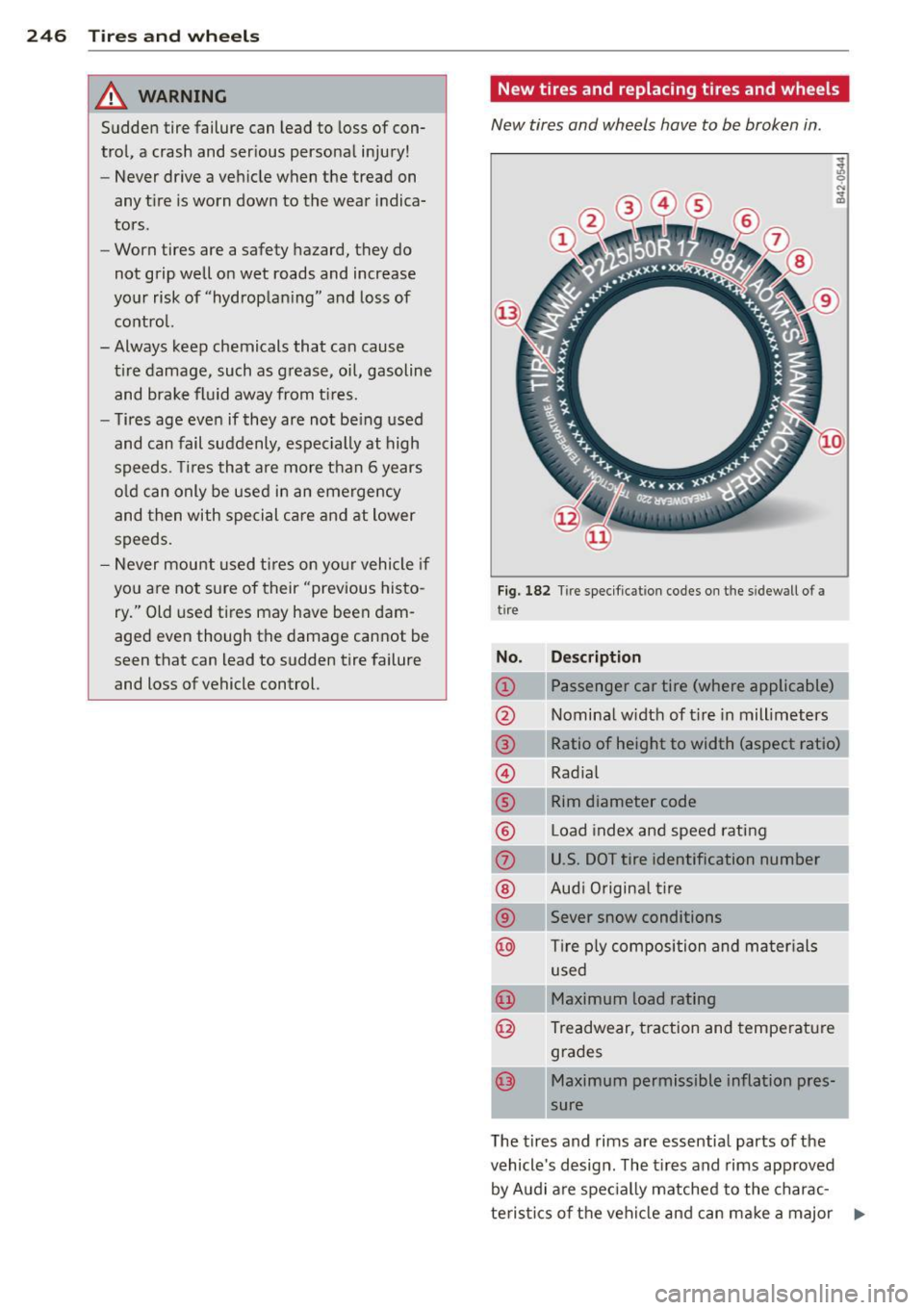
Fig. 182 Tir e specificat ion codes on the s idewall of a
t ire
No. Description
(!) Passenger car tire (where applicable)
@ Nominal width of t ire in millimeters
@ Ratio of height to width (aspect ratio)
© Rad ial
® Rim diameter code
@ L oad index and speed rating
(J) U.S. DOT tire identification number
@ Audi Original tire
@ Sever snow conditions
@ T ire ply composition and materials
used
Maximum load rating
Treadwear, traction and temperature
grades
Maximum permissible inflation pres
sure
T he tires and rims are essential parts of the
vehicle 's design . The tires and rims approved
by Audi are spec ially matched to the charac
teristics of the vehicle and can make a major .,..