Page 39 of 102

FOR YOUR SAFETY – PRE-OPERATION CHECKS
4-1
4
EAU15596
Inspect your vehicle each time you use it to make sure the vehicle is in safe operating condition. Always follow the inspection
and maintenance procedures and schedules described in the Owner’s Manual.
WARNING
EWA11151
Failure to inspect or maintain the vehicle properly increases the possibility of an accident or equipment damage.
Do not operate the vehicle if you find any problem. If a problem cannot be corrected by the procedures provided in
this manual, have the vehicle inspected by a Yamaha dealer.Before using this vehicle, check the following points:
ITEM CHECKS PAGE
FuelCheck fuel level in fuel tank.
Refuel if necessary.
Check fuel line for leakage.
Check fuel tank breather/overflow hose for obstructions, cracks or damage, and
check hose connection.3-16, 3-17
Engine oilCheck oil level in engine.
If necessary, add recommended oil to specified level.
Check vehicle for oil leakage.6-11
CoolantCheck coolant level in reservoir.
If necessary, add recommended coolant to specified level.
Check cooling system for leakage.6-14
Front brakeCheck operation.
If soft or spongy, have Yamaha dealer bleed hydraulic system.
Check brake pads for wear.
Replace if necessary.
Check fluid level in reservoir.
If necessary, add recommended brake fluid to specified level.
Check hydraulic system for leakage.6-25, 6-26
U36CE2E0.book Page 1 Friday, July 16, 2010 10:34 AM
Page 44 of 102

OPERATION AND IMPORTANT RIDING POINTS
5-3
5
EAU16810
Tips for reducing fuel con-
sumption Fuel consumption depends largely on
your riding style. Consider the following
tips to reduce fuel consumption:�
Shift up swiftly, and avoid high en-
gine speeds during acceleration.
�
Do not rev the engine while shifting
down, and avoid high engine
speeds with no load on the engine.
�
Turn the engine off instead of let-
ting it idle for an extended length of
time (e.g., in traffic jams, at traffic
lights or at railroad crossings).
EAU16841
Engine break-in There is never a more important period
in the life of your engine than the period
between 0 and 1600 km (1000 mi). For
this reason, you should read the follow-
ing material carefully.
Since the engine is brand new, do not
put an excessive load on it for the first
1600 km (1000 mi). The various parts in
the engine wear and polish themselves
to the correct operating clearances.
During this period, prolonged full-throt-
tle operation or any condition that might
result in engine overheating must be
avoided.
EAU17093
0–1000 km (0–600 mi)
Avoid prolonged operation above 5800
r/min. NOTICE: After 1000 km (600
mi) of operation, the engine oil must
be changed and the oil filter car-
tridge or element replaced.
[ECA10302]
1000–1600 km (600–1000 mi)
Avoid prolonged operation above 7000
r/min.1600 km (1000 mi) and beyond
The vehicle can now be operated nor-
mally.
NOTICE
ECA10310
�
Keep the engine speed out of
the tachometer red zone.
�
If any engine trouble should oc-
cur during the engine break-in
period, immediately have a
Yamaha dealer check the vehi-
cle.
U36CE2E0.book Page 3 Friday, July 16, 2010 10:34 AM
Page 45 of 102
OPERATION AND IMPORTANT RIDING POINTS
5-4
5
EAU17213
Parking When parking, stop the engine, and
then remove the key from the main
switch.
WARNING
EWA10311
�
Since the engine and exhaust
system can become very hot,
park in a place where pedestri-
ans or children are not likely to
touch them and be burned.
�
Do not park on a slope or on soft
ground, otherwise the vehicle
may overturn, increasing the
risk of a fuel leak and fire.
�
Do not park near grass or other
flammable materials which
might catch fire.
U36CE2E0.book Page 4 Friday, July 16, 2010 10:34 AM
Page 48 of 102

PERIODIC MAINTENANCE AND ADJUSTMENT
6-3
6
EAU46861
TIP�
The annual checks must be performed every year, except if a kilometer-based maintenance, or for the UK, a
mileage-based maintenance, is performed instead.
�
From 50000 km (30000 mi), repeat the maintenance intervals starting from 10000 km (6000 mi).
�
Items marked with an asterisk should be performed by a Yamaha dealer as they require special tools, data and technical
skills.
EAU46910
Periodic maintenance chart for the emission control system NO. ITEM CHECK OR MAINTENANCE JOBODOMETER READING
ANNUAL
CHECK 1000 km
(600 mi)10000 km
(6000 mi)20000 km
(12000 mi)30000 km
(18000 mi)40000 km
(24000 mi)
1*Fuel lineCheck fuel hoses for cracks or
damage.√√√√√
2*Spark plugsCheck condition.
Clean and regap.√√
Replace.√√
3*ValvesCheck valve clearance.
Adjust.Every 40000 km (24000 mi)
4*Fuel injectionAdjust engine idling speed and
synchronization.√√√√√√
5*Air induction sys-
temCheck the air cut-off valve, reed
valve, and hose for damage.
Replace the entire air induction
system if necessary.√√√√√
U36CE2E0.book Page 3 Friday, July 16, 2010 10:34 AM
Page 63 of 102

PERIODIC MAINTENANCE AND ADJUSTMENT
6-18
6
EAU32887
Replacing the air filter element The air filter element should be re-
placed at the intervals specified in the
periodic maintenance and lubrication
chart. Replace the air filter element
more frequently if you are riding in un-
usually wet or dusty areas.
1. Remove the seat. (See page
3-18.)
2. Remove panels B and C. (See
page 6-8.)
3. Remove the fuel tank bolts, and
then lift the fuel tank away from the
air filter case.
4. Remove the air filter case cover by
removing the screws. NOTICE:
When removing the air filtercase cover, be careful not to al-
low foreign objects to drop into
the air intake manifold.
[ECA12881]
5. Pull the air filter element out.6. Insert a new air filter element into
the air filter case. NOTICE: Make
sure that the air filter element is
properly seated in the air filter
case. The engine should never
be operated without the air filter
element installed, otherwise the
piston(s) and/or cylinder(s) may
become excessively worn.
[ECA10481]
7. Install the air filter case cover by in-
stalling the screws.
8. Place the fuel tank in its original
position. Make sure that the fuel
hoses are properly connected and
routed, and are not pinched. Be
sure to place the hoses in their
original position. WARNING! Be-
fore placing the fuel tank in the
original position, make sure that
all hoses (i.e., fuel hose, fuel
tank breather hose, fuel tank
overflow hose) are not dam-
aged, that they are properly con-
nected and routed, and that they
are not pinched. If any hose is
damaged, have a Yamaha dealer
replace the hose before starting
1. Fuel tank bolt
1
1. Air filter case cover
2. Screw
1. Air filter element
2. Air intake manifold
12
2
2
2 1
U36CE2E0.book Page 18 Friday, July 16, 2010 10:34 AM
Page 64 of 102
![YAMAHA XJ6-S 2011 Owners Manual PERIODIC MAINTENANCE AND ADJUSTMENT
6-19
6the engine, otherwise fuel may
leak, creating a fire hazard.
[EWA12463]
9. Install the fuel tank bolts.
10. Install the panels.
11. Install the seat.
EAU34301](/manual-img/51/52610/w960_52610-63.png "YAMAHA XJ6-S 2011 Owners Manual PERIODIC MAINTENANCE AND ADJUSTMENT
6-19
6the engine, otherwise fuel may
leak, creating a fire hazard.
[EWA12463]
9. Install the fuel tank bolts.
10. Install the panels.
11. Install the seat.
EAU34301")
PERIODIC MAINTENANCE AND ADJUSTMENT
6-19
6the engine, otherwise fuel may
leak, creating a fire hazard.
[EWA12463]
9. Install the fuel tank bolts.
10. Install the panels.
11. Install the seat.
EAU34301
Adjusting the engine idling
speed The engine idling speed must be
checked and, if necessary, adjusted as
follows at the intervals specified in the
periodic maintenance and lubrication
chart.
The engine should be warm before
making this adjustment.
Check the engine idling speed and, if
necessary, adjust it to specification by
turning the idle adjusting screw. To in-
crease the engine idling speed, turn the
screw in direction (a). To decrease the
engine idling speed, turn the screw in
direction (b).
TIPIf the specified idling speed cannot be
obtained as described above, have a
Yamaha dealer make the adjustment.
1. Hose
1. Original position (paint mark)
1
1
1. Idle adjusting screw
1
1 (a)
(b)
Engine idling speed:
1250–1350 r/min
U36CE2E0.book Page 19 Friday, July 16, 2010 10:34 AM
Page 65 of 102
PERIODIC MAINTENANCE AND ADJUSTMENT
6-20
6
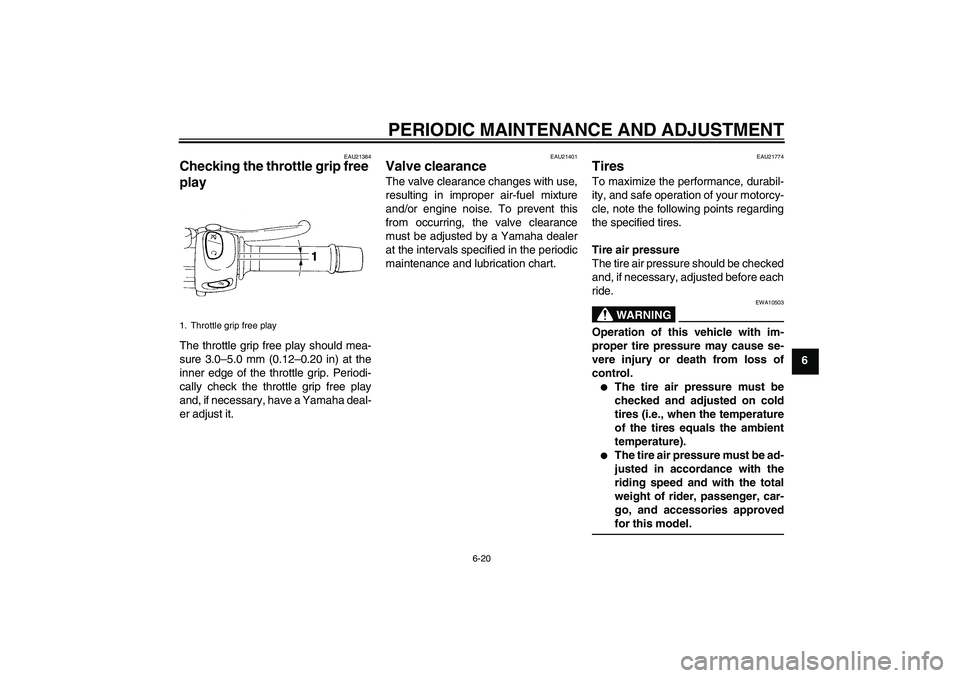
EAU21384
Checking the throttle grip free
play The throttle grip free play should mea-
sure 3.0–5.0 mm (0.12–0.20 in) at the
inner edge of the throttle grip. Periodi-
cally check the throttle grip free play
and, if necessary, have a Yamaha deal-
er adjust it.
EAU21401
Valve clearance The valve clearance changes with use,
resulting in improper air-fuel mixture
and/or engine noise. To prevent this
from occurring, the valve clearance
must be adjusted by a Yamaha dealer
at the intervals specified in the periodic
maintenance and lubrication chart.
EAU21774
Tires To maximize the performance, durabil-
ity, and safe operation of your motorcy-
cle, note the following points regarding
the specified tires.
Tire air pressure
The tire air pressure should be checked
and, if necessary, adjusted before each
ride.
WARNING
EWA10503
Operation of this vehicle with im-
proper tire pressure may cause se-
vere injury or death from loss of
control.�
The tire air pressure must be
checked and adjusted on cold
tires (i.e., when the temperature
of the tires equals the ambient
temperature).
�
The tire air pressure must be ad-
justed in accordance with the
riding speed and with the total
weight of rider, passenger, car-
go, and accessories approved
for this model.
1. Throttle grip free play
U36CE2E0.book Page 20 Friday, July 16, 2010 10:34 AM
Page 80 of 102
PERIODIC MAINTENANCE AND ADJUSTMENT
6-35
6is turned to “OFF”, then con-
nect the positive lead before
connecting the negative lead.
[ECA16840]
4. After installation, make sure that
the battery leads are properly con-
nected to the battery terminals.NOTICE
ECA16530
Always keep the battery charged.
Storing a discharged battery can
cause permanent battery damage.
EAU47172
Replacing the fuses The main fuse and the fuse boxes,
which contain the fuses for the individu-
al circuits, are located under the seat.
(See page 3-18.)TIPTo access the main fuse, remove the
starter relay cover as shown.XJ6SXJ6S1. Starter relay cover
2. Main fuse
3. Spare main fuse
4. Fuse box
2
4 3 1
1. Taillight fuse
2. Spare fuse
3. Headlight fuse
4. Ignition fuse
5. Signaling system fuse
6. Backup fuse (for clock and immobilizer sys-
tem)
7. Fuel injection system fuse
8. Radiator fan fuse
1
2
3
4
5
6
7
8
U36CE2E0.book Page 35 Friday, July 16, 2010 10:34 AM

![YAMAHA XJ6-S 2011 Owners Manual PERIODIC MAINTENANCE AND ADJUSTMENT
6-35
6is turned to “OFF”, then con-
nect the positive lead before
connecting the negative lead.
[ECA16840]
4. After installation, make sure that
the battery lea](/manual-img/51/52610/w960_52610-79.png "YAMAHA XJ6-S 2011 Owners Manual PERIODIC MAINTENANCE AND ADJUSTMENT
6-35
6is turned to “OFF”, then con-
nect the positive lead before
connecting the negative lead.
[ECA16840]
4. After installation, make sure that
the battery lea")