2011 VOLVO XC60 300
[x] Cancel search: 300Page 6 of 360

Contents
6
06
06 During your trip
Driving recommendations....................... 246
Refueling................................................. 250
Loading................................................... 255
Cargo area ............................................. 259
Towing a trailer....................................... 262
Emergency towing.................................. 265
07
07 Wheels and tires
General information ...............................270
Tire inflation............................................. 273
Inflation pressure—U.S. models ............ 275
Inflation pressure—Canadian models..... 276
Tire designations .................................... 277
Glossary of tire terminology ................... 279
Vehicle loading ....................................... 280
Uniform Tire Quality Grading ................. 282
Snow chains, snow tires, studded tires . 283
Temporary Spare ................................... 284
Tire Sealing System................................ 285
Changing a wheel ..................................291
Tire Pressure Monitoring System (TPMS) 294
08
08 Maintenance and
specifications
Volvo maintenance.................................. 300
Maintaining your car............................... 301
Hood and engine compartment.............. 303
Engine oil................................................ 304
Fluids...................................................... 306
Replacing bulbs...................................... 308
Wiper blades and washer fluid................ 315
Battery..................................................... 317
Fuses...................................................... 320
Vehicle care............................................. 328
Page 60 of 360

02 Locks and alarm
Remote key and key blade
02
60
Steady green light: the vehicle is correctly
locked.
Steady yellow light: the vehicle is not
locked.
Steady red light: the alarm has been trig-
gered.
Both red lights flash alternatively: the alarm
was triggered less than 5 minutes ago.
RangeThe PCC's lock and unlock functions have a
range of approximately 60 ft. (20 m) from the
vehicle.
NOTE
•The approach lighting, panic alarm, and
the functions controlled by the informa-
tion button have a range of approxi-
mately 300 ft (100 m) from the vehicle.
•Radio waves, buildings or other obsta-
cles may interfere with the function of
the PCC.
If the vehicle does not provide confirmation
when a button has been pressed, try moving
closer and pressing the button again.
Outside of the PCC´s rangeIf the PCC is more than approximately 300 ft
(100 m) from the vehicle when the information
button is pressed, no new information will be
received. The PCC most recently used to lock
or unlock the vehicle will show the vehicle's
most recently received status. The indicator
lights will not flash when the information button
is pressed while the PCC is out of range.
If more than one PCC is used to lock/unlock
the vehicle, only the one used most recently will
show the correct locking status.
NOTE
If none of the indicator lights illuminate when
the information button is pressed, this may
be because the most recent transmission
between the vehicle and the PCC was inter-
rupted or impeded by buildings or other
objects.
Keyless driveVehicles equipped with the optional Personal
Car Communicator have the keyless drive
function, see page 63 for detailed informa-
tion.
Detachable key blade
The key blade can be removed from the remote
key. When removed, the key blade can be used
to:
•Lock/unlock the driver's door if the remote
key is not functioning properly
•Lock/unlock the glove compartment (see
page 67)
•Block access to the glove compartment
Page 274 of 360
07 Wheels and tires
Tire inflation
07
274
After driving a distance of approximately
1 mile (1.6 km), the tires are considered to be
hot. If you have to drive farther than this dis-
tance to pump your tire(s), check and record
the tire pressure first and add the appropriate
air pressure when you get to the pump.
If checking tire pressure when the tire is hot,
never "bleed" or reduce air pressure. The tires
are hot from driving and it is normal for pres-
sures to increase above recommended cold
pressures. A hot tire at or below recommended
cold inflation pressure could be significantly
under-inflated.
To check inflation pressure:1. Remove the cap from the valve on one tire,
then firmly press the tire gauge onto the
valve.
2. Add air to reach the recommended air
pressure.
3. Replace the valve cap.
4. Visually inspect the tires to make sure there
are no nails or other objects embedded
that could puncture the tire and cause an
air leak.
5. Check the sidewalls to make sure there are
no gouges, cuts, bulges or other irregular-
ities.6. Repeat this procedure for each tire, includ-
ing the spare.
NOTE
•If you overfill the tire, release air by
pushing on the metal stem in the center
of the valve. Then recheck the pressure
with your tire gauge.
•Some spare tires require higher inflation
pressure than the other tires. Consult
the tire inflation tables or see the infla-
tion pressure placard.
Tire ratings
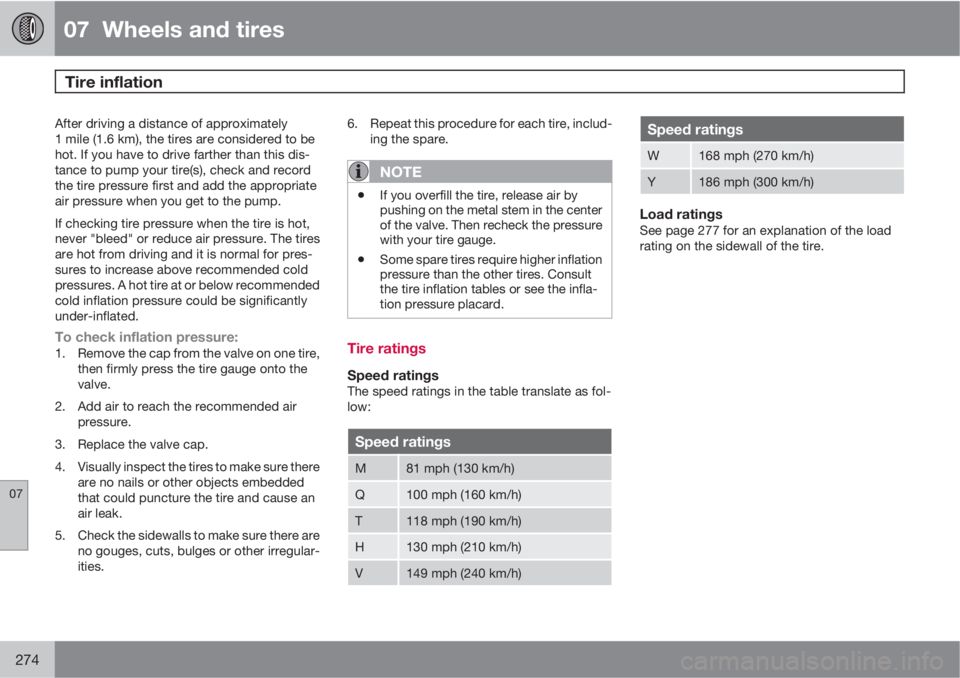
Speed ratingsThe speed ratings in the table translate as fol-
low:
Speed ratings
M81 mph (130 km/h)
Q100 mph (160 km/h)
T118 mph (190 km/h)
H130 mph (210 km/h)
V149 mph (240 km/h)
Speed ratings
W168 mph (270 km/h)
Y186 mph (300 km/h)
Load ratingsSee page 277 for an explanation of the load
rating on the sidewall of the tire.
Page 283 of 360
07 Wheels and tires
Snow chains, snow tires, studded tires
07
283 Winter driving conditions
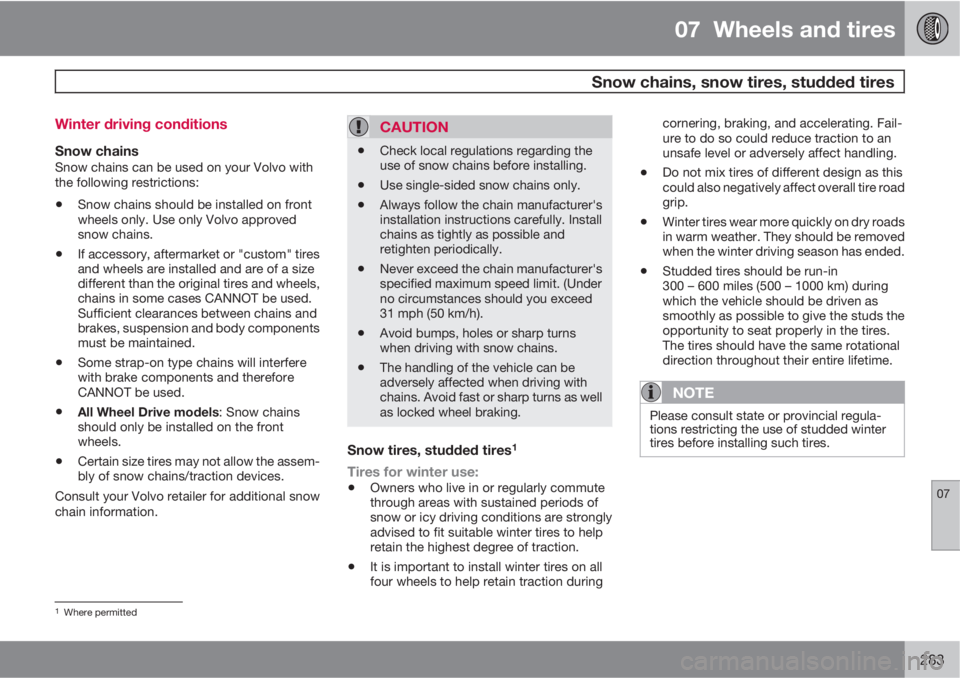
Snow chainsSnow chains can be used on your Volvo with
the following restrictions:
•Snow chains should be installed on front
wheels only. Use only Volvo approved
snow chains.
•If accessory, aftermarket or "custom" tires
and wheels are installed and are of a size
different than the original tires and wheels,
chains in some cases CANNOT be used.
Sufficient clearances between chains and
brakes, suspension and body components
must be maintained.
•Some strap-on type chains will interfere
with brake components and therefore
CANNOT be used.
•All Wheel Drive models: Snow chains
should only be installed on the front
wheels.
•Certain size tires may not allow the assem-
bly of snow chains/traction devices.
Consult your Volvo retailer for additional snow
chain information.
CAUTION
•Check local regulations regarding the
use of snow chains before installing.
•Use single-sided snow chains only.
•Always follow the chain manufacturer's
installation instructions carefully. Install
chains as tightly as possible and
retighten periodically.
•Never exceed the chain manufacturer's
specified maximum speed limit. (Under
no circumstances should you exceed
31 mph (50 km/h).
•Avoid bumps, holes or sharp turns
when driving with snow chains.
•The handling of the vehicle can be
adversely affected when driving with
chains. Avoid fast or sharp turns as well
as locked wheel braking.
Snow tires, studded tires1
Tires for winter use:
•Owners who live in or regularly commute
through areas with sustained periods of
snow or icy driving conditions are strongly
advised to fit suitable winter tires to help
retain the highest degree of traction.
•It is important to install winter tires on all
four wheels to help retain traction duringcornering, braking, and accelerating. Fail-
ure to do so could reduce traction to an
unsafe level or adversely affect handling.
•Do not mix tires of different design as this
could also negatively affect overall tire road
grip.
•Winter tires wear more quickly on dry roads
in warm weather. They should be removed
when the winter driving season has ended.
•Studded tires should be run-in
300 – 600 miles (500 – 1000 km) during
which the vehicle should be driven as
smoothly as possible to give the studs the
opportunity to seat properly in the tires.
The tires should have the same rotational
direction throughout their entire lifetime.
NOTE
Please consult state or provincial regula-
tions restricting the use of studded winter
tires before installing such tires.
1Where permitted
Page 298 of 360
298
Volvo maintenance................................................................................ 300
Maintaining your car............................................................................. 301
Hood and engine compartment............................................................303
Engine oil............................................................................................... 304
Fluids..................................................................................................... 306
Replacing bulbs.................................................................................... 308
Wiper blades and washer fluid.............................................................. 315
Battery................................................................................................... 317
Fuses..................................................................................................... 320
Vehicle care........................................................................................... 328
Page 300 of 360
08 Maintenance and specifications
Volvo maintenance
08
300
Introduction
Volvo advises you to follow the maintenance
program outlined in the Warranty and Service
Records Information booklet. This mainte-
nance program contains inspections and serv-
ices necessary for the proper function of your
vehicle. The maintenance services contain
several checks that require special tools and
training, and therefore must be performed by a
qualified technician. To keep your Volvo in top
condition, specify time-tested and proven
Genuine Volvo Parts and Accessories.
The Federal Clean Air Act – U.SThe Federal Clean Air Act requires vehicle
manufacturers to furnish written instructions to
the ultimate purchaser to assure the proper
servicing and function of the components that
control emissions. These services, which are
listed in the "Warranty and Service Records
Information" booklet, are not covered by the
warranty. You will be required to pay for labor
and material used.
MaintenanceYour Volvo passed several major inspections
before it was delivered to you, in accordance
with Volvo specifications. The maintenance
procedures outlined in the Warranty and Serv-
ice Records Information booklet, many of
which will positively affect your vehicle's emis-
sions, should be performed as indicated. It isrecommended that receipts for vehicle emis-
sion maintenance be retained in case ques-
tions arise concerning maintenance. Inspec-
tion and maintenance should also be per-
formed anytime a malfunction is observed or
suspected.
Applicable warranties – U.S/CanadaIn accordance with applicable U.S. and Cana-
dian regulations, the following list of warranties
is provided.
•New Vehicle Limited Warranty
•Parts and Accessories Limited Warranty
•Corrosion Protection Limited Warranty
•Seat Belt and Supplemental Restraint Sys-
tems Limited Warranty
•Emission Design and Defect Warranty
•Emission Performance Warranty
These are the federal warranties; other warran-
ties are provided as required by state/provin-
cial law. Refer to your separate Warranty and
Service Records Information booklet for
detailed information concerning each of the
warranties.
Periodic maintenance helps minimize
emissions
Periodic maintenance will help keep your vehi-
cle running well. Your Warranty and Service
Records Information booklet provides a com-prehensive periodic maintenance schedule up
to 150,000 miles (240,000 km) of vehicle main-
tenance. The schedule includes components
that affect vehicle emissions. This page
describes some of the emission-related com-
ponents.
Page 340 of 360
09 Specifications
Specifications 09
340
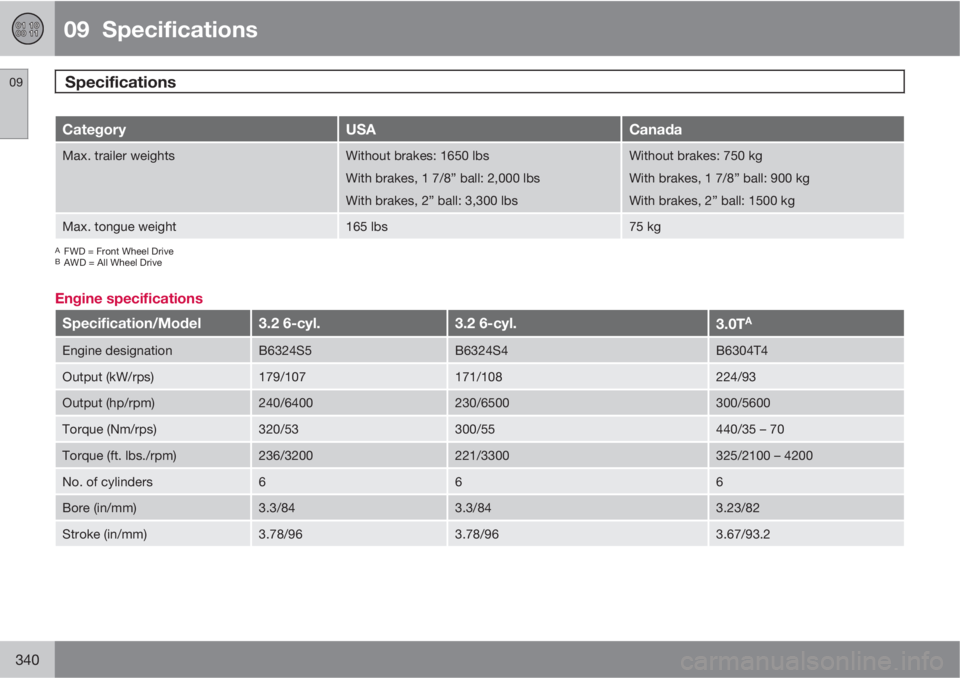
CategoryUSACanada
Max. trailer weightsWithout brakes: 1650 lbs
With brakes, 1 7/8” ball: 2,000 lbs
With brakes, 2” ball: 3,300 lbsWithout brakes: 750 kg
With brakes, 1 7/8” ball: 900 kg
With brakes, 2” ball: 1500 kg
Max. tongue weight165 lbs75 kg
AFWD = Front Wheel DriveBAWD = All Wheel Drive
Engine specifications
Specification/Model3.2 6-cyl.3.2 6-cyl.3.0TA
Engine designationB6324S5B6324S4B6304T4
Output (kW/rps)179/107171/108224/93
Output (hp/rpm)240/6400230/6500300/5600
Torque (Nm/rps)320/53300/55440/35 – 70
Torque (ft. lbs./rpm)236/3200221/3300325/2100 – 4200
No. of cylinders666
Bore (in/mm)3.3/843.3/843.23/82
Stroke (in/mm)3.78/963.78/963.67/93.2
Page 352 of 360

10 Index
10
352
Driver distraction warning.......................... 13
Driving economically................................ 246
Driving in cold weather............................ 248
Driving through water..............................247
E
ECC.................................................139, 140
Economical driving.................................. 246
Electric parking brake.............................. 118
Electronic Climate Control.......137, 139, 140
air distribution table............................ 141
Interior Air Quality System.................. 140
Emergency locking retractor...................... 38
Emergency starting.................................. 110
Emergency towing...........................265, 266
Emission inspection readiness................ 301
Engine
overheating........................................... 79
specifications...................................... 340
starting................................................ 109
switching off....................................... 110
Engine compartment overview................303
Engine Drag Control (EDC)......................144Engine oil
checking............................................. 304
low pressure warning light.............. 77, 78
specifications...................................... 342
volumes.............................................. 343
Environment............................................... 12
Eyelets for anchoring loads..................... 257
F
Federal Clean Air Act............................... 300
Fluid specifications.................................. 343
Fog lights
front/rear............................................... 91
rear...................................................... 312
Four C (active chassis system)................146
Front airbags.............................................. 22
disconnecting passenger’s side air-
bag.................................................. 26, 27
Front park assist.............................. 181, 183
Front seats...........................................82, 84
Fuel filler cap........................................... 253
Fuel filler door, opening........................... 252
Fuel level warning light.............................. 77Fuel requirements............................ 250, 251
Fuel tank volume.....................................343
Fuses............................... 320, 321, 324, 327
G
Gasoline requirements............................. 251
Gas tank volume...................................... 343
Gauges...................................................... 75
Geartronic................................................ 113
Geartronic automatic transmission.. 112, 113
Generator warning light............................. 78
Glossary of tire terminology..................... 279
Grocery bag holder.................................. 257
Gross vehicle weight...............................280
H
Hazard warning flashers............................ 91
HD digital radio........................................ 212
Headlights
Active Bending Lights........................... 90
changing bulbs...........................309, 310