2011 VOLVO S40 lock
[x] Cancel search: lockPage 39 of 294

01 Safety
Child safety01
39 Automatic Locking Retractor/
Emergency Locking Retractor (ALR/
ELR)
To make child seat installation easier, each
seat belt (except for the driver's belt) is equip-
ped with a locking mechanism to help keep the
seat belt taut.
When attaching the seat belt to a child
seat:
1. Attach the seat belt to the child seat
according to the child seat manufacturer's
instructions.
2. Pull the seat belt out as far as possible.
3. Insert the seat belt latch plate into the
buckle (lock) in the usual way.
4. Release the seat belt and pull it taut around
the child seat.
A sound from the seat belt retractor will be
audible at this time and is normal. The belt will
now be locked in place. This function is auto-
matically disabled when the seat belt is
unlocked and the belt is fully retracted.
WARNING
Do not use child safety seats or child
booster cushions/backrests in the front
passenger's seat. We also recommend that
children who have outgrown these devices
sit in the rear seat with the seat belt properly
fastened.
Volvo's recommendationsWhy does Volvo believe that no child should sit
in the front seat of a car? It's quite simple really.
A front airbag is a very powerful device
designed, by law, to help protect an adult.
Because of the size of the airbag and its speed
of inflation, a child should never be placed in
the front seat, even if he or she is properly bel-
ted or strapped into a child safety seat. Volvo
has been an innovator in safety for over sev-
enty-five years, and we'll continue to do our
part. But we need your help. Please remember
to put your children in the back seat, and
buckle them up.
Volvo has some very specific
recommendations:
•Always wear your seat belt.
•Airbags are a SUPPLEMENTAL safety
device which, when used with a three-
point seat belt can help reduce serious
injuries during certain types of accidents.Volvo recommends that you do not dis-
connect the airbag system in your vehicle.
•Volvo strongly recommends that everyone
in the vehicle be properly restrained.
•Volvo recommends that ALL occupants
(adults and children) shorter than 4 feet
7 inches (140 cm) be seated in the back
seat of any vehicle with a front passenger
side airbag.
•Drive safely!
Page 42 of 294

01 Safety
Infant seats 01
42
Securing an infant seat with a seat belt
G026417
Do not place the infant seat in the front passeng-
er's seat
NOTE
Refer to pages 47–49 for information on
securing a child restraint using ISOFIX/
LATCH lower anchors and/or top tether
anchorages.
WARNING
•An infant seat must be in the rear-facing
position only.
•The infant seat should not be positioned
behind the driver's seat unless there is
adequate space for safe installation.
1. Place the infant seat in the rear seat of the
vehicle.
G026493
Positioning the seat belt through the infant seat
2. Attach the seat belt to the infant seat
according to the manufacturer's instruc-
tions.
G026492
Fasten the seat belt
WARNING
A child seat should never be used in the
front passenger seat of any vehicle with a
front passenger airbag – not even if the
Passenger airbag off symbol near the rear-
view mirror is illuminated (on vehicles equip-
ped with Occupant Weight Sensor). If the
severity of an accident were to cause the
airbag to inflate, this could lead to serious
injury or death to a child seated in this posi-
tion.
3. Fasten the seat belt by inserting the latch
plate into the buckle (lock) until a distinct
click is audible.
Page 43 of 294

01 Safety
Infant seats01
43
G026494
Pull out the shoulder section of the seat belt
4. Pull the shoulder section of the seat belt
out as far as possible to activate the belt's
automatic locking function.
NOTE
The locking retractor will automatically
release when the seat belt is unbuckled and
allowed to retract fully.
5. Press the infant seat firmly in place, let the
seat belt retract and pull it taut. A sound
from the seat belt retractor's automatic
locking function will be audible at this timeand is normal. The seat belt should now be
locked in place.
Ensure that the seat is securely in place
WARNING
It should not be possible to move the child
restraint (child seat) more than 1 in. (2.5 cm)
in any direction along the seat belt path.
6. Push and pull the infant seat along the seat
belt path to ensure that it is held securely
in place by the seat belt.
7. The infant seat can be removed by unbuck-
ling the seat belt and letting it retract com-
pletely.
Page 45 of 294

01 Safety
Convertible seats01
45
G026500
Fasten the seat belt
2. Attach the seat belt to the convertible seat
according to the manufacturer's instruc-
tions.
3. Fasten the seat belt by inserting the latch
plate into the buckle (lock) until a distinct
click is audible.
4. Pull the shoulder section of the seat belt
out as far as possible to activate the belt's
automatic locking function.
NOTE
The locking retractor will automatically
release when the seat belt is unbuckled and
allowed to retract fully.
5. Press the convertible seat firmly in place,
let the seat belt retract and pull it taut. A
sound from the seat belt retractor's auto-
matic locking function will be audible at this
time and is normal. The seat belt should
now be locked in place.
G026501
Pull out the shoulder section of the seat belt
6. Push and pull the convertible seat along
the seat belt path to ensure that it is held
securely in place by the seat belt.
WARNING
It should not be possible to move the child
restraint (child seat) more than 1 in. (2.5 cm)
in any direction along the seat belt path.
The convertible seat can be removed by
unbuckling the seat belt and letting it retract
completely.
Ensure that the seat is securely in place
Page 46 of 294

01 Safety
Booster cushions 01
46
Securing a booster cushion
G026489
Position the child correctly on the booster cushion
and fasten the seat belt
WARNING
A child seat should never be used in the
front passenger seat of any vehicle with a
front passenger airbag – not even if the
Passenger airbag off symbol near the rear-
view mirror is illuminated (on vehicles equip-
ped with Occupant Weight Sensor). If the
severity of an accident were to cause the
airbag to inflate, this could lead to serious
injury or death to a child seated in this posi-
tion.
Booster cushions are recommended for chil-
dren who have outgrown convertible seats.
1. Place the booster cushion in the rear seat
of the vehicle.
2. With the child properly seated on the
booster cushion, attach the seat belt to or
around the cushion according to the man-
ufacturer's instructions.
3. Fasten the seat belt by inserting the latch
plate into the buckle (lock) until a distinct
click is audible.
4. Ensure that the seat belt is pulled taut and
fits snugly around the child.
WARNING
•The hip section of the three-point seat
belt must fit snugly across the child's
hips, not across the stomach.
•The shoulder section of the three-point
seat belt should be positioned across
the chest and shoulder.
•The shoulder belt must never be placed
behind the child's back or under the
arm.
Page 49 of 294

01 Safety
Top tether anchors01
49 Top tether anchors
G029703
Top tether anchorage points
Volvo vehicles are equipped with child restraint
top tether anchorages in the rear seating posi-
tions. They are located on the rear sides of the
backrests.
Using the top tether anchorages1. Place the child restraint on the rear seat.
2. Release the backrest and tilt it forward to
access the anchorage. Attach the hook to
the anchorage. Return the seat back to the
upright position and make sure it locks in
place.
G026487
Route the strap under the head restraint
WARNING
Be sure to fasten the child tether attachment
correctly to the anchor. If it is not correctly
fastened, the child seat may not be properly
restrained in the event of a collision.
3. Route the top tether strap under the head
restraint and fasten its attachment to the
anchorage.
4. Firmly tension the top tether strap accord-
ing to the child restraint manufacturer's
instructions. Tension the top tether strap
only after the lower anchor straps or the
seat belt have been firmly tensioned.See page 47 for information on securing the
child restraint to ISOFIX/LATCH lower anchors.
WARNING
•Never route a top tether strap over the
top or around the head restraint. It
should always be routed under the head
restraint.
•Child restraint anchorages are designed
to withstand only those loads imposed
by correctly fitted child restraints. Under
no circumstances are they to be used
for adult seat belts or harnesses. The
anchorages are not able to withstand
excessive forces on them in the event of
collision if full harness seat belts or adult
seat belts are installed to them. An adult
who uses a belt anchored in a child
restraint anchorage runs a great risk of
suffering severe injuries should a colli-
sion occur.
•Do not install rear speakers that require
the removal of the top tether anchors or
interfere with the proper use of the top
tether strap.
Page 55 of 294

02 Instruments and controls
Instrument overview
02
* Option/accessory, for more information, see Introduction.55
Steering wheel adjustment
Hood opener
Controls in front doors
Left steering wheel lever
Lighting panel, fuel filler door opener
Door open handle and locking button
Climate system air vent
Side window air vent
Cruise control
Horn, airbag
Main instrument panel
Audio controls
Right steering wheel lever
Ignition switch
Moonroof control*
Not in use
Not is use
Courtesy lighting switch
Driver's side reading light
Passenger's side reading light
Seat belt reminder and Occupant
Weight Sensor indicator
Rear-view mirror
Display for climate control, personal
settings, and audio system
Audio system
Controls for personal settings and
audio system
Controls for climate system
Gear selector
Hazard warning flashers
Door open handle
Glove compartment
Parking brake
12-volt socket
Position for optional equipment
Position for optional equipment
Control panel in driver's door
Lockout switch for rear windows
Power windows
Door mirror button, driver's side
Door mirror adjustment control
Door mirror button, passenger's side
Page 56 of 294
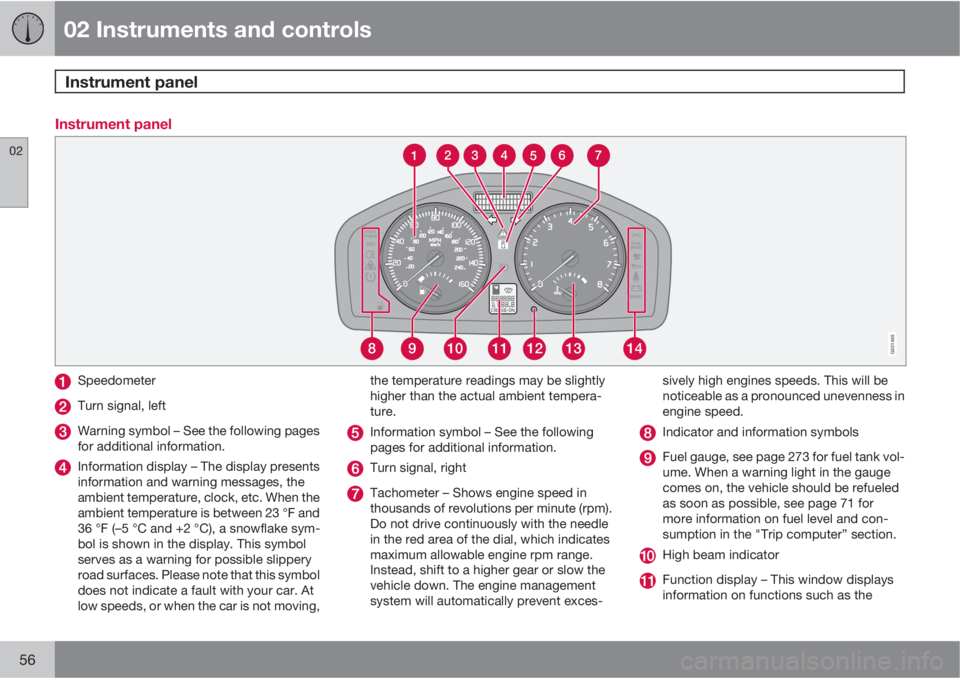
02 Instruments and controls
Instrument panel
02
56
Instrument panel
891112131410G031465
4 3 2
567
1
Speedometer
Turn signal, left
Warning symbol – See the following pages
for additional information.
Information display – The display presents
information and warning messages, the
ambient temperature, clock, etc. When the
ambient temperature is between 23 °F and
36 °F (–5 °C and +2 °C), a snowflake sym-
bol is shown in the display. This symbol
serves as a warning for possible slippery
road surfaces. Please note that this symbol
does not indicate a fault with your car. At
low speeds, or when the car is not moving,the temperature readings may be slightly
higher than the actual ambient tempera-
ture.
Information symbol – See the following
pages for additional information.
Turn signal, right
Tachometer – Shows engine speed in
thousands of revolutions per minute (rpm).
Do not drive continuously with the needle
in the red area of the dial, which indicates
maximum allowable engine rpm range.
Instead, shift to a higher gear or slow the
vehicle down. The engine management
system will automatically prevent exces-sively high engines speeds. This will be
noticeable as a pronounced unevenness in
engine speed.
Indicator and information symbols
Fuel gauge, see page 273 for fuel tank vol-
ume. When a warning light in the gauge
comes on, the vehicle should be refueled
as soon as possible, see page 71 for
more information on fuel level and con-
sumption in the "Trip computer” section.
High beam indicator
Function display – This window displays
information on functions such as the