2011 TOYOTA YARIS SEDAN weight
[x] Cancel search: weightPage 1 of 406
384
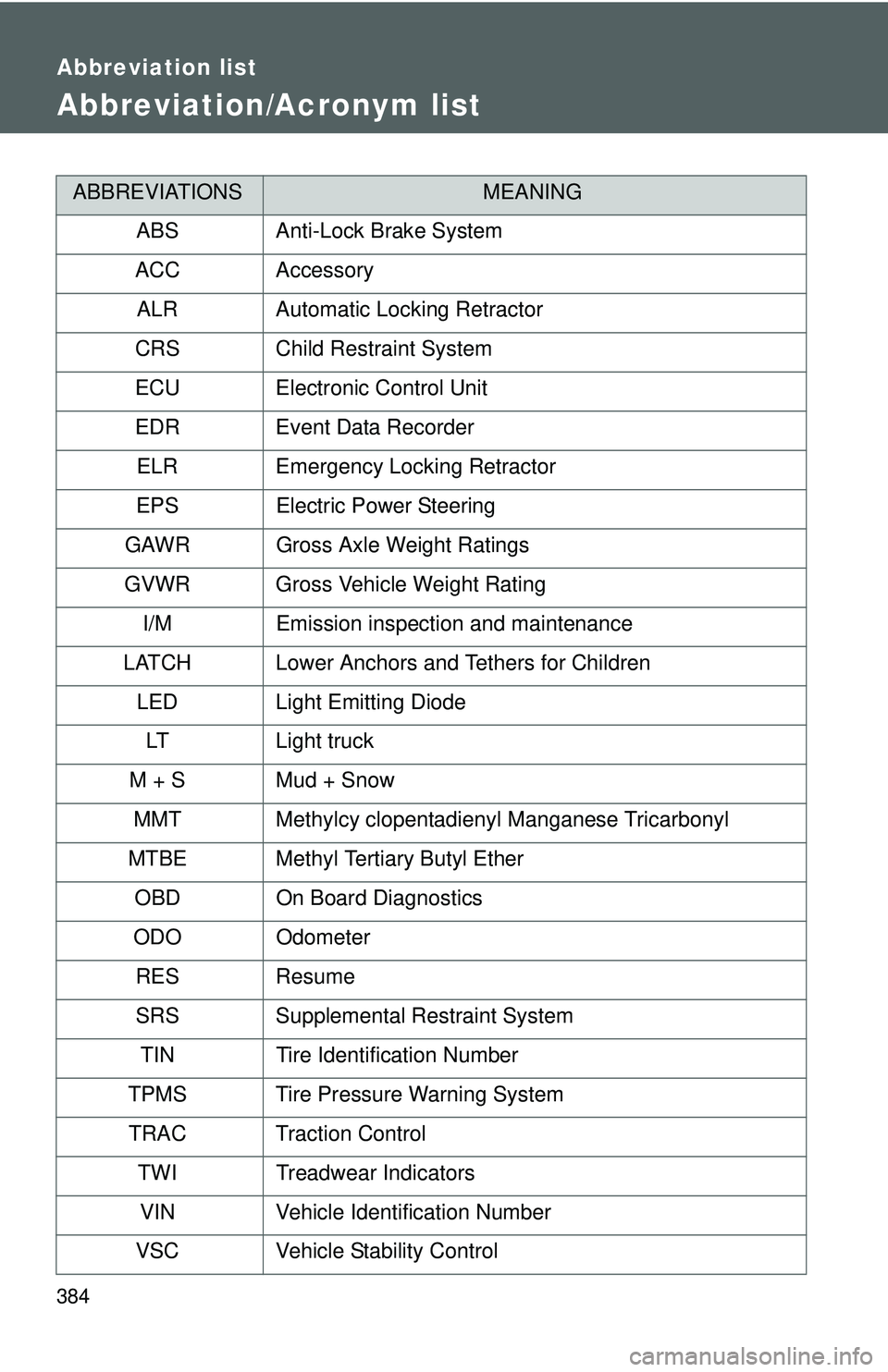
Abbreviation list
Abbreviation/Acronym list
ABBREVIATIONSMEANING
ABS Anti-Lock Brake System
ACC Accessory ALR Automatic Locking Retractor
CRS Child Restraint System
ECU Electronic Control Unit
EDR Event Data Recorder ELR Emergency Locking Retractor
EPS Electric Power Steering
GAWR Gross Axle Weight Ratings
GVWR Gross Vehicle Weight Rating I/M Emission inspection and maintenance
LATCH Lower Anchors and Tethers for Children LED Light Emitting Diode
LT Light truck
M + S Mud + Snow MMT Methylcy clopentadienyl Manganese Tricarbonyl
MTBE Methyl Tertiary Butyl Ether OBD On Board Diagnostics
ODO Odometer
RES Resume
SRS Supplemental Restraint System TIN Tire Identification Number
TPMS Tire Pressure Warning System TRAC Traction Control TWI Treadwear Indicators
VIN Vehicle Identification Number
VSC Vehicle Stability Control
Page 50 of 406
36 1-2. Opening, closing and locking the doors
CAUTION
nUsing the trunk
Observe the following precautions.
Failure to do so may cause parts of the body to be caught, resulting in seri-
ous injury.
lRemove any heavy loads, such as snow and ice, from the trunk lid before
opening it. Failure to do so may cause the trunk lid to fall closed again
after it is opened.
l When opening or closing the trunk lid, thoroughly check to make sure the
surrounding area is safe.
l If anyone is in the vicinity, make sure they are safe and let them know that
the trunk is about to open or close.
l Use caution when opening or closing the trunk lid in windy weather as it
may move abruptly in strong wind.
l Do not attach any accessories other than genuine Toyota parts to the trunk
lid. Such additional weight on the trunk lid may cause the lid to fall closed
again after it is opened.
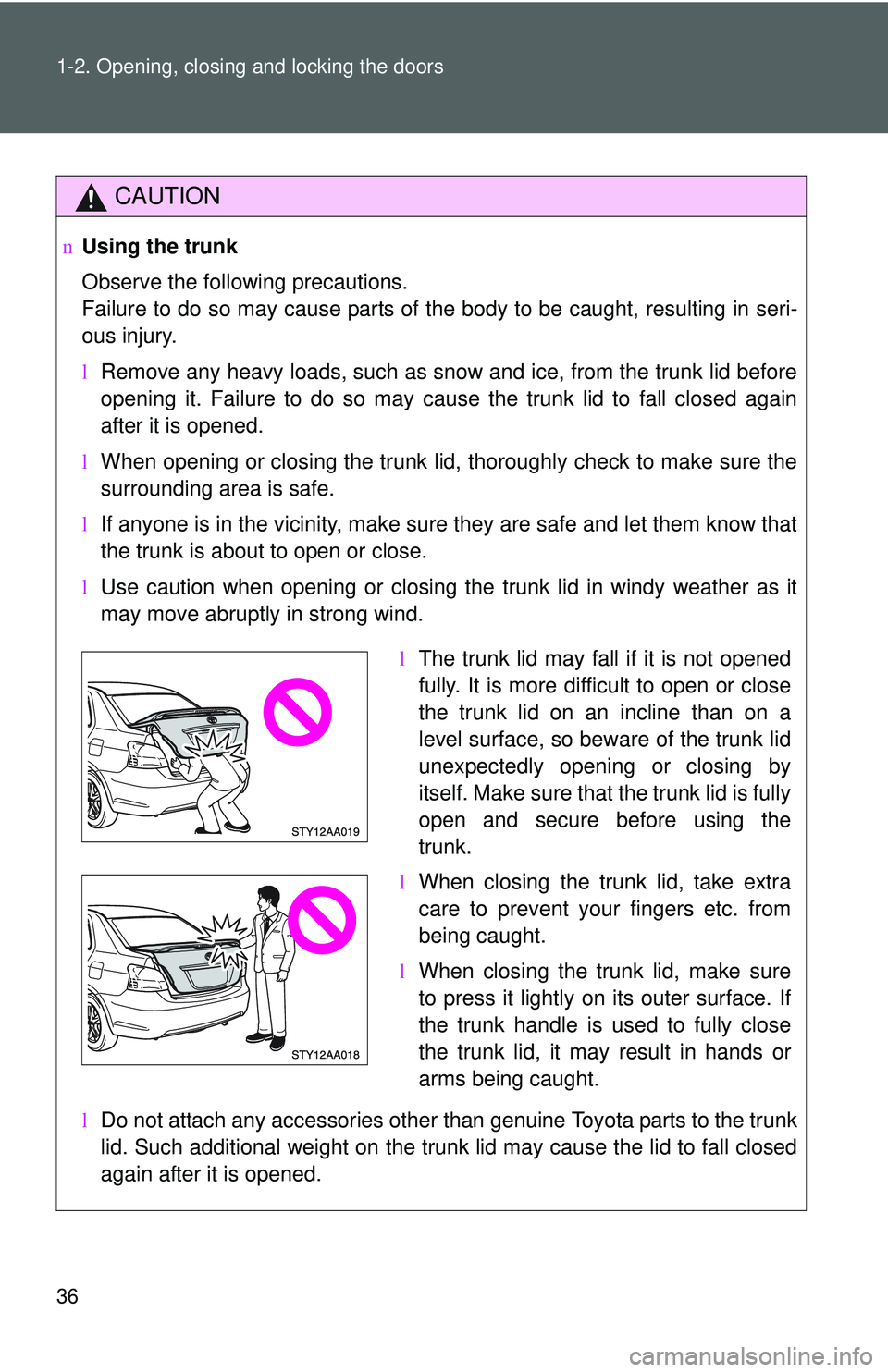
lThe trunk lid may fall if it is not opened
fully. It is more difficult to open or close
the trunk lid on an incline than on a
level surface, so beware of the trunk lid
unexpectedly opening or closing by
itself. Make sure that the trunk lid is fully
open and secure before using the
trunk.
l When closing the trunk lid, take extra
care to prevent your fingers etc. from
being caught.
l When closing the trunk lid, make sure
to press it lightly on its outer surface. If
the trunk handle is used to fully close
the trunk lid, it may result in hands or
arms being caught.
Page 63 of 406
49
1-3. Adjustable components (s
eats, mirrors, steering wheel)
1
Before driving
CAUTION
nWearing a seat belt
lDo not wear the shoulder belt under your arm.
l Always wear your seat belt low and snug across your hips.
n Adjustable shoulder anchor
Always make sure the shoulder belt is positioned across the center of your
shoulder. The belt should be kept away from your neck, but not falling off
your shoulder. Failure to do so could reduce the amount of protection in an
accident and cause death or serious injuries in the event of emergency brak-
ing, sudden swerving or an accident. ( →P. 45)
n Seat belt pretensioners
lDo not place anything, such as a cushion, on the front passenger’s seat.
Doing so will disperse the passenger’s weight, which prevents the sensor
from detecting the passenger’s weight properly. As a result, the seat belt
pretensioner for the front passenger’s seat may not activate in the event of
a collision.
l If the pretensioner has activated, the SRS warning light will come on. In
that case, the seat belt cannot be used again and must be replaced at
your Toyota dealer.
n Seat belt damage and wear
lDo not damage the seat belts by allowing the belt, plate, or buckle to be
jammed in the door.
l Inspect the seat belt system periodically. Check for cuts, fraying, and loose
parts. Do not use a damaged seat belt until it is replaced. Damaged seat
belt cannot protect an occupant from death or serious injury.
l Ensure that the belt and tab are locked and the belt is not twisted.
If the seat belt does not function correctly, immediately contact your Toyota
dealer.
l Replace the seat assembly, including the belts, if your vehicle has been
involved in a serious accident, even if there is no obvious damage.
l Do not attempt to install, remove, modify, disassemble or dispose of the
seat belts. Have any necessary repairs carried out by your Toyota dealer.
Inappropriate handling of the pretensioner may prevent it from operating
properly resulting in death or serious injury.
Page 100 of 406
86 1-7. Safety information
CAUTION
nFront passenger occupant cl assification system precautions
Observe the following precautions regarding front passenger occupant clas-
sification system.
Failure to do so may cause death or serious injury.
l Wear the seat belt properly.
l Make sure the front passenger’s seat belt tab has not been left inserted
into the buckle before someone sits in the front passenger seat.
l Make sure the AIR BAG OFF indicator light is not illuminated when using
the seat belt extender for the front passenger seat. If the AIR BAG OFF
indicator light is illuminated, disconnect the extender tongue from the seat
belt buckle, then reconnect the seat belt. Reconnect the seat belt extender
after making sure the AIR BAG ON indicator light is illuminated. If you use
the seat belt extender while the AIR BAG OFF indicator light is illuminated,
the front passenger airbag and side airbag on the front passenger side
may not activate correctly, which could cause death or serious injury in the
event of collision.
l Do not apply a heavy load to the front passenger seat or equipment.
l Do not put weight on the front passenger seat by putting your hands or
feet on the front passenger seat seatback from the rear passenger seat.
l Do not let a rear passenger lift the front passenger seat with their feet or
press on the seatback with their legs.
l Do not put objects under the front passenger seat.
l Do not recline the front passenger seatback so far that it touches a rear
seat. This may cause the AIR BAG OFF indicator light to be illuminated,
which indicates that the passenger’s airbags will not deploy in the event of
a severe accident. If the seatback touches the rear seat, return the seat-
back to a position where it does not touch the rear seat. Keep the front\
passenger seatback as upright as possible when the vehicle is moving.
Reclining the seatback excessively may lessen the effectiveness of the
seat belt system.
Page 159 of 406
146
2-5. Driving information
Cargo and luggage
Capacity and distributionCargo capacity depends on the total weight of the occupants.
(Cargo capacity) = (Total load capacity) − (Total weight of occupants)
Steps for Determining Correct Load Limit—
(1) Locate the statement “The co mbined weight of occupants and
cargo should never exceed XXX kg or XXX lbs.” on your vehicle’s
placard.
(2) Determine the combined weight of the driver and passengers that
will be riding in your vehicle.
(3)Subtract the combined weight of the driver and passengers from XXX kg or XXX lbs.
(4) The resulting figure equals the av ailable amount of cargo and lug-
gage load capacity.
For example, if the “XXX” amount equals 1400 lbs. and there will
be five 150 lb passengers in your vehicle, the amount of available
cargo and luggage load capacity is 650 lbs. (1400 − 750 (5 × 150)
= 650 lbs.)
(5) Determine the combined weight of luggage and cargo being loaded on the vehicle. That weight may not safely exceed the
available cargo and luggage load capacity calculated in Step 4.
Take notice of the following information about storage precau-
tions, cargo capacity and load.
lStow cargo and luggage in the trunk whenever possible.
l Be sure all items are secured in place.
l Be careful to keep the vehicle level. Placing the weight as far for-
ward as possible helps maintain vehicle balance.
l For better fuel economy, do no t carry unnecessary weight.
Page 160 of 406
147
2-5. Driving information
2
When driving
(6) If your vehicle will be towing a tr
ailer, load from your trailer will be
transferred to your vehicle. Consult this manual to determine how
this reduces the available cargo and luggage load capacity of your
vehicle.
Except Canada:
Toyota does not recommend towing a trailer with your vehicle. Your
vehicle is not designed for trailer towing.
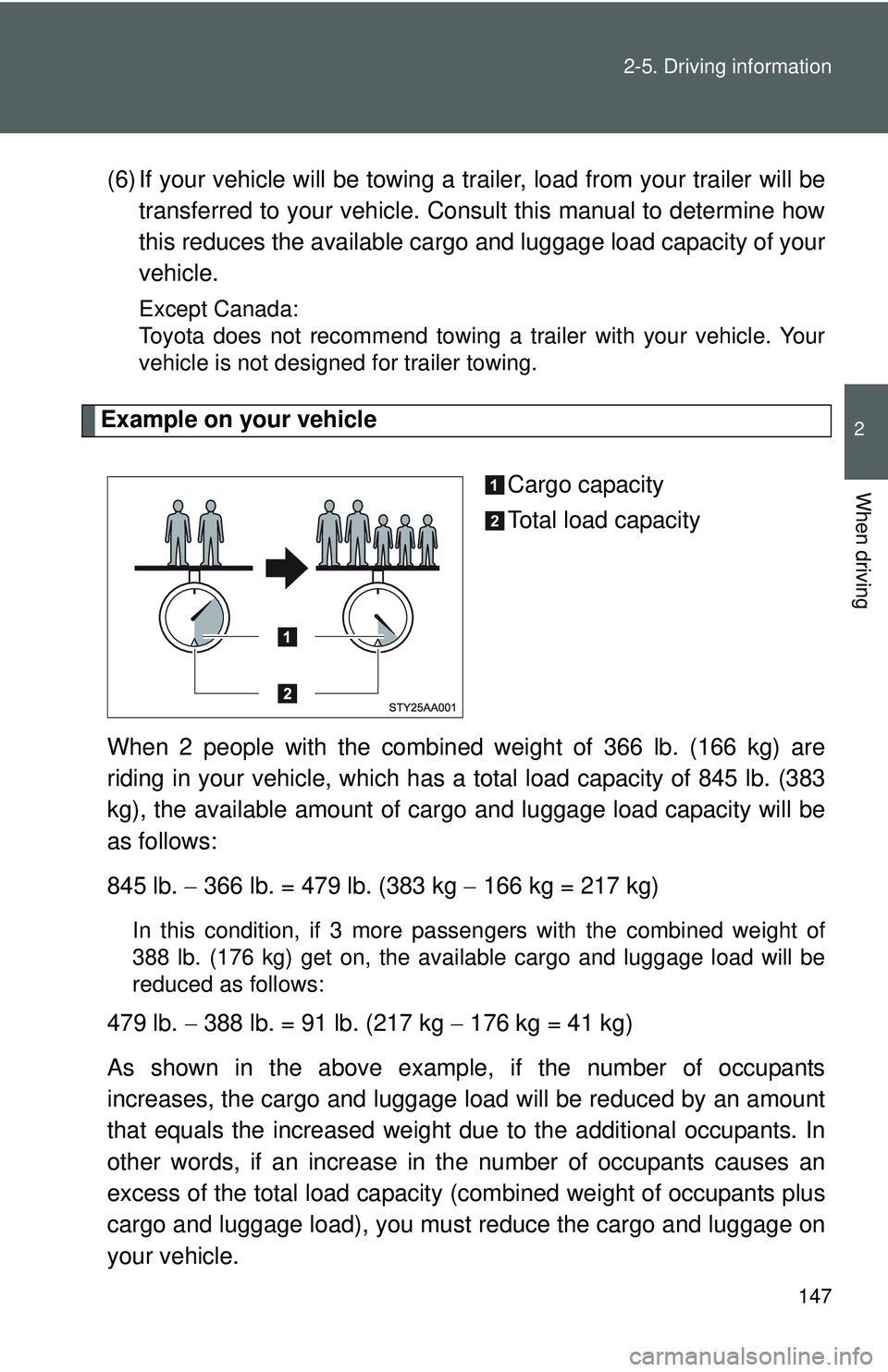
Example on your vehicle
Cargo capacity
Total load capacity
When 2 people with the combined weight of 366 lb. (166 kg) are
riding in your vehicle, which has a total load capacity of 845 lb. (383
kg), the available amount of cargo and luggage load capacity will be
as follows:
845 lb. − 366 lb. = 479 lb. (383 kg − 166 kg = 217 kg)
In this condition, if 3 more pa ssengers with the combined weight of
388 lb. (176 kg) get on , the available cargo and luggage load will be
reduced as follows:
479 lb. − 388 lb. = 91 lb. (217 kg − 176 kg = 41 kg)
As shown in the above example, if the number of occupants
increases, the cargo and luggage load will be reduced by an amount
that equals the increased weight du e to the additional occupants. In
other words, if an increase in th e number of occupants causes an
excess of the total load capacity (combined weight of occupants plus
cargo and luggage load), you must reduce the cargo and luggage on
your vehicle.
Page 161 of 406
148 2-5. Driving information
CAUTION
nThings that must not be carried in the trunk
The following things may cause a fire if loaded in the trunk.
lReceptacles containing gasoline
lAerosol cans
nStorage precautions
Observe the following precautions.
Failing to do so may result in death or serious injury.
lDo not place cargo or luggage in or on the following locations as the
item may get under the clutch, brake or accelerator pedal and prevent
the pedals from being depressed properly, block the driver’s vision, or
hit the driver or passengers, causing an accident.
• Driver’s feet
• Front passenger or rear seats (when stacking items)
• Package tray
• Instrument panel
• Dashboard
• Auxiliary box or tray that has no lid
lSecure all items in the occupant compartment, as they may shift and
injure someone during emergency braking, sudden swerving or an
accident.
lNever allow anyone to ride in the enlarged trunk. It is not designed for
passengers. They should ride in their seats with their seat belts prop-
erly fastened. Otherwise, they are much more likely to suffer death or
serious bodily injury, in the event of sudden braking, sudden swerving
or an accident.
nCapacity and distribution
lDo not exceed the maximum axle weight rating or the total vehicle
weight rating.
lEven if the total load of occupant’s weight and the cargo load is less
than the total load capacity, do not apply the load unevenly. Improper
loading may cause deterioration of steering or braking control which
may cause death or serious injury.
Page 162 of 406
149
2-5. Driving information
2
When driving
Vehicle load limits
nTotal load capacity and seating capacity
These details are also described on the tire and loading information
label. (→P. 256)
CAUTION
nOverloading the vehicle
Do not overload the vehicle.
It may not only cause damage to the ti res, but also degrade steering and
braking ability, resulting in an accident.
Vehicle load limits include total load capacity, seating capacity,
towing capacity and cargo capacity.
n Total load capacity: 845 lb. (383 kg)
Total load capacity means the combined weight of occupants,
cargo and luggage.
n Seating capacity: 5 occupants (Front 2, Rear 3)
Seating capacity means the ma ximum number of occupants
whose estimated average weight is 150 lb. (68 kg) per person.
Even if the number of occupants are within the seating capacity,
do not exceed the total load capacity.
n Towing capacity (Canada): 700 lb. (318 kg)
Towing capacity means the maximum gross trailer weight (trailer
weight plus its cargo weight) that your vehicle is able to tow.
n Towing capacity (except Canada):
Toyota does not recommend towing a trailer with your vehicle.
n Cargo capacity
Cargo capacity may increase or decrease depending on the
weight and the number of occupants.