2011 TOYOTA YARIS SEDAN overheating
[x] Cancel search: overheatingPage 122 of 406
109
2-1. Driving procedures
2
When driving
CAUTION
n
When taking a nap in the vehicle
Always turn the engine off. Otherwise, you may accidentally move the shift
lever or depress the accelerator pedal, which could cause an accident or fire
due to engine overheating. Additionally, if the vehicle is parked in a poorly
ventilated area, exhaust gases may collect and enter the vehicle, leadin\
g to
death or a serious health hazard.
n When braking the vehicle
lWhen the brakes are wet, drive more cautiously.
Braking distance increases when the brakes are wet, and may cause one
side of the vehicle to brake differently than the other side. Also the parking
brake may not securely hold the vehicle.
l If the power brake assist function does not operate, do not follow other
vehicles closely and avoid downhills or sharp turns that require braking.
In this case, braking is still possible, but it will require more force on the
pedal than usual. Braking distance may also increase.
l Do not pump the brake pedal if the engine stalls.
Each push on the brake pedal uses up the reserve for the power-assisted
brakes.
l The brake system consists of 2 individual hydraulic systems: If one of the
systems fails, the other will still operate. In this case, the brake pedal
should be depressed more firmly than usual and braking distance
becomes longer.
Do not drive your vehicle with only a single brake system. Have your
brakes fixed immediately.
Page 134 of 406
121
2-1. Driving procedures
2
When driving
n
Parking brake engaged warning buzzer
The buzzer sounds to indicate that parking brake is still engaged (with the
vehicle having reached a speed of 3 mph [5 km/h]).
n Usage in winter time
See “Winter driving tips” for parking brake usage in winter time. (→ P. 150)
NOTICE
nBefore driving
Fully release the parking brake.
Driving the vehicle with the parking brake set will lead to brake components
overheating, which may affect braking performance and increase brake
wear.
Page 140 of 406
127
2-2. Instrument cluster
2
When driving
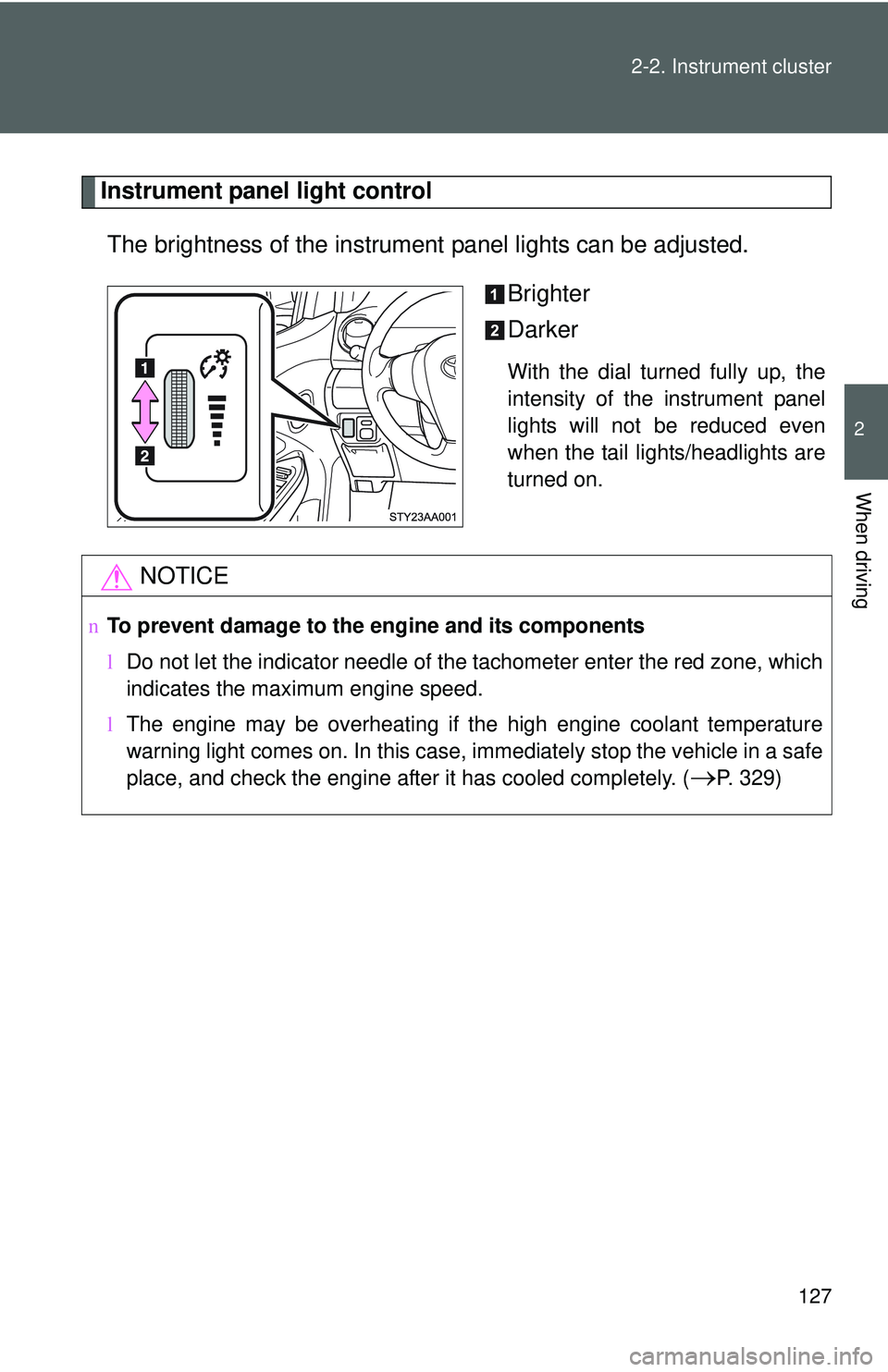
Instrument panel light control
The brightness of the instrument panel lights can be adjusted.
Brighter
Darker
With the dial turned fully up, the
intensity of the instrument panel
lights will not be reduced even
when the tail lights/headlights are
turned on.
NOTICE
nTo prevent damage to the engine and its components
lDo not let the indicator needle of the tachometer enter the red zone, which
indicates the maximum engine speed.
l The engine may be overheating if the high engine coolant temperature
warning light comes on. In this case, immediately stop the vehicle in a safe
place, and check the engine after it has cooled completely. (
→P. 329)
Page 157 of 406
144 2-4. Using other driving systems
nAutomatic reactivation of TRAC and VSC
Turning the engine switch OFF after turning off the TRAC and VSC systems
will automatically re-enable them.
n Automatic TRAC reactivation
If only the TRAC system is turned off, the TRAC system will turn on when
vehicle speed increases.
n Automatic TRAC and VSC reactivation
If the TRAC and VSC systems are turned off, the systems will not turn on
even when vehicle speed increases.
n If the slip indicator light up
There is a malfunction in the TRAC and VSC systems. Contact your Toyota
dealer and have your Toyota inspected.
n EPS operation sound
When the steering wheel operates, a motor sound (whirring sound) may be
heard.
This does not indicate a malfunction.
n Reduced effectiveness of EPS
The effectiveness of EPS is reduced to prevent the system from overheating
when there is frequent steering input over an extended period of time. The
steering wheel may feel heavy as a result. Should this occur, refrain from
excessive steering input or stop the vehicle and turn the engine off. The sys-
tem should return to normal within 10 minutes.
Page 173 of 406
160 2-5. Driving information
lTake care when passing other v ehicles. Passing requires consider-
able distance. After passing a vehi cle, do not forget the length of
your trailer, and be sure you hav e plenty of room before changing
lanes.
l In order to maintain engine braking efficiency, do not use the trans-
mission in D (automatic transmission) or 5 (manual transmission).
l Due to the added load of the trailer, your vehicle’s engine may
overheat on hot days (at temper atures over 85°F [30°C]) when
driving up a long or steep grade. If the engine coolant temperature
gauge indicates overheating, immediately turn off the air condition-
ing (if in use), pull your vehicle off the road and stop in a safe spot.
( → P. 329)
l Always place wheel blocks under both the vehicle and the trailer
wheels when parking. Apply the parking brake firmly, and put the
transmission in P (automatic transmission) or in 1 or R (manual
transmission). Avoid parking on a slope, but if unavoidable, do so
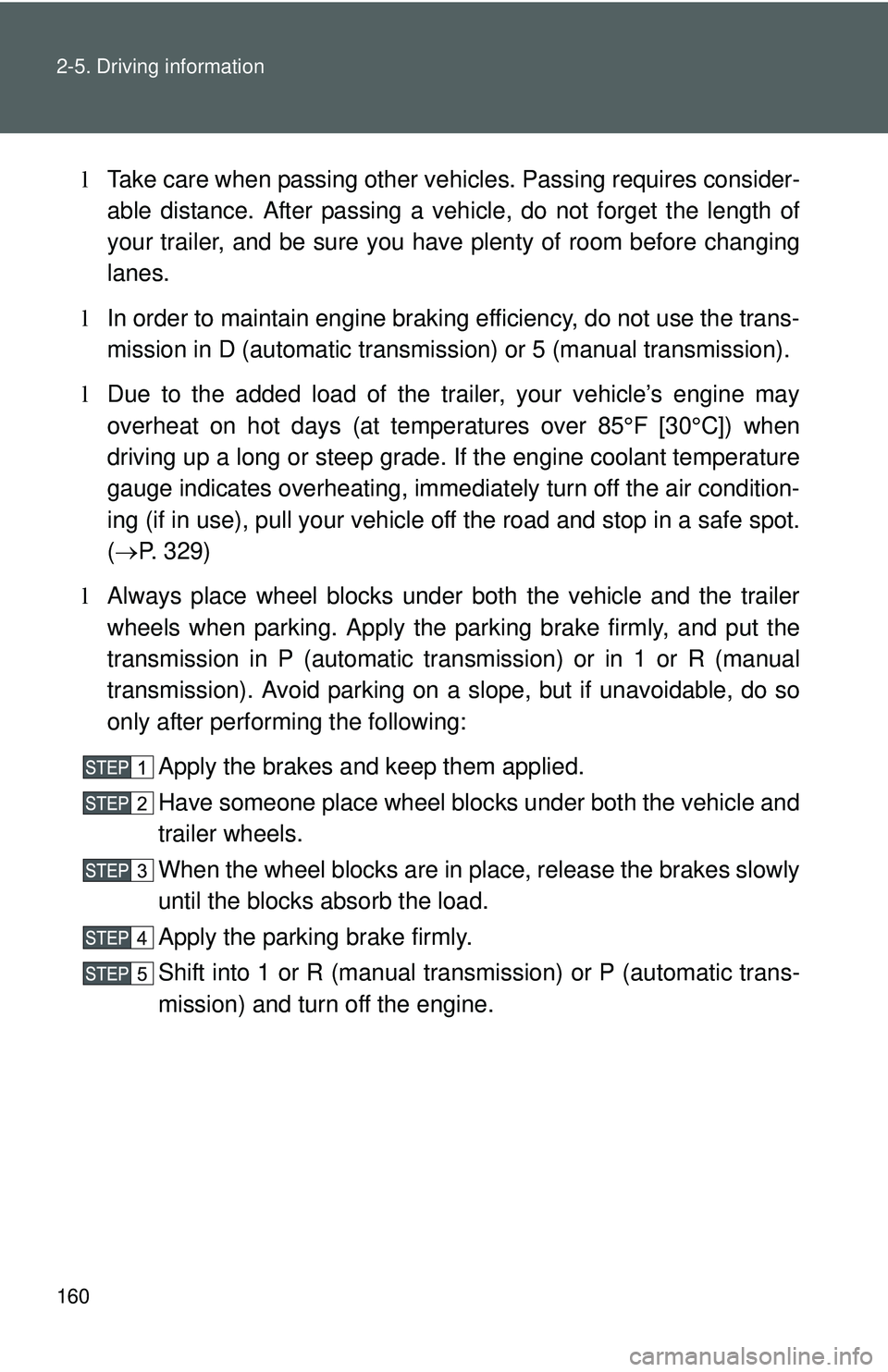
only after performing the following:
Apply the brakes and keep them applied.
Have someone place wheel bloc ks under both the vehicle and
trailer wheels.
When the wheel blocks are in place, release the brakes slowly
until the blocks absorb the load.
Apply the parking brake firmly.
Shift into 1 or R (manual transmission) or P (automatic trans-
mission) and turn off the engine.
Page 312 of 406
302 5-2. Steps to take in an emergency
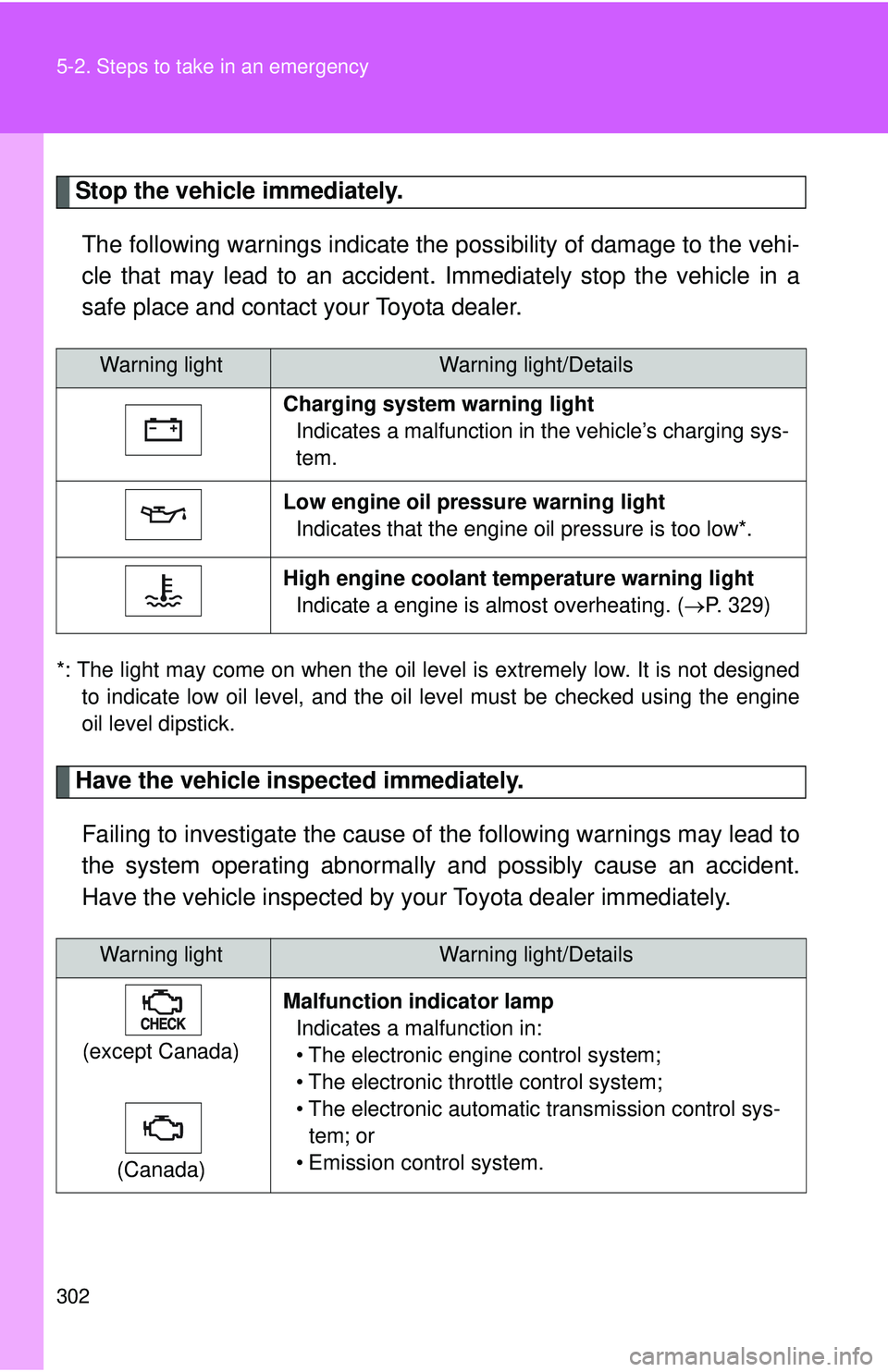
Stop the vehicle immediately.The following warnings indicate the possibility of damage to the vehi-
cle that may lead to an accident. Immediately stop the vehicle in a
safe place and contact your Toyota dealer.
*: The light may come on when the oil level is extremely low. It is not designed to indicate low oil level, and the oil level must be checked using the engine
oil level dipstick.
Have the vehicle inspected immediately.
Failing to investigate the cause of the following warnings may lead to
the system operating abnormally and possibly cause an accident.
Have the vehicle inspected by your Toyota dealer immediately.
Warning lightWarning light/Details
Charging system warning light Indicates a malfunction in the vehicle’s charging sys-
tem.
Low engine oil pressure warning light Indicates that the engine oil pressure is too low*.
High engine coolant temperature warning light Indicate a engine is almost overheating. ( →P. 329)
Warning lightWarning light/Details
(except Canada)
(Canada) Malfunction indicator lamp
Indicates a malfunction in:
• The electronic engine control system;
• The electronic throttle control system;
• The electronic automatic transmission control sys-tem; or
• Emission control system.
Page 341 of 406
5
When trouble arises
331
5-2. Steps to take in an emergency
n
Overheating
If you observe the following, your vehicle may be overheating.
lThe high engine coolant temperature warning light flashes or comes on
or a loss of power is experienced.
l Steam is coming from under the hood.
CAUTION
nTo prevent an accident or injury when inspecting under the hood of
your vehicle
lIf steam is seen coming from under the hood, do not open the hood until
the steam has subsided. The engine compartment may be very hot, caus-
ing serious injury such as burns.
l Keep hands and clothing away from the fan and other belts while the
engine is running.
l Do not loosen the radiator cap while the engine and radiator are hot.
Serious injury, such as burns, may result from hot coolant and steam
released under pressure.
NOTICE
nWhen adding engine coolant
Wait until the engine has cooled down before adding engine coolant.
When adding coolant, do so slowly. Adding cool coolant to a hot engine too
quickly can cause damage to the engine.
Page 393 of 406
387
Alphabetical index
Electric power steering
Electric power steering ......... 141
Warning light ........................ 302
Emergency flashers Switch ................................... 290
Emergency, in case of If the engine will not start...... 322
If the shift lever cannot be shifted from P ..................... 324
If the vehicle battery is discharged ......................... 326
If the warning buzzer sounds ............................... 301
If the warning light
turns on .............................. 301
If you have a flat tire ............ 311
If you lose your keys............. 325
If you think something is wrong ................................. 297
If the vehicle becomes
stuck................................... 332
If your vehicle has to be stopped in an emergency... 334
If your vehicle needs to be towed ................................. 291
If your vehicle overheats ...... 329
Engine Compartment........................ 238
Engine switch ....................... 112
Hood ..................................... 235
How to start the engine ........ 112
Identification number ............ 340
If the engine will not start...... 322
Ignition switch ....................... 112
Immobilizer system................. 63
Overheating .......................... 329
Specifications ....................... 341
Warning light ........................ 302 Engine coolant
Capacity ................................343
Checking ...............................243
Indicator ................................128
Preparing and checking
before winter .......................150
Type ......................................343
Warning light .........................302
Engine immobilizer system.......63
Engine oil Capacity ................................342
Checking ...............................239
Grade ....................................342
Initializing the maintenance
data .....................................241
Preparing and checking before winter .......................150
Warning light .........................302
Engine switch ...........................112
Engine oil maintenance data .........................................241
EPS EPS .......................................141
Warning light .........................302
Event data recorder .................299
Floor mat...................................217
Fluid Automatic transmission .........345
Brake .....................................244
Clutch ....................................345
Warning light .................301, 304
Washer ..................................248
Fog lights
Indicator ................................134
Replacing light bulbs .............278
Switch....................................134
Wattage .................................348
Front fog lights Indicator ................................134
Replacing light bulbs .............278
Switch....................................134
Wattage .................................348E
F