Page 247 of 416
247
4-2. Maintenance
4
Maintenance and care
Vehicle interior
ItemsCheck points
Accelerator pedal • Moves smoothly (without uneven
pedal effort or catching)?
Automatic transmission “Park”
mechanism • Can the vehicle be hold securely
on an incline with the shift lever in
P?
Brake pedal • Moves smoothly?
• Does it have appropriate clear-
ance and correct amount of free
play?
Brakes • Not pull to one side when
applied?
• Loss of brake effectiveness?
• Spongy feeling brake pedal?
• Pedal almost touches floor?
Clutch pedal • Moves smoothly?
• Does it have correct amount of
free play?
Head restraints • Move smoothly and lock
securely?
Indicators/buzzers • Function properly?
Lights • Do all the lights come on?
• Headlights aimed correctly?
Parking brake • Moves smoothly?
• Can hold the vehicle securely on
an incline?
Seat belts • Does the seat belt system oper-
ate smoothly?
• Are the belts undamaged?
Seats • Do the seat controls operate
properly?
Page 255 of 416

255
4-3. Do-it-yourself maintenance
4
Maintenance and care
CAUTION
■
When raising your vehicle
Make sure to observe the following to reduce the possibility of death or\
seri-
ous injury.
●When using a floor jack, follow the instructions of the manual provided with
the jack.
● Do not use the jack that was supplied with your vehicle.
● Do not put any part of your body or get underneath the vehicle supported
only by the floor jack.
● Always use floor jack and/or automotive jack stands on a solid, flat, level
surface.
● Do not start the engine while the vehicle is supported by the floor jack.
● Stop the vehicle on level firm ground, firmly set the parking brake and put
the shift lever in P (automatic transmission) or R (manual transmission).
● Make sure to set the floor jack properly at the jack point.
Raising the vehicle with an improperly positioned floor jack will damage
the vehicle and may cause the vehicle to fall off the floor jack.
● Do not raise the vehicle while someone is in the vehicle.
● When raising the vehicle, do not place any objects on top of or underneath
the floor jack.
●Lift up the vehicle using a floor jack
such as the one shown in the illustra-
tion.
Page 295 of 416

295
4-3. Do-it-yourself maintenance
4
Maintenance and care
9 ID/UP/MIR HTR 10 A
Multiport fuel injection system/
sequential multiport fuel injection
system, outside rear view mirror
control, outside rear view mirror
heaters
10 IGN 7.5 A Multiport fuel injection system/
sequential multiport fuel injection
system, SRS airbag system, front
passenger occupant classification
system
11 MET 7.5 A Meter and gauge
12 WIP 25 A Windshield wiper
13 RR WIP 15 A Rear wiper
14 WSH 15 A Windshield washer
15 ECU-IG 10 ADaytime running light system, anti-
lock brake system, electric power
steering system, power windows,
door lock system, theft deterrent
system, electric cooling fan
16 GAUGE 10 ACharging system, turn signal lights,
emergency flashers, back-up
lights, instrument panel light con-
trol, shift lock system, rear window
defogger, air conditioning system,
automatic transmission system
17 OBD2 7.5 A On-board diagnosis system
18 STOP 10 AStop lights, high mounted stop-
light, multiport fuel injection sys-
tem/sequential multiport fuel
injection system, shift lock system,
anti-lock brake system
19 D/L 25 A Door lock system
20 FR FOG 15 A Front fog lights
FuseAmpereCircuit
Page 307 of 416
When trouble arises5
307
5-1. Essential informationEmergency flashers ......... 308
If your vehicle needs to be towed ........................ 309
If you think something is wrong ............................. 315
Fuel pump shut off system ........................... 316
Event data recorder ......... 317 5-2. Steps to take in an
emergency
If a warning light turns on or a warning buzzer
sounds... ........................ 319
If you have a flat tire......... 329
If the engine will not start ................................ 341
If the shift lever cannot be shifted from P (vehicles
with an automatic
transmission) ................. 343
If you lose your keys ........ 344
If the vehicle battery is discharged ..................... 345
If your vehicle overheats ....................... 349
If the vehicle becomes stuck .............................. 352
If your vehicle has to be stopped in an
emergency ..................... 354
Page 309 of 416
5
When trouble arises
309
5-1. Essential information
If your vehicle needs to be towed
Before towingThe following may indicate a problem with your transmission. Contact
your Toyota dealer before towing.
● The engine is running, but the vehicle will not move.
● The vehicle makes an abnormal sound.
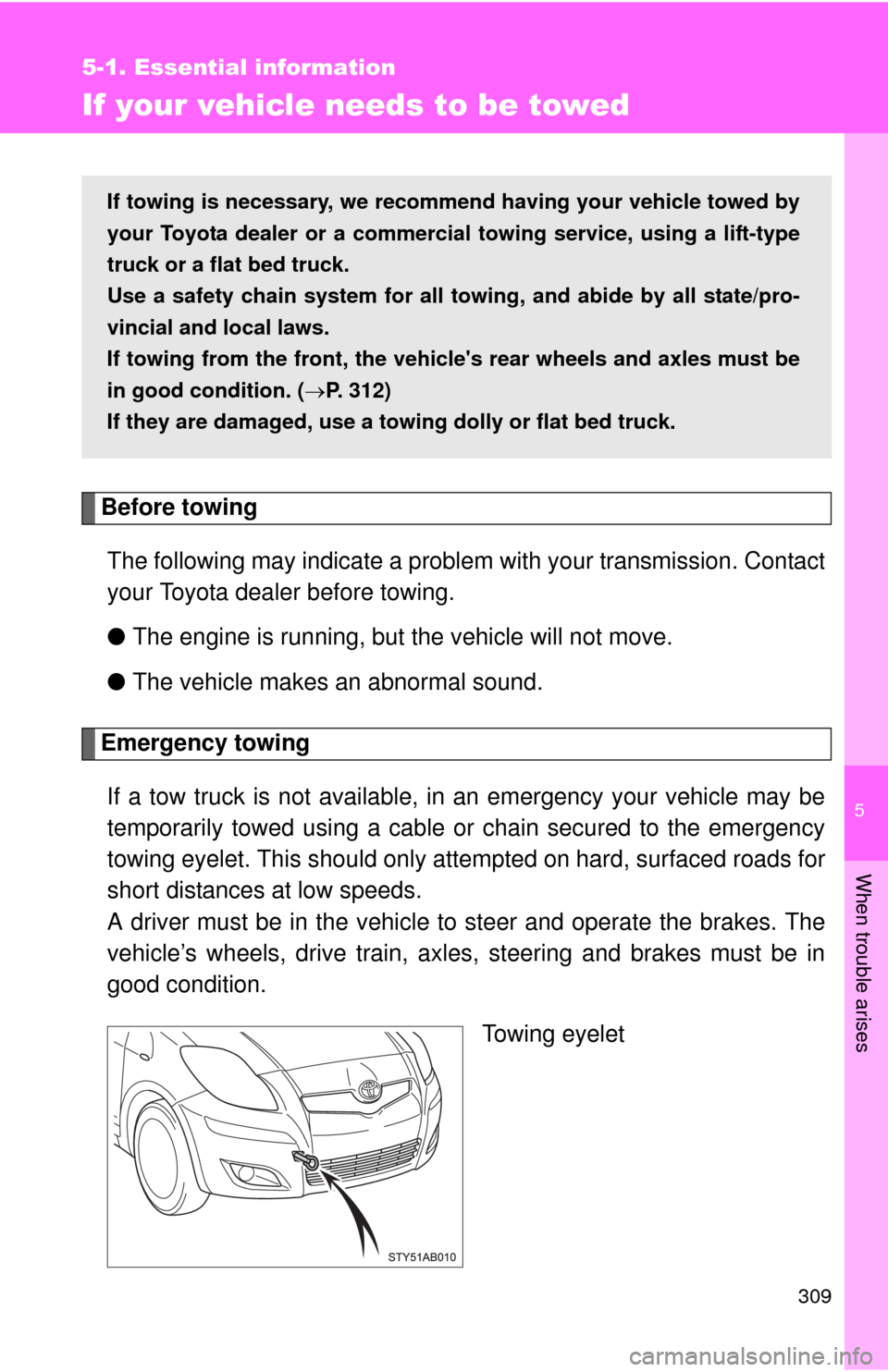
Emergency towing
If a tow truck is not available, in an emergency your vehicle may be
temporarily towed using a cable or chain secured to the emergency
towing eyelet. This should only attempted on hard, surfaced roads for
short distances at low speeds.
A driver must be in the vehicle to steer and operate the brakes. The
vehicle’s wheels, drive train, axles, steering and brakes must be in
good condition.
Towing eyelet
If towing is necessary, we recommend having your vehicle towed by
your Toyota dealer or a commerci al towing service, using a lift-type
truck or a flat bed truck.
Use a safety chain system for all to wing, and abide by all state/pro-
vincial and local laws.
If towing from the front, the vehic le's rear wheels and axles must be
in good condition. (P. 312)
If they are damaged, use a towing dolly or flat bed truck.
Page 310 of 416

310 5-1. Essential information
■Emergency towin g procedure
Release the parking brake.
Put the transmission in N.
Turn the engine switch to the ACC (engine off) or ON (engine run-
ning) position.
CAUTION
■ Caution while towing
●Use extreme caution when towing the vehicle.
Avoid sudden starts or erratic driving maneuvers which place excessive
stress on the emergency towing eyelet and the cables or chains. Always
use caution for the surroundings and other vehicles while towing.
● If the engine is not running, the power assist for the brakes and steering
will not function, making steering and braking more difficult.
NOTICE
■To prevent causing serious dama ge to the transmission
(vehicles with an automatic transmission)
Never tow this vehicle from the rear with the front wheels on the ground.
This may cause serious damage to the transmission.
■ When towing a vehicle without using a towing dolly
(vehicles with a manual transmission)
Do not tow with the key removed or in the LOCK position.
Page 313 of 416
5
When trouble arises
313
5-1. Essential information
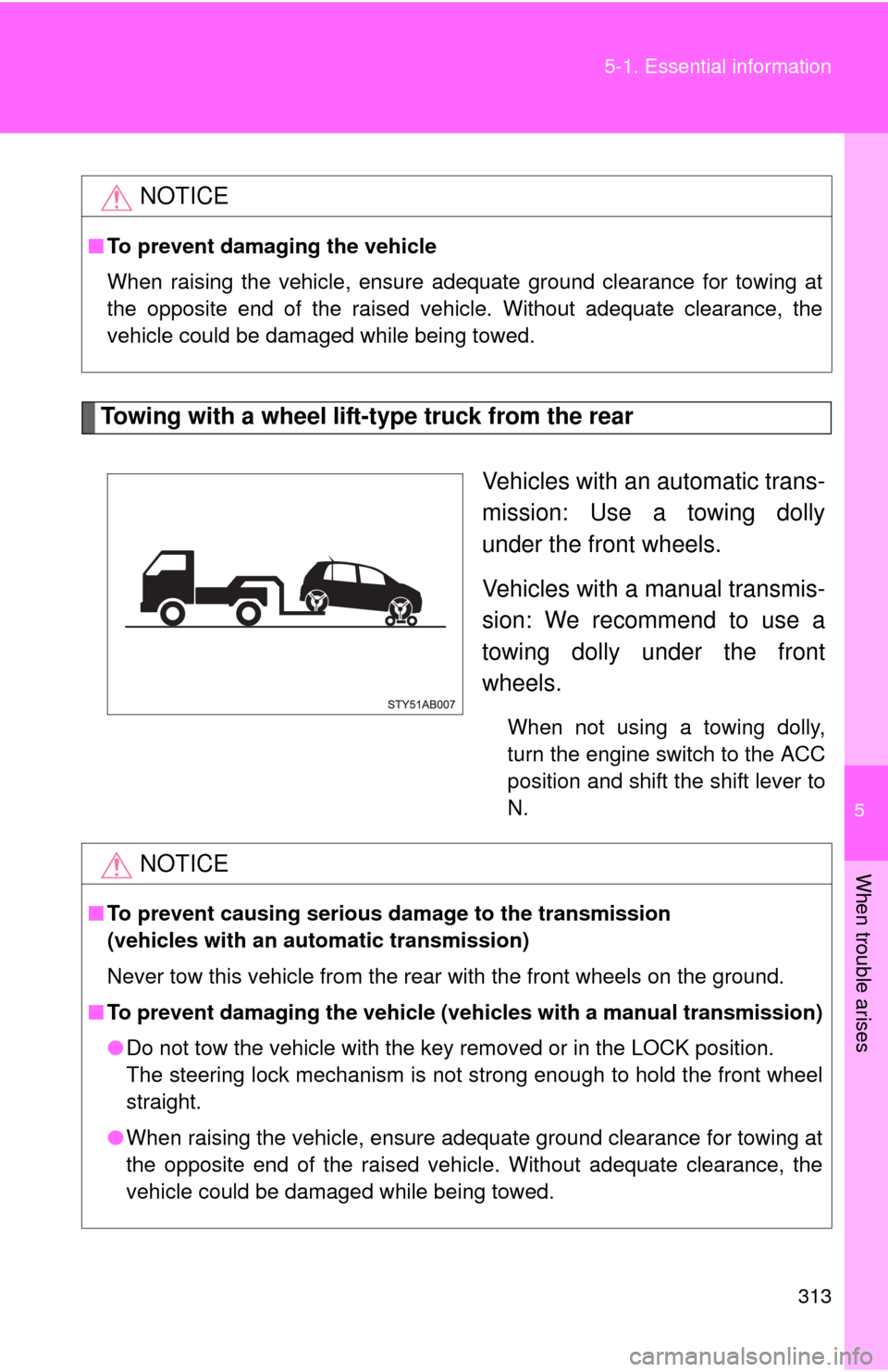
Towing with a wheel lift-type truck from the rear
Vehicles with an automatic trans-
mission: Use a towing dolly
under the front wheels.
Vehicles with a manual transmis-
sion: We recommend to use a
towing dolly under the front
wheels.
When not using a towing dolly,
turn the engine switch to the ACC
position and shift the shift lever to
N.
NOTICE
■To prevent damaging the vehicle
When raising the vehicle, ensure adequate ground clearance for towing at
the opposite end of the raised vehicle. Without adequate clearance, the
vehicle could be damaged while being towed.
NOTICE
■To prevent causing serious da mage to the transmission
(vehicles with an automatic transmission)
Never tow this vehicle from the rear with the front wheels on the ground.
■ To prevent damaging the vehicle (vehicles with a manual transmission)
●Do not tow the vehicle with the key removed or in the LOCK position.
The steering lock mechanism is not strong enough to hold the front wheel
straight.
● When raising the vehicle, ensure adequate ground clearance for towing at
the opposite end of the raised vehicle. Without adequate clearance, the
vehicle could be damaged while being towed.
Page 317 of 416

5
When trouble arises
317
5-1. Essential information
Event data recorder
In a crash or a near car crash eventThe SRS airbag sensor assembly contains the EDR. In a crash or a
near car crash event, this device may record some or all of the follow-
ing information:
● Engine speed
● Whether the brake pedal was applied or not
● Vehicle speed
● To what extent the accelerator pedal was depressed
● Position of the transmission shift lever
● Whether the driver and front passenger wore seat belts or not
● Driver’s seat position
● SRS airbag deployment data
● SRS airbag system diagnostic data
● Front passenger’s occupant classification
The information above is intended to be used for the purpose of
improving vehicle safety performance. Unlike general data recorders,
the EDR does not record sound data such as conversation between
passengers.
Your vehicle has computers that monitor and control certain aspects
of your vehicle. These computers assi st in driving and maintaining
optimal vehicle performance.
Besides storing data useful for tr oubleshooting, there is an event
data recorder (EDR) that records data in a crash or a near car
crash event.