Page 331 of 416
5
When trouble arises
331
5-2. Steps to take in an emergency
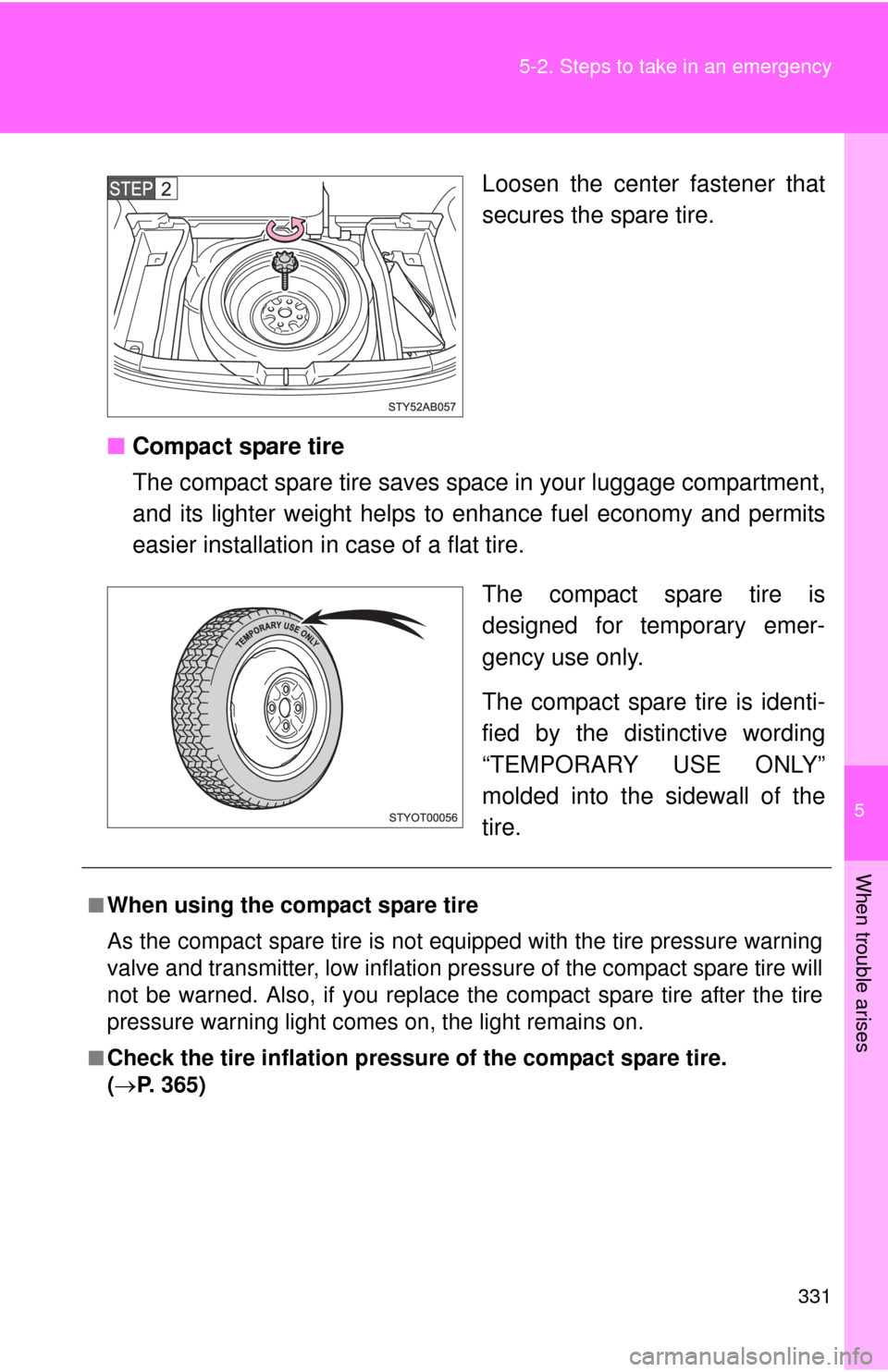
Loosen the center fastener that
secures the spare tire.
■ Compact spare tire
The compact spare tire saves space in your luggage compartment,
and its lighter weight helps to enhance fuel economy and permits
easier installation in case of a flat tire.
The compact spare tire is
designed for temporary emer-
gency use only.
The compact spare tire is identi-
fied by the distinctive wording
“TEMPORARY USE ONLY”
molded into the sidewall of the
tire.
■When using the compact spare tire
As the compact spare tire is not equipped with the tire pressure warning
valve and transmitter, low inflation pr essure of the compact spare tire will
not be warned. Also, if you replace the compact spare tire after the tire
pressure warning light comes on, the light remains on.
■Check the tire inflation pressure of the compact spare tire.
( P. 365)
Page 333 of 416
5
When trouble arises
333
5-2. Steps to take in an emergency
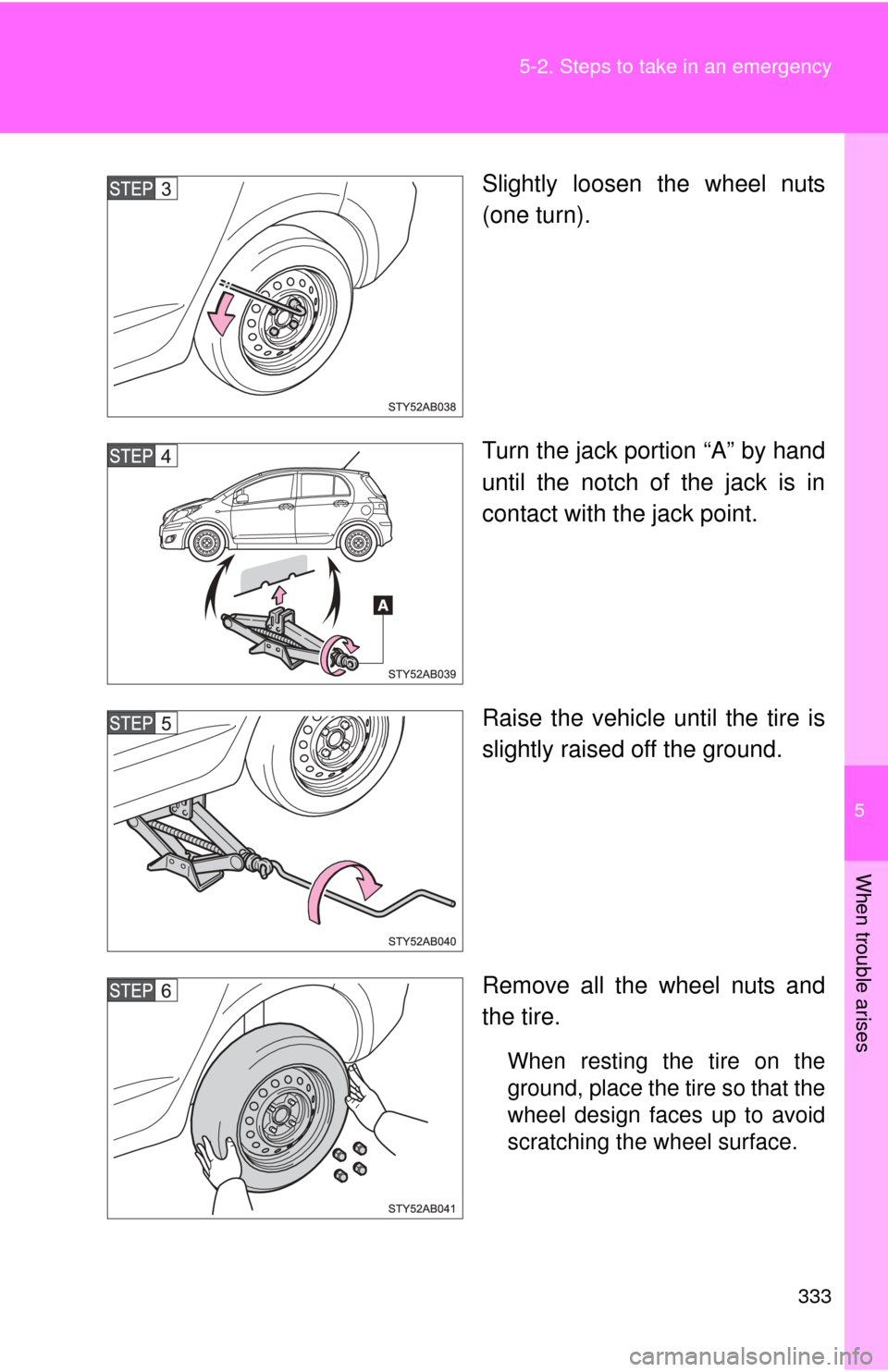
Slightly loosen the wheel nuts
(one turn).
Turn the jack portion “A” by hand
until the notch of the jack is in
contact with the jack point.
Raise the vehicle until the tire is
slightly raised off the ground.
Remove all the wheel nuts and
the tire.
When resting the tire on the
ground, place the tire so that the
wheel design faces up to avoid
scratching the wheel surface.
Page 341 of 416
5
When trouble arises
341
5-2. Steps to take in an emergency
If the engine will not star t
If the engine still does not start after following the correct starting
procedure ( P. 130) or releasing the steering lock (P. 131), confirm
the following points.
■ The engine will not start even when the starter motor oper-
ates normally.
One of the following may be the cause of the problem.
●There may not be sufficient fuel in the vehicle’s tank.
Refuel the vehicle.
● The engine may be flooded.
Try to restart the engine once more following correct starting
procedures. ( P. 130)
● Vehicles with engine immobilizer system: There may be a
malfunction in the engine immobilizer system.
( P. 7 8 )
■ The starter motor turns over slowly, the interior lights and
headlights are dim, or the horn does not sound or sounds at
a low volume.
One of the following may be the cause of the problem.
●The battery may be discharged. ( P. 345)
● The battery terminal connec tions may be loose or corroded.
Page 342 of 416
342 5-2. Steps to take in an emergency
■The starter motor does not turn over, the interior lights and
headlights do not turn on, or the horn does not sound.
One of the following may be the cause of the problem.
● One or both of the battery terminals may be disconnected.
● The battery may be discharged. ( P. 345)
Contact your Toyota dealer if the problem cannot be repaired, or if
repair procedures are unknown.
Page 346 of 416
346 5-2. Steps to take in an emergency
Connecting the jumper cablesPositive (+) battery terminal on your vehicle
Positive (+) battery terminal on the second vehicle
Negative (-) battery terminal on the second vehicle
Connect the jumper cable to ground on your vehicle as shown in
the illustration. Start the engine of the second vehicle. Increase the engine
speed slightly and maintain at that level for approximately 5
minutes to recharge the battery of your vehicle.
Maintain the engine speed of the second vehicle and start
the vehicle's engine.
Once the vehicle’s engine has started, remove the jumper
cables in the exact reverse order in which they were con-
nected.
Page 347 of 416

5
When trouble arises
347
5-2. Steps to take in an emergency
■
Starting the engine when the battery is discharged (vehicles with an
automatic transmission)
The engine cannot be started by push-starting.
■ Avoiding a discharged battery
●Turn off the headlights and the audio system while the engine is turned
off.
● Turn off any unnecessary electrical components when the vehicle is run-
ning at a low speed for an extended period, such as in heavy traffic, etc.
CAUTION
■Avoiding battery fires or explosions
Observe the following precautions to prevent accidentally igniting the flam-
mable gas that may be emitted from the battery.
●Make sure the jumper cable is connected to the correct terminal and that it
is not unintentionally in contact with any part other than the intended termi-
nal.
● Do not allow the jumper cables to come into contact with the “+” and “-” ter-
minals.
● Do not smoke, use matches, cigarette lighters or allow open flame near
the battery.
Reinstall the cover.
Once the engine starts, have the vehicle checked at your Toyota
dealer as soon as possible.
Page 349 of 416
5
When trouble arises
349
5-2. Steps to take in an emergency
If your vehicle overheats
If your engine overheats:
Stop the vehicle in a safe place and turn off the air condi-
tioning system.
Check to see if steam is coming out from under the hood.
If you see steam: Stop the engine. Carefully lift the hood after the steam
subsides and then restart the engine.
If you do not see steam: Leave the engine running and carefully lift the hood.
Check to see if the cooling fan is operating.
If the fan is operating: Wait until the high engine coolant temperature warning
light goes off and then stop the engine.
If the fan is not operating: Stop the engine immediately and call your local Toyota
dealer.
Page 351 of 416
5
When trouble arises
351
5-2. Steps to take in an emergency
■
Overheating
If you observe the following, your vehicle may be overheating.
●The high engine coolant temperature warning light flashes or comes on
or a loss of power is experienced.
● Steam is coming from under the hood.
CAUTION
■To prevent an accident or injury when inspecting under the hood of
your vehicle
●If steam is seen coming from under the hood, do not open the hood until
the steam has subsided. The engine compartment may be very hot, caus-
ing serious injury such as burns.
● Keep hands and clothing away from the fan and other belts while the
engine is running.
● Do not loosen the radiator cap while the engine and radiator are hot.
Serious injury, such as burns, may result from hot coolant and steam
released under pressure.
NOTICE
■When adding engine coolant
Wait until the engine has cooled down before adding engine coolant.
When adding coolant, do so slowly. Adding cool coolant to a hot engine too
quickly can cause damage to the engine.