2011 TOYOTA VERSO S height
[x] Cancel search: heightPage 448 of 664
4485-6. Driving tips
Specific design characteristics
give it a higher center of gravity
than ordinary passenger cars.
This vehicle design feature
causes this type of vehicle to be
more likely to rollover. And, utility
vehicles have a significantly
higher rollover rate than other
types of vehicles.
An advantage of the higher
ground clearance is a better view
of the road allowing you to antici-
pate problems.
It is not designed for cornering at
the same speeds as ordinary
passenger cars any more than
low-slung sports cars are
designed to perform satisfactorily
under off-road conditions. There-
fore, sharp turns at excessive
speeds may cause the vehicle to
rollover.
When driving your vehicle off-road,
please observe the following pre-
Utility vehicle precau-
tions
This vehicle belongs to the
utility vehicle class, which has
higher ground clearance and
narrower tread in relation to
the height of its center of grav-
ity to make it capable of per-
forming in a wide variety of off-
road applications.
Utility vehicle feature
WARNING
■Utility vehicle precautions
Always observe the following precau-
tions to minimize the risk of death, serious injury or damage to your vehi-cle:
●In a rollover crash, an unbelted per-son is significantly more likely to die than a person wearing a seat belt.
Therefore, the driver and all pas- sengers should always fasten their seat belts.
●Avoid sharp turns or abrupt maneu-vers, if at all possible.
Failure to operate this vehicle cor- rectly may result in loss of control or vehicle rollover causing death or
serious injury.
●Loading cargo on the roof luggage
carrier (if equipped) will make the center of the vehicle gravity higher. Avoid high speeds, sudden starts,
sharp turns, sudden braking or abrupt maneuvers, otherwise it may result in loss of control or vehicle
rollover due to failure to operate this vehicle correctly.
●Always slow down in gusty cross-winds. Because of its profile and higher center of gravity, your vehi-
cle is more sensitive to side winds than an ordinary passenger car. Slowing down will allow you to have
better control.
●Do not drive horizontally across
steep slopes. Driving straight up or straight down is preferred. Your vehicle (or any similar off-road vehi-
cle) can tip over sideways much more easily than forward or back-ward.
Off-road driving
Page 532 of 664
5327-3. Do-it-yourself maintenance
Left-hand drive vehicles
1Turn the power switch off.
Confirm that the charging connector is
not connected. Also, do not use the
Remote Air Conditioning System during
the procedure.
2Open the front passenger’s
door.
By keeping the door open, unexpected
operation of the Remote Air Condition-
ing System can be prevent. (P.460)
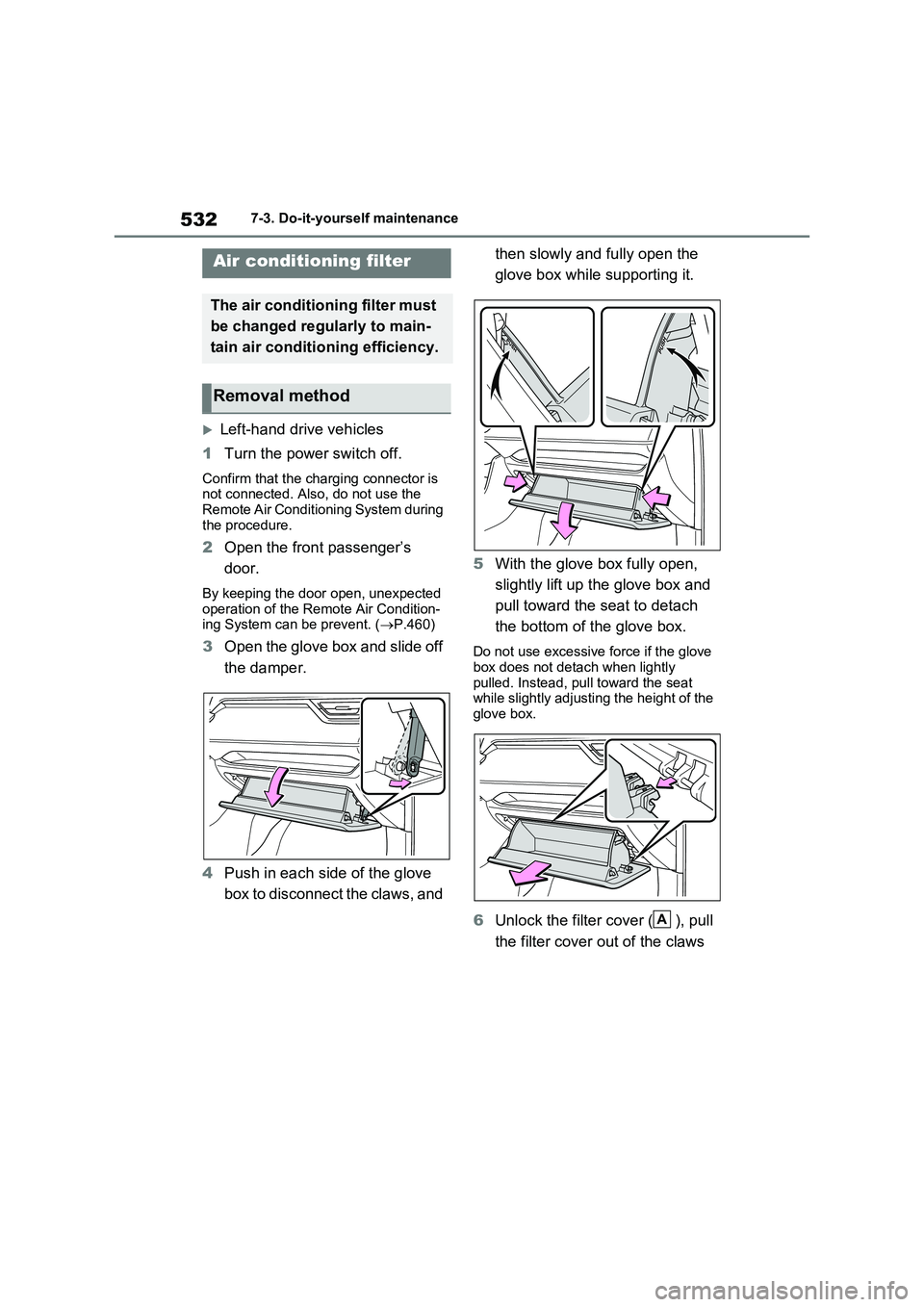
3Open the glove box and slide off
the damper.
4Push in each side of the glove
box to disconnect the claws, and then slowly and fully open the
glove box while supporting it.
5With the glove box fully open,
slightly lift up the glove box and
pull toward the seat to detach
the bottom of the glove box.Do not use excessive force if the glove
box does not detach when lightly
pulled. Instead, pull toward the seat
while slightly adjusting the height of the
glove box.
6Unlock the filter cover ( ), pull
the filter cover out of the claws
Air conditioning filter
The air conditioning filter must
be changed regularly to main-
tain air conditioning efficiency.
Removal method
A
Page 534 of 664
5347-3. Do-it-yourself maintenance
pull toward the seat to detach
the bottom of the glove box.
Do not use excessive force if the glove
box does not detach when lightly pulled. Instead, pull toward the seat while slightly adjusting the height of the
glove box.
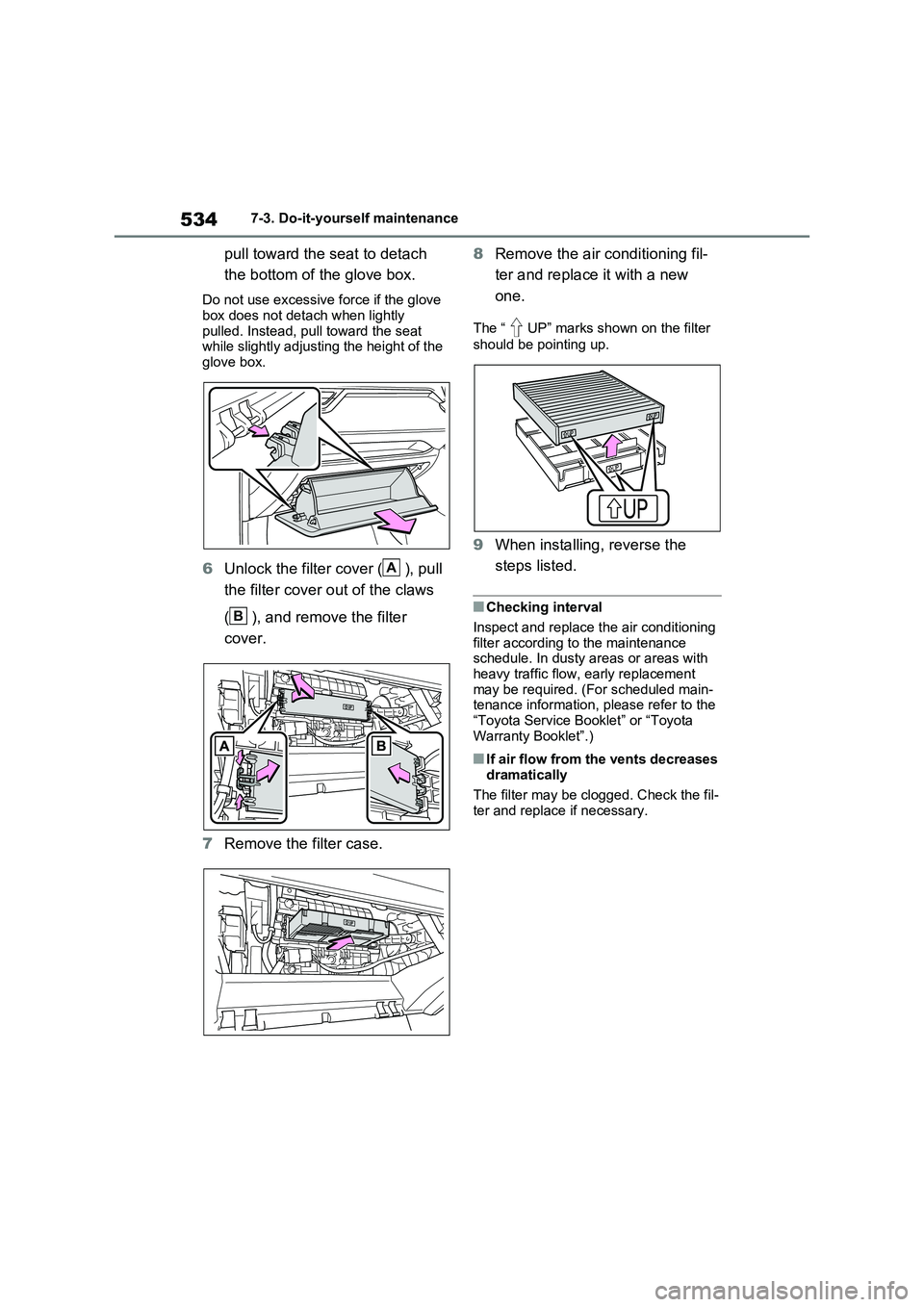
6 Unlock the filter cover ( ), pull
the filter cover out of the claws
( ), and remove the filter
cover.
7 Remove the filter case.
8 Remove the air conditioning fil-
ter and replace it with a new
one.
The “ UP” marks shown on the filter
should be pointing up.
9 When installing, reverse the
steps listed.
■Checking interval
Inspect and replace the air conditioning filter according to the maintenance schedule. In dusty areas or areas with
heavy traffic flow, early replacement may be required. (For scheduled main-tenance information, please refer to the
“Toyota Service Booklet” or “Toyota Warranty Booklet”.)
■If air flow from the vents decreases dramatically
The filter may be clogged. Check the fil- ter and replace if necessary.
A
B
Page 595 of 664
595
8
8-2. Steps to take in an emergency
When trouble arises
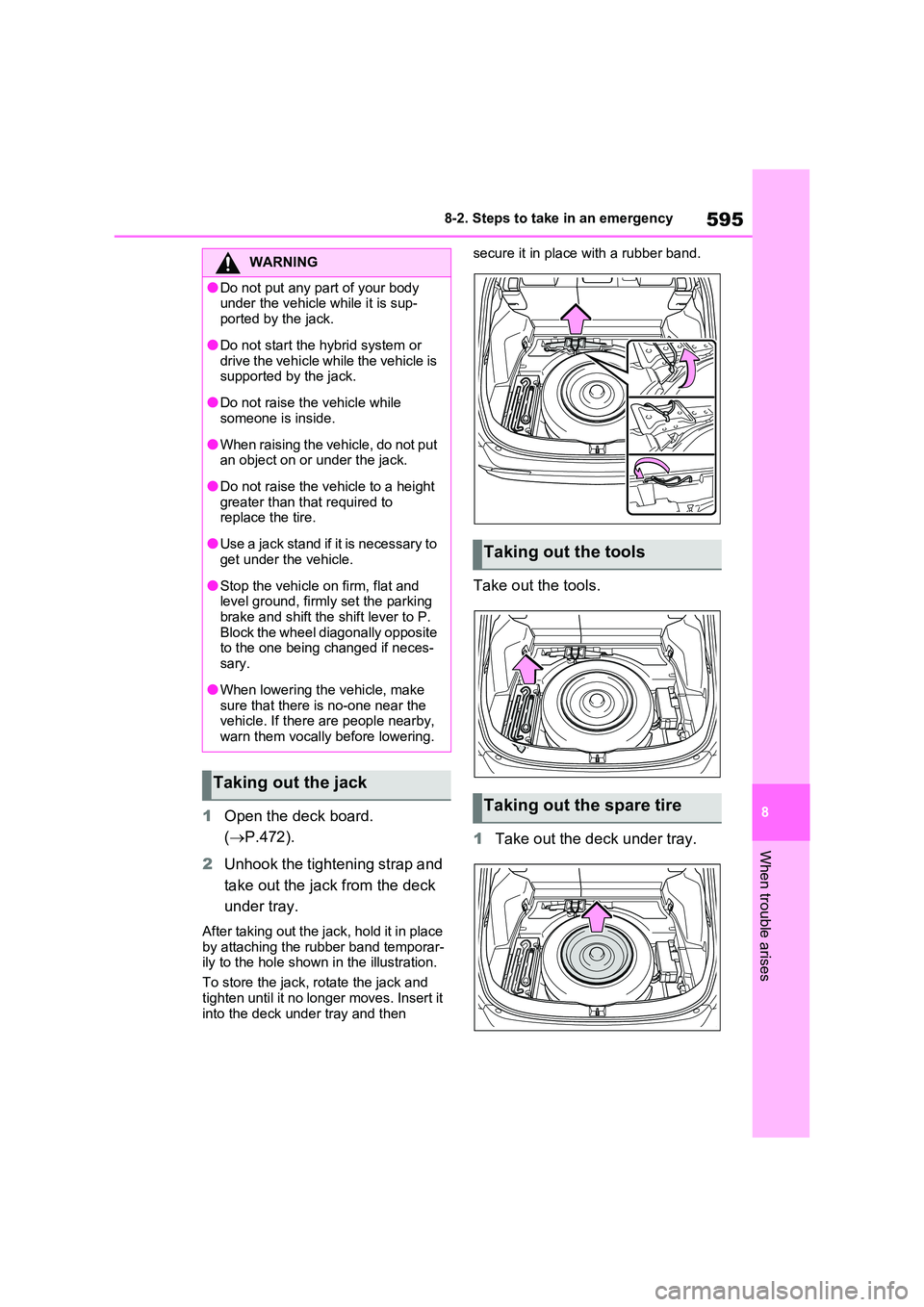
1 Open the deck board.
( P.472).
2 Unhook the tightening strap and
take out the jack from the deck
under tray.
After taking out the jack, hold it in place
by attaching the rubber band temporar- ily to the hole shown in the illustration.
To store the jack, rotate the jack and
tighten until it no longer moves. Insert it into the deck under tray and then
secure it in place with a rubber band.
Take out the tools.
1 Take out the deck under tray.
WARNING
●Do not put any part of your body under the vehicle while it is sup-
ported by the jack.
●Do not start the hybrid system or
drive the vehicle while the vehicle is supported by the jack.
●Do not raise the vehicle while someone is inside.
●When raising the vehicle, do not put an object on or under the jack.
●Do not raise the vehicle to a height greater than that required to replace the tire.
●Use a jack stand if it is necessary to get under the vehicle.
●Stop the vehicle on firm, flat and level ground, firmly set the parking
brake and shift the shift lever to P. Block the wheel diagonally opposite to the one being changed if neces-
sary.
●When lowering the vehicle, make
sure that there is no-one near the vehicle. If there are people nearby, warn them vocally before lowering.
Taking out the jack
Taking out the tools
Taking out the spare tire
Page 598 of 664
5988-2. Steps to take in an emergency
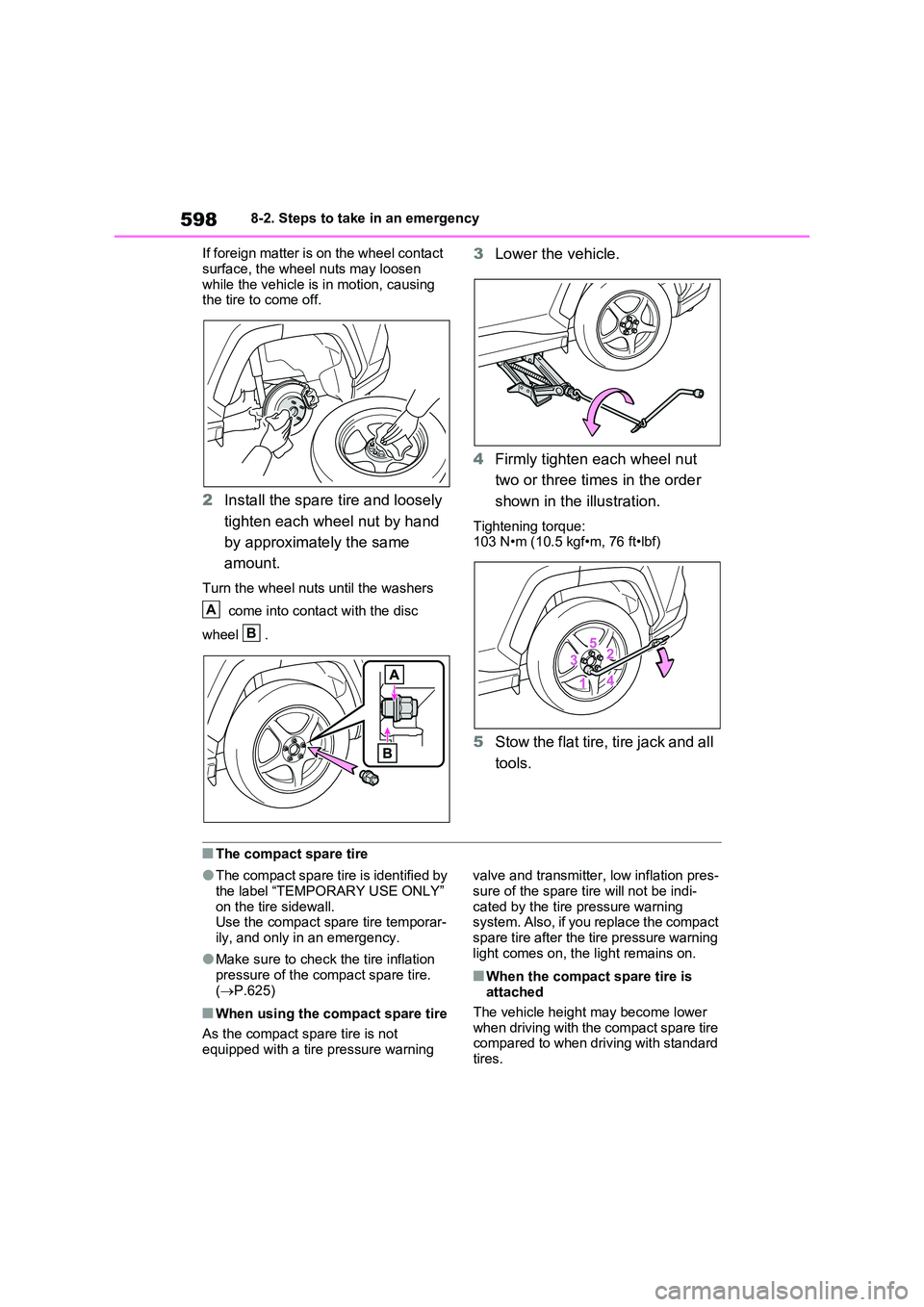
If foreign matter is on the wheel contact
surface, the wheel nuts may loosen while the vehicle is in motion, causing the tire to come off.
2 Install the spare tire and loosely
tighten each wheel nut by hand
by approximately the same
amount.
Turn the wheel nuts until the washers
come into contact with the disc
wheel .
3 Lower the vehicle.
4 Firmly tighten each wheel nut
two or three times in the order
shown in the illustration.
Tightening torque: 103 N•m (10.5 kgf•m, 76 ft•lbf)
5 Stow the flat tire, tire jack and all
tools.
■The compact spare tire
●The compact spare tire is identified by
the label “TEMPORARY USE ONLY” on the tire sidewall.Use the compact spare tire temporar-
ily, and only in an emergency.
●Make sure to check the tire inflation
pressure of the compact spare tire. ( P.625)
■When using the compact spare tire
As the compact spare tire is not
equipped with a tire pressure warning
valve and transmitter, low inflation pres-
sure of the spare tire will not be indi- cated by the tire pressure warning system. Also, if you replace the compact
spare tire after the tire pressure warning light comes on, the light remains on.
■When the compact spare tire is attached
The vehicle height may become lower when driving with the compact spare tire compared to when driving with standard
tires.
A
B
Page 600 of 664

6008-2. Steps to take in an emergency
WARNING
■When using the compact spare tire
●Remember that the compact spare tire provided is specifically designed for use with your vehicle.
Do not use your compact spare tire on another vehicle.
●Do not use more than one compact spare tire simultaneously.
●Replace the compact spare tire with a standard tire as soon as possible.
●Avoid sudden acceleration, abrupt steering, sudden braking and shift-ing operations that cause sudden
engine braking.
■When the compact spare tire is
attached
The vehicle speed may not be cor- rectly detected, and the following sys-
tems may not operate correctly:
• ABS & Brake assist
• VSC/Trailer Sway Control
•TRC
• Cruise control (if equipped)
• Dynamic radar cruise control with full-speed range (if equipped)
• PCS (Pre-Collision System) (if equipped)
• EPS
• LTA (Lane Tracing Assist) (if
equipped)
• Tire pressure warning system
• AHB (Automatic High Beam) (if equipped)
• BSM (Blind Spot Monitor) (if equipped)
• Rear view monitor system (if equipped)
• Panoramic view monitor (if equipped)
• Toyota parking assist monitor (if equipped)
• Toyota parking assist-sensor (if equipped)
• PKSB (Parking Support Brake) (if equipped)
• Navigation system (if equipped)
Also, not only can the following sys-
tem not be utilized fully, but it may actually negatively affect the drive-train components:
• E-Four (Electronic On-Demand AWD system)
■Speed limit when using the com-pact spare tire
Do not drive at speeds in excess of 80
km/h (50 mph) when a compact spare tire is installed on the vehicle.
The compact spare tire is not
designed for driving at high speeds. Failure to observe this precaution may lead to an accident causing
death or serious injury.
■After using the tools and jack
Before driving, make sure all the tools and jack are securely in place in their storage location to reduce the possi-
bility of personal injury during a colli- sion or sudden braking.
NOTICE
■Be careful when driving over
bumps with the compact spare tire installed on the vehicle
The vehicle height may become lower
when driving with the compact spare tire compared to when driving with standard tires. Be careful when driv-
ing over uneven road surfaces.
Page 618 of 664
6189-1. Specifications
9-1.Spec ific ations
*: Unladen vehicle
■Vehicle identification number
The vehicle identification number
(VIN) is the legal identifier for your
vehicle. This is the primary identifi-
cation number for your Toyota. It is
used in registering the ownership of
your vehicle.
On some models, this number is stamped on the top left of the
instrument panel.
Maintenance data (fuel, oil level, etc.)
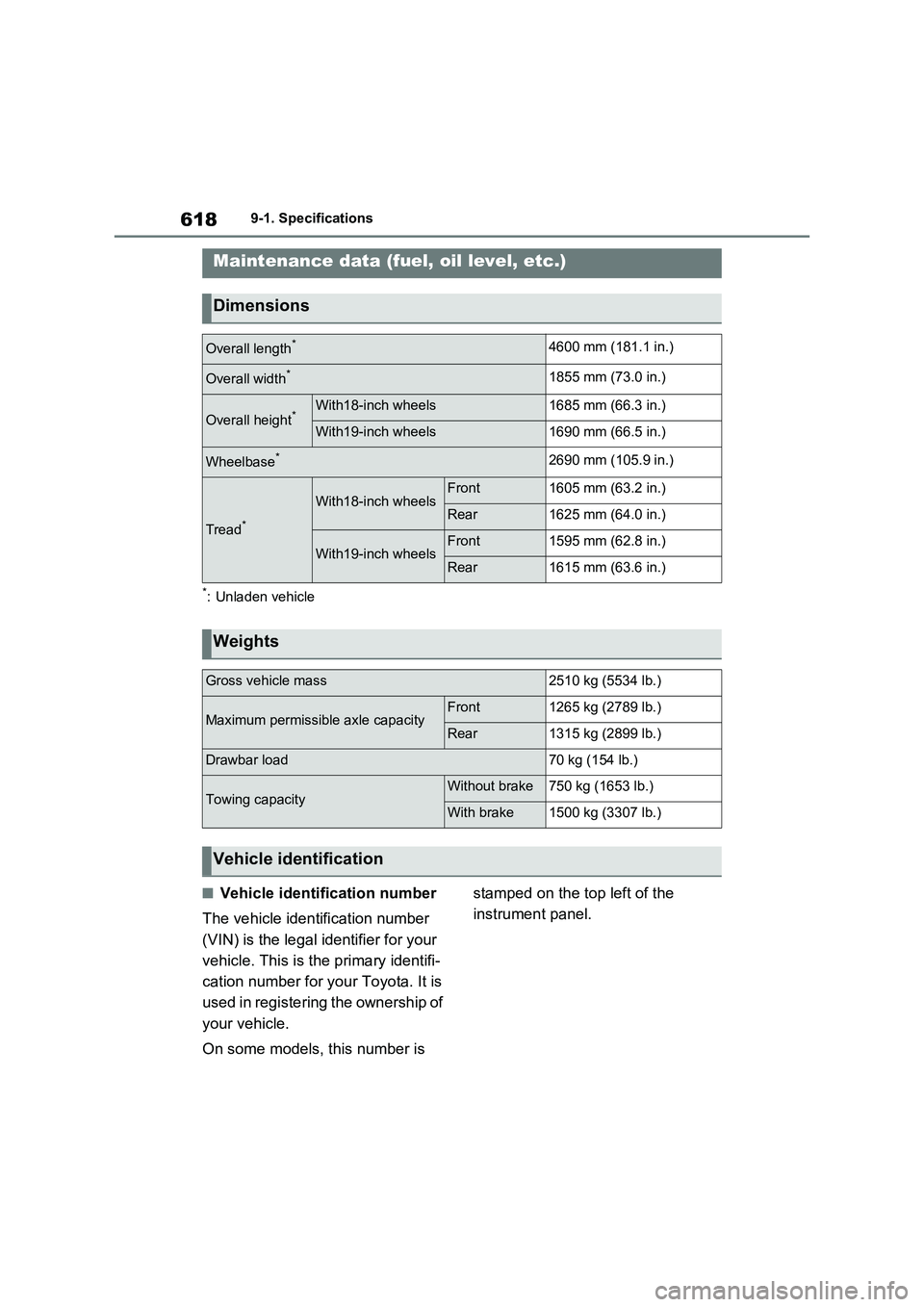
Dimensions
Overall length*4600 mm (181.1 in.)
Overall width*1855 mm (73.0 in.)
Overall height*With18-inch wheels1685 mm (66.3 in.)
With19-inch wheels1690 mm (66.5 in.)
Wheelbase*2690 mm (105.9 in.)
Tread*
With18-inch wheelsFront1605 mm (63.2 in.)
Rear1625 mm (64.0 in.)
With19-inch wheelsFront1595 mm (62.8 in.)
Rear1615 mm (63.6 in.)
Weights
Gross vehicle mass2510 kg (5534 lb.)
Maximum permissible axle capacityFront1265 kg (2789 lb.)
Rear1315 kg (2899 lb.)
Drawbar load70 kg (154 lb.)
Towing capacityWithout brake750 kg (1653 lb.)
With brake1500 kg (3307 lb.)
Vehicle identification
Page 659 of 664

659Alphabetical Index
Inside rear view mirror ............... 279
Outside rear view mirrors ........... 289
Rear window defogger ................. 454
Rear window wiper ....................... 340
Refueling ....................................... 342
Capacity ..................................... 620
Fuel types .................................. 620
If the fuel filler door cannot be
opened..................................... 603
Opening the fuel tank cap .......... 342
Regenerative braking ..................... 90
Remote Air Conditioning System 460
Replacing
Electronic key battery................. 543
Fuses ......................................... 545
Light bulbs.................................. 548
Tires ........................................... 593
Wiper insert ................................ 539
Road accident cautions ................. 96
Road Sign Assist .......................... 372
RSA (Road Sign Assist) ............... 372
S
Seat belt reminder light........ 575, 576
Seat belts ........................................ 35
Adjusting the seat belt shoulder
anchor height ............................. 37
Child restraint system installation 61
Cleaning and maintaining the seat
belt ........................................... 491
Emergency Locking Retractor (ELR)
................................................... 37
How to wear your seat belt .......... 36
How your child should wear the seat
belt ............................................. 36
Pregnant women, proper seat belt
use ............................................. 35
Reminder light and buzzer . 575, 576
Seat belt pretensioners ................ 37
SRS warning light ...................... 570
Seat heaters .................................. 462Seat position memory ..................273
Seats
Adjustment precautions...... 270, 271
Adjustment ......................... 270, 271
Armrest....................................... 484
Cleaning ..................................... 491
Driving position memory............. 273
Folding down the rear seatbacks272
Head restraint.............................276
Properly sitting in the seat ............ 33
Seat heaters ............................... 462
Seat position memory ................ 273
Seat ventilators .......................... 462
Seat ventilators .............................462
Secondary Collision Brake .......... 439
Sensor
Automatic headlight system ....... 332
Automatic High Beam system .... 334
BSM (Blind Spot Monitor)........... 408
Digital Rear-view Mirror.............. 283
Front camera .............................. 344
Humidity sensor ......................... 459
Inside rear view mirror................ 279
Intrusion sensor and tilt sensor .... 79
LTA (Lane Tracing Assist).......... 362
Parking Support Brake function
(rear-crossing vehicles)............408
Parking Support Brake function
(static objects) .......................... 414
Radar sensor.............................. 344
Rain-sensing windshield wipers .339
RCTA ......................................... 408
Tilt sensor.....................................79
Toyota parking assist-sensor ..... 414
Toyota Safety Sense ..................344
Service plug .................................... 94
Shift lever ...................................... 321
If the shift lever cannot be shifted
from P ...................................... 323
Shift lock system .......................... 323
Side airbags .................................... 39