2011 TOYOTA VERSO S charging
[x] Cancel search: chargingPage 88 of 664
882-1. Plug-in hybrid system
be changed even if the AUTO EV/HV
mode switch or EV/HV mode selection switch is pressed. (In this case, the warning message is displayed on the
multi-information display when the switch is pressed.)
●When electricity needed for EV driving is not remaining (when in EV mode or AUTO EV/HV mode)
●When the traction battery is almost completely charged (hybrid battery
[traction battery] charge mode)
■When switching from EV mode to another mode using the switch
●After switching from EV mode to HV
mode or hybrid battery (traction bat- tery) charge mode and the power
switch is turned off, the system returns to EV mode the next time the
vehicle is started.*
●After switching from EV mode to
AUTO EV/HV mode and the power switch is turned off, the system does not return to EV mode the next time
the vehicle is started.*
*: If there is not enough charge remain-
ing in the hybrid battery (traction bat-
tery) to allow EV driving, the system
switches to HV mode.
■Hybrid battery (traction battery) charge mode
●The following may occur to protect the system, etc.• Cannot switch to hybrid battery (trac-
tion battery) charge mode or cannot cancel it• Gasoline engine does not start or
stops even after switching to hybrid battery (traction battery) charge mode
●If a load to the system is large, such as when the power consumption of the air conditioning system is large or
when the temperature of the engine coolant is high, it may take longer time than usual to charge using the hybrid
battery (traction battery) charge mode, or charging to the hybrid bat-tery (traction battery) may not be per-
formed.
■When in EV mode
In EV mode, EV driving (driving
using only the electric motor)* is
possible. However, depending on
the situation, EV driving may be
canceled and both gasoline engine
and electric motor are used
( P.90). Also, if a little electricity is
remaining in the hybrid battery
(traction battery), HV mode is auto-
matically selected. To drive in EV
mode long, observe the followings.
Avoid sudden acceleration and
sudden deceleration, and be
sure to drive smoothly.
If you repeatedly accelerate, the
hybrid battery (traction battery)
WARNING
■When using the hybrid battery (traction battery) charge mode
Observe the following precautions
when using the hybrid battery (trac- tion battery) charge mode while park-ing.
Failure to do so may lead to death or serious health hazard, as the gasoline engine operates when in the hybrid
battery (traction battery) charge mode.
●Do not stop the vehicle near flam-
mable materials.
●Do not use the hybrid battery (trac-
tion battery) charge mode in a closed area where ventilation is insufficient, such as in a garage or
area with snow buildup.
Control when driving in
each mode
Page 89 of 664
89
2 2-1. Plug-in hybrid system
Plug-in hybrid system
charge will deplete quickly. Also,
EV driving may be canceled by
rapid acceleration or vehicle
speed.
Restrain your speed as much as
possible. The distance that can
be driven in EV mode will reduce
considerably at high speeds.
*: The EV driving range can be checked
using the multi-information display.
(P.181)
■When in AUTO EV/HV mode
Only the electric motor is used for
EV driving
* during normal driving,
but when the accelerator pedal is
strongly depressed, the gasoline
engine starts. (P.90)
Also, when the hybrid battery (trac-
tion battery) level is low, the mode
switches to HV mode automatically
the same as in EV mode.
AUTO EV/HV mode is suitable for
driving conditions when more
power is required, such as for driv-
ing uphill or accelerating suddenly.
However, because the gasoline
engine will start more easily, it is
recommended to drive in EV mode
usually.
*: The EV driving range can be checked
using the multi-information display.
(P.181)
■When in HV mode
The vehicle can be used in the
same way as a standard hybrid
vehicle.
In HV mode, controls are primarily carried out as follows in accor-
dance with the driving conditions.
The gasoline engine stops
* when
the vehicle is stopped.
During start off, the electric
motor (traction motor) drives the
vehicle.
During normal driving, the gaso-
line engine and electric motor
(traction motor) are controlled
effectively, and the vehicle is
driven with optimum fuel effi-
ciency. Also, when necessary,
the electric motor (traction
motor) operates as an electrical
generator to charge the hybrid
battery (traction battery).
When the accelerator pedal is
depressed heavily, drive force
from both the gasoline engine
and the electric motor (traction
motor) is used to accelerate.
*: When the hybrid battery (traction bat-
tery) requires charging or the engine
is warming up, etc., the gasoline
engine will not automatically stop.
(P.91)
■When braking (regenerative
braking)
The electric motor (traction motor)
charges the hybrid battery (traction
battery).
The EV driving range can be
extended by actively using this
regenerative braking to store elec-
tricity in the hybrid battery (traction
battery).
Page 90 of 664
902-1. Plug-in hybrid system
Moreover, as fuel consumption is
also reduced when in HV mode, the
regenerative braking system can be
used effectively.
■Regenerative braking
In the following situations, kinetic energy
is converted to electric energy and
deceleration force can be obtained in
conjunction with the recharging of the
hybrid battery (traction battery).
●The accelerator pedal is released
while driving with the shift lever in D or
S.
●The brake pedal is depressed while
driving with the shift lever in D or S.
■EV driving range
●The EV driving range is displayed on
the multi-information display.
(P.181)
●The EV driving range changes in
accordance with the charge status of
the hybrid battery (traction battery),
the speed of the vehicle, etc.
●Even if there is enough charge
remaining in the hybrid battery (trac-
tion battery), EV driving may be can-
celed and both gasoline engine and
electric motor are used depending on
the situation. (P.90)
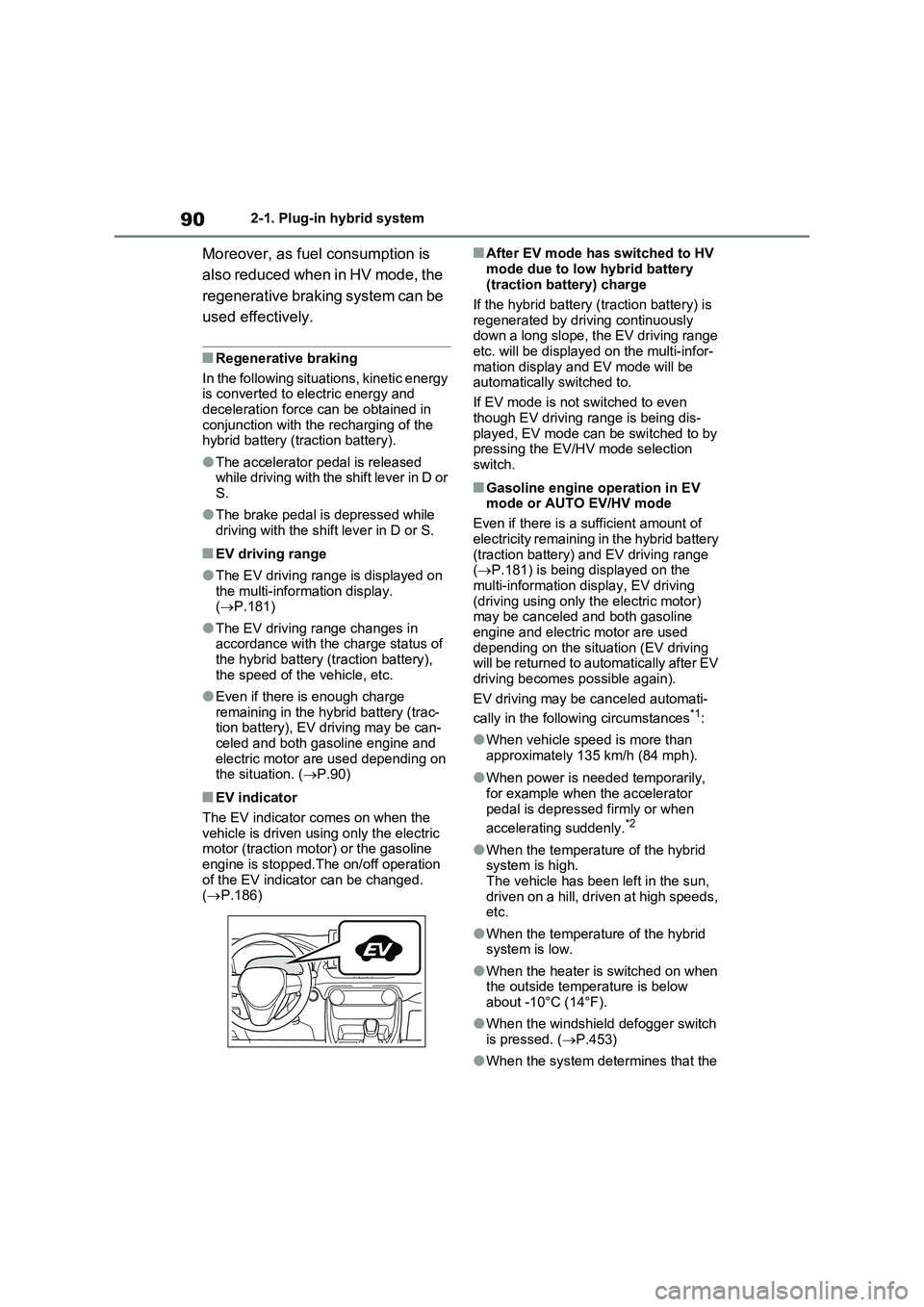
■EV indicator
The EV indicator comes on when the
vehicle is driven using only the electric
motor (traction motor) or the gasoline
engine is stopped.The on/off operation
of the EV indicator can be changed.
(P.186)
■After EV mode has switched to HV
mode due to low hybrid battery
(traction battery) charge
If the hybrid battery (traction battery) is
regenerated by driving continuously
down a long slope, the EV driving range
etc. will be displayed on the multi-infor-
mation display and EV mode will be
automatically switched to.
If EV mode is not switched to even
though EV driving range is being dis-
played, EV mode can be switched to by
pressing the EV/HV mode selection
switch.
■Gasoline engine operation in EV
mode or AUTO EV/HV mode
Even if there is a sufficient amount of
electricity remaining in the hybrid battery
(traction battery) and EV driving range
(P.181) is being displayed on the
multi-information display, EV driving
(driving using only the electric motor)
may be canceled and both gasoline
engine and electric motor are used
depending on the situation (EV driving
will be returned to automatically after EV
driving becomes possible again).
EV driving may be canceled automati-
cally in the following circumstances
*1:
●When vehicle speed is more than
approximately 135 km/h (84 mph).
●When power is needed temporarily,
for example when the accelerator
pedal is depressed firmly or when
accelerating suddenly.
*2
●When the temperature of the hybrid
system is high.
The vehicle has been left in the sun,
driven on a hill, driven at high speeds,
etc.
●When the temperature of the hybrid
system is low.
●When the heater is switched on when
the outside temperature is below
about -10°C (14°F).
●When the windshield defogger switch
is pressed. (P.453)
●When the system determines that the
Page 91 of 664

91
2 2-1. Plug-in hybrid system
Plug-in hybrid system
gasoline engine needs to be started.*1: The gasoline engine may also oper-
ate in circumstances other than those
listed above, depending on condi-
tions.
*2: When driving in AUTO EV/HV mode.
Even in EV mode, the gasoline
engine may start, depending on the
condition of the hybrid battery (trac-
tion battery).
■If “Engine Started to Protect Sys-
tem EV driving unavailable” is dis-
played on the multi-information
display
EV driving may be canceled in order to
protect the hybrid system, etc.
In this case, perform driving with the
gasoline engine until EV driving will be
returned to automatically.
■Conditions in which the gasoline
engine may not stop
The gasoline engine starts and stops
automatically. However, it may not stop
automatically in the following condi-
tions
*:
●During gasoline engine warm-up
●During hybrid battery (traction battery)
charging
●When the temperature of the hybrid
battery (traction battery) is high or low
●When the windshield defogger switch
is pressed. (P.453)
*: Depending on the circumstances, the
gasoline engine may also not stop
automatically in situations other than
those above.
■Sounds and vibrations specific to a
hybrid vehicle
There may be no engine sound or vibra-
tion even though the vehicle is able to
move with the “READY” indicator is illu-
minated. For safety, apply the parking
brake and make sure to shift the shift
lever to P when parked.The following sounds or vibrations may
occur when the hybrid system is operat-
ing and are not a malfunction.
●Motor sounds may be heard from the
engine compartment.
●Sounds may be heard from the hybrid
battery (traction battery) when the
hybrid system starts or stops.
●Relay operating sounds such as a
snap or soft clank will be emitted from
the hybrid battery (traction battery),
behind the rear seats, when the hybrid
system is started or stopped.
●Sounds from the hybrid system may
be heard when the back door is open.
●Sounds may be heard from the trans-
mission when the gasoline engine
starts or stops, when driving at low
speeds, or during idling.
●Engine sounds may be heard when
accelerating sharply.
●Sounds may be heard due to regener-
ative braking when the brake pedal is
depressed or as the accelerator pedal
is released.
●Vibration may be felt when the gaso-
line engine starts or stops.
●Cooling fan sounds may be heard
from the air intake vent under the rear
seat. (P.98)
●Sounds may be heard from near the
hybrid battery (traction battery) in
accordance with the operation of the
air conditioning system or “Battery
Cooler” (P.129).
■Maintenance, repair, recycling, and
disposal
Contact any authorized Toyota retailer
or Toyota authorized repairer, or any
reliable repairer regarding mainte-
nance, repair, recycling and disposal.
Do not dispose of the vehicle yourself.
In order to make EV mode or AUTO
EV/HV mode available, charge the
Charging (P.105)
Page 92 of 664
922-1. Plug-in hybrid system
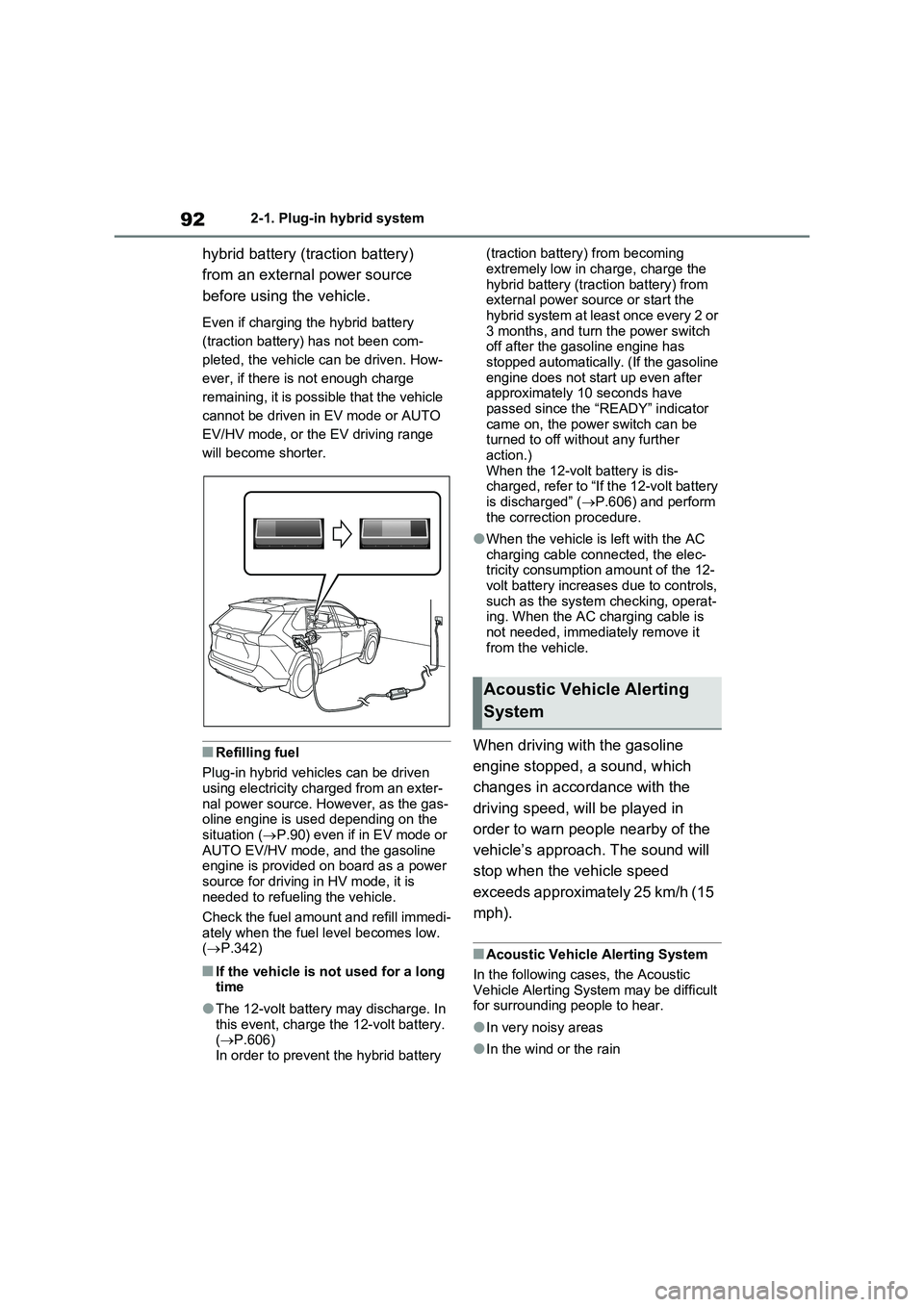
hybrid battery (traction battery)
from an external power source
before using the vehicle.
Even if charging the hybrid battery
(traction battery) has not been com-
pleted, the vehicle can be driven. How-
ever, if there is not enough charge
remaining, it is possible that the vehicle
cannot be driven in EV mode or AUTO
EV/HV mode, or the EV driving range
will become shorter.
■Refilling fuel
Plug-in hybrid vehicles can be driven
using electricity charged from an exter- nal power source. However, as the gas-oline engine is used depending on the
situation ( P.90) even if in EV mode or AUTO EV/HV mode, and the gasoline engine is provided on board as a power
source for driving in HV mode, it is needed to refueling the vehicle.
Check the fuel amount and refill immedi-
ately when the fuel level becomes low. ( P.342)
■If the vehicle is not used for a long time
●The 12-volt battery may discharge. In
this event, charge the 12-volt battery. ( P.606) In order to prevent the hybrid battery
(traction battery) from becoming
extremely low in charge, charge the hybrid battery (traction battery) from external power source or start the
hybrid system at least once every 2 or 3 months, and turn the power switch off after the gasoline engine has
stopped automatically. (If the gasoline engine does not start up even after approximately 10 seconds have
passed since the “READY” indicator came on, the power switch can be turned to off without any further
action.) When the 12-volt battery is dis-charged, refer to “If the 12-volt battery
is discharged” ( P.606) and perform the correction procedure.
●When the vehicle is left with the AC charging cable connected, the elec-tricity consumption amount of the 12-
volt battery increases due to controls, such as the system checking, operat-ing. When the AC charging cable is
not needed, immediately remove it from the vehicle.
When driving with the gasoline
engine stopped, a sound, which
changes in accordance with the
driving speed, will be played in
order to warn people nearby of the
vehicle’s approach. The sound will
stop when the vehicle speed
exceeds approximately 25 km/h (15
mph).
■Acoustic Vehicle Alerting System
In the following cases, the Acoustic
Vehicle Alerting System may be difficult for surrounding people to hear.
●In very noisy areas
●In the wind or the rain
Acoustic Vehicle Alerting
System
Page 94 of 664
942-1. Plug-in hybrid system
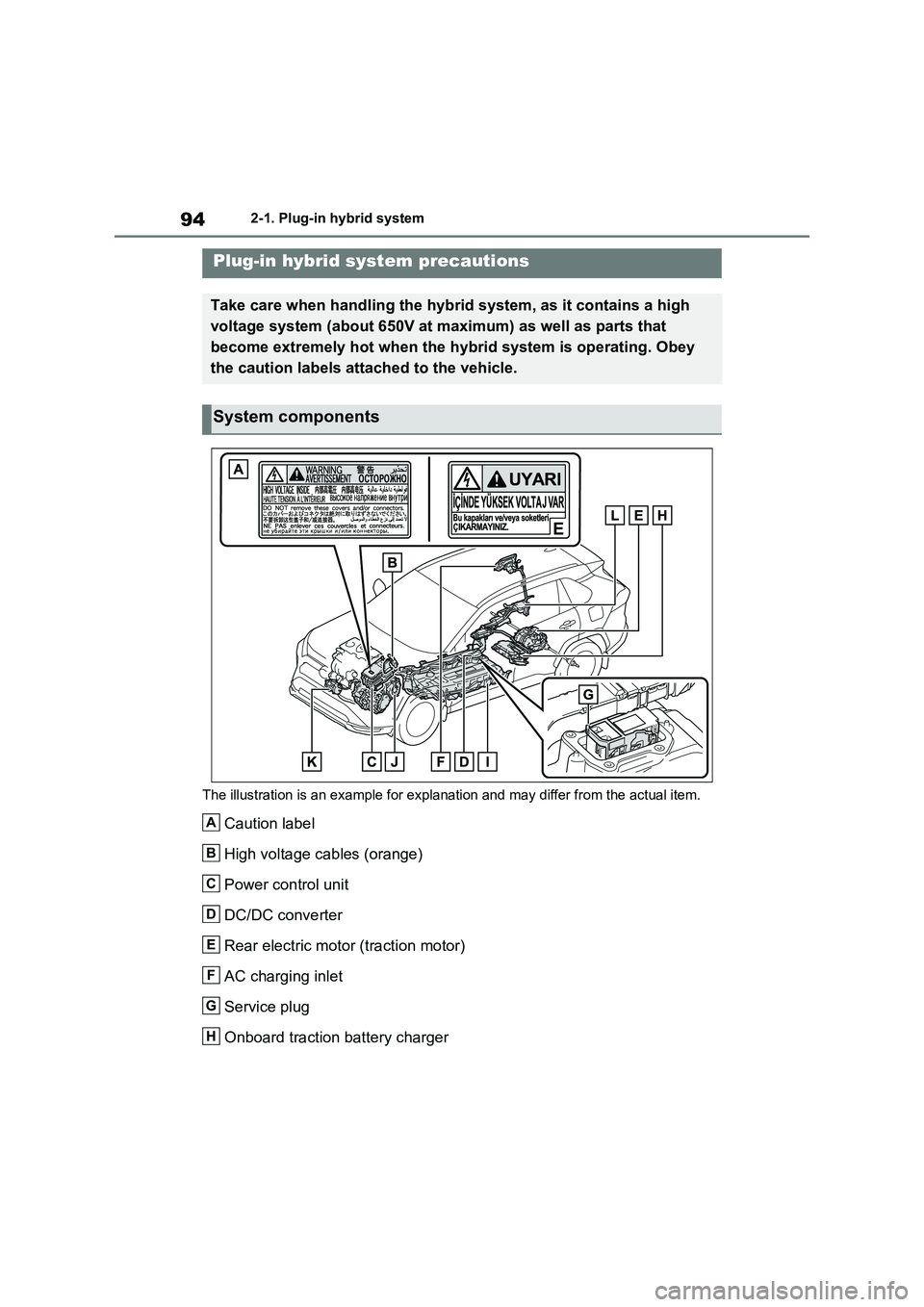
The illustration is an example for explanation and may differ from the actual item.
Caution label
High voltage cables (orange)
Power control unit
DC/DC converter
Rear electric motor (traction motor)
AC charging inlet
Service plug
Onboard traction battery charger
Plug-in hybrid system precautions
Take care when handling the hybrid system, as it contains a high
voltage system (about 650V at maximum) as well as parts that
become extremely hot when the hybrid system is operating. Obey
the caution labels attached to the vehicle.
System components
A
B
C
D
E
F
G
H
Page 100 of 664
1002-1. Plug-in hybrid system
Shift the shift lever to D when
stopped at a traffic light, or driving
in heavy traffic etc. Shift the shift
lever to P when parking. When
using the N, there is no positive
effect on fuel consumption. In the
N, the gasoline engine operates but
electricity cannot be generated.
Also, when using the air condition-
ing system, etc., the hybrid battery
(traction battery) power is con-
sumed.
Drive your vehicle smoothly.
Avoid abrupt acceleration and
deceleration. Gradual accelera-
tion and deceleration will make
more effective use of the electric
motor (traction motor) without
having to use gasoline engine
power.
Avoid repeated acceleration.
Repeated acceleration con-
sumes hybrid battery (traction
battery) power, resulting in poor
fuel consumption. Battery power
can be restored by driving with
the accelerator pedal slightly
released.
Make sure to operate the brakes
gently and a timely manner. A greater amount of electrical energy
can be regenerated when slowing
down.
Repeated acceleration and decel-
eration, as well as long waits at traf-
fic lights, will lead to high fuel and
electricity consumption. Check traf-
fic reports before leaving and avoid
delays as much as possible. When
driving in a traffic jam, gently
release the brake pedal to allow the
vehicle to move forward slightly
while avoiding overuse of the accel-
erator pedal. Doing so can help
control excessive electricity and
fuel consumption.
Control and maintain the vehicle
at a constant speed. Before stop-
ping at a toll booth or similar,
allow plenty of time to release
the accelerator and gently apply
the brakes. A greater amount of
electrical energy can be regener-
ated when slowing down.
Electricity consumption will
increase significantly when driv-
ing at high speeds in EV mode or
AUTO EV/HV mode. If there will
be a long distance to the next
external charging point after
leaving a freeway, it is recom-
mended to drive in HV mode
while on the freeway and change
Shift lever operation
Accelerator pedal/brake
pedal operation
When braking
Delays
Highway driving
Page 101 of 664
101
2 2-1. Plug-in hybrid system
Plug-in hybrid system
to EV mode or AUTO EV/HV
mode after leaving the freeway.
(P.86)
Turn the “A/C” switch off when it
is not needed. Doing so can help
reduce excessive electricity and
fuel consumption.
In summer: When the ambient tem-
perature is high, use the recirculated air
mode. Doing so will help to reduce the
burden on the air conditioning system
and reduce electricity and fuel con-
sumption as well.
In winter: Avoid excessive and unnec-
essary use of the heater. Usage of the
heated steering wheel (if equipped)
(P.462) and seat heaters (P.463)
are effective.
Using the Remote Air Condition-
ing System (P.460) while the
AC charging cable is connected
to the vehicle can reduce elec-
tricity consumption immediately
after starting off by operating air
conditioning mainly using elec-
tricity from an external power
source.
When setting the charging
schedule, setting the charging
mode to “Departure” and “Cli-
mate Prep” to on can reduce
electricity consumption immedi-
ately after starting off by operat-
ing air conditioning before
charging is completed. (P.144)Make sure to check the tire inflation
pressure frequently. If there is
improper tire inflation pressure in
the tires, the EV driving range will
become shorter, and fuel consump-
tion when in HV mode will increase.
Also, as snow tires can cause large
amounts of friction, their use on dry
roads can lead to increased fuel
and electricity consumption.
Carrying heavy luggage will lead to
poor fuel economy. Avoid carrying
unnecessary luggage. Installing a
large roof rack will also cause poor
fuel economy.
Since the gasoline engine starts up
and cuts out automatically, warm-
ing up is not necessary.
Air conditioning
Checking tire inflation pres-
sure
Luggage
Warming up before driving