Page 446 of 588

446 4-3. Do-it-yourself maintenance
VERSO_WE_OM64524E
8ACC 7.5 AShift lock system, audio system,
main body ECU, power outlet
9 MIR HTR 10 A Outside rear view mirror defoggers
10 RR FOG 7.5 A Rear fog light
11 I G N 7 . 5 ASteering lock system, SRS airbag
system, multiport fuel injection sys-
tem/sequential multiport fuel injec-
tion system, automatic
transmission
*1, starting system
12 METER 7.5 A Gauges and meters
13 SEAT HTR
*2 15 A Seat heaters
14 HTR-IG 10 A Air conditioning system
15 WIPER 25 AWindshield wipers, rain-sensing
windshield wipers
16 RR WIPER 15 A Rear window wiper
17 WASHER 15 AWindshield washers, rear window
washer
18 ECU-IG NO.1 10 AMain body ECU, electric cooling
fan(s), shift lock system, anti-lock
brake system, steering sensor,
VSC+, headlight cleaner,
SEQUENTIAL switch, automatic
headlight leveling system, Electric
Power Steering
19 ECU-IG NO.2 10 ABack-up lights, charging system,
emergency flashers, rear window
defogger, front passenger’s seat
belt reminder light, “PASSENGER
AIRBAG” indicator, air conditioning
system, Toyota parking assist-sen-
sor indicator, Toyota parking assist-
sensor switch
20 OBD 7.5 A On-board diagnosis system
FuseAmpereCircuit
Page 464 of 588
464
VERSO_WE_OM64524E
5-1. Essential information
Emergency flashers
NOTICE
To prevent battery discharge
Do not leave the emergency flashers on longer than necessary when the
engine is not running.
Use the emergency flashers if the vehicle malfunctions or is
involved in an accident.
Press the switch to flash all
the turn signal lights. To turn
them off, press the switch
once again.
Page 483 of 588
5
483 5-2. Steps to take in an emergency
When trouble arises
VERSO_WE_OM64524E
(Flashing)Indicates that the
parking brake is still
engaged.
A buzzer sounds to
indicate that parking
brake is still engaged
(with the vehicle hav-
ing reached a speed
of more than 5 km/h [3
mph]).Release the parking
brake.
*1Indicates that the Mul-
tidrive or automatic
transmission fluid
temperature is too
high.
A buzzer also sounds.Stop the vehicle in a
safe place and shift
lever to “P”.
If the light does not go
off, contact any autho-
rized Toyota dealer or
repairer, or another duly
qualified and equipped
professional.
*2
Indicates that engine
oil level is low.
A buzzer also sounds.Check the level of
engine oil, and add if
necessary.
(Flashing)Indicates that the
headlight switch is left
on (with the key
removed and the
driver’s door opened).
A buzzer also sounds.Turn the headlight
switch off.
Warning messageDetailsCorrection procedure
Page 488 of 588
488 5-2. Steps to take in an emergency
VERSO_WE_OM64524E
Once
*1
(Flashing)Indicates that
the shift lever
out of in “P” or
“N” and turned
to the “ENGINE
START STOP”
switch OFF.Turn the
“ENGINE
START STOP”
switch OFF to
after shift the
shift lever to “P”.
Indicates that
the auto power
off function.Start the
engine.
Increase the
engine speed
slightly and
maintain at that
level for approx-
imately 5 min-
utes to recharge
the battery of
your vehicle.
OnceIndicates that
the key battery
is low.Replace the
battery.
*1
(Flashing)Indicates that a
door has been
opened or
closed and the
“ENGINE
START STOP”
switch has been
switched twice to
the ACCES-
SORY mode
from OFF.Press the
“ENGINE
START STOP”
switch while
applying the
brakes.
Interior
buzzerExterior
buzzerWarning messageDetailsCorrection
procedure
Page 512 of 588
512 5-2. Steps to take in an emergency
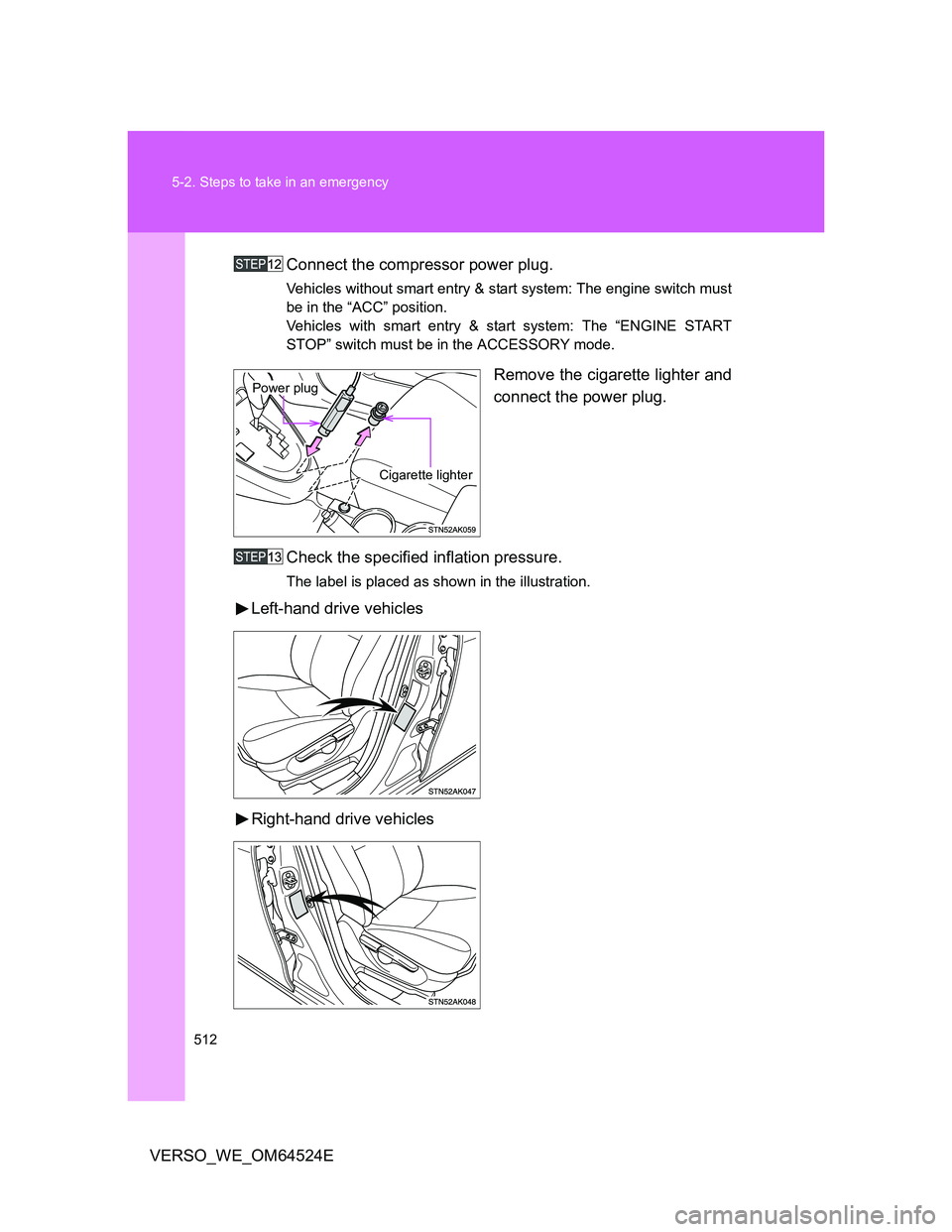
VERSO_WE_OM64524EConnect the compressor power plug.
Vehicles without smart entry & start system: The engine switch must
be in the “ACC” position.
Vehicles with smart entry & start system: The “ENGINE START
STOP” switch must be in the ACCESSORY mode.
Remove the cigarette lighter and
connect the power plug.
Check the specified inflation pressure.
The label is placed as shown in the illustration.
Left-hand drive vehicles
Right-hand drive vehicles
Power plug
Cigarette lighter
Page 520 of 588

520 5-2. Steps to take in an emergency
VERSO_WE_OM64524E
Emergency start function (vehicles with smart entry & start system)
When the engine does not start, the following steps can be used as
an interim measure to start the engine if the “ENGINE START STOP”
switch is functioning normally.
Vehicles with a Multidrive or an automatic transmission
Set the parking brake.
Put the shift lever in “P”.
Set the “ENGINE START STOP” switch to the ACCESSORY
mode.
Press and hold the “ENGINE START STOP” switch about 15
seconds while depressing the brake pedal firmly.
The starter motor does not turn over, the personal/interior
lights and headlights do not turn on, or the horn does not
sound
One of the following may be the cause of the problem.
One or both of the battery terminals may be disconnected.
The battery may be discharged. (P. 528)
There may be a malfunction in the steering lock system. (vehi-
cles with smart entry & start system)
Contact any authorized Toyota dealer or repairer, or another duly
qualified and equipped professional, if the problem cannot be
repaired, or if repair procedures are unknown.
Page 528 of 588
528
5-2. Steps to take in an emergency
VERSO_WE_OM64524E
If the vehicle batter y is discharged
The following procedures may be used to start the engine if the vehi-
cle’s battery is discharged.
You can call any authorized Toyota dealer or repairer, or another duly
qualified and equipped professional.
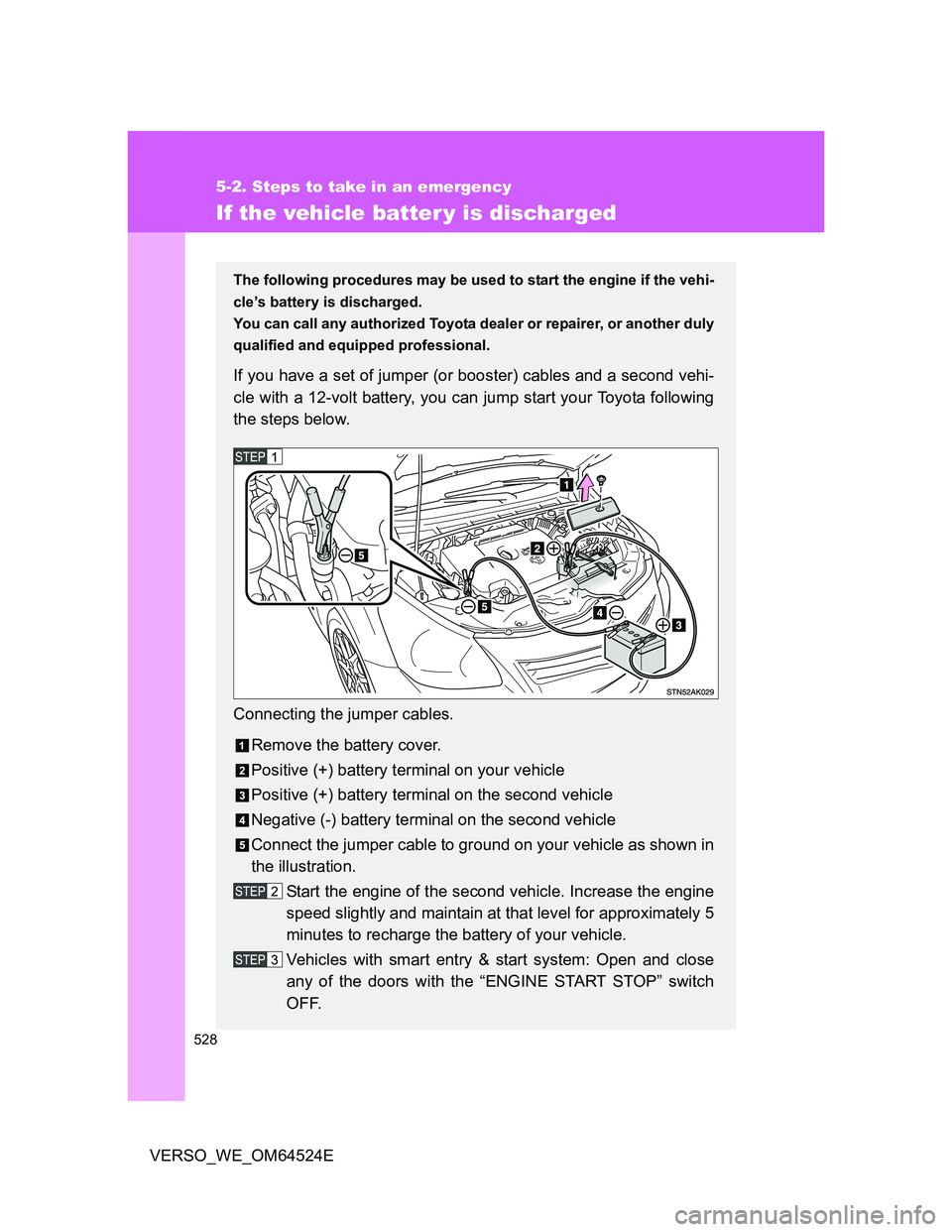
If you have a set of jumper (or booster) cables and a second vehi-
cle with a 12-volt battery, you can jump start your Toyota following
the steps below.
Connecting the jumper cables.
Remove the battery cover.
Positive (+) battery terminal on your vehicle
Positive (+) battery terminal on the second vehicle
Negative (-) battery terminal on the second vehicle
Connect the jumper cable to ground on your vehicle as shown in
the illustration.
Start the engine of the second vehicle. Increase the engine
speed slightly and maintain at that level for approximately 5
minutes to recharge the battery of your vehicle.
Vehicles with smart entry & start system: Open and close
any of the doors with the “ENGINE START STOP” switch
OFF.
Page 529 of 588

5
529 5-2. Steps to take in an emergency
When trouble arises
VERSO_WE_OM64524E
Starting the engine when the battery is discharged (vehicles with a
Multidrive or an automatic transmission)
The engine cannot be started by push-starting.
Avoiding a discharged battery
Turn off the headlights and the audio system while the engine is turned
off.
Turn off any unnecessary electrical components when the vehicle is run-
ning at a low speed for an extended period, such as in heavy traffic, etc.
Charging the battery
The electricity stored in the battery will discharge gradually even when the
vehicle is not in use, due to natural discharge and the draining effects of cer-
tain electrical appliances. If the vehicle is left for a long time, the battery may
discharge, and the engine may be unable to start. (The battery recharges
automatically during driving.)
Vehicles without smart entry & start system: Maintain the
engine speed of the second vehicle and turn the engine
switch to the “ON” position, then start the vehicle’s engine.
Vehicles with smart entry & start system: Maintain the
engine speed of the second vehicle and turn the “ENGINE
START STOP” switch to IGNITION ON mode, then start the
vehicle’s engine.
Once the vehicle’s engine has started, remove the jumper
cables in the exact reverse order in which they were con-
nected.
Once the engine starts, have the vehicle checked at any autho-
rized Toyota dealer or repairer, or another duly qualified and
equipped professional, as soon as possible.