Page 33 of 732
33
1: If equipped
2: Vehicles with multi-information display
3: 4WD models
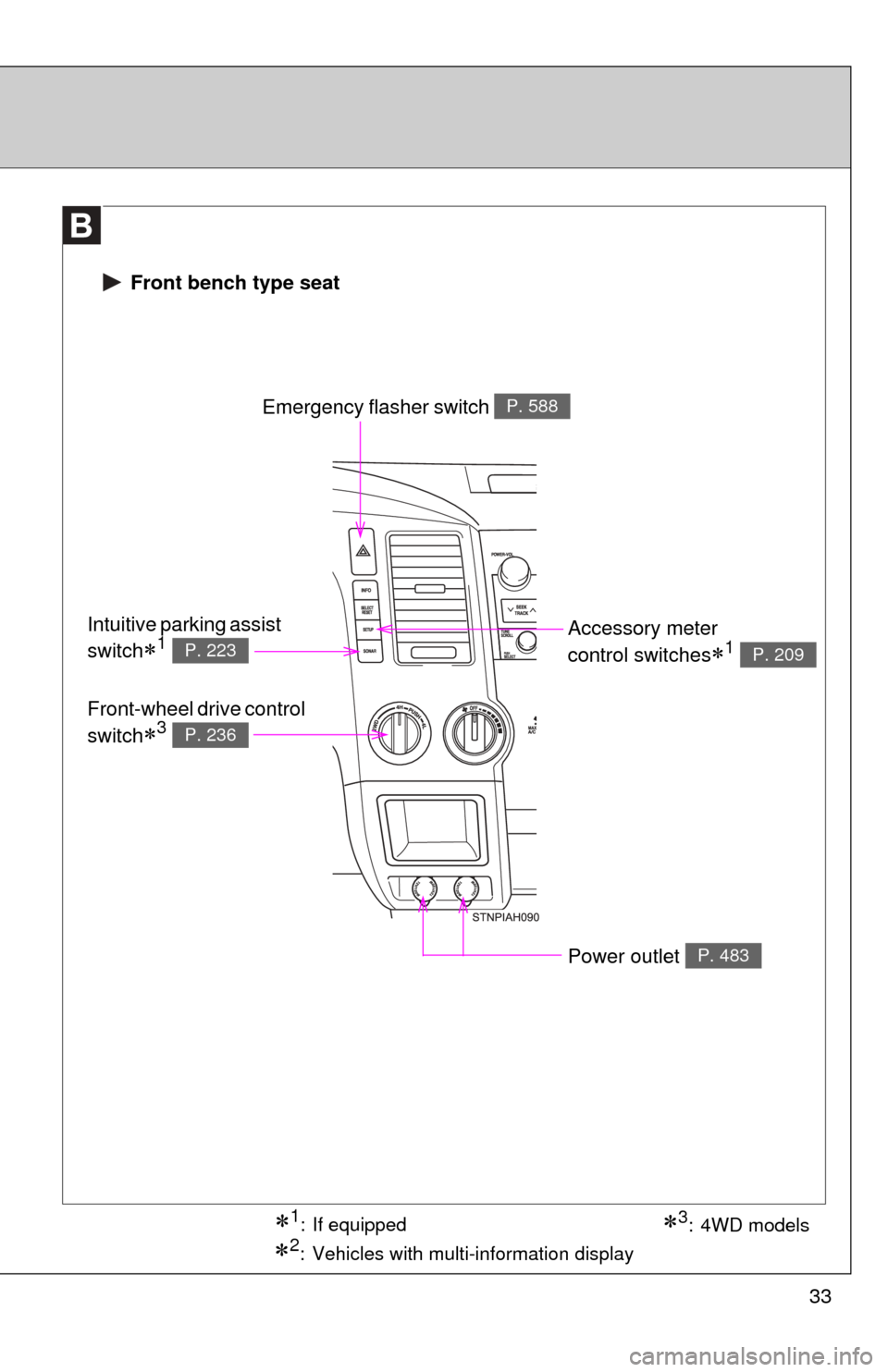
Front bench type seat
Emergency flasher switch P. 588
Accessory meter
control switches
1 P. 209
Intuitive parking assist
switch
1 P. 223
Front-wheel drive control
switch
3 P. 236
Power outlet P. 483
Page 35 of 732
35
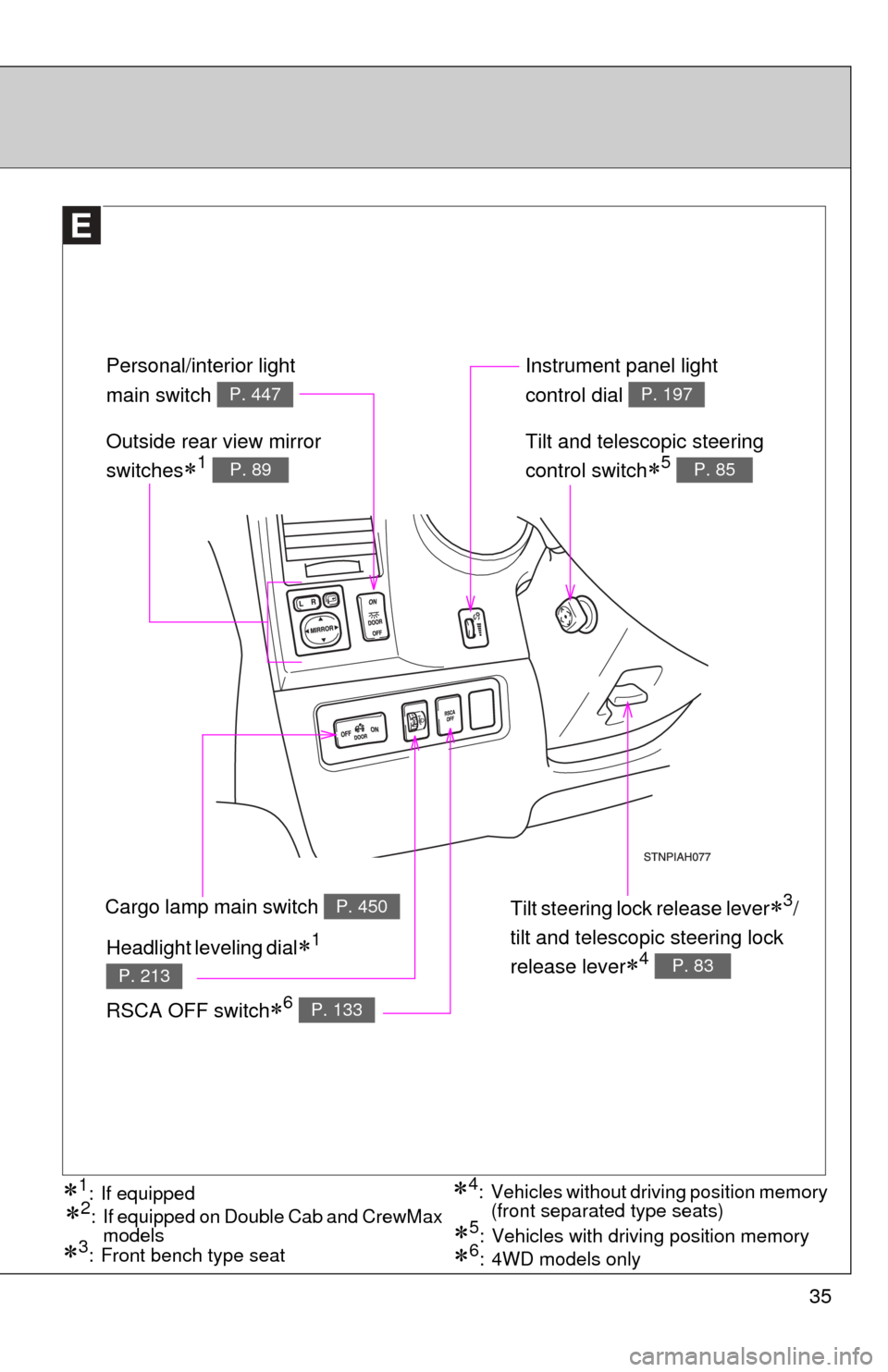
Instrument panel light
control dial
P. 197
Outside rear view mirror
switches
1 P. 89
Tilt steering lock release lever3/
tilt and telescopic steering lock
release lever
4 P. 83
Personal/interior light
main switch
P. 447
Cargo lamp main switch P. 450
RSCA OFF switch6 P. 133
Tilt and telescopic steering
control switch
5 P. 85
1: If equipped
2: If equipped on Double Cab and CrewMax models
3: Front bench type seat
4: Vehicles without driving position memory
(front separated type seats)
5: Vehicles with driving position memory
Headlight leveling dial1
P. 213
6: 4WD models only
Page 121 of 732

121
1-7. Safety information
1
Before driving
Your vehicle is equipped with
ADVANCED AIRBAGS designed based
on US motor vehicle safety standards (FMVSS208). The airbag sys-
tem controls airbag deployment power for the driver and right front
passenger. The driver airbag system consists of the driver seat’s
position sensor etc. The front pass enger’s airbag system consists of
the front passenger occupant classification sensor etc.
The main SRS airbag system components are shown above. The
SRS airbag system is controlled by the airbag sensor assembly. The
airbag sensor assembly consists of a safing sensor and an airbag
sensor.
Front bench type seat: The SRS airbags are designed to protect the
driver and right front passenger, and they are not designed to protect
an occupant in the front center seating position.
In certain types of severe frontal or side impacts, the SRS airbag sys-
tem triggers the airbag inflators. A chemical reaction in the inflators
quickly fills the airbags with non-toxic gas to help rest rain the motion
of the occupants. Side airbags
AIR BAG ON and AIR BAG
OFF indicator lights
Curtain shield airbags
Front passenger airbag
Knee airbags
Side and curtain shield air-
bag sensors
Front airbag sensors
Airbag sensor assembly
Curtain shield airbag sen-
sors (Double Cab and
CrewMax models)
Front passenger’s seat belt
buckle switch
Occupant detection system
(ECU and sensors)
SRS warning light and
RSCA OFF indicator light
RSCA OFF switch
(4WD models only)
Driver’s seat position sen-
sor
Driver airbag
Driver’s seat belt buckle
switch
Passenger airbag off switch
(Regular Cab models)
Page 133 of 732
133
1-7. Safety information
1
Before driving
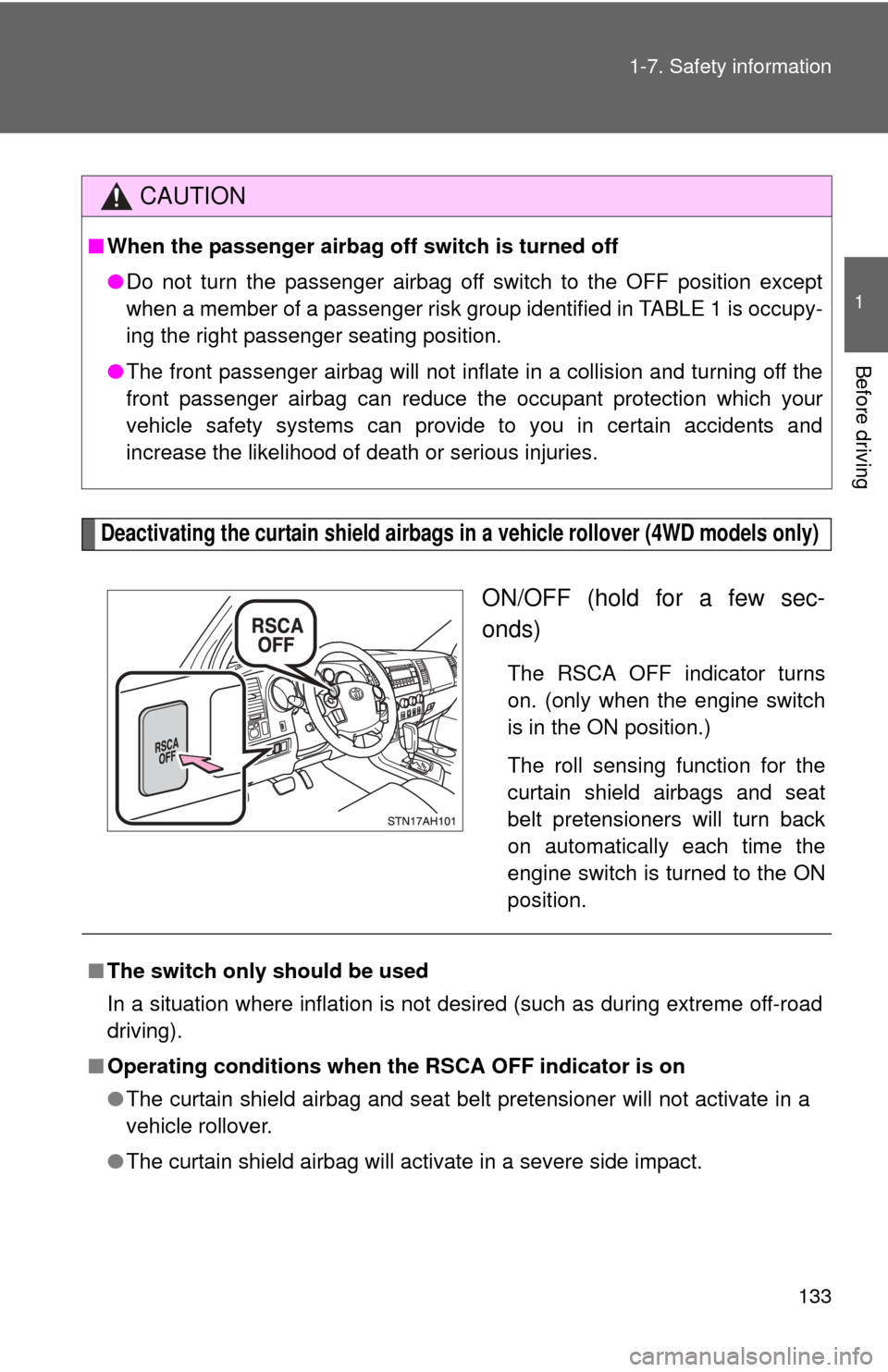
Deactivating the curtain shield airbags in a vehicle rollover (4WD models only)
ON/OFF (hold for a few sec-
onds)
The RSCA OFF indicator turns
on. (only when the engine switch
is in the ON position.)
The roll sensing function for the
curtain shield airbags and seat
belt pretensioners will turn back
on automatically each time the
engine switch is turned to the ON
position.
CAUTION
■
When the passenger airbag of f switch is turned off
● Do not turn the passenger airbag off switch to the OFF position except
when a member of a passenger risk group identified in TABLE 1 is occupy-
ing the right passenger seating position.
● The front passenger airbag will not inflate in a collision and turning off the
front passenger airbag can reduce the occupant protection which your
vehicle safety systems can provide to you in certain accidents and
increase the likelihood of death or serious injuries.
■The switch only should be used
In a situation where inflation is not desired (such as during extreme off-road
driving).
■ Operating conditions when th e RSCA OFF indicator is on
● The curtain shield airbag and seat belt pretensioner will not activate in a
vehicle rollover.
● The curtain shield airbag will activate in a severe side impact.
Page 180 of 732

180 2-1. Driving procedures
NOTICE
■If you hear a squealing or scrapin g noise while driving (brake pad wear
limit indicators)
Have the brake pads checked and replaced by your Toyota dealer as soon
as possible.
The rotor damage can result if the pads are not replaced when needed.
It is dangerous to drive the vehicle when the wear limits of the brake pads
and/or that of the brake discs are exceeded.
■ If you get a flat tire while driving
A flat or damaged tire may cause the following situations. Hold the steering
wheel firmly and gradually press the brake pedal to slow down the vehicle.
●It may be difficult to control your vehicle.
● The vehicle will make abnormal sounds.
● The vehicle will behave abnormally.
Replace a flat tire with a new one. ( P. 612)
■ When encountering flooded roads
Do not drive on a road that has flooded after heavy rain etc. Doing so may
cause the following serious damage to the vehicle.
●Engine stalling
● Short in electrical components
● Engine damage caused by water immersion
In the event that you drive on a flooded road and the vehicle is flooded, be
sure to have your Toyota dealer check the following.
● Brake function
● Changes in quantity and quality of oil and fluid used for the engine, trans-
mission, transfer (4WD models), differentials, etc.
● Lubricant condition for the propeller shaft, bearings and suspension joints
(where possible) and the function of all joints, bearings, etc.
Page 200 of 732
200 2-2. Instrument cluster
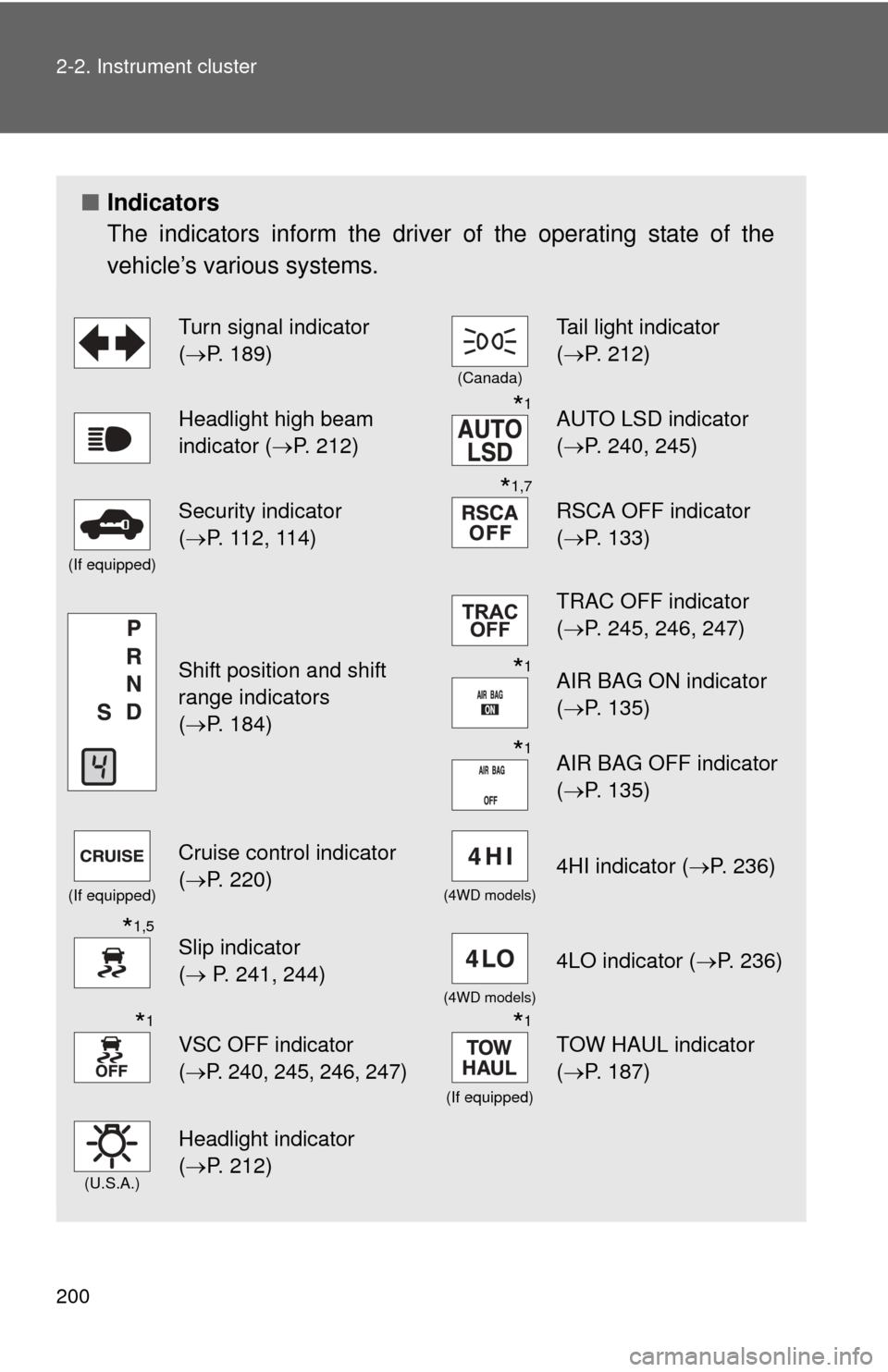
■Indicators
The indicators inform the driver of the operating state of the
vehicle’s various systems.
Turn signal indicator
(P. 189)
(Canada)
Tail light indicator
( P. 212)
Headlight high beam
indicator ( P. 212)*1AUTO LSD indicator
(P. 240, 245)
(If equipped)
Security indicator
(P. 112, 114)*1,7
RSCA OFF indicator
( P. 133)
Shift position and shift
range indicators
(P. 184)
TRAC OFF indicator
( P. 245, 246, 247)
*1AIR BAG ON indicator
(P. 135)
*1AIR BAG OFF indicator
(P. 135)
(If equipped)
Cruise control indicator
(P. 220)
(4WD models)
4HI indicator ( P. 236)
*1,5
Slip indicator
( P. 241, 244)
(4WD models)
4LO indicator ( P. 236)
*1
VSC OFF indicator
(
P. 240, 245, 246, 247)
*1
(If equipped)
TOW HAUL indicator
(P. 187)
(U.S.A.)
Headlight indicator
(P. 212)
Page 240 of 732
240
2-4. Using other driving systems
AUTO LSD system
The AUTO LSD system aids traction by using the traction control
system to control engine performance and braking when one of the
rear wheels begins to spin.
The system should be used only wh en one of the rear wheels spin-
ning occurs in a ditch or rough surface.
■ System operation
The system can be used on 2W D models and in 2WD mode on
4WD models.
The system is activated when dr iving at a speed under 62 mph
(100 km/h).
The AUTO LSD system will be ac tivated with the following two
procedures.
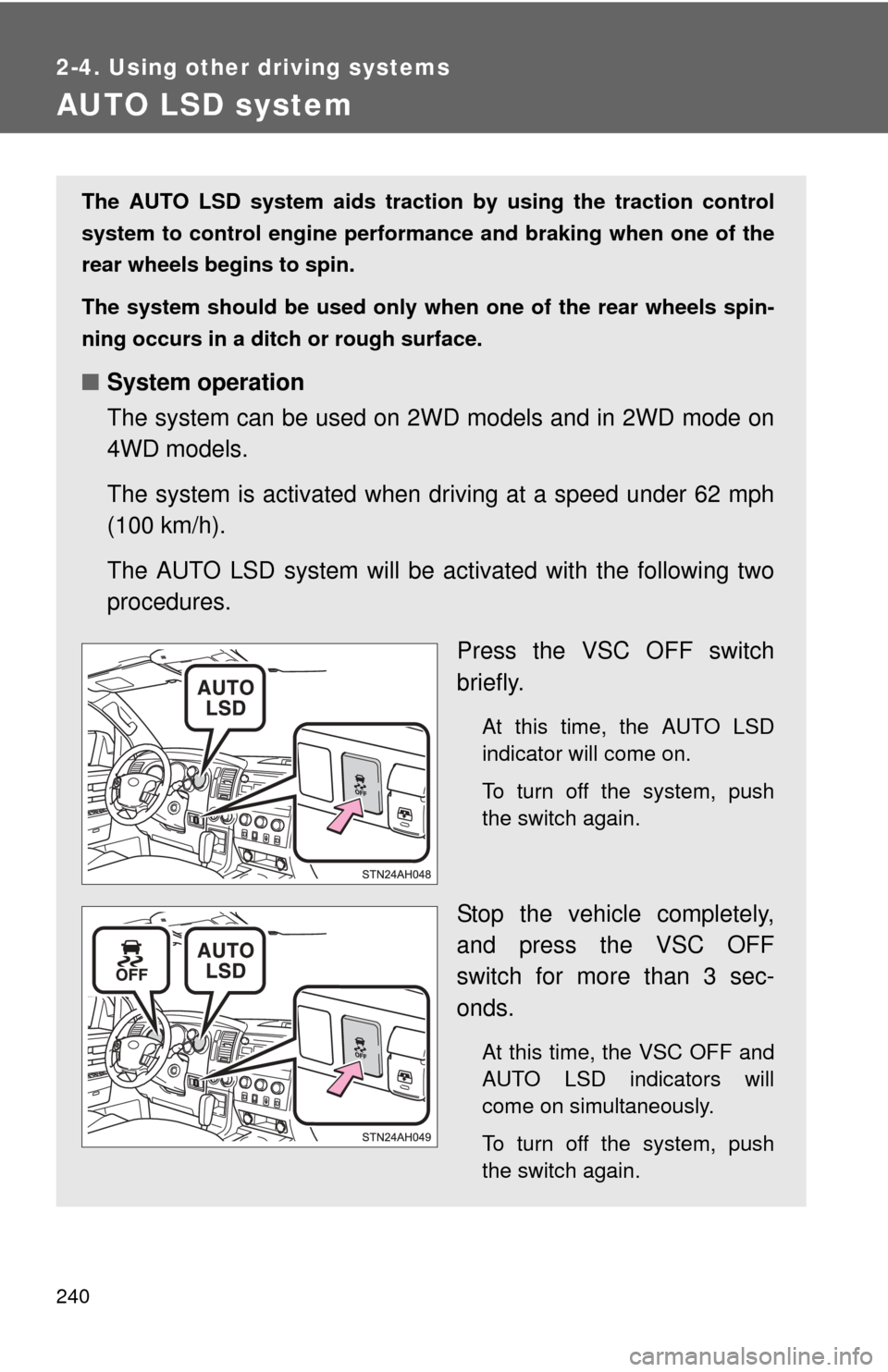
Press the VSC OFF switch
briefly.
At this time, the AUTO LSD
indicator will come on.
To turn off the system, push
the switch again.
Stop the vehicle completely,
and press the VSC OFF
switch for more than 3 sec-
onds.
At this time, the VSC OFF and
AUTO LSD indicators will
come on simultaneously.
To turn off the system, push
the switch again.
Page 243 of 732
243
2-4. Using other driving systems
2
When driving
Driving assist systems
To help enhance driving safety and performance, the following sys-
tems operate automatically in res ponse to various driving situations.
Be aware, however, that these systems are supplementary and
should not be relied upon too heavi ly when operating the vehicle.
■ABS (Anti-lock Brake System)
Helps to prevent wheel lock when the brakes are applied suddenly, or if
the brakes are applied while driving on a slippery road surface.
■Brake Assist
Generates an increased level of braking force after the brake pedal is
depressed, when the system detects a panic stop situation.
■VSC (Vehicle Stability Control)
Helps the driver to control skidding when swerving suddenly or turning
on slippery road surfaces.
■Trailer Sway Control
Helps the driver to control trailer sway by selectively applying brake
pressure for individual wheels and reducing engine torque when trailer
sway is detected.
Trailer Sway Control is part of the VSC system and will not operate if
VSC is turned off or experiences a malfunction.
■ TRAC (Traction Control) for 2WD models and 2WD mode on
4WD models
Maintains drive power and prevents the rear wheels from spinning
when starting the vehicle or accelerating on slippery roads.
■A-TRAC (Active Traction Control) for 4WD mode on 4WD
models
Maintains drive power and prevents all wheels from spinning when
starting the vehicle or accelerating on slippery roads.