Page 609 of 732
5
When trouble arises
609
5-2. Steps to take in an emergency
Follow the correction procedures.
After taking the specified steps to correct the suspected problem,
check that the warning light turns off.
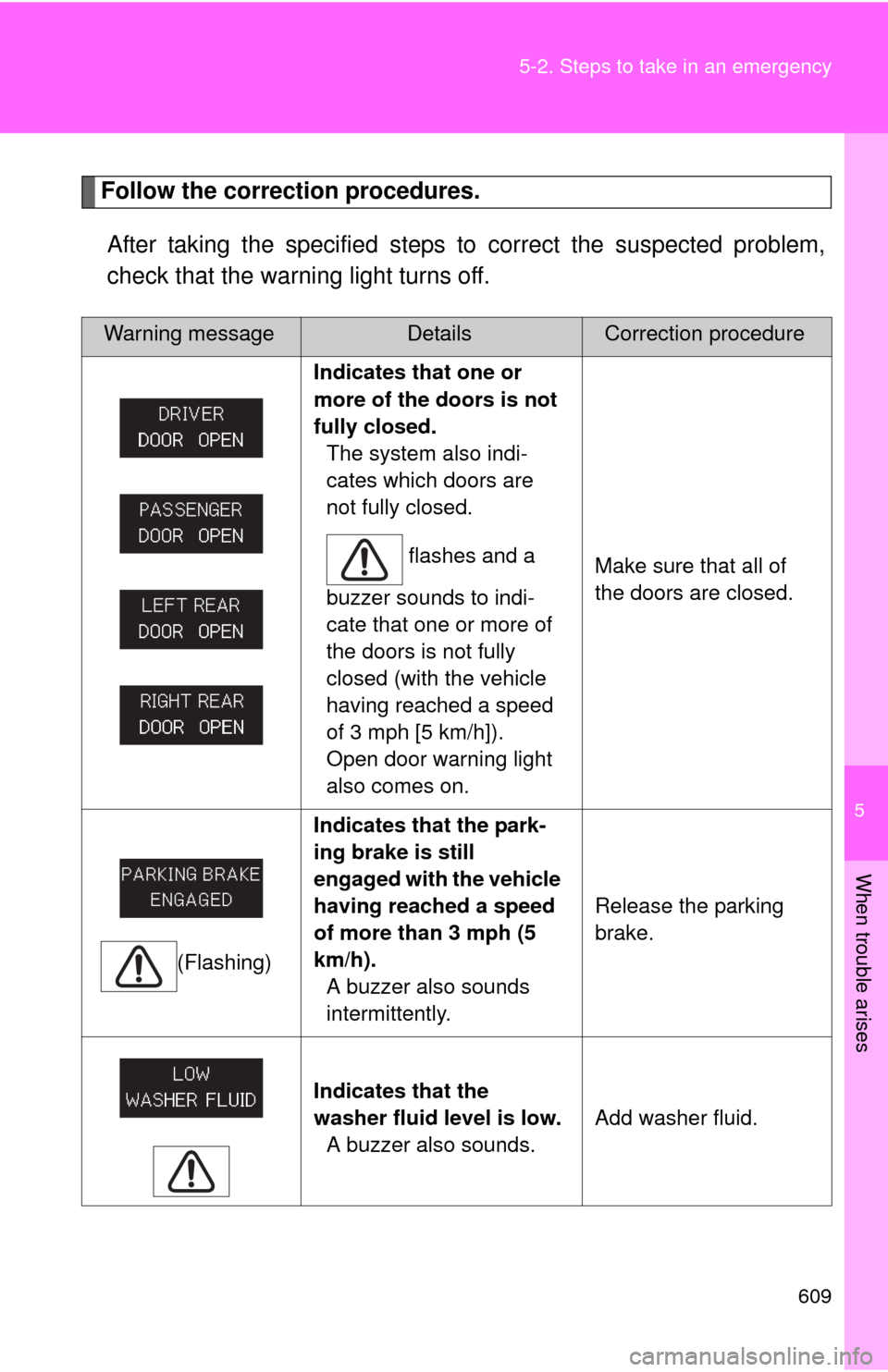
Warning messageDetailsCorrection procedure
Indicates that one or
more of the doors is not
fully closed. The system also indi-
cates which doors are
not fully closed.
flashes and a
buzzer sounds to indi-
cate that one or more of
the doors is not fully
closed (with the vehicle
having reached a speed
of 3 mph [5 km/h]).
Open door warning light
also comes on. Make sure that all of
the doors are closed.
(Flashing) Indicates that the park-
ing brake is still
engaged with the vehicle
having reached a speed
of more than 3 mph (5
km/h).
A buzzer also sounds
intermittently. Release the parking
brake.
Indicates that the
washer fluid level is low. A buzzer also sounds. Add washer fluid.
Page 610 of 732
610 5-2. Steps to take in an emergency
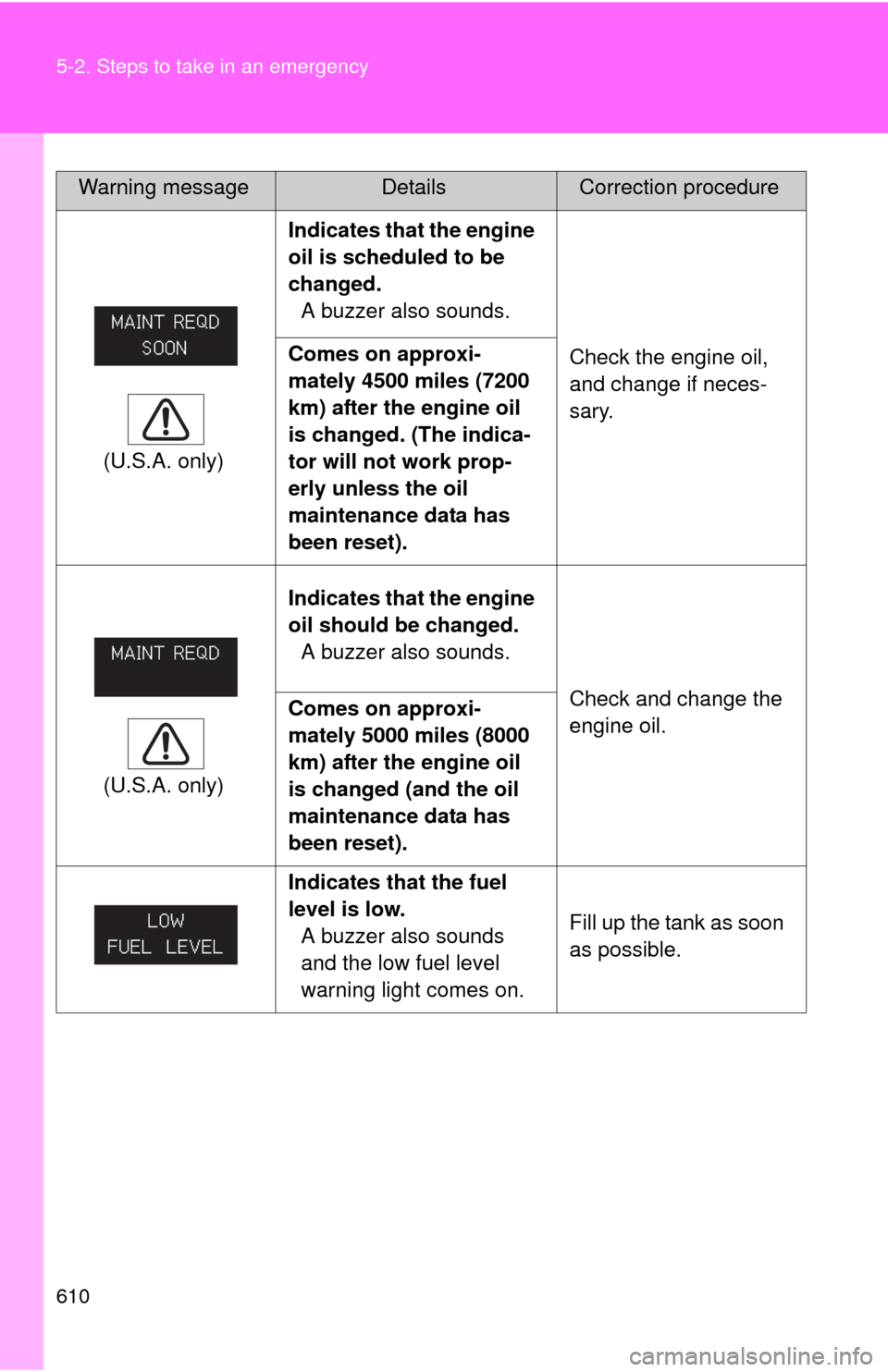
(U.S.A. only)Indicates that the engine
oil is scheduled to be
changed.
A buzzer also sounds.
Check the engine oil,
and change if neces-
sary.
Comes on approxi-
mately 4500 miles (7200
km) after the engine oil
is changed. (The indica-
tor will not work prop-
erly unless the oil
maintenance data has
been reset).
(U.S.A. only) Indicates that the engine
oil should be changed.
A buzzer also sounds.
Check and change the
engine oil.
Comes on approxi-
mately 5000 miles (8000
km) after the engine oil
is changed (and the oil
maintenance data has
been reset).
Indicates that the fuel
level is low.
A buzzer also sounds
and the low fuel level
warning light comes on. Fill up the tank as soon
as possible.
Warning messageDetailsCorrection procedure
Page 624 of 732
624 5-2. Steps to take in an emergency
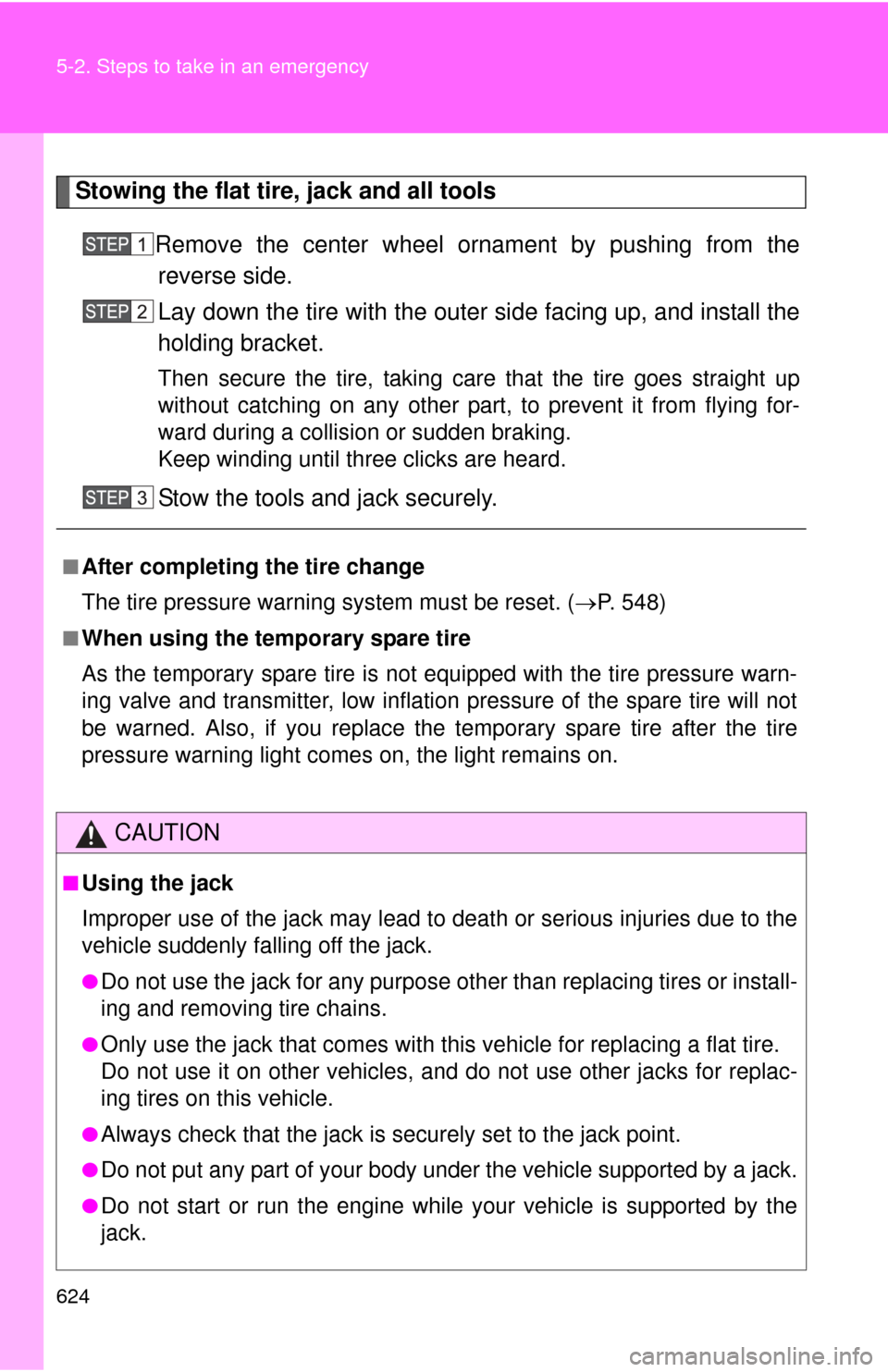
Stowing the flat tire, jack and all toolsRemove the center wheel ornament by pushing from thereverse side.
Lay down the tire with the outer side facing up, and install the
holding bracket.
Then secure the tire, taking care that the tire goes straight up
without catching on any other part, to prevent it from flying for-
ward during a collisi on or sudden braking.
Keep winding until three clicks are heard.
Stow the tools and jack securely.
■After completing the tire change
The tire pressure warnin g system must be reset. ( P. 548)
■When using the temporary spare tire
As the temporary spare tire is not equipped with the tire pressure warn-
ing valve and transmitter, low inflation pressure of the spare tire will not
be warned. Also, if you replace the temporary spare tire after the tire
pressure warning light comes on, the light remains on.
CAUTION
■Using the jack
Improper use of the jack may lead to death or serious injuries due to the
vehicle suddenly fa lling off the jack.
●Do not use the jack for any purpose ot her than replacing tires or install-
ing and removing tire chains.
●Only use the jack that comes with this vehicle for replacing a flat tire.
Do not use it on other vehicles, an d do not use other jacks for replac-
ing tires on this vehicle.
●Always check that the jack is securely set to the jack point.
●Do not put any part of your body under the vehicle supported by a jack.
●Do not start or run the engine while your vehicle is supported by the
jack.
Page 627 of 732

5
When trouble arises
627
5-2. Steps to take in an emergency
CAUTION
■When the spare tire is attached
The vehicle speed may not be correctly detected, and the following sys-
tems may not operate correctly:
●ABS & Brake assist
●VSC
●TRAC
●A-TRAC
●AUTO LSD
●Cruise control
●Navigation system
Also, not only can the following syste m not be utilized fully, it may actu-
ally negatively effect t he drive-train components:
●4WD system
NOTICE
■Do not drive the vehicle with a flat tire
Do not continue driving with a flat tire.
Driving even a short distance with a flat tire can damage the tire and the
wheel beyond repair.
■When replacing the tires
●When removing or fitting the wheels, tires or the tire pressure warning
valve and transmitter, contact your Toyota dealer as the tire pressure
warning valve and transmitter may be damaged if not handled cor-
rectly.
●Replace the grommets for the tire pressure warning valves and trans-
mitters as well.
■To avoid damaging the tire pressure warning valves and transmit-
ters
Do not use liquid sealants on flat tires.
Page 676 of 732

676 6-1. Specifications
■Treadwear
The treadwear grade is a comparative rating based on the wear
rate of the tire when tested under controlled conditions on a speci-
fied government test course.
For example, a tire graded 150 would wear one and a half (1 - 1/2)
times as well on the government course as a tire graded 100.
The relative performance of tires depends upon the actual conditions
of their use, however, and may depart significantly from the norm due
to variations in driving habits, service practices and differences in
road characteristics and climate.
■ Traction AA, A, B, C
The traction grades, from highest to lowest, are AA, A, B and C,
and they represent the tire’s ab ility to stop on wet pavement as
measured under controlled cond itions on specified government
test surfaces of asphalt and concrete.
A tire marked C may have poor traction performance.
Warning: The traction grade assigned to this tire is based on braking
(straight ahead) traction tests and does not include cornering (turn-
ing) traction.
■ Temperature A, B, C
The temperature grades are A (the highest), B, and C, represent-
ing the tire’s resistance to the generation of heat and its ability to
dissipate heat when tested under controlled conditions on a speci-
fied indoor laboratory test wheel.
Sustained high temperature can cause the material of the tire to
degenerate and reduce tire life, and excessive temperature can lead
to sudden tire failure.
The grade C corresponds to a level of performance which all passen-
ger car tires must meet under the Federal Motor Vehicle Safety Stan-
dard No. 109.
Grades B and A represent higher levels of performance on the labo-
ratory test wheel than the minimum required by law.
Page 677 of 732
677
6-1. Specifications
6
Vehicle specifications
Warning: The temperature grades for this tire are established for a
tire that is properly inflated and not overloaded.
Excessive speed, underinflation, or
excessive loading, either sepa-
rately or in combination, can caus e heat buildup and possible tire fail-
ure.
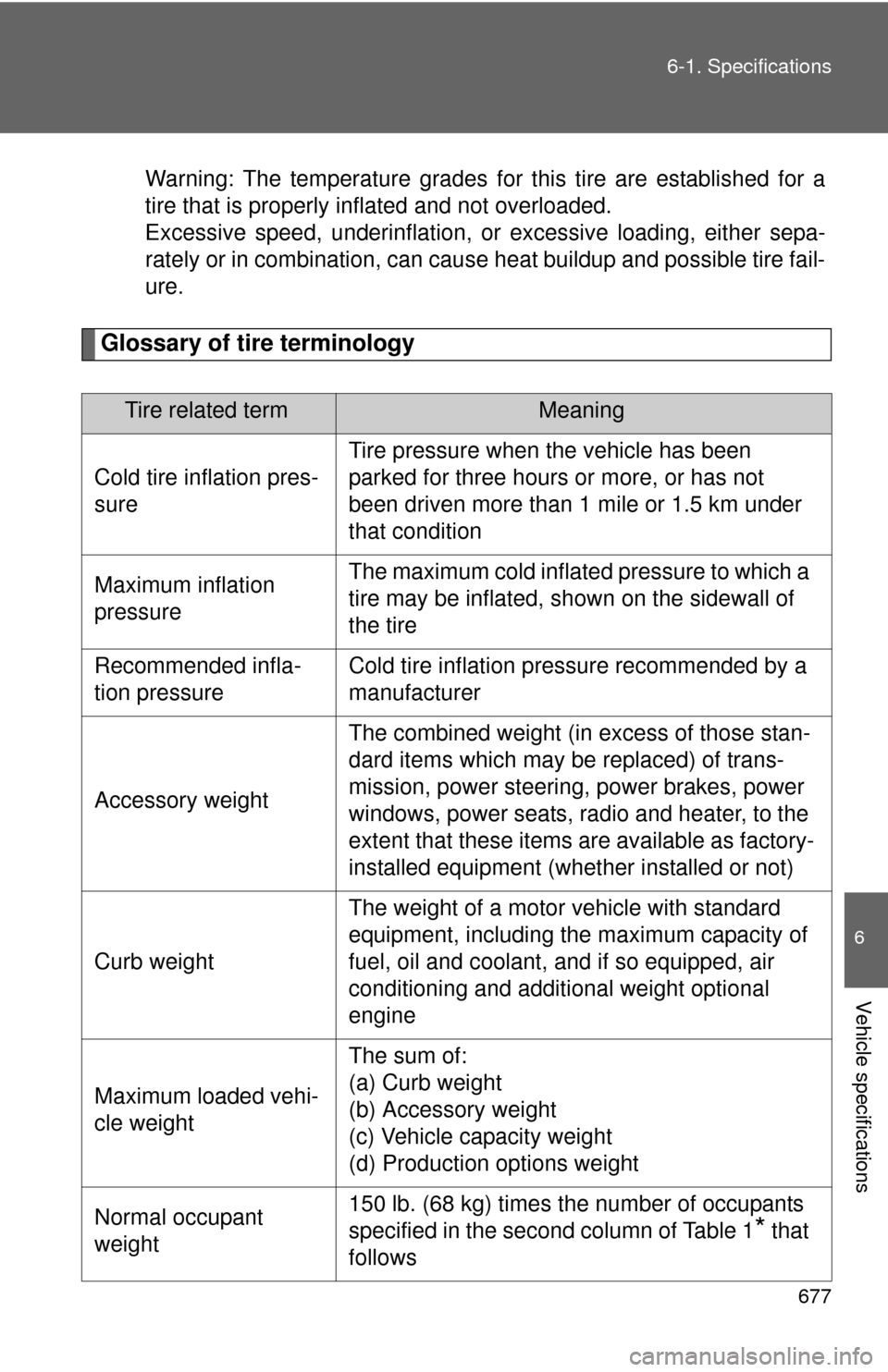
Glossary of tire terminology
Tire related termMeaning
Cold tire inflation pres-
sure
Tire pressure when the vehicle has been
parked for three hours or more, or has not
been driven more than 1 mile or 1.5 km under
that condition
Maximum inflation
pressureThe maximum cold inflated pressure to which a
tire may be inflated, s hown on the sidewall of
the tire
Recommended infla-
tion pressureCold tire inflation pressure recommended by a
manufacturer
Accessory weight
The combined weight (in excess of those stan-
dard items which may be replaced) of trans-
mission, power steering, power brakes, power
windows, power seats, radio and heater, to the
extent that these items are available as factory-
installed equipment (whether installed or not)
Curb weight
The weight of a motor vehicle with standard
equipment, including the maximum capacity of
fuel, oil and coolant, and if so equipped, air
conditioning and additional weight optional
engine
Maximum loaded vehi-
cle weight
The sum of:
(a) Curb weight
(b) Accessory weight
(c) Vehicle capacity weight
(d) Production options weight
Normal occupant
weight150 lb. (68 kg) times the number of occupants
specified in the second column of Table 1
* that
follows
Page 686 of 732
686
6-2. Customization
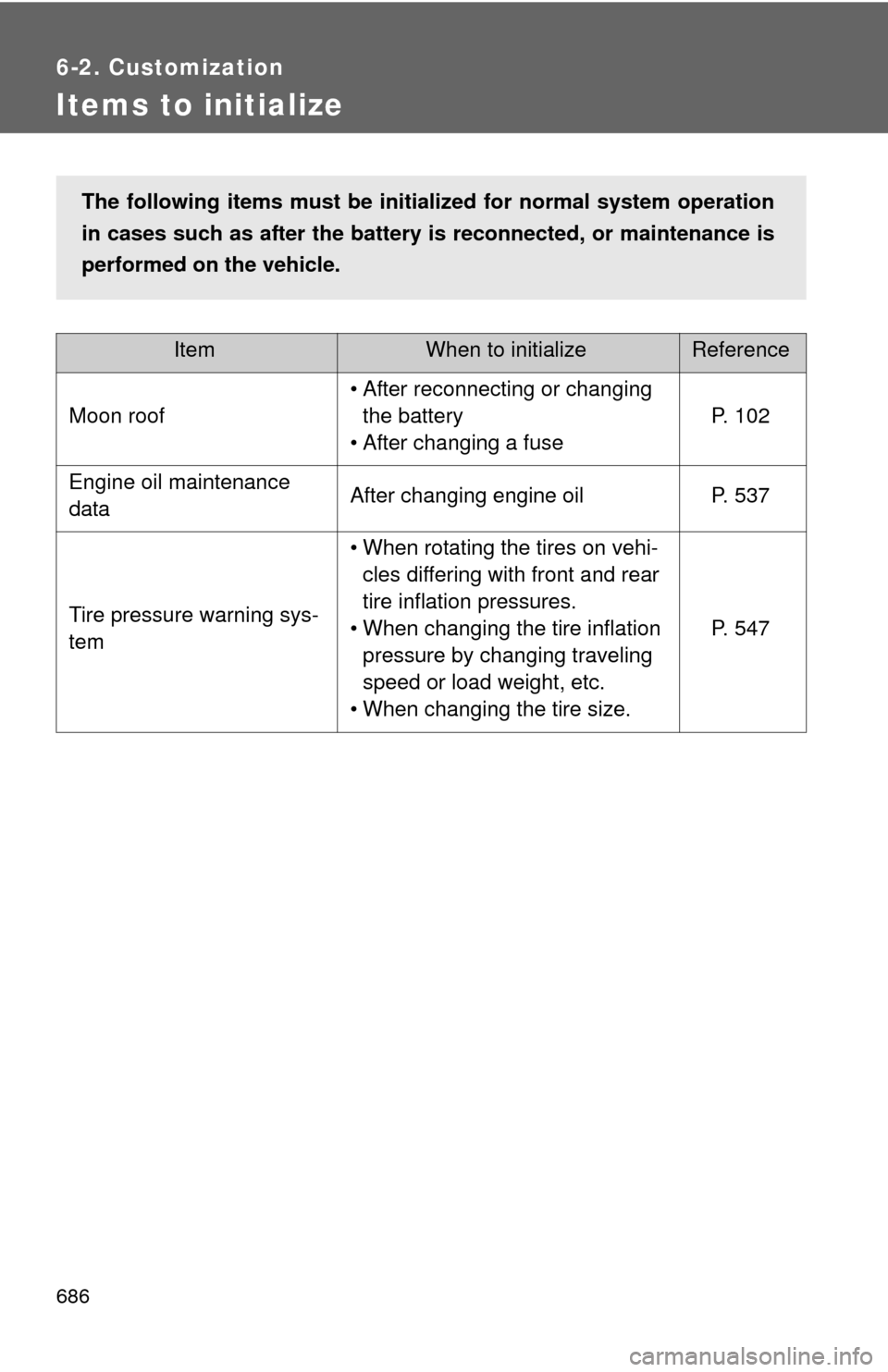
Items to initialize
ItemWhen to initializeReference
Moon roof
• After reconnecting or changing the battery
• After changing a fuse
P. 102
Engine oil maintenance
dataAfter changing engine oilP. 537
Tire pressure warning sys-
tem
• When rotating the tires on vehi- cles differing with front and rear
tire inflation pressures.
• When changing the tire inflation pressure by changing traveling
speed or load weight, etc.
• When changing the tire size.
P. 547
The following items must be initia lized for normal system operation
in cases such as after the battery is reconnected, or maintenance is
performed on the vehicle.
Page 717 of 732
717
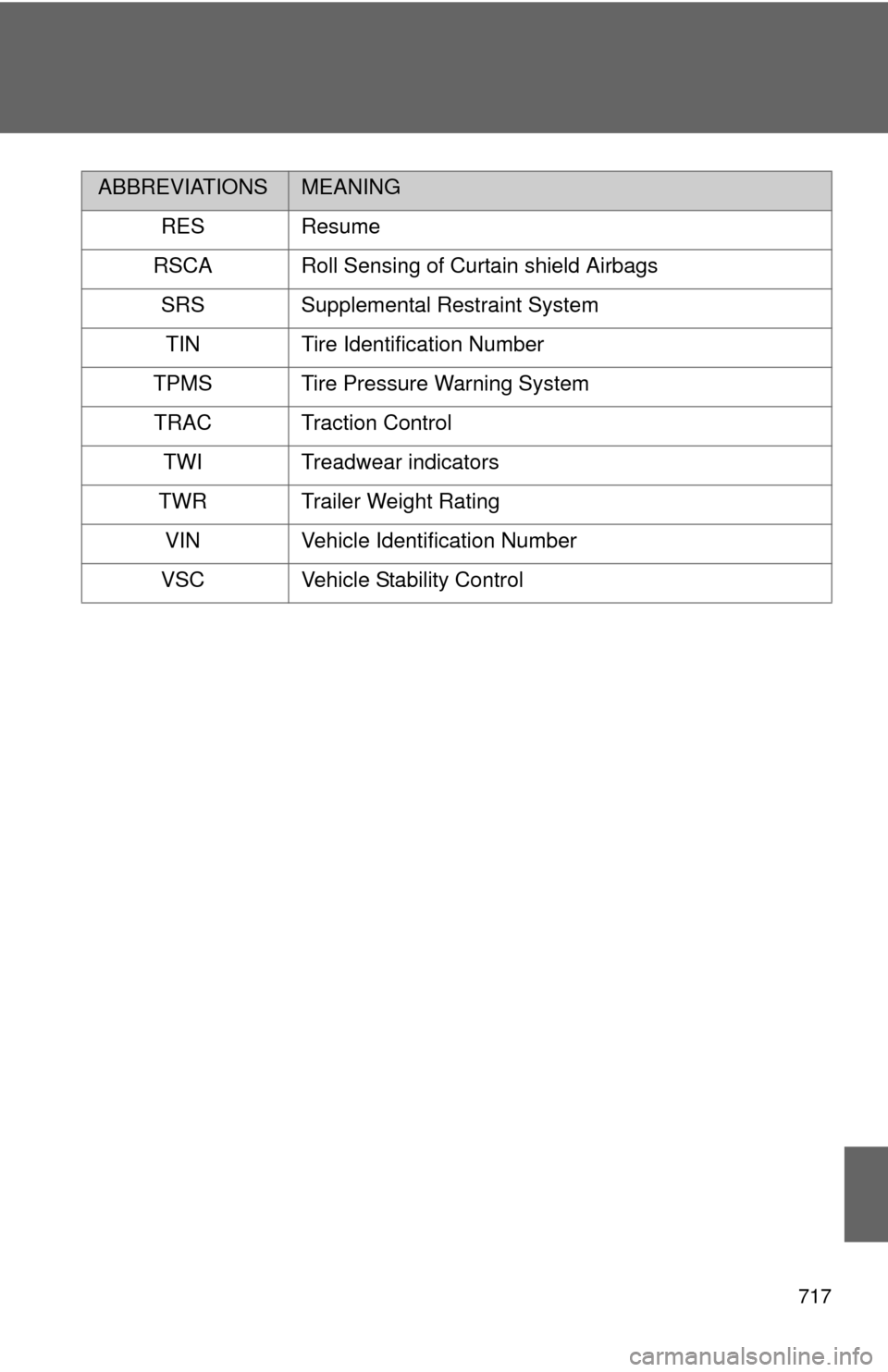
RES Resume
RSCA Roll Sensing of Curtain shield Airbags SRS Supplemental Restraint System
TIN Tire Identification Number
TPMS Tire Pressure Warning System TRAC Traction Control
TWI Treadwear indicators
TWR Trailer Weight Rating VIN Vehicle Identification Number
VSC Vehicle Stability Control
ABBREVIATIONSMEANING