Page 128 of 732
128 1-7. Safety information
CAUTION
■SRS airbag precautions
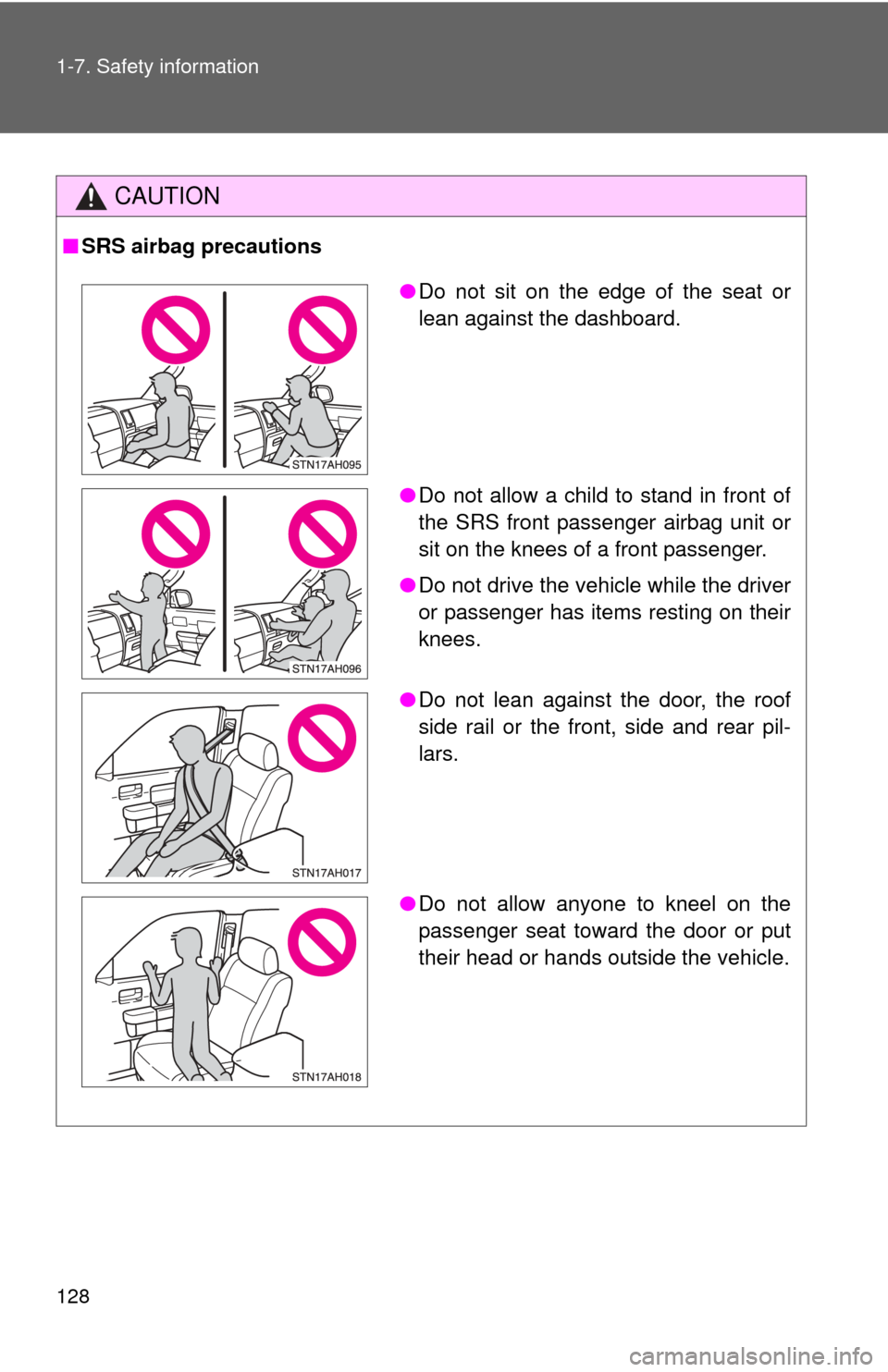
●Do not sit on the edge of the seat or
lean against the dashboard.
● Do not allow a child to stand in front of
the SRS front passenger airbag unit or
sit on the knees of a front passenger.
● Do not drive the vehicle while the driver
or passenger has items resting on their
knees.
● Do not lean against the door, the roof
side rail or the front, side and rear pil-
lars.
● Do not allow anyone to kneel on the
passenger seat toward the door or put
their head or hands outside the vehicle.
Page 171 of 732
When driving2
171
2-1. Driving proceduresDriving the vehicle............ 172
Engine (ignition) switch .... 181
Automatic transmission .... 184
Turn signal lever .............. 189
Parking brake ................... 190
Horn ................................. 191
2-2. Instrument cluster Gauges and meters ......... 192
Indicators and warning lights .............................. 198
Multi-information display............................ 203
Accessory meter .............. 209
2-3. Operating the lights and wipers
Headlight switch ............... 212
Fog light switch ................ 216
Windshield wipers and washer ........................... 217
2-4. Using other driving systems Cruise control ................... 220
Intuitive parking assist...... 223
Rear view monitor system ........................... 229
Four-wheel drive system ........................... 236
AUTO LSD system........... 240
Driving assist systems ..... 243 2-5. Driving information
Off-road precautions ........ 251
Cargo and luggage .......... 256
Vehicle load limits ............ 259
Winter driving tips ............ 261
Trailer towing ................... 265
Dinghy towing .................. 288
Page 173 of 732

173
2-1. Driving procedures
2
When driving
Starting on a steep uphill
With the brake pedal depressed, firmly set the parking brake
and shift the shift lever to D.
Gently depress the accelerator pedal.
Release the parking brake.
■Driving in the rain
●Drive carefully when it is raining, because visibility will be reduced, the
windows may become fogged-up, and the road will be slippery.
● Drive carefully when it starts to rain, because the road surface will be
especially slippery.
● Refrain from high speeds when driving on an expressway in the rain,
because there may be a layer of water between the tires and the road
surface, preventing the steering and brakes from operating properly.
■ Breaking in your new Toyota
To extend the life of the vehicle, the following precautions are recommended
to observe:
●For the first 200 miles (300 km):
Avoid sudden stops.
● For the first 500 miles (800 km):
Do not tow a trailer.
● For the first 1000 miles (1600 km):
• Do not drive at extremely high speeds.
• Avoid sudden acceleration.
• Do not drive continuously in the low gears.
• Do not drive at a constant speed for extended periods.
■ Drum-in disc type parking brake system
Your vehicle has a drum-in-disc type parking brake system. This type of
brake system needs bedding-down of the brake shoes periodically or when-
ever the parking brake shoes and/or drum are replaced. Have your Toyota
dealer perform the bedding down.
Page 187 of 732
187
2-1. Driving procedures
2
When driving
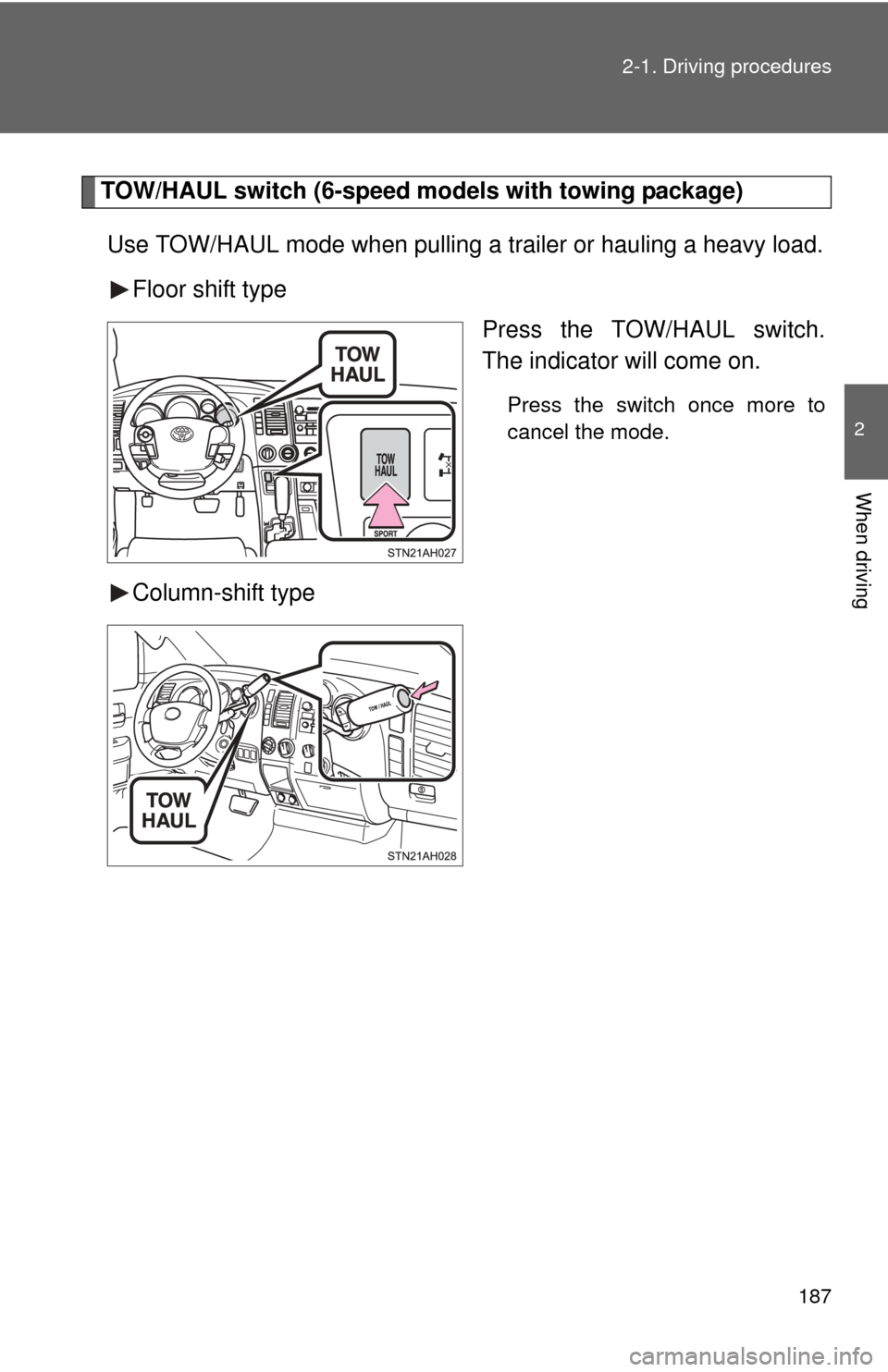
TOW/HAUL switch (6-speed
models with towing package)
Use TOW/HAUL mode when pulling a trailer or hauling a heavy load. Floor shift type Press the TOW/HAUL switch.
The indicator will come on.
Press the switch once more to
cancel the mode.
Column-shift type
Page 200 of 732
200 2-2. Instrument cluster
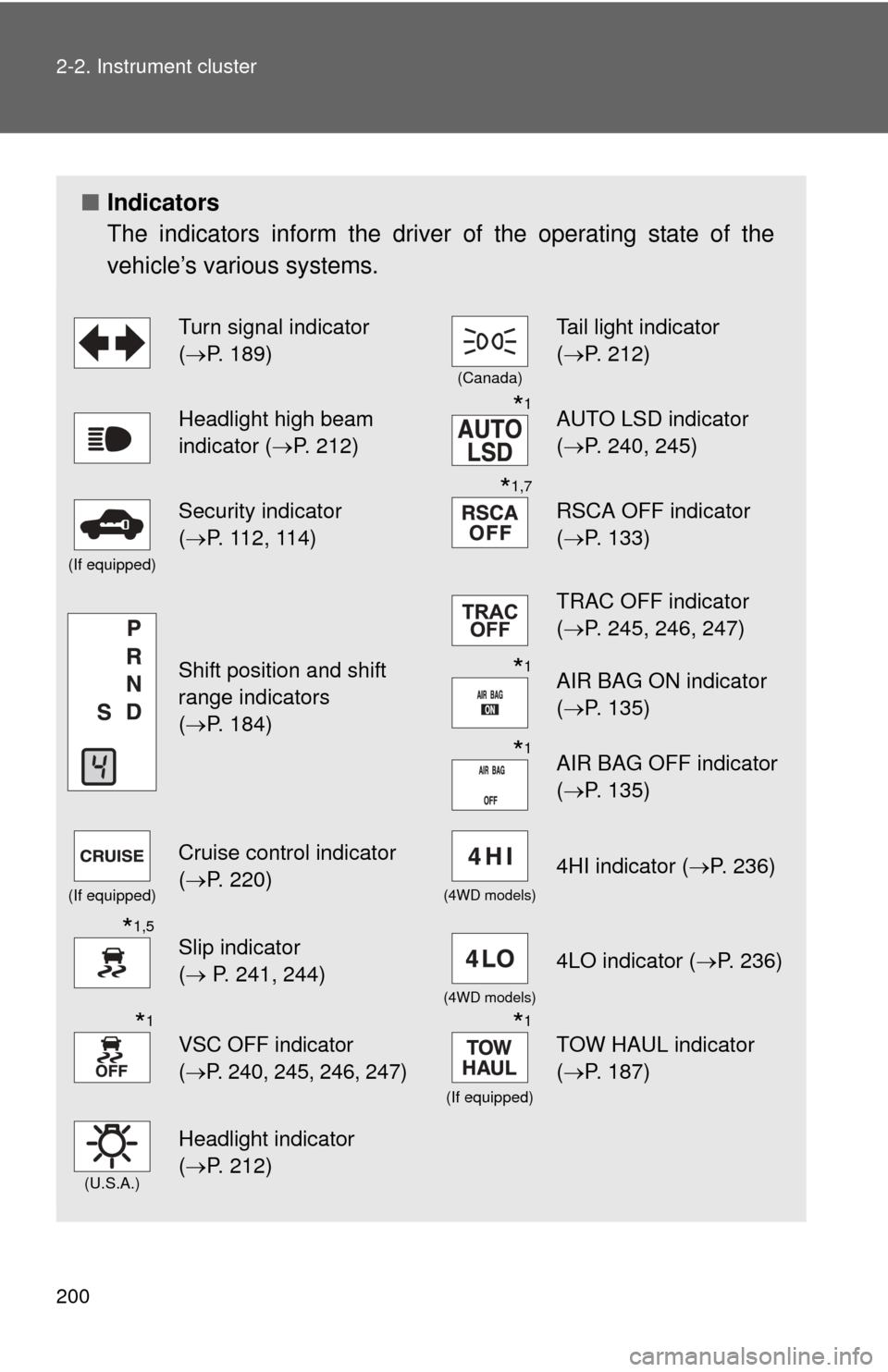
■Indicators
The indicators inform the driver of the operating state of the
vehicle’s various systems.
Turn signal indicator
(P. 189)
(Canada)
Tail light indicator
( P. 212)
Headlight high beam
indicator ( P. 212)*1AUTO LSD indicator
(P. 240, 245)
(If equipped)
Security indicator
(P. 112, 114)*1,7
RSCA OFF indicator
( P. 133)
Shift position and shift
range indicators
(P. 184)
TRAC OFF indicator
( P. 245, 246, 247)
*1AIR BAG ON indicator
(P. 135)
*1AIR BAG OFF indicator
(P. 135)
(If equipped)
Cruise control indicator
(P. 220)
(4WD models)
4HI indicator ( P. 236)
*1,5
Slip indicator
( P. 241, 244)
(4WD models)
4LO indicator ( P. 236)
*1
VSC OFF indicator
(
P. 240, 245, 246, 247)
*1
(If equipped)
TOW HAUL indicator
(P. 187)
(U.S.A.)
Headlight indicator
(P. 212)
Page 213 of 732
213
2-3. Operating the lights and wipers
2
When driving
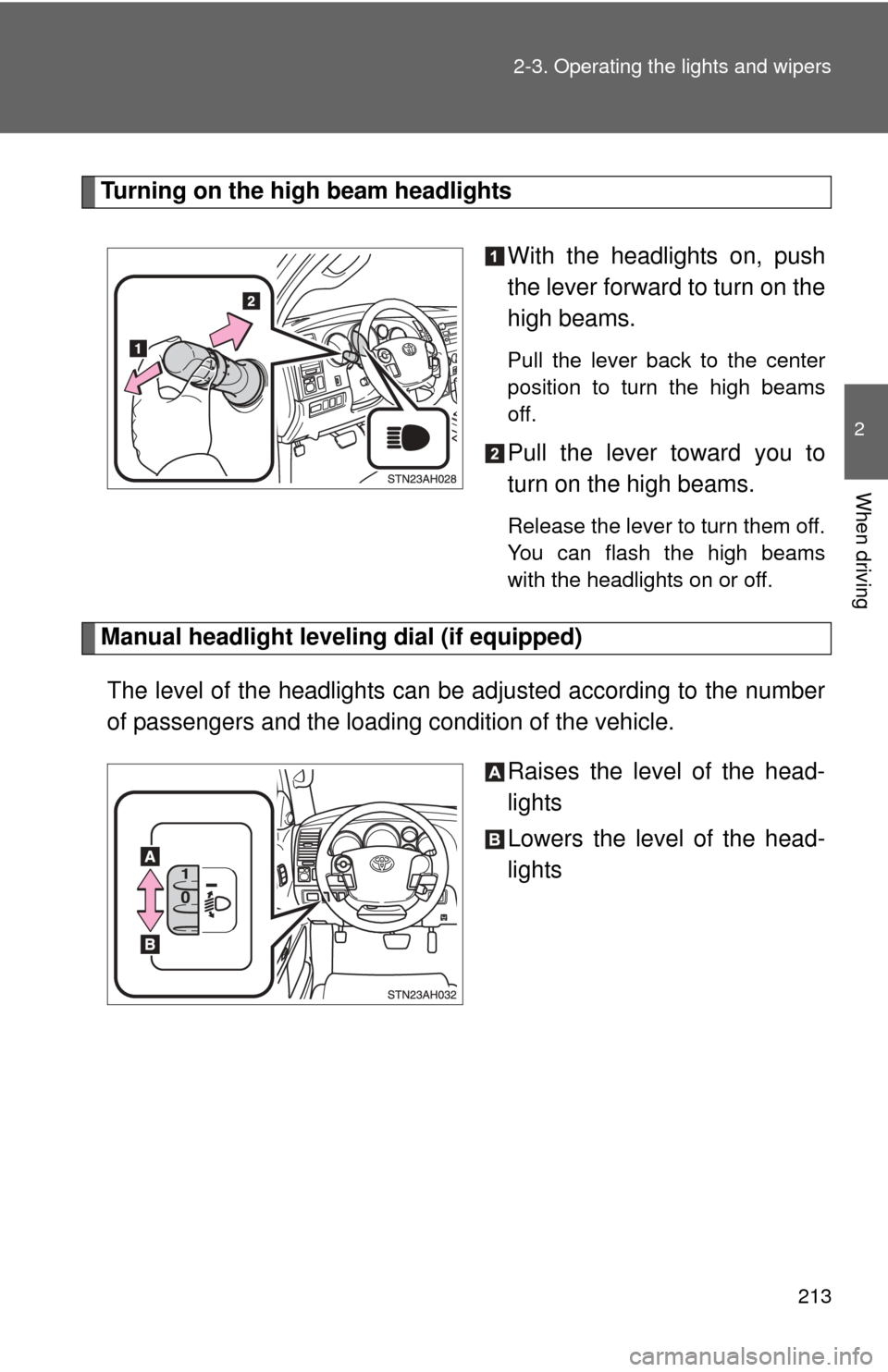
Turning on the high beam headlights
With the headlights on, push
the lever forward to turn on the
high beams.
Pull the lever back to the center
position to turn the high beams
off.
Pull the lever toward you to
turn on the high beams.
Release the lever to turn them off.
You can flash the high beams
with the headlights on or off.
Manual headlight leveling dial (if equipped)
The level of the headlights can be adjusted according to the number
of passengers and the loading condition of the vehicle.
Raises the level of the head-
lights
Lowers the level of the head-
lights
Page 214 of 732
214 2-3. Operating the lights and wipers
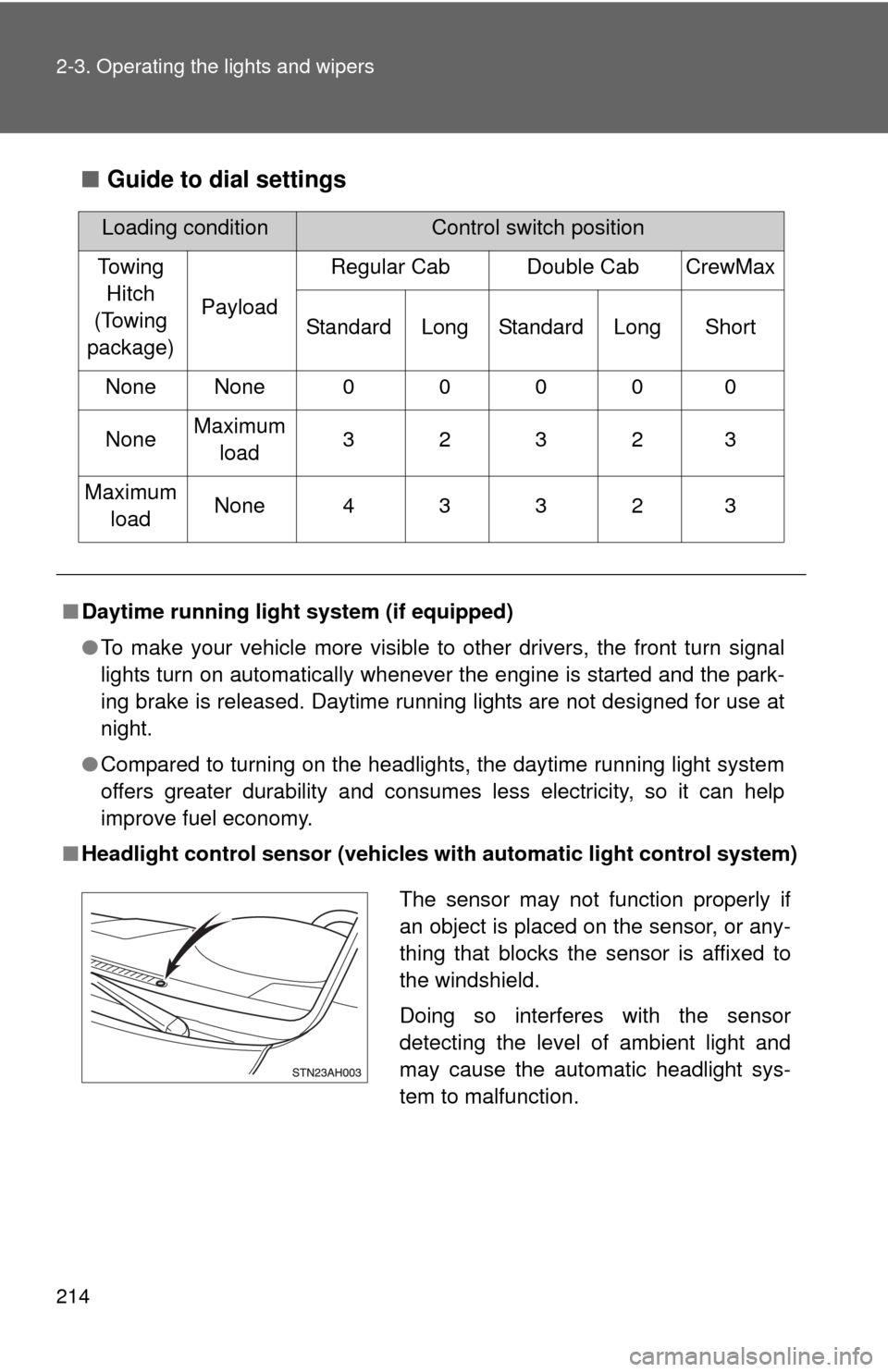
■Guide to dial settings
Loading conditionControl switch position
Towing Hitch
(Towing
package) Payload Regular Cab Double Cab CrewMax
Standard Long Standard Long Short
None None 0 0 0 0 0
None Maximum
load 32323
Maximum load None 4 3 3 2 3
■ Daytime running light system (if equipped)
●To make your vehicle more visible to other drivers, the front turn signal
lights turn on automatically whenever the engine is started and the park-
ing brake is released. Daytime running lights are not designed for use at
night.
● Compared to turning on the headlights, the daytime running light system
offers greater durability and consumes less electricity, so it can help
improve fuel economy.
■ Headlight control sensor (vehicles wi th automatic light control system)
The sensor may not function properly if
an object is placed on the sensor, or any-
thing that blocks the sensor is affixed to
the windshield.
Doing so interferes with the sensor
detecting the level of ambient light and
may cause the automatic headlight sys-
tem to malfunction.
Page 219 of 732
219
2-3. Operating the lights and wipers
2
When driving
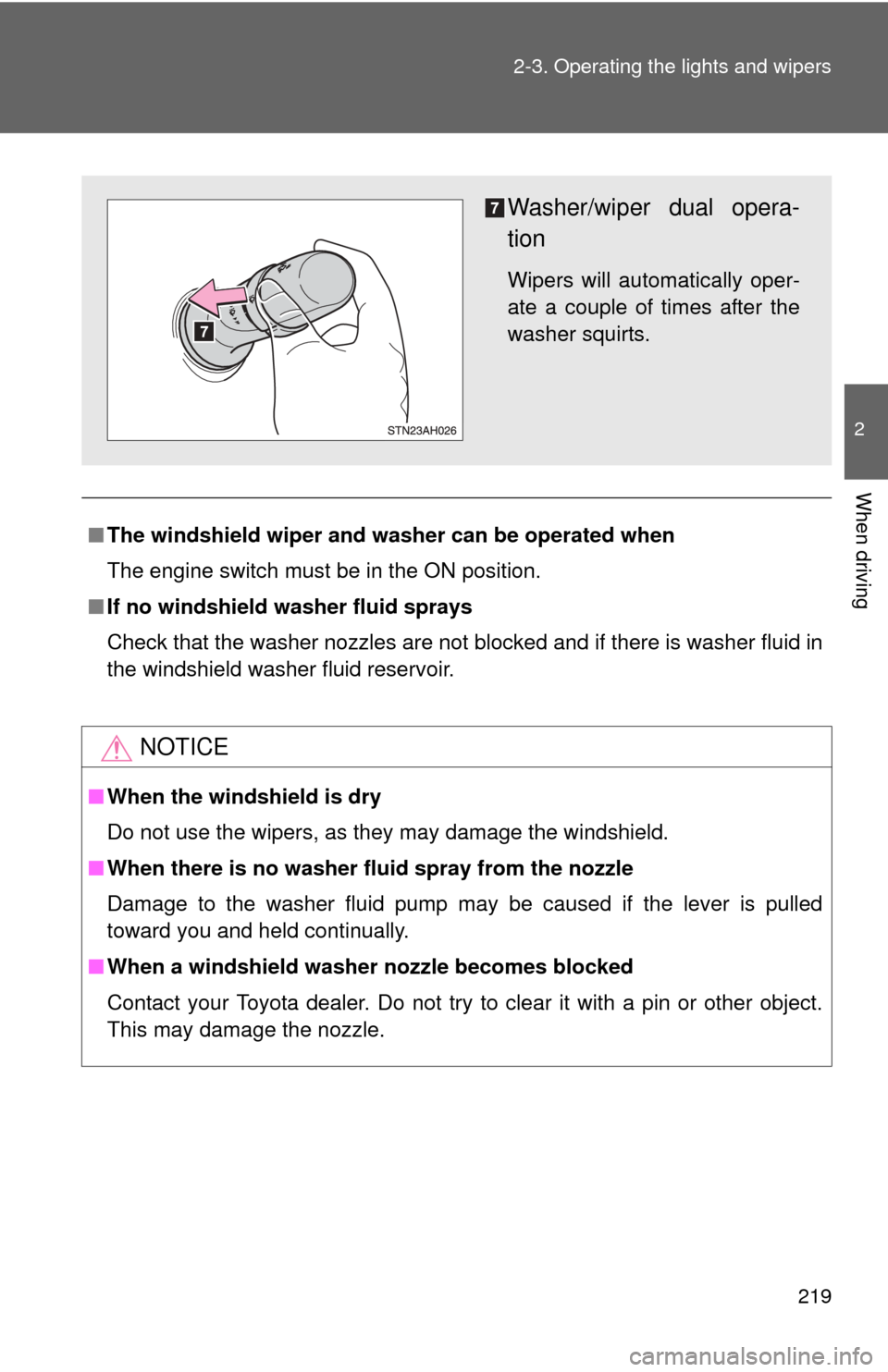
■
The windshield wiper and washer can be operated when
The engine switch must be in the ON position.
■ If no windshield washer fluid sprays
Check that the washer nozzles are not blocked and if there is washer fluid in
the windshield washer fluid reservoir.
NOTICE
■When the windshield is dry
Do not use the wipers, as they may damage the windshield.
■ When there is no washer fluid spray from the nozzle
Damage to the washer fluid pump may be caused if the lever is pulled
toward you and held continually.
■ When a windshield washer nozzle becomes blocked
Contact your Toyota dealer. Do not try to clear it with a pin or other object.
This may damage the nozzle.
Washer/wiper dual opera-
tion
Wipers will automatically oper-
ate a couple of times after the
washer squirts.