Page 51 of 732
51
1-2. Opening, closing and locking the doors
1
Before driving
CAUTION
■
To prevent an accident
Observe the following precautions while driving the vehicle.
Failing to do so may result in a door opening and an occupant falling out,
resulting in death or serious injury.
●Always use a seat belt.
● Always lock the doors.
● Ensure that all doors are properly closed.
● Do not pull the inside handle of the doors while driving.
The doors may be opened and the passengers are thrown out of the vehi-
cle and it may result in serious injury or death.
Be especially careful for the front doors, as the doors may be opened even
if the inside lock buttons are in locked position.
● Double Cab and CrewMax models: Set the rear door child protector locks
when children are seated in the rear seats.
Page 64 of 732
64 1-3. Adjustable components (seats, mirrors, steering wheel)
Raising the bottom cushion (Double Cab models)
■ Before raising the bottom cushion
Stow the seat belt buckles.
This prevents the seat belt buck-
les from falling out when you fold
the seatback.
Pass the seat belts through the
seat belt hangers.
This prevents the shoulder belt
from being damaged.
Make sure that the seat belts are
removed from the hangers before
using them.
■Raising the bottom cushion
Raise the bottom cushion up
while pulling the lever until it
locks.
When returning bottom cushion to
its original position, push the bot-
tom cushion down while pulling
the lever until it locks.
Page 65 of 732
65
1-3. Adjustable components (s
eats, mirrors, steering wheel)
1
Before driving
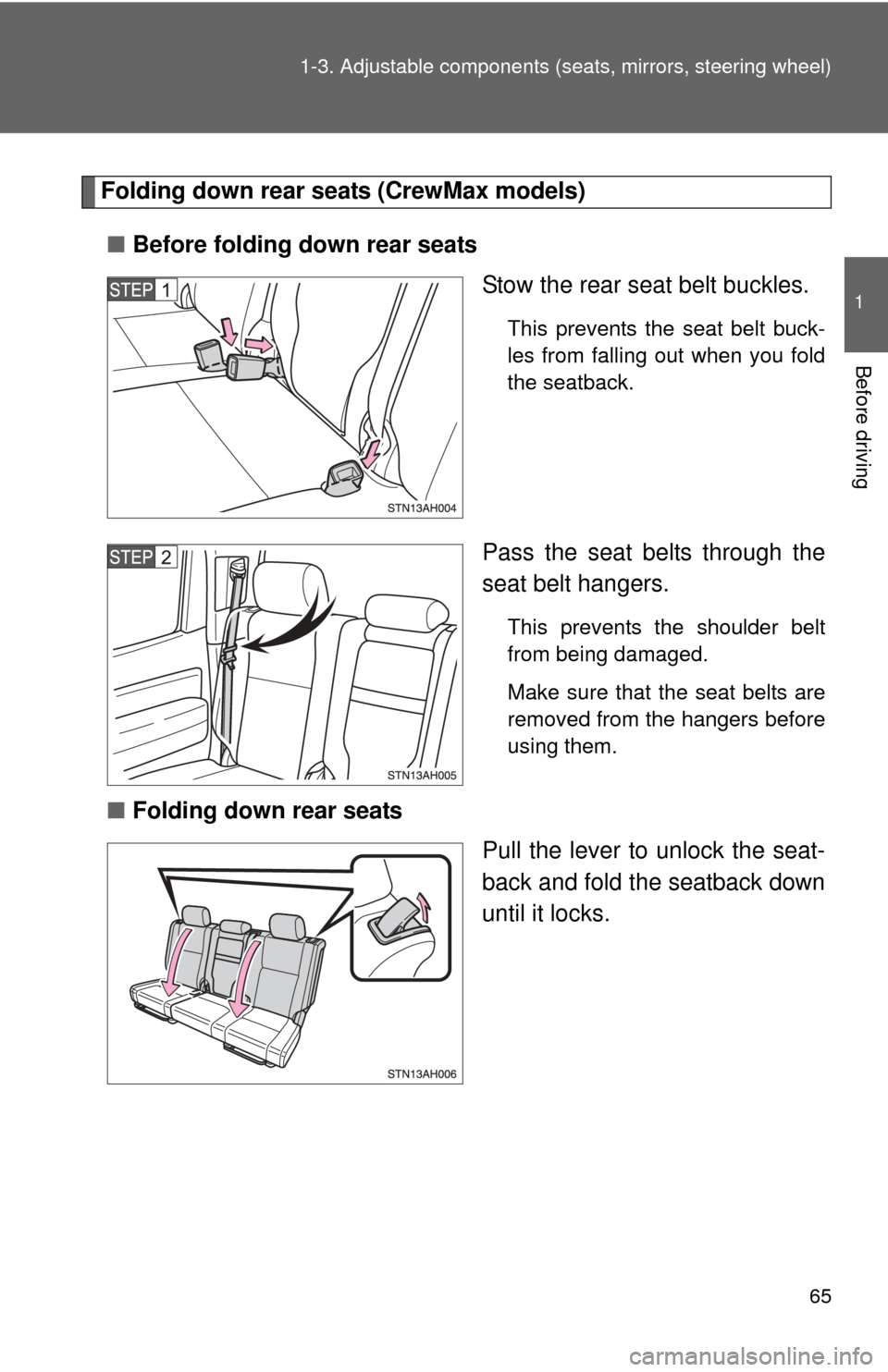
Folding down rear seats (CrewMax models)
■ Before folding down rear seats
Stow the rear seat belt buckles.
This prevents the seat belt buck-
les from falling out when you fold
the seatback.
Pass the seat belts through the
seat belt hangers.
This prevents the shoulder belt
from being damaged.
Make sure that the seat belts are
removed from the hangers before
using them.
■Folding down rear seats
Pull the lever to unlock the seat-
back and fold the seatback down
until it locks.
Page 76 of 732
76 1-3. Adjustable components (seats, mirrors, steering wheel)
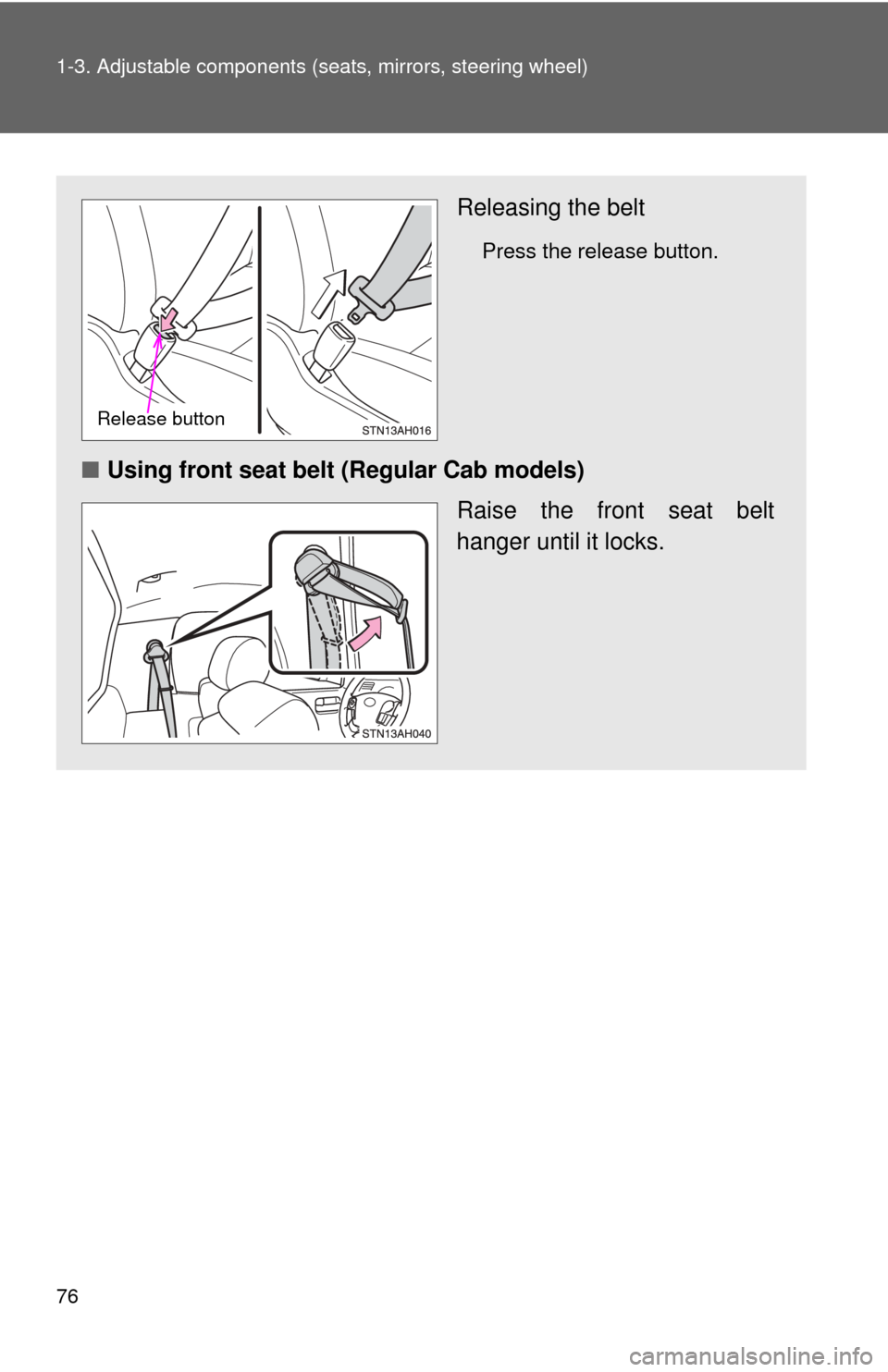
Releasing the belt
Press the release button.
■Using front seat belt (Regular Cab models)
Raise the front seat belt
hanger until it locks.
Release button
Page 152 of 732
152 1-7. Safety information
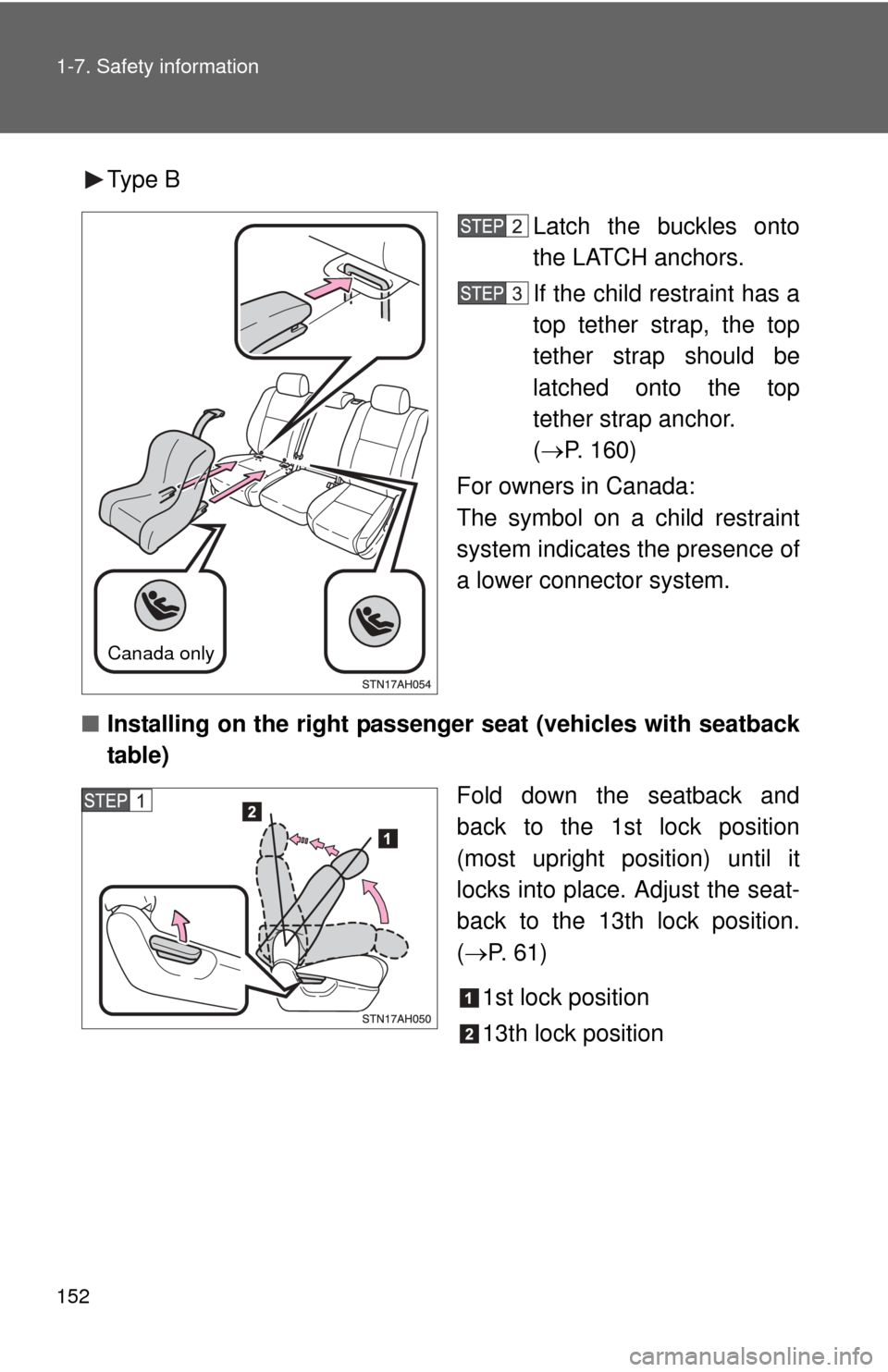
Type BLatch the buckles onto
the LATCH anchors.
If the child restraint has a
top tether strap, the top
tether strap should be
latched onto the top
tether strap anchor.
( P. 160)
For owners in Canada:
The symbol on a child restraint
system indicates the presence of
a lower connector system.
■ Installing on the right passenger seat (vehicles with seatback
table)
Fold down the seatback and
back to the 1st lock position
(most upright position) until it
locks into place. Adjust the seat-
back to the 13th lock position.
( P. 61)
1st lock position
13th lock position
Canada only
Page 155 of 732
155
1-7. Safety information
1
Before driving
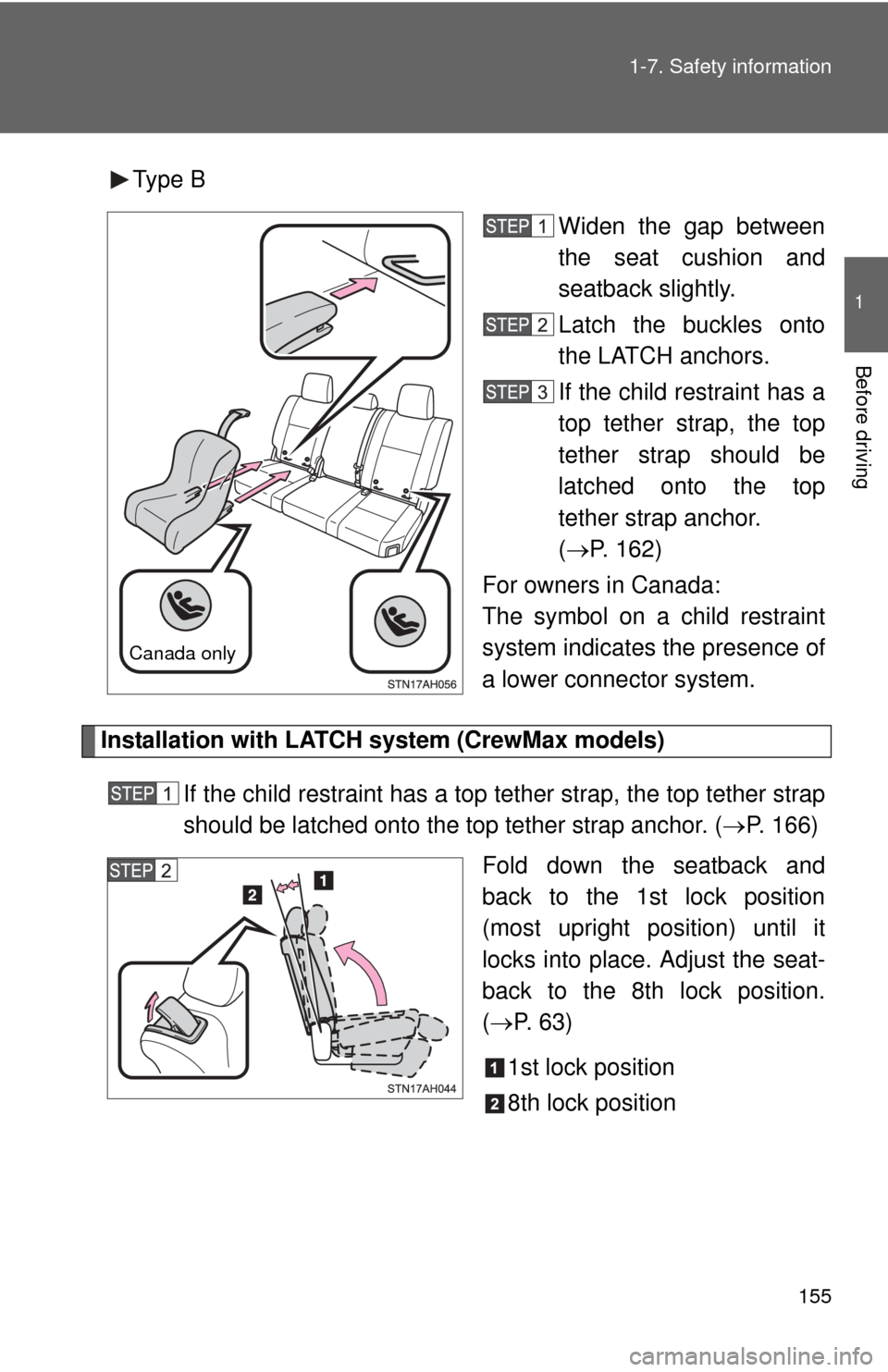
Type B
Widen the gap between
the seat cushion and
seatback slightly.
Latch the buckles onto
the LATCH anchors.
If the child restraint has a
top tether strap, the top
tether strap should be
latched onto the top
tether strap anchor.
( P. 162)
For owners in Canada:
The symbol on a child restraint
system indicates the presence of
a lower connector system.
Installation with LATCH system (CrewMax models)
If the child restraint has a top te ther strap, the top tether strap
should be latched onto the top tether strap anchor. ( P. 166)
Fold down the seatback and
back to the 1st lock position
(most upright position) until it
locks into place. Adjust the seat-
back to the 8th lock position.
( P. 63)
1st lock position
8th lock position
Canada only
Page 214 of 732
214 2-3. Operating the lights and wipers
■Guide to dial settings
Loading conditionControl switch position
Towing Hitch
(Towing
package) Payload Regular Cab Double Cab CrewMax
Standard Long Standard Long Short
None None 0 0 0 0 0
None Maximum
load 32323
Maximum load None 4 3 3 2 3
■ Daytime running light system (if equipped)
●To make your vehicle more visible to other drivers, the front turn signal
lights turn on automatically whenever the engine is started and the park-
ing brake is released. Daytime running lights are not designed for use at
night.
● Compared to turning on the headlights, the daytime running light system
offers greater durability and consumes less electricity, so it can help
improve fuel economy.
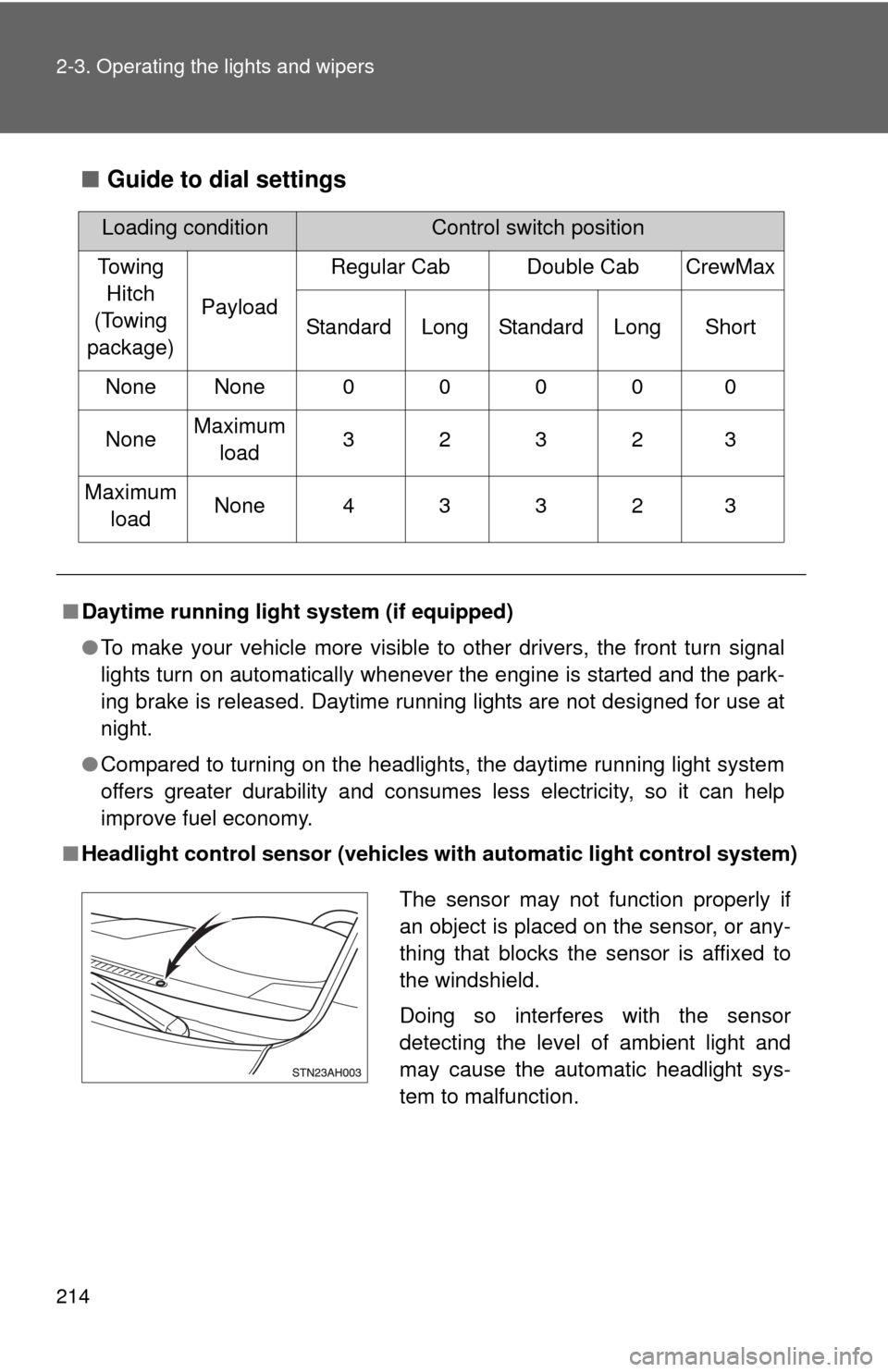
■ Headlight control sensor (vehicles wi th automatic light control system)
The sensor may not function properly if
an object is placed on the sensor, or any-
thing that blocks the sensor is affixed to
the windshield.
Doing so interferes with the sensor
detecting the level of ambient light and
may cause the automatic headlight sys-
tem to malfunction.
Page 282 of 732

282 2-5. Driving information
●To maintain engine braking efficiency when driving on a long steep
downgrade, do not use the transmission in D.
Transmission shift range position must be in 5 in the S mode (6-
speed models) or in 4 in the S mode (5-speed models).
● Instability happens more frequently when descending steep or long
downhill grades. Before descending, slow down and downshift. Do
not make sudden downshifts while descending steep or long down-
hill grades.
● Avoid holding the brake pedal down too long or applying the
brakes too frequently. This could cause the brakes to overheat and
result in reduced braking efficiency.
● Due to the added load of the trailer, your vehicle’s engine may
overheat on hot days (at temper atures over 85°F [30°C]) when
driving up a long or steep grade. If the engine coolant temperature
gauge indicates overheating, immediately turn off the air condition-
ing (if in use), pull your vehicle off the road and stop in a safe spot.
( P. 637)
● Always place wheel blocks under both the vehicle’s and the
trailer’s wheels when parking. Ap ply the parking brake firmly, and
put the transmission in P. Avoid parking on a slope, but if unavoid-
able, do so only after performing the following:
Apply the brakes and keep them applied.
Have someone place wheel blo cks under both the vehicle’s
and trailer’s wheels.
When the wheel blocks are in place, release the brakes slowly
until the blocks absorb the load.
Apply the parking brake firmly.
Shift into P and turn off the engine.