Page 539 of 688
539
4-3. Do-it-yourself maintenance
4
Maintenance and care
CAUTION
■Proper inflation is critical
to save tire performance
Keep your tires properly inflated.
Otherwise, the following conditions may occur and result in an accident
causing death or serious injury.
●Excessive wear
●Uneven wear
●Poor handling
●Possibility of blowouts resu lting from overheated tires
●Poor sealing of the tire bead
●Wheel deformation and/or tire separation
●A greater possibility of tire damage from road hazards
NOTICE
■When inspecting and adjusting tire inflation pressure
Be sure to reinstall the tire valve caps.
Without the valve caps, dirt or mo isture could get into the valve and
cause air leakage, which could result in an accident. If the caps have
been lost, replace them as soon as possible.
Page 540 of 688

540
4-3. Do-it-yourself maintenance
Wheels
If a wheel is bent, cracked or heavily corroded, it should be
replaced.
Otherwise, the tire may separate from the wheel or cause loss of
handling control.
■Wheel selection
When replacing wheels, care should be taken to ensure that
they are equivalent to those removed in load capacity, diameter,
rim width, and inset*.
Replacement wheels are available at your Toyota dealer.
*: Conventionally referred to as “offset”.
Toyota does not recommend using:
●Wheels of different sizes or types
● Used wheels
● Bent wheels that have been straightened
■ Wheel precautions
●Use only Toyota wheel nuts and wrench designed for use with
your aluminum wheels.
● When rotating, repairing or changing your tires, check that the
wheel nuts are still tight after driving 100 miles (160 km).
● Be careful not to damage the aluminum wheels when using
tire chains.
● Use only Toyota genuine balance weights or equivalent and a
plastic or rubber hammer when balancing your wheels.
Page 541 of 688

541
4-3. Do-it-yourself maintenance
4
Maintenance and care
■When replacing wheels
The wheels of your Toyota are equipped with tire pressure warning
valves and transmitters (except for sp
are tire) that allow the tire pressure
warning system to provide advanced warning in the event of a loss in tire
inflation pressure. Whenever wheels are replaced, the tire pressure
warning valves and transmitte rs must be installed. (P. 530)
CAUTION
■When replacing wheels
●Do not use wheels that are a different size from those recommended in
the Owner’s Manual, as this may re sult in loss of handling control.
●Never use an inner tube in a leaking wheel which is designed for a
tubeless tire. Doing so may result in an accident, causing death or seri-
ous injury.
NOTICE
■Replacing tire pressure warning valves and transmitters
●Because tire repair or replacement may affect the tire pressure warn-
ing valves and transmitters, make su re to have tires serviced by your
Toyota dealer or other qualified service shop. In addition, make sure to
purchase your tire pressure warning valves and transmitters at your
Toyota dealer.
●Ensure that only genuine Toyota wheels are used on your vehicle.
Tire pressure warning valves and transmitters may not work properly
with non-genuine wheels.
Page 555 of 688

555
4-3. Do-it-yourself maintenance
4
Maintenance and care
15 ECU-IG No.1 7.5 A
Anti-lock brake system, vehicle sta-
bility control system, multiplex com-
munication system, intuitive
parking assist system, power front
driver’s seat, power tilt and power
telescopic, shift lock, tire pressure
warning system, accessory meter,
trailer towing, power outlet, electric
moon roof, power back door, head
light cleaner
16 AIR SUS IG 20 A Electronically modulated air sus-
pension system
17 LH-IG 7.5 A Back-up lights, charging system,
gauge and meters, turn signal
lights, air conditioning system, seat
heaters, rear window defogger
18 4WD 20 A Four-wheel drive control system
19 RR SEAT-HTR
LH 10 A Seat heaters
20 WSH 20 A Window washer
21 WIPER 30 A Wiper and washer
22 ECU-IG No.2 7.5 A Multiplex communication system
23 TAIL 15 A Tail lights, trailer lights (tail lights),
parking lights
24 A/C IG 10 A Air conditioning system
25 SEAT-HTR 20 A Seat heater or Heated and venti-
lated seats
FuseAmpereCircuit
Page 573 of 688
5
When trouble arises
573
5-1. Essential information
If your vehicle needs to be towed
Before towingThe following may indicate a problem with your transmission. Contact
your Toyota dealer before towing.
● The engine is running, but the vehicle will not move.
● The vehicle makes an abnormal sound.
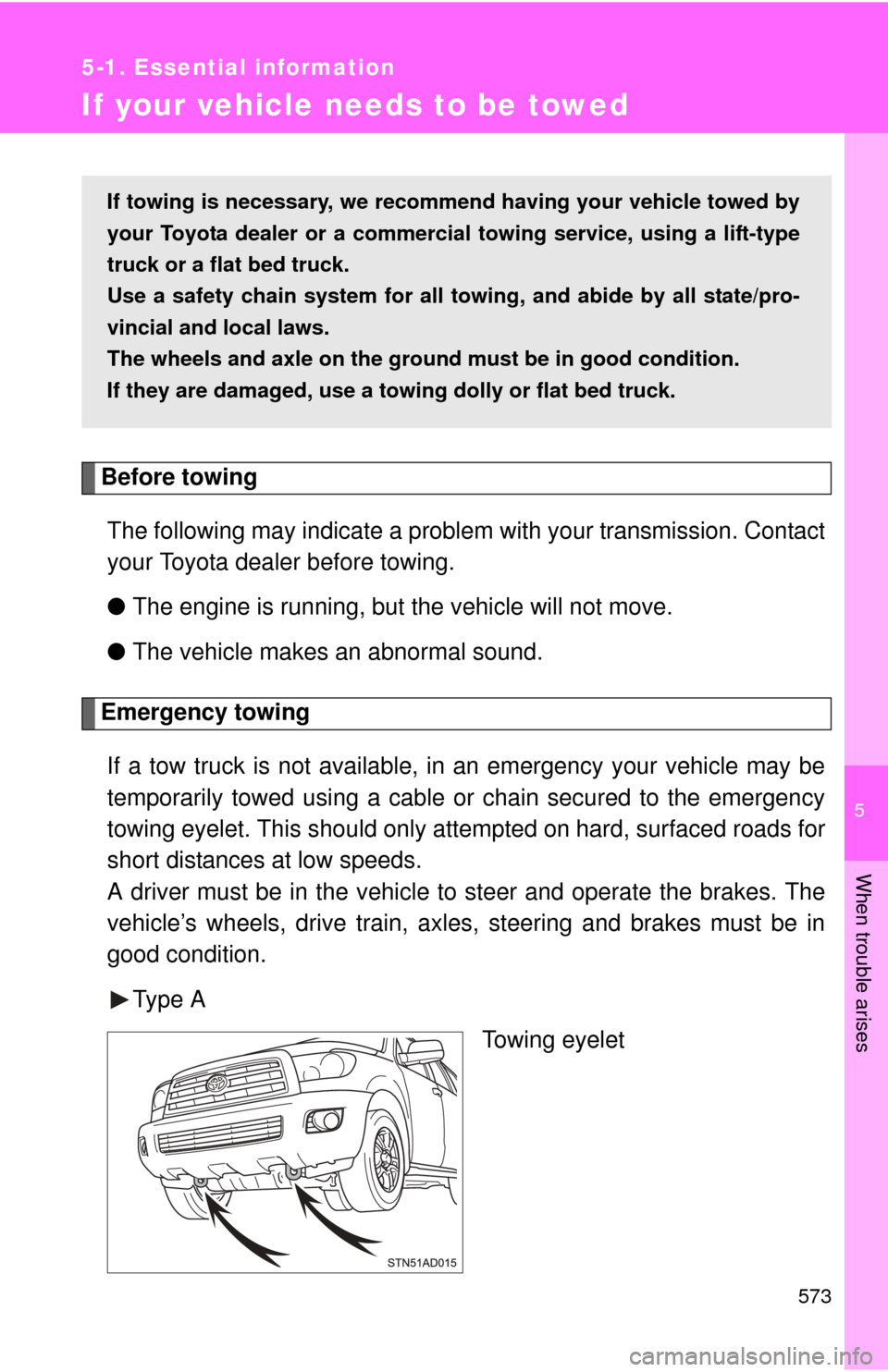
Emergency towing
If a tow truck is not available, in an emergency your vehicle may be
temporarily towed using a cable or chain secured to the emergency
towing eyelet. This should only attempted on hard, surfaced roads for
short distances at low speeds.
A driver must be in the vehicle to steer and operate the brakes. The
vehicle’s wheels, drive train, axles, steering and brakes must be in
good condition.
Type A Towing eyelet
If towing is necessary, we recommend having your vehicle towed by
your Toyota dealer or a commerci al towing service, using a lift-type
truck or a flat bed truck.
Use a safety chain system for all to wing, and abide by all state/pro-
vincial and local laws.
The wheels and axle on the groun d must be in good condition.
If they are damaged, use a towing dolly or flat bed truck.
Page 574 of 688
574 5-1. Essential information
Type BTowing eyelet
■Emergency towin g procedure
The engine switch must be in the ACC (engine off) or the ON
(engine running) position.
4WD models: Put the front wheel drive control switch in 2WD.
Put the shift lever in N.
Release the parking brake.
CAUTION
■ Caution while towing
●Use extreme caution when towing the vehicle.
Avoid sudden starts or erratic driving maneuvers which place excessive
stress on the emergency towing eyelet and the cables or chains. Always
use caution for the surroundings and other vehicles while towing.
● If the engine is not running, the power assist for the brakes and steering
will not function, making steering and braking more difficult.
Page 575 of 688
5
When trouble arises
575
5-1. Essential information
Towing with a sling-type truck
NOTICE
■
To prevent causing serious da mage to the transmission
Never tow this vehicle from the rear with the four wheels on the ground.
This may cause serious damage to the transmission.
■ Emergency towing eyelet precautions
● Before emergency towing, check that the eyelet is not broken or damaged
and that the installation bolts are not loose.
● Fasten the towing cable or chain securely to the eyelet.
● Do not jerk the eyelet. Apply steady and even force.
● To avoid damaging the eyelet, do not pull from the side or at a vertical
angle. Always pull straight ahead.
NOTICE
■To prevent body damage
Do not tow with a sling-type truck, either from the front or rear.
Page 576 of 688
576 5-1. Essential information
Towing with a wheel lift-type truck from the frontUse a towing dolly under the rear
wheels.
Towing with a wheel lift-type truck from the rear2WD models Turn the engine switch to the
ACC position.
NOTICE
■To prevent causing serious damage to the transmission
Never tow this vehicle wheels on the ground.


