Page 122 of 536
122 1-7. Safety information
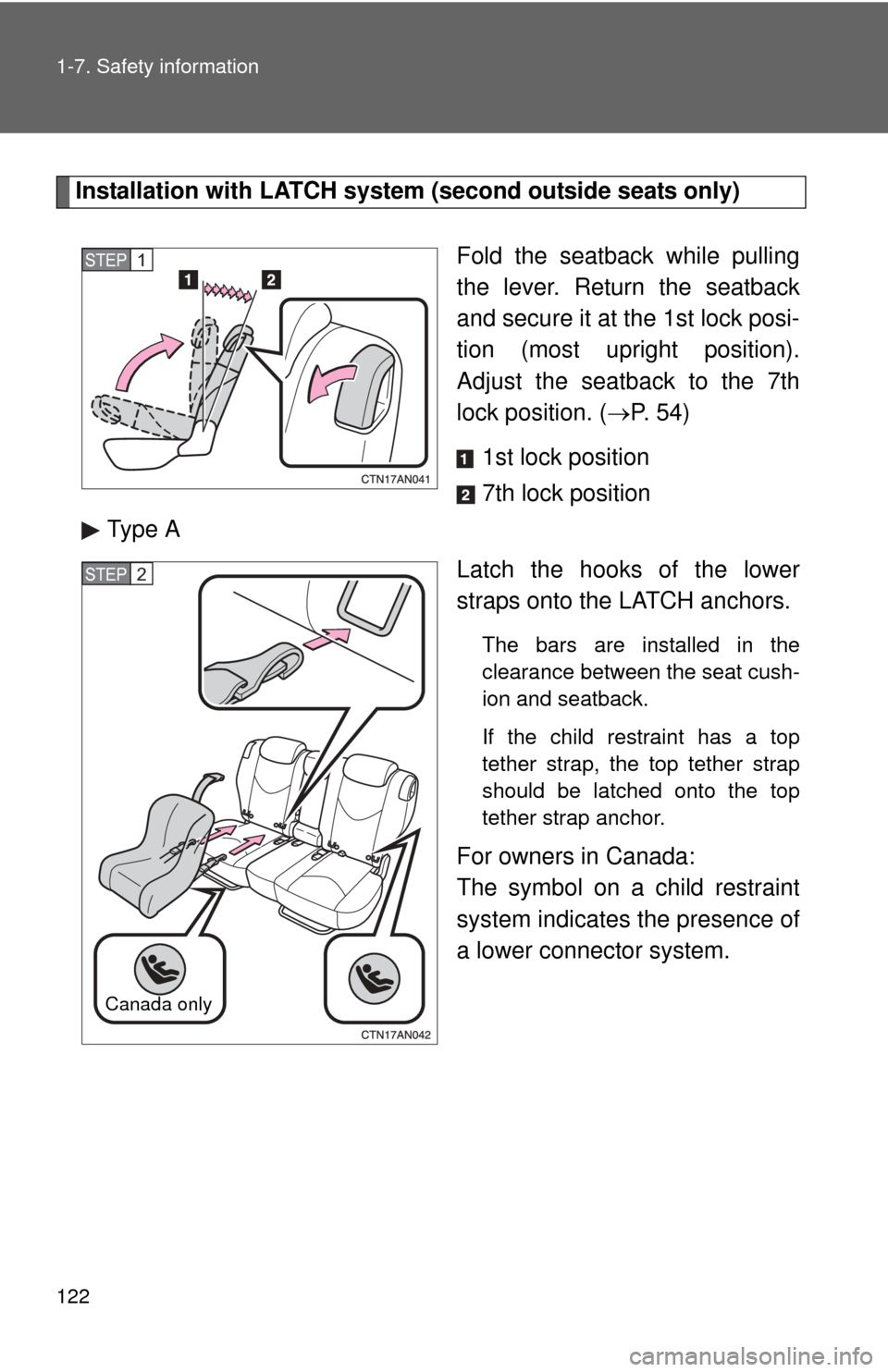
Installation with LATCH system (second outside seats only)
Fold the seatback while pulling
the lever. Return the seatback
and secure it at the 1st lock posi-
tion (most upright position).
Adjust the seatback to the 7th
lock position. ( P. 54)
1st lock position
7th lock position
Type A
Latch the hooks of the lower
straps onto the LATCH anchors.
The bars are installed in the
clearance between the seat cush-
ion and seatback.
If the child restraint has a top
tether strap, the top tether strap
should be latched onto the top
tether strap anchor.
For owners in Canada:
The symbol on a child restraint
system indicates the presence of
a lower connector system.
STEP 1
STEP 2
Canada only
Page 124 of 536
124 1-7. Safety information
Installing child restraints using a seat belt (child restraint lock function belt)
■Rear facing Infant seat/convertible seat
Place the child seat on the rear
seat facing the rear of the vehi-
cle.
Run the seat belt through the
child seat and insert the plate
into the buckle. Make sure that
the belt is not twisted.
Fully extend the shoulder belt
and then allow it to retract
slightly in order to activate the
ALR lock mode.
Lock mode allows the seat belt to
retract only.
STEP 1
STEP 2
STEP 3
Page 125 of 536
125
1-7. Safety information
1
Before driving
While pushing the child seat
down into the rear seat, allow the
shoulder belt to retract until the
child seat is securely in place.
After the shoulder belt has
retracted to a point where there is
no slack in the belt, pull the belt to
check that it cannot be extended.
■
Forward facing Convertible seat
Place the child seat on the seat
facing the front of the vehicle.
Run the seat belt through the
child seat and insert the plate
into the buckle. Make sure that
the belt is not twisted.
Fully extend the shoulder strap
and then allow it to retract
slightly into the ALR lock mode.
Lock mode allows the seat belt to
retract only.
STEP 4
STEP 1
STEP 2
STEP 3
Page 128 of 536
128 1-7. Safety information
Slide the seats forward slightly if
it is in the rear-most position.
Secure the child restraint using
the seat belt. Latch the hook
onto the anchor bracket and
tighten the top tether strap.
Make sure the top tether strap is
securely latched.
Replace the head restraint.
Move the seats to the rear-most
lock position.
STEP 2
STEP 3 Front of vehicle
STEP 4
STEP 5
Page 130 of 536

130 1-7. Safety information
CAUTION
■When installing a booster seat
Do not fully extend the shoulder belt to prevent the belt from going to ALR
lock mode. ( P. 71)
ALR mode causes the belt to tighten only which could cause injury or dis-
comfort to the child.
■ When installing a child restraint system
Follow the directions given in the child restraint system installation manual
and fix the child restraint system securely in place.
If the child restraint system is not correctly fixed in place, the child or other
passengers may be seriously injured or even killed in the event of sudden
braking, sudden swerving or an accident.
●If the driver's seat interferes with the
child restraint system and prevents it
from being attached correctly, attach
the child restraint system to the right-
hand rear seat.
● Adjust the front passenger seat or sec-
ond seats so that it does not interfere
with the child restraint system.
● Only put a forward-facing or booster
child seat on the front seat when
unavoidable. When installing a forward-
facing or booster child seat on the front
passenger seat, move the seat as far
back as possible even if “AIR BAG
OFF” indicator light is illuminated. Fail-
ing to do so may result in death or seri-
ous injury if the airbags deploy (inflate).
Page 131 of 536

131
1-7. Safety information
1
Before driving
CAUTION
■
When installing a child restraint system
●When installing a child restraint system in the rear center seat, adjust both
seat cushions to the same position and align seatbacks at the same angle.
Otherwise, the child restraint system cannot be securely restrained and
this may cause death or serious injuries in the event of sudden braking,
sudden swerving or an accident.
● When using the LATCH anchors for a child restraint system, move the seat
as far back as possible (second seat only), with the seatback close to the
child restraint system.
● When a booster seat is installed, always ensure that the shoulder belt is
positioned across the center of the child's shoulder. The belt should be
kept away from the child's neck, but not so that it could fall off the child's
shoulder. Failing to do so may result in death or serious injury in the event
of sudden braking, sudden swerving or an accident.
● Ensure that the belt and tab are securely locked and the seat belt is not
twisted.
● Push and pull the child seat from side to side and forward to be sure it is
secure.
● After securing a child restraint system, never adjust the seat.
● Follow all installation instructions provided by the child restraint system
manufacturer.
■ Do not use a seat belt extender
If a seat belt extender is used when installing a child restraint system, the
seat belt will not securely hold the child restraint system, which could cause
death or serious injury to the child or other passengers in the event of sud-
den braking, sudden swerving or an accident.
■ To correctly attach a child r estraint system to the anchors
When using the LATCH anchors, be sure that there are no foreign objects
around the anchors and that the seat belt is not caught behind the child
restraint. Make sure the child restraint system is securely attached, or it may
cause death or serious injury to the child or other passengers in the event of
a sudden stop, sudden swerve or accident.
Page 133 of 536

When driving2
133
2-1. Driving proceduresDriving the vehicle............ 134
Engine (ignition) switch (vehicles with smart
key system).................... 143
Engine (ignition) switch (vehicles without smart
key system).................... 147
Automatic transmission .... 150
Turn signal lever .............. 153
Parking brake ................... 154
Horn ................................. 155
2-2. Instrument cluster Gauges and meters ......... 156
Indicators and warning lights .............................. 159
Trip information display .... 162
2-3. Operating the lights and wipers
Headlight switch ............... 165
Fog light switch ................ 168
Windshield wipers and washer ........................... 169
Rear window wiper and washer ........................... 171 2-4. Using other driving
systems
Cruise control ................... 172
Rear view monitor system (vehicles with auto
anti-glare inside rear
view mirror) .................... 176
Driving assist systems ..... 184
Hill-start assist control ...... 191
Downhill assist control system ........................... 193
Four-wheel drive lock switch (4WD models) ..... 196
2-5. Driving information Utility vehicle precautions .................... 197
Cargo and luggage .......... 202
Vehicle load limits ............ 208
Winter driving tips ............ 210
Trailer towing ................... 214
Dinghy towing .................. 224
Page 134 of 536

134
2-1. Driving procedures
Driving the vehicle
The following procedures should be observed to ensure safe driv-
ing.
■ Starting the engine
P. 143, 147
■ Driving
With the brake pedal depressed, shift the shift lever to D. ( P. 150)
Release the parking brake. ( P. 154)
Gradually release the brake pedal and gently depress the
accelerator pedal to accelerate the vehicle.
■ Stopping
With the shift lever in D, depress the brake pedal.
If necessary, set the parking brake.
When the vehicle is stopped for an extended period of time, shift
the shift lever to P or N. ( P. 150)
■Parking the vehicle
With the shift lever in D, depress the brake pedal.
Set the parking brake. ( P. 154)
Shift the shift lever to P. ( P. 150)
When parking on a hill, if necessary, block the wheels.
Vehicles without smart key system:
Turn the engine switch to the “LOCK” position to stop the
engine.
Vehicles with smart key system:
Press the “ENGINE START STOP” switch to stop the
engine.
Lock the door, making sure that you have the key on your
person.
STEP 1
STEP 2
STEP 3
STEP 1
STEP 2
STEP 1
STEP 2
STEP 3
STEP 4
STEP 5